Why Bears Hibernate But Wolves Don’t
A black bear and a gray wolf can spend the same January night a mile (1.6 km) apart in the same forest, under the same snow, in the same cold. One of them is asleep in a den and will not eat again for months. The other is awake, on the move, and often better fed than it was in summer. The weather is identical for both animals, which is the first clue that cold is not what drives a bear into its den. The real divide runs through the stomach. Bears hibernate and wolves do not because of what each animal eats and whether that food survives the winter.
Hibernation Answers a Food Problem, Not a Cold One

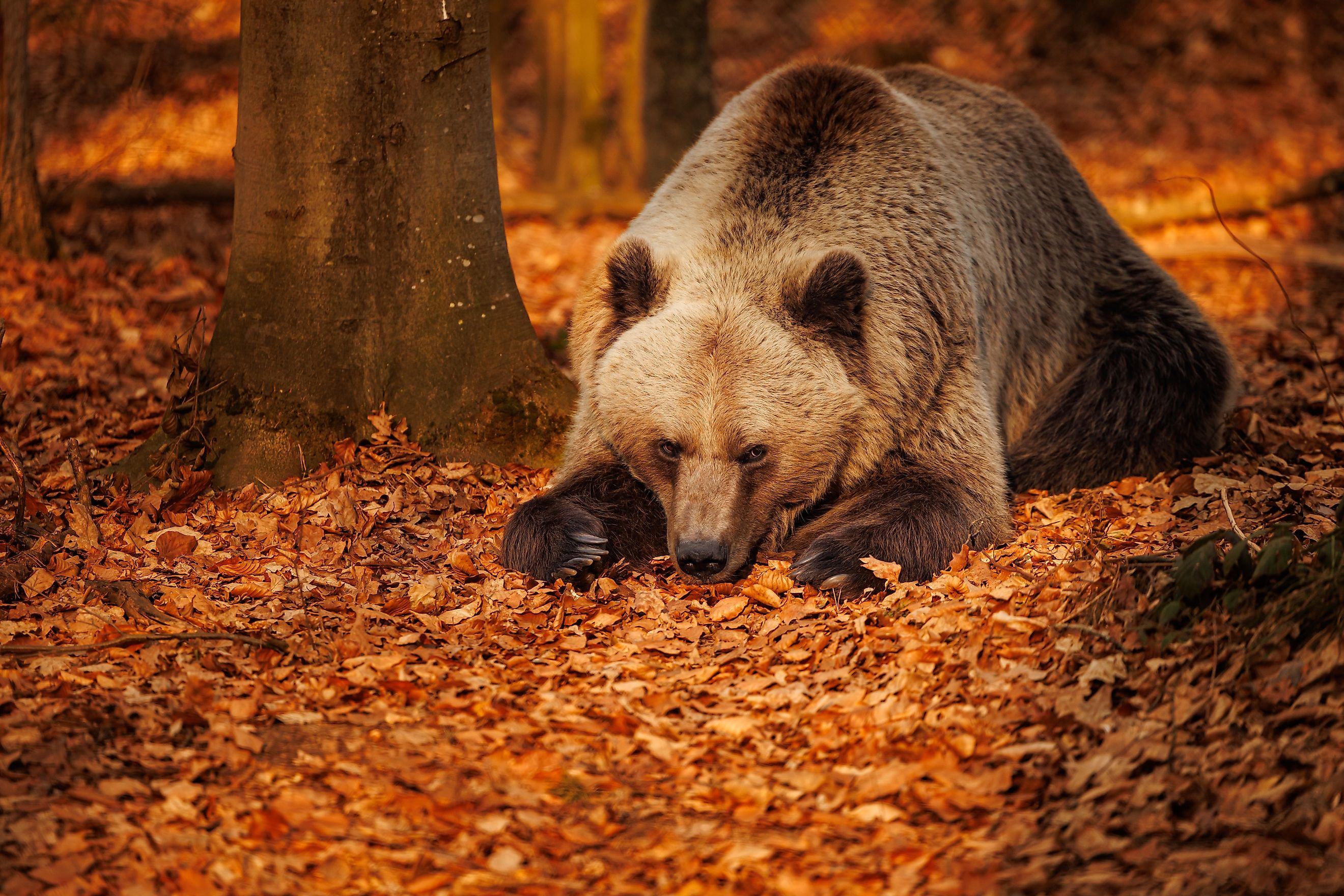
The American black bear (Ursus americanus) is an omnivore that leans heavily on plants. Its year runs on berries, acorns, beechnuts, grasses, roots, and insects, with meat as an occasional bonus. Nearly all of that vanishes once hard frosts arrive. A 300-pound (140 kg) animal cannot graze its way through a northern winter on what little remains, so evolution handed bears a different answer. They wait the shortage out in a state of deep dormancy, living on fat stored during the richer months. The North American Bear Center describes hibernation plainly as an adaptation for seasons of food scarcity, and the American Museum of Natural History frames it the same way, noting that eastern bears with longer fall access to nuts and berries den later than bears farther north.
Shortening days and dropping temperatures tell a bear that the food is about to disappear, which is the cue to fatten up and find a den. The proof is in the exceptions. Black bears in Florida and parts of southern California, where something is almost always growing or available, may barely hibernate at all. The North Carolina Wildlife Resources Commission notes that where mild winters and year-round food keep calories on the table, bears have far less reason to sleep. Polar bears sharpen the point. They live in the coldest place any bear calls home, yet they do not hibernate, because seals remain huntable on the ice all winter. Only pregnant females den. An empty landscape sends a bear to bed, not a cold one.
What Happens Inside a Sleeping Bear

Hibernation is not an ordinary long nap. A black bear can go five to seven months without eating, drinking, urinating, or defecating, recycling its own waste internally the entire time. The most detailed look inside that process came from a 2011 study led by physiologist Oivind Toien at the University of Alaska Fairbanks and published in the journal Science. His team wired captive black bears in quiet artificial dens and measured them around the clock.
The numbers surprised even the researchers. A bear's metabolism fell by about 75 percent, running at roughly a quarter of its normal rate. What made that remarkable was the body temperature. Small hibernators such as arctic ground squirrels crash their core temperature close to freezing, and the usual rule is that metabolism roughly halves for every 18 degrees Fahrenheit (10 degrees Celsius) of cooling. Bears broke the rule. Their temperature dropped only about 9 to 11 degrees Fahrenheit (5 to 6 degrees Celsius), from near 100 degrees Fahrenheit (38 degrees Celsius) down into the upper 80s and low 90s Fahrenheit (about 31 to 33 degrees Celsius), yet their metabolism fell far more than that modest cooling could explain. Heart rate told the same story, sliding from around 55 beats per minute to as few as 9, with long pauses between beats. The suppression, Toien's team concluded, runs largely independent of temperature, a mechanism no one had documented before.
That efficiency buys bears something ground squirrels never get. They leave the den without the muscle wasting or bone loss that months of stillness would cause in a person. Females do more than sleep. They give birth in the den in January or February and nurse newborns through the rest of winter. According to the National Park Service, newborn cubs weigh less than half a pound (0.2 kg) and emerge in spring weighing several pounds (a couple of kilograms), all of it drawn from the mother's fat while she herself has eaten nothing.
The Fat That Makes It Possible

None of this works without an enormous pre-winter binge. In late summer and fall, bears enter a phase biologists call hyperphagia, an almost around-the-clock drive to eat. The National Park Service reports that Yellowstone grizzlies put away up to 30 pounds (14 kg) of food a day during this period, and that the much larger Alaskan brown bears can eat 80 to 90 pounds (36 to 41 kg) a day, adding 3 to 6 pounds (1.4 to 2.7 kg) of fat with every one. That stored fat is the entire budget for the winter. It fuels the heartbeat, keeps the brain running, warms the body through its modest temperature dip, and in pregnant females it builds cubs and milk.
A bear can only run this strategy because its food peaks sharply and briefly. The berries and nuts that disappear in November are overwhelming in August. Hibernation is the matched response to that boom-and-bust supply. Gorge while the forest is generous, then sleep through the lean stretch it cannot provide.
Why a Wolf Has No Reason to Sleep

The gray wolf (Canis lupus) is a carnivore, and that single fact rewrites the whole winter equation. The International Wolf Center describes the wolf as a generalist carnivore built to catch, kill, and eat other animals, preying mainly on large hoofed mammals such as deer, elk, moose, and caribou. Those animals do not ripen and rot on a seasonal schedule the way berries do. A deer standing in the woods is as edible in January as in July. Where the bear faces a wall of scarcity every winter, the wolf's food supply simply walks around in the cold, still present and still worth chasing.
Because the pantry never closes, a wolf has nothing to sleep through. The standard reference on the species, Wolves, Behavior, Ecology, and Conservation, edited by biologists L. David Mech and Luigi Boitani, lays out a year-round hunter whose life is organized around finding and killing prey in every season. Shutting the body down for months would not save a wolf from hunger. It would only stop the hunting that keeps hunger away. A wolf can also go a week or more between meals when it must, which smooths over the gaps that hibernation would otherwise seem to answer.
Winter Can Work in the Wolf's Favor

For a wolf, the cold season is not merely survivable. It can be the best hunting of the year. Deep snow is punishing for heavy, small-hoofed animals like deer and elk, which break through the crust and flounder. Wolves, lighter for their size and equipped with broad paws that spread their weight, stay nearer the surface and keep their footing. The International Wolf Center notes that wolves often take prey that deep snow has already weakened or trapped, and that kill rates track winter severity, with the hardest winters leaving even otherwise healthy deer vulnerable.
The National Park Service has documented the same edge in Yellowstone, where thinning snowpack is expected to make winter hunting harder for wolves over time. Cold helps in a quieter way too. It slows decay, so a large kill can be cached and fed on for an extended period without spoiling. The advantage is not unconditional. A 2018 study of Alberta wolves found that during active snowfall the animals actually moved less and hunted less, because falling snow muffles the scent trails they rely on to locate prey. Snow on the ground is an ally. Snow in the air is a nuisance. Either way, the wolf stays in the game rather than opting out of it.
A Body Already Built for the Cold

A wolf can stay active in brutal weather because its body comes equipped for it. A dense double coat holds in body heat even when temperatures fall well below zero degrees Fahrenheit (under minus 18 degrees Celsius), and a heat-exchange system in the legs keeps the paws from freezing against snow and ice while losing little core heat. When a storm is at its worst, wolves curl into a tight ball, tuck their noses under their tails, and let the snow blanket them, waiting the weather out for a few hours rather than a few months. Hunting in a pack spreads the cost and risk of bringing down a large animal, and a single big kill can feed the group for days. Taken together, these traits remove the very problem that hibernation exists to solve.
Two Animals, Two Answers to the Same Winter
The difference between bears and wolves in winter comes down to what each animal eats. Much of the bear's food supply disappears or becomes inaccessible during the cold months, so it spends late summer and fall building up fat reserves before retreating to its den for hibernation. Wolves, on the other hand, face a different situation. Their prey remains active through winter, allowing them to keep hunting. Snow can even give them an advantage by making travel easier across open ground. Both animals have adapted to the same harsh conditions, but their diets lead them to very different strategies. Bears rely on stored energy to get through the winter, while wolves continue to hunt for food. These different approaches have little to do with the cold and much more to do with whether food remains available through the winter.