Where Black Bears Den For The Winter
Sometime between October and December, nearly every one of North America's roughly 900,000 American black bears (Ursus americanus) disappears into a hole, and the holes are stranger and more varied than most people imagine. Some bears dig a burrow into a hillside. Some climb 60 feet up a hollow tree and sleep in the attic. Some curl up under a highway bridge, a brush pile, or somebody's backyard deck, and some southern bears barely bother denning at all. The den is the most important real estate decision a bear makes all year, the difference between cubs that survive and cubs that do not, and where a bear chooses to make it depends on geography, gender, and what the neighborhood offers. Here is where the continent's most common bear actually spends the winter.
Hibernation, Bear Style

What happens inside the den is one of the great feats in mammal physiology. For as long as five to seven months in the North, a denned black bear does not eat, drink, urinate, or defecate. Its heart slows from around 40 or 50 beats per minute to as few as 8, yet its body temperature drops only modestly, staying near 88 to 95 degrees Fahrenheit rather than crashing toward freezing the way a ground squirrel's does. The bear recycles the nitrogen in its own urea into new protein, loses fat by the tens of pounds while keeping its muscle and bone, and emerges in spring merely thinner, a trick medical researchers study for everything from kidney disease to long spaceflight. Hibernation comes in many versions; the bear's is the one engineers envy.
It is also the version that stays armed. Because its temperature barely falls, a black bear can rouse in moments if disturbed, which is why biologists who crawl into dens for winter research do so carefully, and why the only sensible rule for anyone who stumbles across a den is to leave the way they came. The bear is asleep, not absent.
The Dug-Out Den
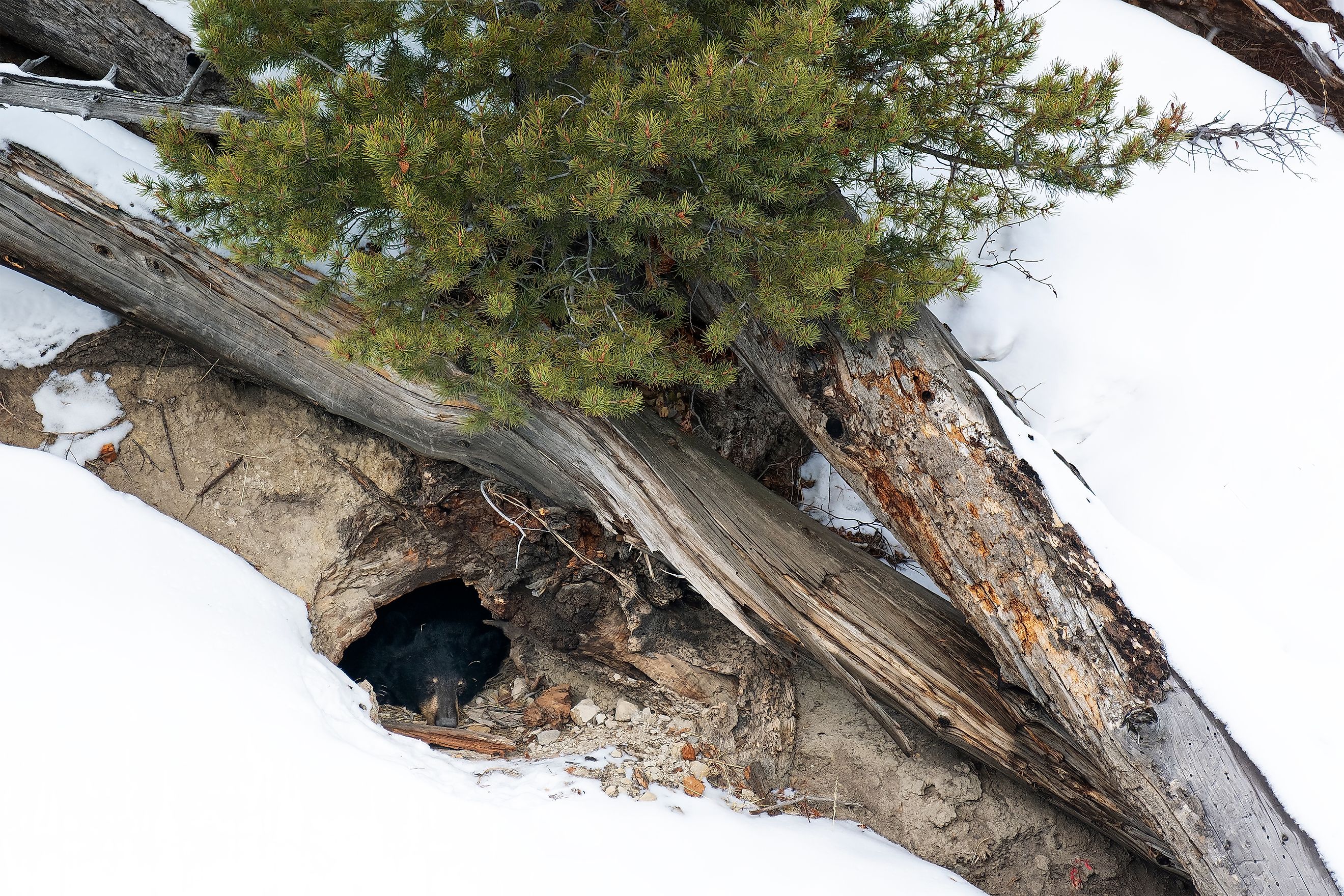
The classic black bear den is excavated: a burrow dug into a hillside, under the root mass of a fallen tree, into an old stump, or beneath a brush-buried log, with a tight entrance and a chamber not much bigger than the bear itself. The snugness is the point. A small chamber traps body heat, and bears line the floor with raked-in leaves, grass, and bark until the bed is inches deep. In the snowbelt, winter then finishes the construction job, drifting over the entrance and sealing the sleeper under a blanket of insulation that can hide the den completely until a spring thaw reveals the breathing hole.
Excavated dens dominate across much of the species' range, from the big western and Appalachian bear mountains to the lake states, partly because they can be built almost anywhere the soil allows. A bear needs only a slope, a few nights of digging, and privacy, and it usually builds fresh rather than reusing last year's address, since a new den means no accumulated parasites and no previous tenant's scent advertising the location.
The Penthouse Option: Tree Cavities

In the forests of the Southeast and the old hardwood country of the East, the premium den is vertical: a hollow in a living giant, often entered 20, 40, even 60 feet above the ground. Black bears are superb climbers from their first months of life, and a sow that dens in a high tree cavity buys her newborn cubs the safest nursery in the forest, dry above the floods that soak lowland ground dens, out of reach of roaming males, dogs, and nearly everything else with teeth.
The catch is the real estate market. A cavity big enough to hold a bear only forms in a tree of serious age and girth, a centuries-old tupelo, cypress, or oak with a rotted heart and a living shell, which makes den trees one of the quiet arguments for keeping big old trees on the landscape. Where the giants have been cut, the penthouse option disappears, and the bears go back to the ground.
Rock Dens, Caves, And Ready-Made Shelter

Where the landscape offers stone, bears take the shortcut. Rock crevices, boulder piles, talus slopes, and shallow caves serve as dens across the mountain West, the Ozarks, and the rockier stretches of Appalachia, pre-built chambers that need only a bed of raked vegetation to move in. A good rock den can shave weeks of digging down to a night of housekeeping, and the thermal mass of stone buffers the worst cold snaps.
The same opportunism explains the odder addresses on record: culverts, highway bridge abutments, hollow logs barely wider than the bear, and road cuts within earshot of traffic. Biologists tracking collared bears regularly find animals wintering within a few hundred yards of busy human activity, asleep in plain sight, because the den's job is not remoteness. Its job is a dry chamber, a defensible entrance, and quiet enough neighbors.
The Ground Nest: Winter In The Open

Follow the species south and the den gradually dissolves. In the Deep South's mild winters, many black bears, especially males, skip the burrow entirely and winter on a ground nest, a raked-together bed of leaves and branches in a thicket, a canebrake, or a dry island in a swamp, open to the sky. Food, not cold, sets the schedule: denning evolved mainly to wait out the hungry months, so where acorns, palmetto berries, and green browse run deep into winter, bears in Florida and along the Gulf may stay active nearly year-round, denning briefly or not at all.
The great exception, everywhere on the map, is the pregnant female. However mild the winter, an expecting sow dens, because the den is not really a bedroom. It is a delivery room.
Under The Deck

As black bears reclaim their old range across the East and suburbs push into bear country everywhere, a new den type has joined the catalog: the crawl space. Every winter, homeowners in states like New Jersey, Connecticut, and California discover a bear settled in beneath the deck, the porch, or the garden shed, having judged the spot by the only criteria a bear uses, dry, dark, defensible, and quiet. From the bear's perspective, a deck is a rock overhang with better drainage.
Wildlife agencies handle dozens of such calls a season, and the standard advice runs against instinct: a denned bear under the house is usually best left asleep until spring under an agency's guidance, since a bear evicted in January has nowhere good to go. The longer-term fix is autumn-proofing, screening off crawl spaces before the hyperphagic weeks of fall, when next door's bird feeder is funding the neighborhood's strangest tenant.
The Nursery Rule

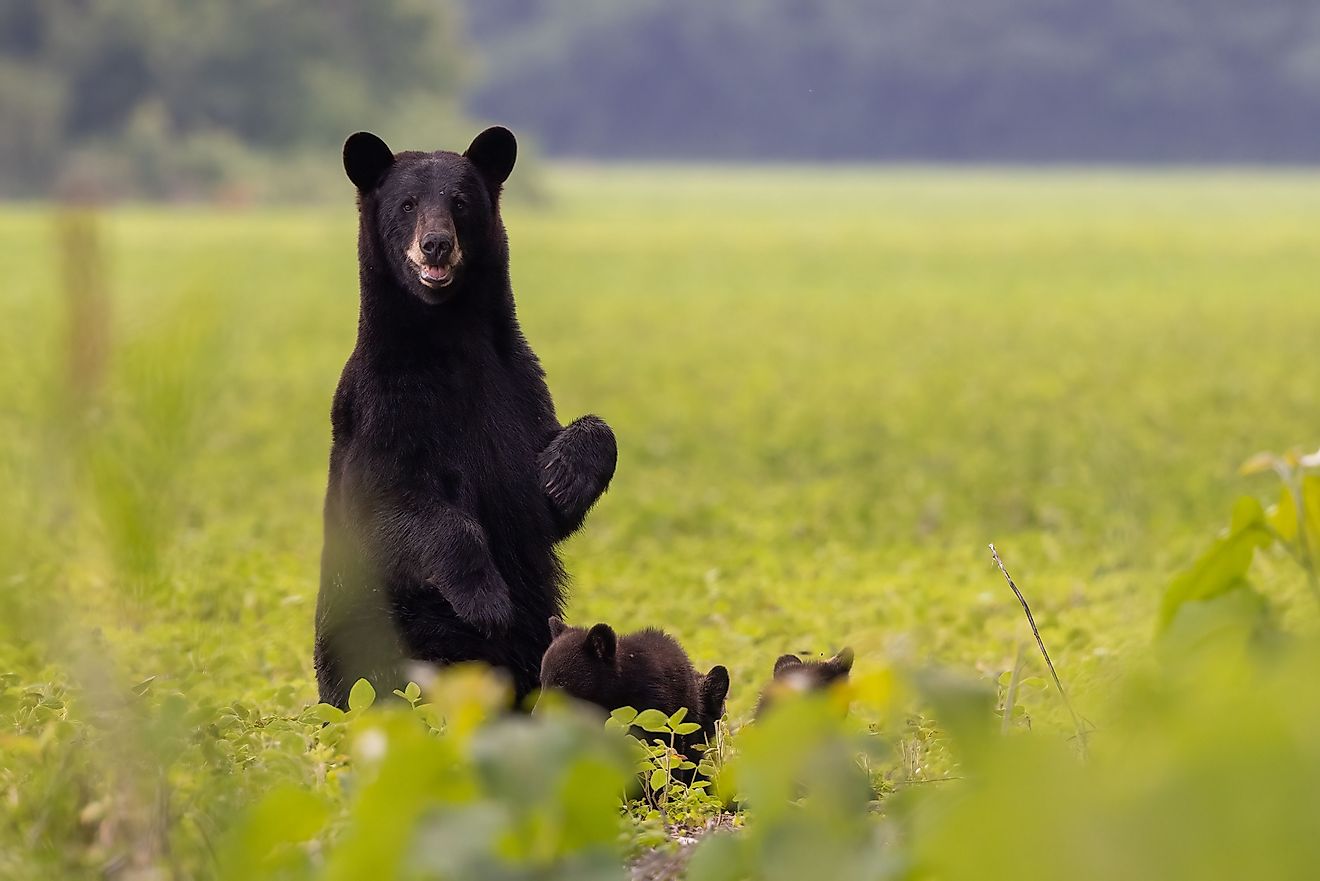
Whatever the architecture, the den's highest purpose is the same everywhere: black bear cubs are born in it, in January or February, while their mother is denned. Newborns arrive almost absurdly unfinished, blind, nearly hairless, and weighing well under a pound, and they spend their first months nursing in the den while the sow lives off her fat, her milk flowing through the fast. By emergence, the cubs have multiplied their birth weight many times over and exit as the fuzzy spring icons the species is known for.
The calendar of emergence follows the stakes. Adult males leave first, often in March, lean and hungry; sows with new cubs hold out longest, sometimes into late April or May, until the little ones can travel. It is the den system working exactly as evolution drew it: the most vulnerable bears get the most winter.
A Hole Of One's Own

The pattern across the continent is a species with one need and endless solutions: a dry, tight, defensible chamber to carry it through the hungry season, dug from a hillside, hollowed in a giant tree, borrowed from a boulder field, raked together in a southern thicket, or discovered under a deck. The bear spends autumn eating up to 20,000 calories a day to pay for the stay, picks a fresh address most years, and performs a metabolic magic trick until spring. For people who share bear country, the takeaway fits in a sentence: in winter, assume any sheltered hole might be occupied, and give the tenant until April. The lease is older than ours.