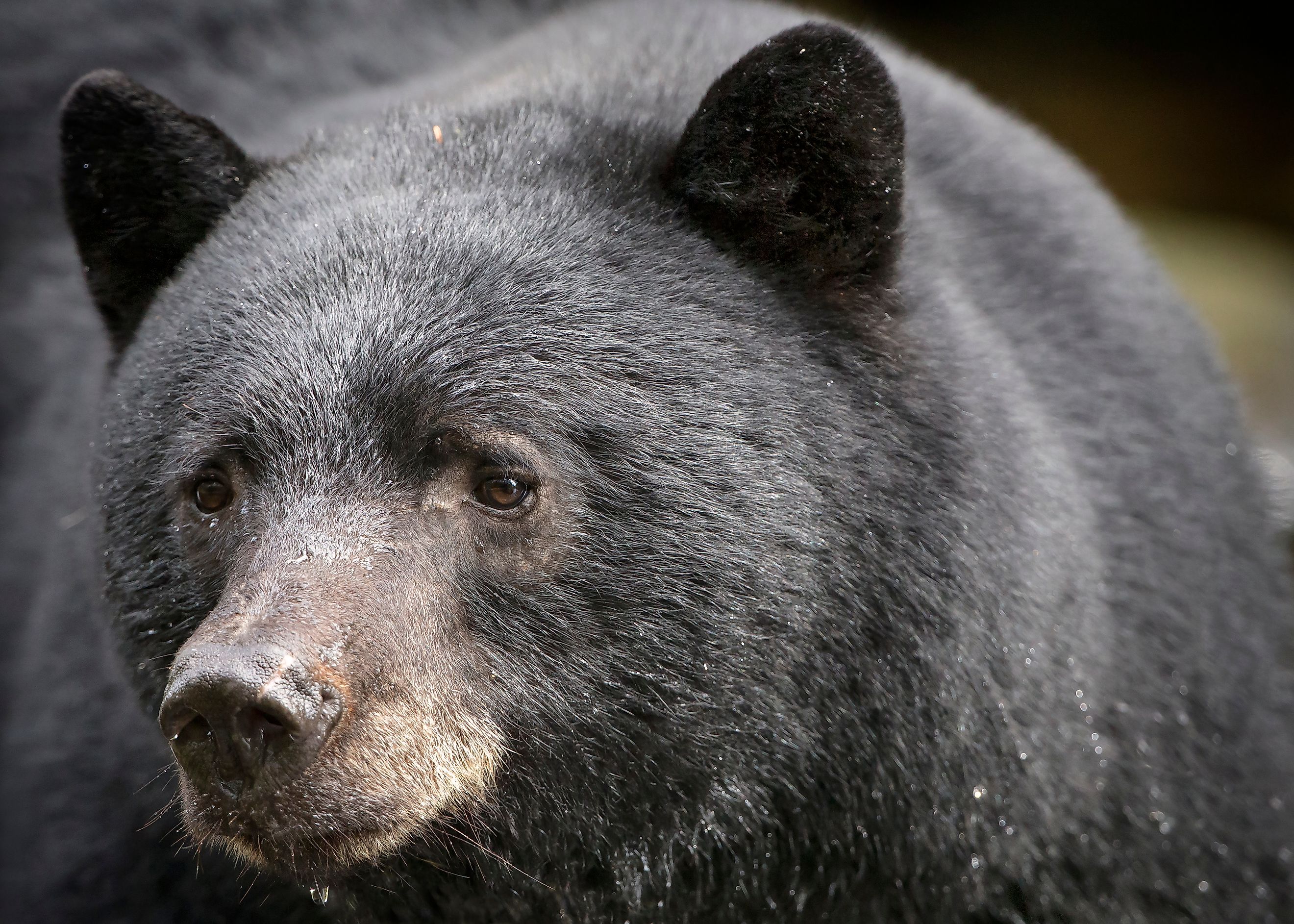
Black Bear
There are more black bears alive than every other bear species on the planet combined. Estimates put the North American total near 850,000 to 900,000, against fewer than two thousand giant pandas and a handful of surviving Asian and Andean populations. The black bear owns the continent it evolved on, and it did so by staying flexible.
Taxonomic Classification

The American black bear is Ursus americanus, one of eight living bear species and the only one endemic to North America. The modern species emerged in North America roughly one to two million years ago, having split earlier from the Asian black bear lineage, and it has kept to this continent since. Taxonomists recognize about sixteen subspecies, most of them regional. The list runs to the cinnamon bear of the interior West, the Louisiana black bear of the lower Mississippi bottomlands, the glacier bear of southeastern Alaska, and the Kermode or spirit bear of coastal British Columbia. The Kermode carries a recessive gene that turns some individuals cream-white.
Despite the color variation, these are one species. A white spirit bear and a jet-black bear from the Appalachians can interbreed without trouble. Black is the common coat color in the East, but in the West, a bear may be brown, blond, cinnamon, or the pale blue-gray phase seen near Yakutat Bay.
Range and Habitat

Resident populations occur across 12 Canadian provinces and territories, 40 U.S. states, and 6 Mexican states, occupying about 10.5 million square kilometers (roughly 4 million square miles). That is roughly 65 percent of the historic range, which is a recovery, not a loss. A century ago, the axe and the plow had pushed black bears into swamps, thickets, and mountains too steep to farm. They held on in that hard country and spread back out once forests returned, and hunting came under regulation.
The habitat requirement is simple: forest cover, or something close to it. Black bears range through northern boreal forest, Appalachian hardwoods, southern swamp, western montane conifer, and the chaparral and desert edges of northern Mexico, where yucca and cactus fruit carry them through drought. They also range the outskirts of towns, where garbage and orchards make easy forage. What they need is dense cover to escape into and a food supply that shifts with the season. They do not need wilderness. Some of the densest populations sit within a short drive of major cities.
Physical Description

A black bear is a heavy animal on a compact frame. Males typically weigh about 130 to 310 pounds (60 to 140 kilograms) and females about 90 to 155 pounds (40 to 70 kilograms), though a large male in autumn can top 550 pounds (250 kilograms). Both figures swing widely with the season and the food year. A bear entering the den in November can carry a third more weight than the same bear leaving it in April. The build is heavy, the skull broad, the eyes and ears small, the tail short. The claws are curved, non-retractable, and roughly an inch and a half long, built for climbing and digging rather than for holding prey.
Unlike the grizzly, which loses its climbing ability as it grows, the black bear climbs well its whole life, and cubs go up trees at the first sign of trouble. The foot is plantigrade, flat to the ground like a human foot, which is why a black bear track in soft mud reads almost like a broad bare footprint with claw marks ahead of the toes.
Food

Call it a carnivore by taxonomic order and a generalist by practice. Over 85 percent of a black bear's diet is plant matter: grasses and forbs in spring, berries and soft mast through summer, acorns and beechnuts and hard mast in fall. The rest is insects, mostly ants and bee larvae torn out of rotten logs, plus carrion, the occasional fish, and newborn deer fawns taken in the weeks when fawns cannot yet outrun anything.
In the weeks before denning in autumn, a bear enters hyperphagia and forages nearly around the clock, taking in as many as 20,000 calories a day to build the fat that will carry it through winter. A failed mast crop in fall shows up the following spring as thin bears, smaller litters, and more animals testing the edges of town for something to eat. The bear's whole calendar bends to what the forest produced that year.
Behavior

Black bears are solitary outside of mating season, and the bond between a female and her cubs. They forage alone. Where food concentrates, at a salmon run or a good berry slope or a dump, they tolerate one another at close range, but the tolerance is practical, not social. A dominant bear feeds first, and the others wait.
In the north, bears may hole up for as long as seven months, living off fat with heart rate and metabolism dropped low, but body temperature only slightly reduced. Older accounts called that torpor rather than true hibernation, though most biologists now count the bear as a hibernator, and an unusually efficient one. In the warm parts of the southern range, where food holds through winter, some bears barely den at all. The one constant is that pregnant females always den and give birth inside it.
Black bears are strong swimmers and, for their bulk, fast over short distances. A bear can cross open ground quickly when it chooses to. Most of the time, it does not choose to. Despite being widely feared by humans, their default response during an encounter is to leave.
Reproduction

The reproductive system is built around uncertainty. Mating runs through June and into mid-July, but the fertilized egg does not implant. It floats in delayed implantation for over a hundred days while the female feeds through the fall. Only when she dens, and only if she has laid down enough fat, does the egg implant and active gestation begin. A female in poor condition reabsorbs the embryos and skips the year.
Cubs are born in the den in January or February, blind, nearly hairless, and weighing about half a pound. They nurse on rich milk while the mother sleeps, and emerge in spring at around six pounds. Litters run two in the West and closer to three in the East, with first litters often just one or two. Females breed first at three to eight years, depending on food, and raise cubs for 16 to 18 months, which means a litter every other year at best. Yearlings are pushed off just before the next breeding season. Young males go farthest; young females may settle near their mother's range.
Importance and Threats

As a large omnivore, the black bear moves energy and seeds through the forest. It disperses berry seeds across a wide area, opens rotten logs that speed decomposition, and scavenges carcasses. For thousands of years, it was among the most important animals to Indigenous peoples across the continent, for food, fat, hides, and tools, and it holds a place in many cultures still.
The species is listed as Least Concern, with stable or rising numbers, and stands as one of the clearer wildlife recoveries in North America. The threats now are chronic rather than acute. These include habitat loss and fragmentation, roads and the vehicle collisions that come with them, failed natural food crops, and the conflict that follows when bears and expanding human settlement occupy the same ground. Two subspecies show how far the animal can be pulled back. The Louisiana black bear was listed as federally threatened in 1992 and had recovered enough to leave the endangered species list in 2016. The Florida black bear was never on the federal list. It made a parallel comeback under state protection. A population of a few hundred animals in the mid-20th century now runs to several thousand, and the state removed it from its threatened list in 2012.
Bear Sightings

For numbers in one place, nothing in the East matches Great Smoky Mountains National Park. Biologists put the population somewhere between 1,500 and 1,900 bears across roughly 800 square miles, about two to the square mile, among the densest black bear country on the continent. The park's count has climbed over the past half-century. Biologists tallied roughly 600 bears in the 1970s, and today's estimate is the highest on record, helped by food-storage rules and returning forest. Bears range every elevation in the park, but sightings cluster where the cover opens. Cades Cove is the most reliable spot, a valley clearing ringed by an eleven-mile loop road. Bears forage the meadow edges there in spring and early summer, often within sight of a stopped car. Along the Roaring Fork route, cubs climb the trees beside the road. The first hours after sunrise and the last two before dark produce most encounters from April through October, and fall hyperphagia from late September into early November produces the most movement of the year.