Elk
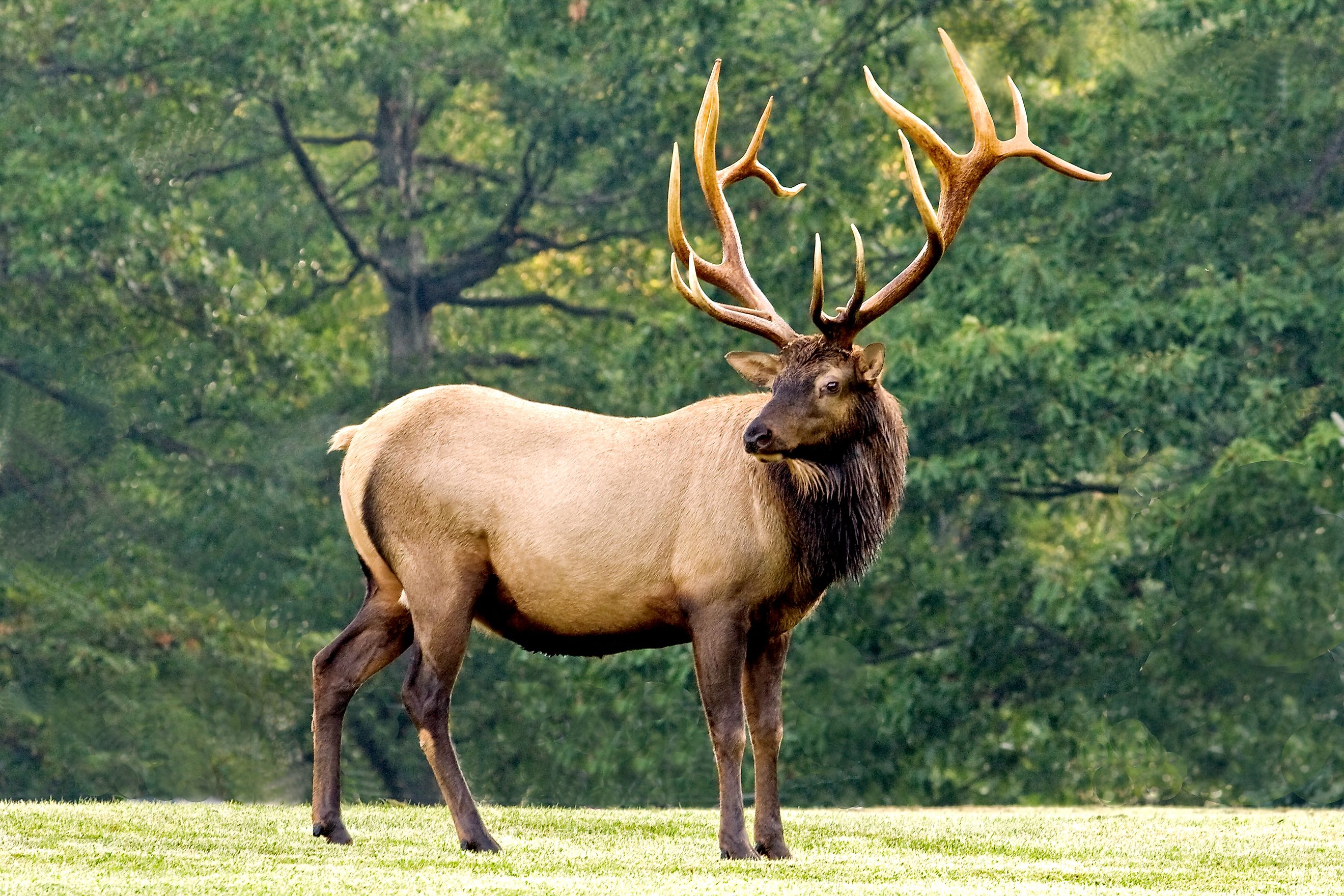
The elk (Cervus canadensis) is the second largest member of the deer family, Cervidae, exceeded in size only by the moose. A mature bull stands up to 5 feet (1.5 m) at the shoulder, weighs 700 pounds (320 kg) or more, and grows a rack of branched antlers that can span 4 feet (1.2 m) and add another 4 feet to his standing height. Only male elk carry antlers, and they regrow the entire set every year.
Also called the wapiti, from the Shawnee and Cree word waapiti meaning "white rump," the elk is native to western North America and parts of Central, East, and North Asia. It occupies forests, forest edges, and mountain meadows, moving to high elevations in summer and dropping to sheltered lower ranges in winter. The species was hunted out of most of eastern North America by the late nineteenth century, but reintroductions and protective management have since driven a strong recovery.
Today the elk is one of the best-studied large mammals on the continent, valued as a grazer that shapes plant communities, as prey for wolves and cougars, and as a game animal that supports state wildlife budgets. Its global population, wild and farmed, numbers roughly two million and is increasing.
Taxonomic Classification

The elk belongs to the order Artiodactyla (even-toed ungulates), the family Cervidae (deer), and the genus Cervus. Its accepted scientific name is Cervus canadensis, described by Johann Christian Polycarp Erxleben in 1777. For most of the twentieth century, biologists treated the elk as a North American subspecies of the European red deer (Cervus elaphus). Genetic work changed that. Mitochondrial DNA studies beginning in the late 1990s, reinforced by analyses in the mid-2000s, showed that elk and red deer are separate species. The same research placed the elk closer to Thorold's deer (Cervus albirostris) and the sika deer (Cervus nippon) than to the red deer it once shared a name with. A wider rump patch and paler antlers are among the physical traits that separate C. canadensis from C. elaphus.
Several subspecies are recognized. In North America, the survivors include the Rocky Mountain elk (C. c. nelsoni), the Roosevelt elk (C. c. roosevelti) of the Pacific Northwest, the tule elk (C. c. nannodes) of California, and the Manitoban elk (C. c. manitobensis). Asian forms include C. c. sibiricus and C. c. xanthopygus, among others. Two North American subspecies are now extinct: the eastern elk (C. c. canadensis), whose last known individual was killed in Pennsylvania in 1877, and Merriam's elk (C. c. merriami), which once inhabited the arid Southwest but disappeared by around 1906. In a 2017 revision, the IUCN folded most remaining North American forms into C. c. canadensis, leaving the tule and Roosevelt subspecies distinct.
Physical Description

Elk are built on a long-legged, high-shouldered frame. Head and body length reaches about 8 feet (2.4 m), and shoulder height runs 4.5 to 5 feet (1.4 to 1.5 m). Bulls are considerably larger than cows. A typical bull weighs 700 to 800 pounds (320 to 360 kg), and large individuals top 1,000 pounds (450 kg). Roosevelt elk, the heaviest subspecies, produce bulls of 700 to 1,300 pounds (320 to 590 kg). Cows weigh 500 to 600 pounds (225 to 270 kg). Both sexes share the same distinctive two-tone coloration, with dark brown heads, necks, and legs contrasting with tan to light brown bodies and a cream to pale orange rump patch. Bulls grow a shaggy mane of dark fur along the neck and chest. The coat molts seasonally, sleek in summer and thick with insulating underfur in winter.
Antlers are the elk's defining feature and belong to bulls alone. A mature rack reaches 4 feet (1.2 m) in length and can weigh up to 40 pounds (18 kg). The antlers grow from bony pedicles on the skull and are cast and regrown every year. Antler growth is remarkably rapid, with developing antlers adding up to an inch (2.5 cm) per day while covered in a soft layer of skin called velvet, making them one of the fastest-growing tissues found in any mammal. The velvet carries the blood supply that feeds this growth. In late summer the velvet dries and the bull rubs it off, exposing hardened bone. Bulls cast the antlers in late winter, typically from late February through April, with the oldest bulls dropping first. A large mature rack often carries six tines, or points, per side.
Range and Habitat

Elk are native to two widely separated regions, spanning western North America and parts of Central, Eastern, and Northern Asia. The North American range centers on the Rocky Mountains and the mountain ranges of the western United States and Canada, with reintroduced populations now established well beyond that core. During the Late Pleistocene the species ranged much farther, across Eurasia and into Western Europe, before its distribution contracted.
The animal favors forests, woodland edges, parklands, and open mountain meadows, habitats that combine grazing ground with tree cover for shelter. In the western mountains, elk follow a seasonal altitudinal migration, spending the summer grazing at high elevations before descending to lower grasslands and shrublands in winter, where nearby forests provide shelter from the cold. Elk have been introduced outside their natural range as well. Populations in New Zealand and Argentina took hold so successfully that the species can behave as an invasive competitor there. In the eastern United States and Canada, wildlife agencies have reintroduced elk to states and provinces including Kentucky, Tennessee, North Carolina, Pennsylvania, Michigan, Missouri, Wisconsin, and Ontario, restoring the animal to parts of the range where the eastern elk once lived.
Diet

Elk are herbivores and ruminants, digesting plant material in a four-chambered stomach. Their diet shifts with the season. Through spring and summer, they graze on grasses and forbs, the growing herbaceous plants that carry the most protein. In fall and winter, when green forage is scarce, they browse on shrubs, tree sprouts, and bark. An adult eats a large volume of low-energy plant matter to meet its needs, consuming up to about 20 pounds (9 kg) of vegetation a day. Feeding is concentrated at dawn and dusk, and animals move between feeding areas and cover through the day. This grazing pressure is heavy enough to influence which plants dominate a landscape, which is one reason elk are studied closely in restored predator systems where their numbers were previously unchecked.
Behavior

Elk are social animals that spend most of the year in single-sex groups. Cows, calves, and yearlings form the largest herds, often led by an older cow, while bulls gather in smaller bachelor groups or range alone. A herd may hold only a handful of animals or swell to several hundred, and group size expands on open winter range. Elk are most active at dawn and dusk, a crepuscular pattern that keeps them feeding when light is low and predators are harder to see.
The animals are strong movers. A bull can run at speeds approaching 40 miles per hour (64 km/h) and clear substantial obstacles, and elk swim readily. Communication runs through posture, scent, and a wide range of calls. The best known is the bull's bugle, a rising call that carries for miles and combines a low roar with a high whistle, produced during the fall breeding season to advertise status and challenge rivals. Cows and calves use higher chirps and mews to stay in contact. Outside the rut, the annual mating season, elk are largely tolerant of one another, and the sexes rejoin on shared winter range before separating again in spring.
Reproduction

Breeding runs from late August into October and peaks in September. Bulls compete for access to groups of cows, gathering harems that typically hold around six females but can be much larger. They advertise dominance by bugling, thrashing vegetation with their antlers, and sparring. Fights between evenly matched bulls can be violent and occasionally end in serious injury or death. A dominant bull defends a shifting territory around his harem rather than a fixed patch of ground.
Both sexes reach sexual maturity at about 16 months, but young bulls rarely breed until they are old enough to compete with prime males, usually at two to four years. Gestation lasts roughly 240 to 262 days, about eight and a half months. Cows give birth in late spring and early summer, almost always to a single calf; twins occur in well under one percent of births. A newborn weighs 30 to 40 pounds (14 to 18 kg), wears a spotted coat, and is nearly scentless, all of which help it avoid predators in its first vulnerable weeks. Calves can stand and walk within about 15 minutes of birth and can double their weight in roughly two weeks. Cows separate from the herd to give birth and keep the calf hidden until it can run. In the wild, elk generally live 8 to 12 years, though some reach far older ages under protection.
Importance to the World

Elk play a central ecological role as large grazers. By cropping grasses and browsing shrubs, they influence plant composition, nutrient cycling, and the structure of the landscapes they occupy, effects that ripple through to birds, insects, and other herbivores. They are also a major prey species. Wolves, cougars, and bears rely on elk across much of the western range, and the relationship between elk and wolves has become one of the most closely watched predator-prey systems in the world, particularly following wolf restoration in the Greater Yellowstone Ecosystem.
Elk are a leading big-game animal in North America, and the licenses and fees tied to elk hunting fund a large share of state wildlife management. Elk meat is leaner and higher in protein than beef, and the animal is farmed in several countries. In parts of Asia, antler velvet is harvested for use in traditional medicine, supporting a substantial trade.
An elk's role does not end when it dies. A carcass, whether left by a predator, a harsh winter, or a hunter, supports a broad scavenging community. Ravens and magpies often find the remains within hours, followed by bald and golden eagles, coyotes, wolverines, and bears emerging from hibernation in early spring when little other food is available. Blow flies and carrion beetles then reduce what remains to bone within weeks. The remains fertilize the ground as well. Field studies in Yellowstone have found that an elk carcass raises soil respiration and microbial activity and lifts the nutrient content of the plants that later grow on the spot, leaving a small, long-lasting patch of enriched soil. Alive or dead, the animal keeps moving energy and nutrients through the systems it occupies.
Threats and Conservation

The elk is listed as Least Concern on the IUCN Red List, and its population is increasing. That status marks a recovery from a low point. Unregulated hunting and habitat loss wiped elk out of most of eastern North America and shrank western herds by the early twentieth century. Colorado held fewer than 1,000 elk in 1910; the state now supports more than 290,000, the largest herd in the United States. The tule elk of California, reduced to near extinction around 1870, has rebuilt to several thousand animals through decades of protection and translocation.
Threats remain despite the healthy overall trend. Chronic wasting disease, a fatal prion infection that spreads among deer and elk, is a growing concern for wild herds and farmed animals alike. Brucellosis persists in some populations and creates conflict with the livestock industry. Habitat loss and fragmentation from development, roads, and energy extraction reduce winter range and block migration routes. In regions where elk have been introduced or farmed alongside red deer, hybridization can dilute the genetic distinctness of local stock. Conservation work focuses on regulated hunting to keep herds within the capacity of their range, protection and connection of migration corridors, disease surveillance, and continued reintroduction into historical habitat.
Takeaway
The elk is a large, adaptable grazer whose size, annual antler cycle, and autumn bugling make it one of the signature mammals of the northern hemisphere. It shapes the plant communities it feeds on, feeds the predators that hunt it, and anchors a hunting and management system worth hundreds of millions of dollars. Nearly eliminated from the eastern half of its North American range a century ago, the species has recovered through protection, regulated harvest, and reintroduction, and it now stands as one of conservation's clearer successes. Emerging pressures, chronic wasting disease chief among them, will test how well that recovery holds.
Fun Facts

- Antlers grow almost visibly. A bull's antlers can add up to an inch (2.5 cm) a day, placing them among the fastest-growing tissues in the animal kingdom.
- A bugle is two sounds at once. The rutting call combines a low roar and a high whistle, produced as the bull moves both its lips and its nostrils, and it can carry for miles.
- "Elk" means two different animals. In British English, "elk" refers to the moose (Alces alces), which is why the North American name "wapiti" is used to avoid confusion.
- Calves hit the ground running. A newborn elk can stand and walk within about 15 minutes of birth and can double its weight in roughly two weeks.
- They are genuine mountaineers. Western herds migrate up to high summer pastures and back down to winter range each year, tracking the growth of the plants they eat.
Quick Facts
- Scientific name: Cervus canadensis
- Family / Order: Cervidae / Artiodactyla
- IUCN status: Least Concern (population increasing)
- Shoulder height: 4.5 to 5 feet (1.4 to 1.5 m)
- Body length: Up to about 8 feet (2.4 m)
- Weight: Cows 500 to 600 lb (225 to 270 kg); bulls 700 to 1,100+ lb (320 to 500+ kg)
- Lifespan: 8 to 12 years in the wild
- Diet: Herbivore (grasses, forbs, shrubs, bark)
- Range: Western North America; Central, East, and North Asia; introduced elsewhere