Why Cardinals Stay All Winter
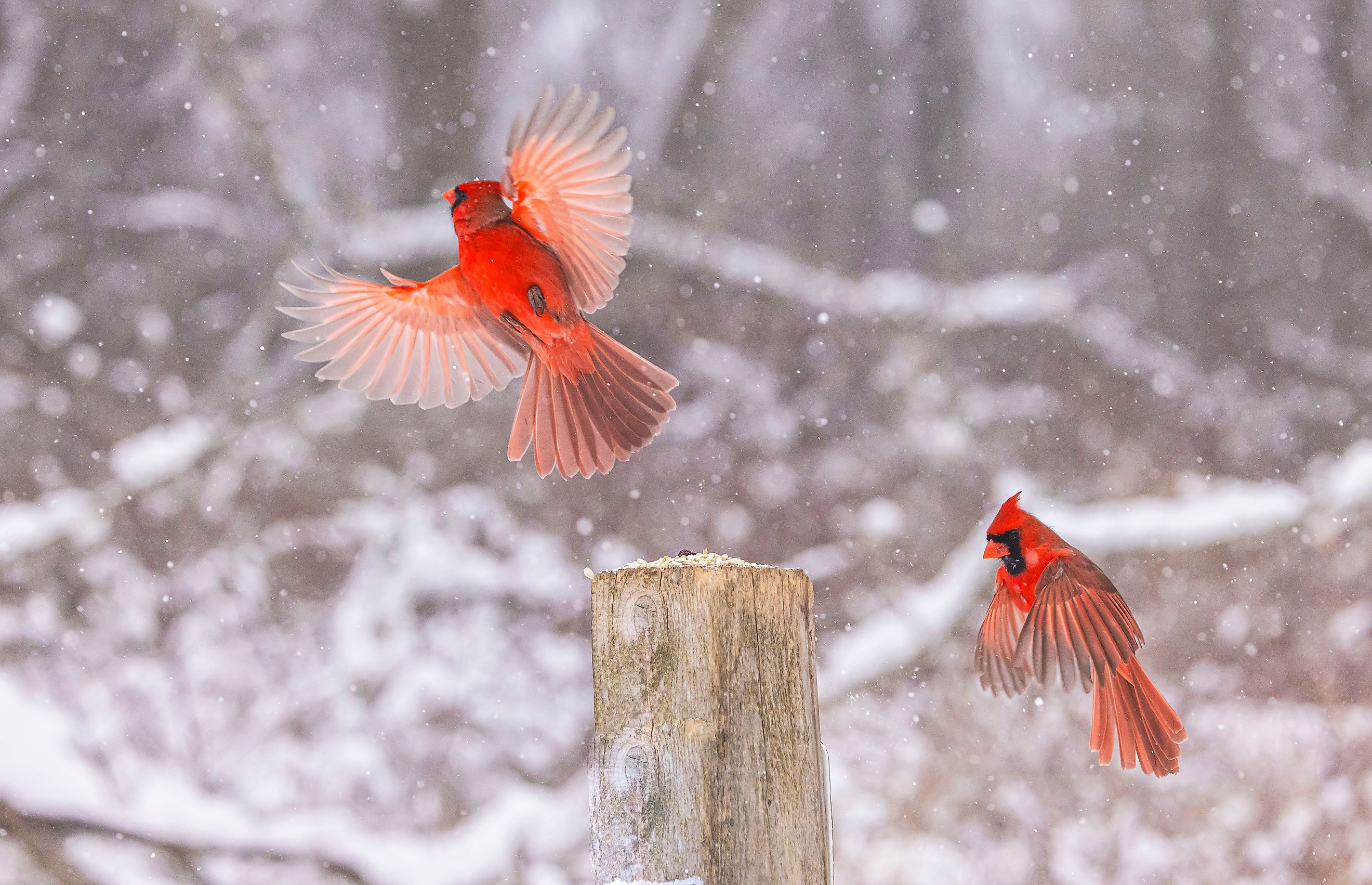
Northern cardinals are sedentary. They hold the same territory year-round across their entire range, including the parts of it that border Canada, and they do not molt into a drab winter plumage the way many birds do. A male is as bright against February snow as he is in June. The reason they can stay is diet: about 88 percent of what a cardinal eats in winter is plant food, and plant food does not fly south.
Seeds Are Why They Can Stay

Most birds migrate because their food disappears, not because they are cold.
Cardinals are primarily granivorous, feeding on seeds, grains and fruits. In winter roughly 88 percent of the diet is plant material: weed seeds, wild fruit, berries and feeder seed.
An insect-eating warbler has no choice but to leave. A seed-eater does, because weed heads and berries persist above the snow line all winter.
Nights Cost Twice As Much

The hard part of a cardinal's winter is not the day, it is the length of the dark.
A cardinal burns nearly twice as much energy overnight in winter as it does on a short summer night. That is the cost that has to be covered by the previous day's feeding.
At the northern edge of the range, cardinals may be close to the limit of what they can physically survive. The margin is thin rather than comfortable.
Their Winter Range Expands

Staying put does not mean staying still.
A cardinal's winter home range is much larger than its summer territory, and birds may travel between feeding stations up to 2.1 kilometers, or about 1.3 miles, apart.
Summer territories run 2 to 10 acres. In winter the birds abandon strict territorial behavior, join loose flocks and work a circuit instead.
They Do Not Fade
One thing cardinals conspicuously do not do is change color for the season.
Unlike many songbirds, cardinals do not molt into a dull winter plumage. The male stays fully red through the coldest months.
That is why the bird is so strongly associated with winter imagery. It is not that cardinals are more common in December, it is that they are the only thing with that color still visible.
Feathers Do The Insulating

The physical defenses are the standard songbird toolkit applied rigorously.
Cardinals fluff their feathers to trap a layer of warm air, build fat reserves that serve as both energy store and insulation, and lower their body temperature somewhat at night.
They also seek out dense cover, roosting in evergreen trees and thickets that shield them from wind and precipitation. Shelter quality matters as much as food supply.
They Have Moved North For A Century
The most interesting thing about cardinals in winter is that there are far more of them than there used to be.
The species historically did not reside in the far northern states. Since the early 1900s it has expanded its range steadily northward, reaching southeastern Canada.
In 1879 a visitor to the Toronto area was told by locals about an invasion of warbirds, which he identified as northern cardinals. That was the beginning of a century of expansion.
Three Things Drove The Expansion

The northward march has identifiable causes rather than being a mystery.
Research attributes it to three primary factors: a warmer climate producing less snow depth and better winter foraging, human encroachment into forested areas creating suitable edge habitat, and the establishment of winter feeding stations increasing food availability.
Backyard feeders are doing real ecological work here. The range expansion tracks their spread.
It Is Expansion, Not Migration

The distinction matters for understanding what is actually happening.
Warming winters are pushing the range north, but the birds settle, breed and stay. No individual cardinal is flying thousands of kilometers. The population boundary has moved while every bird in it remained sedentary.
Juveniles searching for new territory and adults making short trips to food patches account for most individual movement.
Rank Decides The Feeder

Where several cardinals share a winter food source, the order is predictable.
During foraging, young birds give way to adults and females tend to give way to males. Competition at feeders can limit how much any individual takes in.
They prefer to perch on a feeder tray rather than hover, and fly mostly short distances between thickets while working an area.
Many Of Them Do Not Make It

The survival figure is a reminder that staying is a strategy with costs.
One account records that roughly 60 percent of northern cardinals survive the winter. Ice storms and heavy snow restrict foraging, and rain can rapidly degrade feather condition in a way that threatens survival directly.
Snow accumulation pushes northern birds toward feeders because that is where food is easiest to find. For a species at the edge of its range, a feeder can be the difference.
The Short Answer

Cardinals stay all winter because they eat seeds and fruit rather than insects, and that food remains available when the insects are gone. They hold territory year-round, expand their range in winter to work a circuit of feeding stations up to 1.3 miles apart, fluff their feathers, roost in evergreens and keep their full red plumage throughout.
The remarkable part is the trend. Cardinals were absent from the far northern states before 1900 and now reach Canada, pushed north by warmer winters, suburban edge habitat and a century of backyard bird feeders.