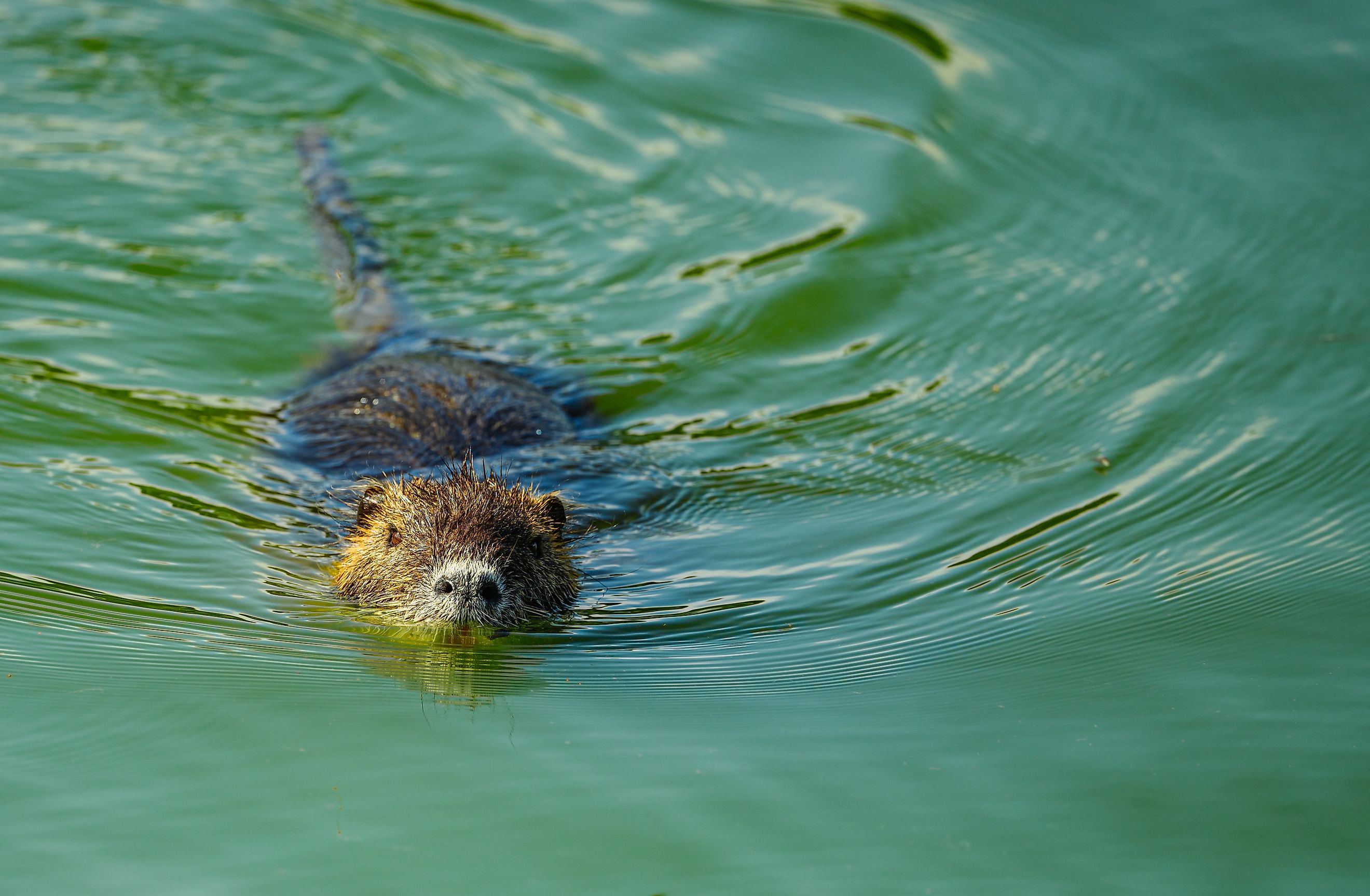
Why California Is Racing To Wipe Out Nutria Before They Spread
In March 2017, a trapper in a private wetland near Gustine took a single pregnant rodent. California had declared the species eradicated in the 1970s and had not seen one in forty years.
As of 11 August 2026, the state has taken 9,472 of them, and necropsies have accounted for roughly 12,400 more that were never born. The programme has surveyed 1.9 million acres to do it.
The urgency is not really about the animals. It is about what sits under the levees holding back the water supply for most of the state.
A Twenty-Pound Rodent With Orange Teeth

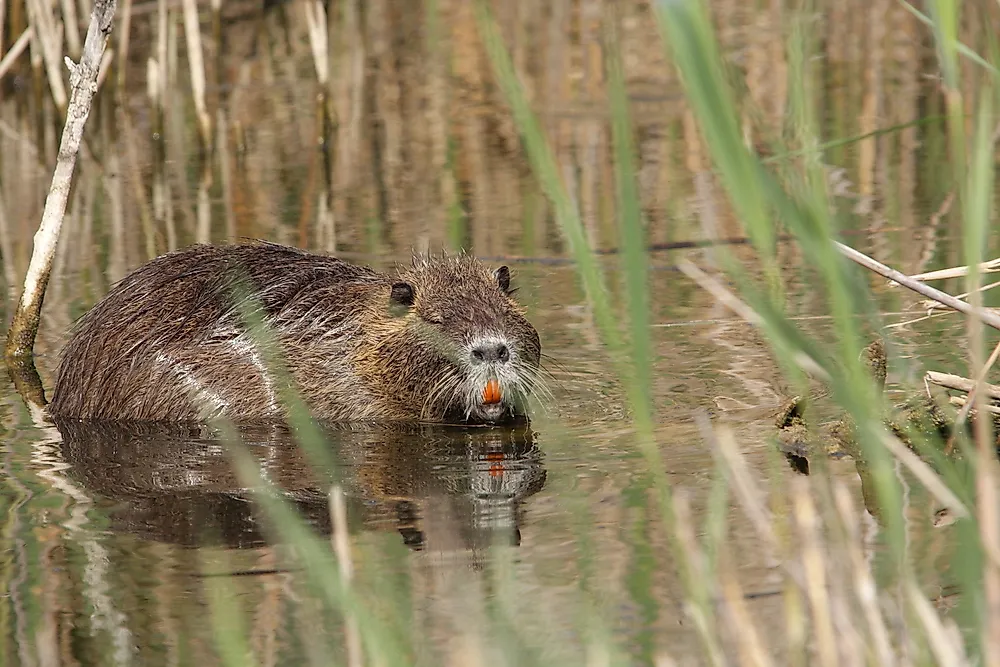
Nutria, Myocastor coypus, are semi-aquatic rodents native to South America. They reach around 20 pounds and two and a half feet in length, with webbed hind feet, a round rat-like tail, and incisors stained a vivid orange by the iron in their enamel.
They were brought to North America for the fur trade, arriving in California as early as 1899 at Elizabeth Lake, where the original animals failed to establish. Later releases across the South did establish, spectacularly, when fur prices collapsed and farms simply opened the pens, which is how Louisiana acquired its permanent population.
The damage is not from what they eat so much as how they eat it. A nutria consumes around a quarter of its body weight daily and digs out roots and rhizomes rather than grazing the tops, which kills the plant instead of trimming it. Enough of them working one area produces what managers call an eat-out: marsh vegetation gone, root mat destroyed, and open water where wetland used to be.
The Breeding Maths Are The Problem
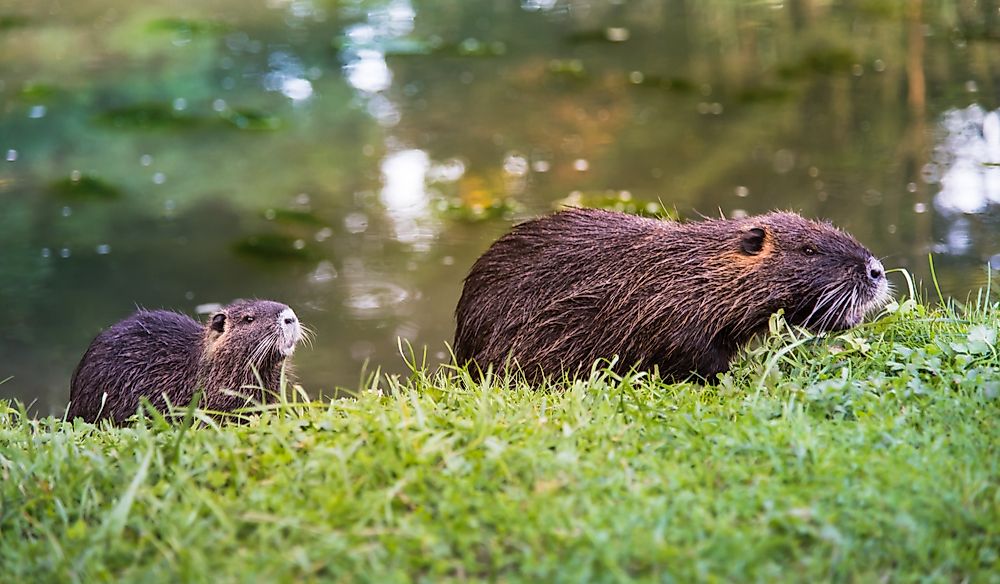
Females reach sexual maturity at around four months, breed year-round, and can produce three litters a year of up to thirteen young. A female can be pregnant again within a day or two of giving birth.
That is why the fetal count matters as much as the body count. Of the 9,400-plus necropsies California has performed, roughly 12,400 unborn nutria have been removed from the population, meaning the programme has prevented more nutria than it has caught.
It is also why speed is the whole strategy. A population that can multiply several times over in a single year does not give anyone the option of monitoring the situation for a few seasons and deciding later.
The Levees Are The Real Stake

Nutria dig. Burrows can run 50 feet into a bank, with multiple entrances and chambers, and they are excavated into exactly the structures California cannot afford to lose: the earthen levees of the Sacramento-San Joaquin Delta.

Those levees protect farmland sitting below sea level, and more importantly they keep salt water out of the point where the state and federal water projects draw from. Water for tens of millions of people and a very large share of the nation's produce passes through that one hydraulic bottleneck, drawn from where the state's two great river systems meet.

In October 2022 a family group turned up on lower Sherman Island in Sacramento County, which is squarely in the Delta. Sixty-one animals were removed there between then and August 2025. That detection is the reason the programme's tempo changed.
Somebody Probably Put Them There

For years the working assumption was that a remnant population had survived the 1970s eradication undetected and quietly rebuilt. Genetic research announced in April 2026 says otherwise.
CDFW scientists compared DNA from today's animals against historical skins and skulls held in museums and universities, including a taxidermy specimen found in the Butte County Weights and Measures office. California's historical nutria came from several diverse lineages. The modern population descends from a single one, and its closest match is a population in central Oregon.
CDFW geneticist Michael Buchalski put the implication plainly, noting that given where the animals were rediscovered it is nearly impossible they could have migrated there on their own. Programme manager Valerie Cook said the study supports the long-held belief that this is a reintroduction rather than the growth of a hidden remnant.
In other words, the most likely explanation for one of the most expensive wildlife operations in the state is that a person moved some animals several hundred miles and released them.
What Nine Thousand Takes Looks Like

The operational numbers are striking for a programme most Californians have never heard of. Since March 2018 the effort has executed entry permits with more than 5,300 landowners covering 14,000 parcels across 20 counties, which is the unglamorous part of eradication: most of the habitat is private.
Field teams have set up 15,320 camera stations and carried out more than 125,000 camera checks, deployed 23,288 trap sets for over 240,000 trap nights, and confirmed nutria at 1,604 separate 40-acre survey cells, a scale of monitoring more typical of a major invasive incursion than a single rodent.

The take is heavily concentrated. Merced County accounts for 3,440 and Fresno 3,043, together roughly two thirds of the total. Solano has produced 1,435 and Stanislaus 1,005, with Madera at 285 and the rest in double or single figures: Sacramento 61, Contra Costa 47, Mariposa 26, Kings 16, Sonoma 4.
Those small numbers are the ones managers watch. A county in single digits is either newly invaded or nearly clear, and telling the difference is the hardest part of the job.
It Has Been Done, And It Has Been Lost

There are two precedents and they point in opposite directions. Maryland was declared free of nutria in 2022 after a campaign spanning more than two decades around Chesapeake Bay, removing roughly 14,000 animals from the Chesapeake Bay marshes. The last known Maryland nutria was caught in 2015, and the seven years after that were spent proving a negative.
Louisiana is the other outcome. There, nutria are permanently established across coastal marsh, and the state runs a bounty programme rather than an eradication one. Since 2002 trappers have harvested around five million animals under it, and damage estimates still run past 100,000 acres of coastal wetland.
California's entire argument is that it is currently in Maryland's position rather than Louisiana's, and that the window closes.
Finding The Last Ones

The programme runs a five-phase strategy: survey to map the extent, knock-down to trap populations to zero density, mop-up for stragglers and new arrivals, then confirmation and ongoing surveillance. The phases get harder as the numbers fall, because absence is far more difficult to establish than presence.

Detection methods have had to get stranger as a result. Alongside motion cameras and visual surveys, California brought in scat-detection dogs trained on the Chesapeake Bay project, which can work ground where no animal has been photographed in months.
The programme asks the public to report sightings, which matters because the species is still unfamiliar enough in California to be mistaken for a beaver or a muskrat. A nutria has a round tail; a beaver's is flat and a muskrat's is laterally flattened, and a muskrat is a fraction of the size.
Nine years in, with more than nine thousand animals taken and a confirmed foothold in the Delta, the question is no longer whether California can find nutria. It is whether it can stop finding them.