What Happens To Burmese Pythons When Florida Gets A Cold Snap
Florida's Burmese pythons have no natural predators as adults, no effective ceiling on their numbers, and a two-decade record of shrugging off everything the state has thrown at them, hunters, bounties, dogs, radio tags, and public enthusiasm included. But the invasion has one genuine enemy, and it arrives by weather forecast. When a hard cold front drives south Florida's temperatures into the 30s and holds them there, something happens that no removal program has ever managed: pythons die across the landscape by the hundreds and thousands, and in January 2010, the coldest snap the region had seen in decades, they died on a scale that stunned the biologists tracking them. What happens to Burmese pythons in a Florida cold snap is, in short, the closest thing the Everglades has to a counterattack, and the full story, which includes snakes dying of bad decisions, a natural selection experiment run in real time, and an invisible wall across central Florida, explains both why the python has conquered the state's southern tip and why it has conquered nothing beyond it.
A Tropical Snake In A Subtropical Trap

The vulnerability is written in the python's passport. Burmese pythons evolved in the wet tropics and warm subtropics of Southeast Asia, country that essentially never freezes, and the species arrived in the Everglades through the pet trade carrying tropical equipment: superb heat sensing, no antifreeze, and an operating range that starts failing when body temperatures slide into the 40s Fahrenheit and turns lethal in the 30s. A big python's sheer bulk buys it hours of thermal inertia that a garter snake could never afford, but bulk only delays the arithmetic; it cannot repeal it.

South Florida, for all its tropical billing, is a subtropical borderland that the Arctic occasionally reaches. Every few winters, a continental cold front barrels down the peninsula with nothing to stop it, there being no mountains between Miami and the Canadian border, and delivers freezing or near-freezing nights to the python's entire stronghold, complete with frost on the sawgrass. For the invasion's first decade, those fronts stayed mild and the pythons multiplied in what looked like paradise. Then paradise had a January like the old ones.
The Freeze That Fought Back

In early January 2010, a historic cold event parked itself over Florida for nearly two weeks, with hard freezes reaching deep into the peninsula and South Florida shivering through day after day of record and near-record cold. The state's wildlife took it broadside: fish kills whitened canals, cold-stunned sea turtles and manatees crowded rescue operations, invasive iguanas dropped rigid out of trees across the suburbs, and in the Everglades, the python invasion ran into the first force that had ever beaten it in the open field.
The die-off was dramatic and, thanks to radio-tracked study animals, unusually well documented. At monitored sites, large shares of telemetered pythons, in some study groups most of them, were found dead when the cold released its grip, and surveys afterward turned up python carcasses scattered along canal banks and levees across the invasion zone. Mortality clearly varied by place and shelter, with estimates across studies running from heavy losses to the large majority of local snakes, but the headline was not in dispute: a single stretch of weather had killed more pythons in two weeks than every human removal effort combined had managed in years.
They Die Of Bad Decisions

The strangest finding from 2010 was not how many pythons died but how. Researchers kept recovering dead snakes stretched out in the open, on levees, on banks, in plain view, animals that had apparently responded to lethal cold by trying to bask, surfacing into the killing air in search of a sun that could not save them, when survivable shelter sat yards away. Florida's native snakes, from the species that actually belong there to every rat snake in the state, answer cold with an ancient script: go down, into burrows, holes, and deep cover, and wait. The python never learned the script, because its homeland never taught it.
Biologists describe it as a behavioral mismatch, an animal physically capable of surviving a Florida freeze, had it simply hidden, dying instead of a bad instinct, and it is the invasion's one genuine blind spot. The python is a flawless predator and a hopeless meteorologist. In a landscape it has otherwise mastered completely, the one thing it reliably gets wrong is winter, and for two weeks in 2010, getting winter wrong was the most dangerous mistake in the Everglades.
The Survivors' School

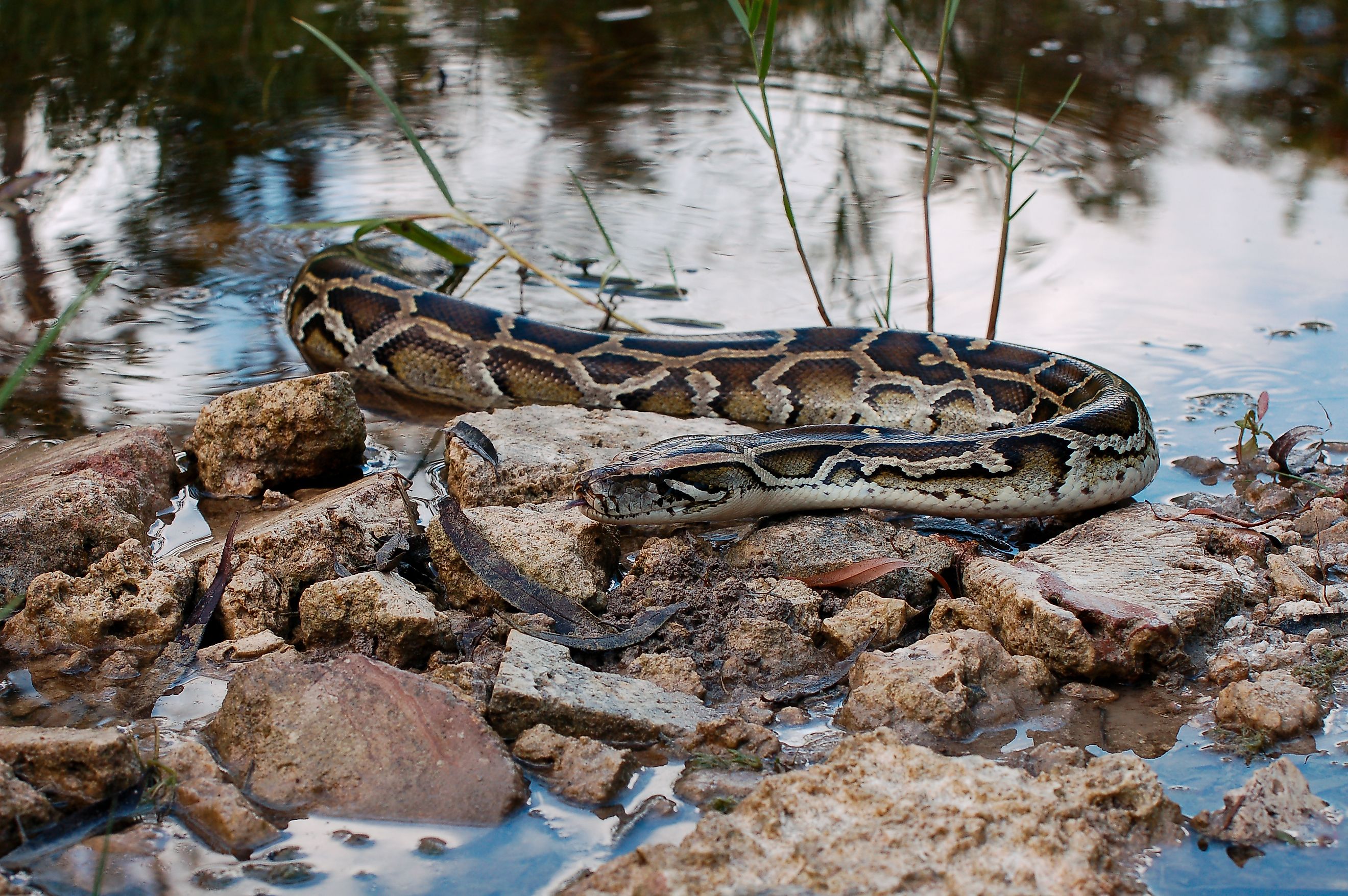
The pythons that lived through 2010 were, disproportionately, the ones that did the right things: snakes that went underground into mammal burrows and solution holes, wedged into deep debris, or slid into the canals and sloughs whose water, holding steady in the 50s and 60s while the air froze, works as the landscape's great thermal battery. Water is the quiet hero of python winters, and the invasion's densest strongholds along canal systems are no accident; a python wintering within a body-length of a warm canal carries insurance a levee-basker never has.
What 2010 did to the population's genetics is one of the invasion's live scientific questions. Researchers have documented cold-response differences since and debated whether the freeze ran a brutal selection event, culling the open-baskers and leaving a population fractionally better at hiding from cold, with some evidence pointing that way. What nobody debates is the demographic answer: the population absorbed the blow and recovered fully within a few seasons, because a single surviving female can lay dozens of eggs a year and the Everglades' food supply rebuilt the numbers. A cold snap is a massacre, not an eradication, and the species' engine restarts the moment the thermometer climbs.
The Invisible Wall

Zoom out and the cold snaps stop being events and become a border. Early projections once painted Burmese pythons spreading across the warm third of the United States, but two decades of real winters have drawn a much tighter map: the breeding invasion remains pinned to the southern end of the peninsula, thinning dramatically north of the Lake Okeechobee country, precisely along the gradient where freezes arrive often enough and hard enough to keep collecting their tax. Individual pythons turn up farther north, and the frontier has crept, but every serious cold winter burns the advance back, a wall made of nothing but weather.

The wall's fine print is the uncomfortable part: it is maintained by a climate that is warming. Milder winters, fewer deep freezes, and any inherited improvement in the pythons' cold behavior all push the line north, and biologists watch the range edge for exactly that reason. The native alligators, meanwhile, demonstrate what a true Florida local does with a freeze, parking in the water with snout raised and idling through nights that kill pythons outright, 60 million years of resident experience versus 40 years of residency, visible in a single cold morning.
What A Cold Snap Can And Cannot Do
It is tempting to read the freezes as the Everglades' salvation, and the temptation should be resisted with numbers. The python population, estimated anywhere from the tens of thousands into the hundreds of thousands because nobody can truly count a cryptic snake in a roadless marsh, has already done its deepest damage, with surveys in the invasion's core documenting the collapse of marsh rabbits, raccoons, opossums, and other mid-sized mammals by rates north of 90 percent. A freeze resets none of that; it prunes the predator without restoring the prey, and the warm years between snaps give the python everything it needs to refill.

So the cold works as an ally rather than an answer, one partner in a containment effort that otherwise runs on human labor: the contractor programs and public hunts through which Florida pays people to pull pythons out of the marsh by the thousands, the detector dogs and scout-snake telemetry, and the native resistance that picks off what it can, alligators included. Each freeze is a one-time subsidy to all of it, knocking the population back and, in the parks the python has claimed, briefly thinning the woods in a way no season of hunting can.

And one practical note rides along for anyone in python country the morning after a freeze: a cold-stunned python is not a dead python. Torpid snakes found stiff in the open can revive as the day warms, which is why wildlife officials ask residents to report rather than handle them, the same rule that governs every venomous and dangerous snake encounter in the country: distance, a photo, and a phone call beat a shovel and a surprise.
Winter Does What The Hunters Cannot

So what happens to Burmese pythons when Florida gets a cold snap is the invasion's whole paradox in two weeks of weather: a tropical superpredator that has beaten every opponent in the Everglades dies in the open by the hundreds, often of the simple mistake of basking when it should hide, while the survivors shelter in burrows and warm canals and rebuild the empire by summer. The freezes cannot win the war, but they hold the border, pinning the python to the peninsula's southern tip and reminding everyone watching that the snake's one unconquered enemy is the thermometer. Florida spends millions fighting its most famous invader. Every few winters, for free, the Arctic sends help.