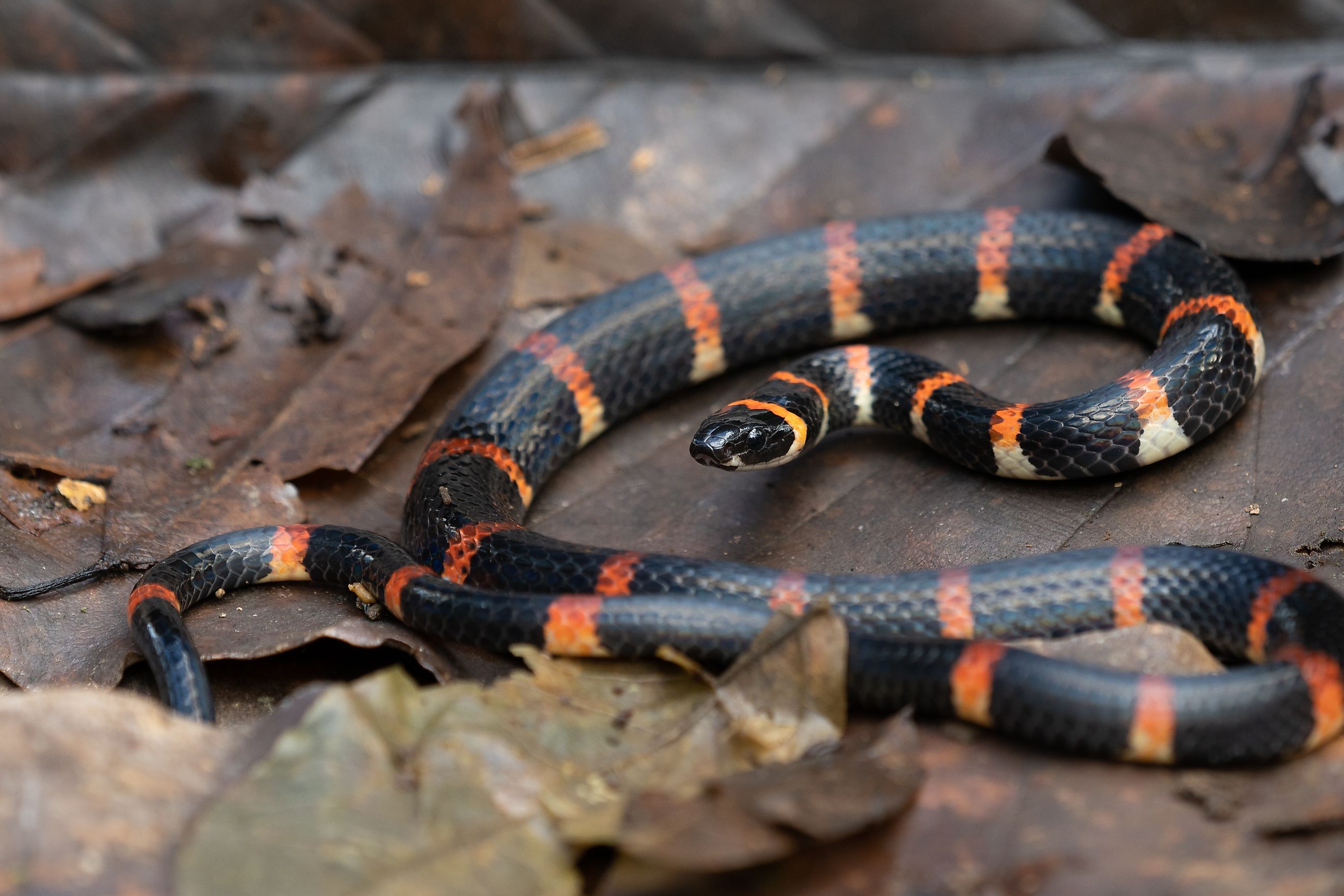
How Far North Coral Snakes Live
Coral snakes are tropical and subtropical animals at heart, and inside the United States they sit near the northern frontier of a group that is far more diverse across Central and South America. Three species live within US borders, and each one fades out at a different northern boundary fixed by climate, soil, and habitat. The eastern coral snake marks the northernmost point for the entire group along the Atlantic, holding on in the Sandhills of North Carolina near 35 degrees north latitude. Farther west the picture changes, with the Texas coral snake halting in southern Arkansas and the Sonoran coral snake stopping in central Arizona. Where coral snakes end, and why they end there, reveals a great deal about how cold-sensitive reptiles survive at the edges of their range.
The Three Coral Snakes of the United States

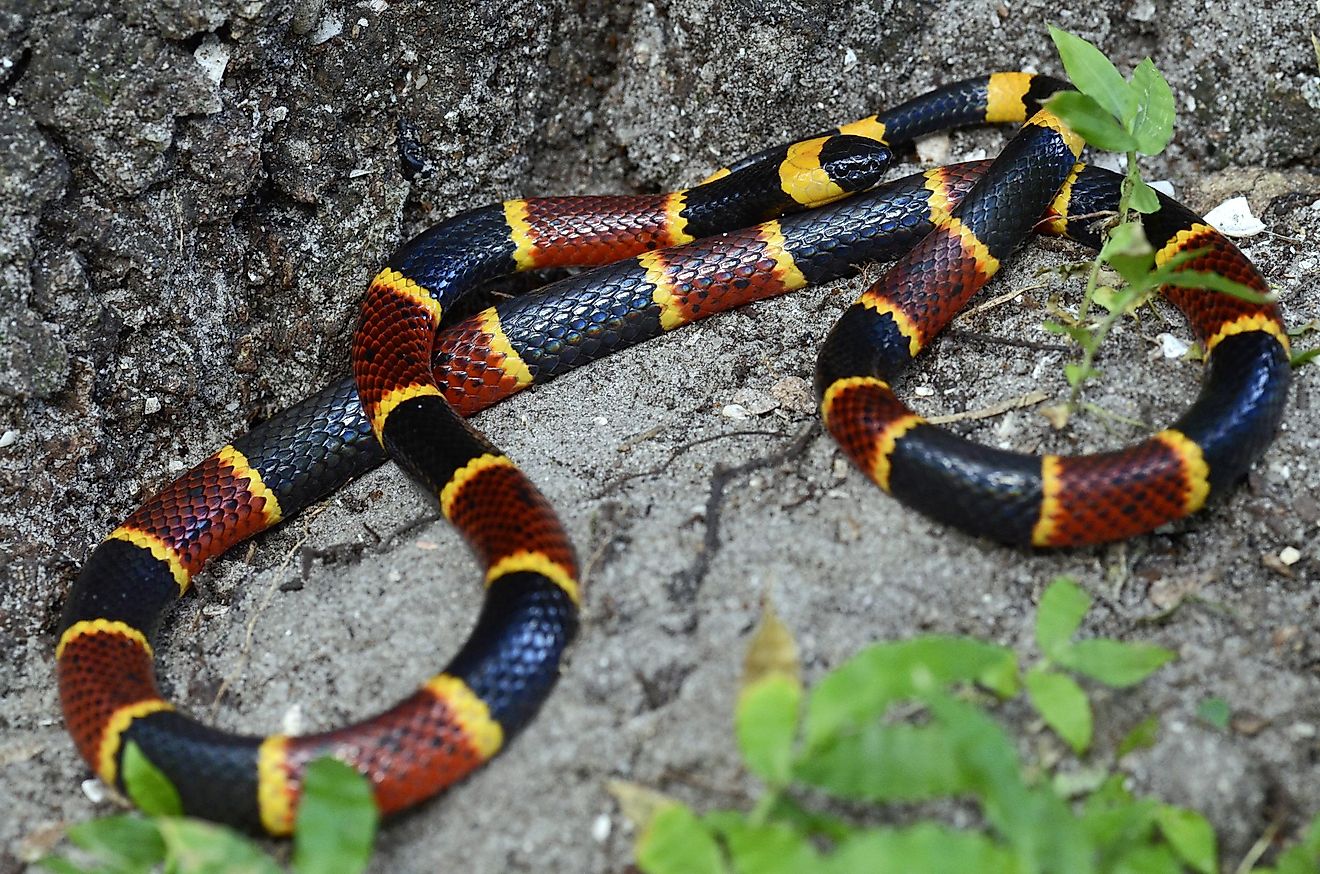
The United States hosts three native coral snakes spread across two genera. The eastern coral snake (Micrurus fulvius) occupies the southeastern Coastal Plain and the whole of Florida. The Texas coral snake (Micrurus tener) covers much of Texas and reaches into Louisiana and Arkansas. The Sonoran coral snake (Micruroides euryxanthus), also called the Arizona or western coral snake, lives in the desert Southwest. The first two were once treated as a single species, and later genetic and morphological work separated M. tener as distinct. All three carry strongly neurotoxic venom and belong to the family Elapidae, the same family as cobras and mambas. Because no coral snake ranges far beyond the warm southern tier of states, the question of how far north they live has three separate answers, one for each species.
The Northern Edge in the East

The eastern coral snake sets the northernmost record for any coral snake in the country. Its range reaches the Sandhills and Coastal Plain of south-central and southeastern North Carolina, roughly 35 degrees north. The snake does not cross into the Piedmont or the mountains, and within North Carolina it is confined to areas of deep, porous, sandy soil in pine and scrub-oak country. The species is genuinely rare there. North Carolina lists it as Endangered, and sightings have grown scarce since about 1960, with at least one regional account warning that it may vanish from the state altogether. North Carolina has no confirmed record of a coral snake bite in its entire recorded history, a direct reflection of how seldom the animal is seen. South Carolina classifies it as imperiled, and the snake grows steadily more common toward the south, reaching its greatest abundance in Florida, where it occurs in every county and onto Key Largo in the northern Keys.
The Northern Edge in the Center

West of the Mississippi the northern boundary belongs to the Texas coral snake. Its US range centers on Texas and extends into western and central Louisiana, the extreme southeastern corner of Oklahoma, and the southern and southwestern counties of Arkansas. Southern Arkansas, near 33 to 34 degrees north, marks the practical northern edge in this part of the country. The Arkansas populations are sparse and poorly studied, documented in only a handful of counties and listed by the state as a Species of Greatest Conservation Need. Like its eastern relative, the Texas coral snake favors wooded ground with loose soil and leaf litter, and it spends most of its life underground. Its distribution continues well south into northeastern and central Mexico, which underscores that the Arkansas records sit at the cool, dry margin of a largely Texan and Mexican range rather than at its core.
The Northern Edge in the West

The Sonoran coral snake holds the northern limit in the desert Southwest. It ranges across central and southern Arizona and into the extreme southwestern corner of New Mexico, then continues south into Sonora and Sinaloa in Mexico. Central Arizona, in the Sonoran Desert, represents its northern boundary, generally below about 5,800 feet in elevation. This is a small, secretive, burrowing snake of rocky upland desert, and it belongs to a different genus than the two eastern species. Its presence in Arizona shows that the northern limit of US coral snakes is not one clean line of latitude but a staggered front shaped by regional climate and terrain, with each species pushing north only as far as local conditions allow.
Why the Range Stops Where It Does

Coral snakes are ectotherms, which means their body temperature tracks the surrounding environment, and the whole group is adapted to warm conditions. For warm-adapted reptiles, the northern edge of a range is usually governed by cold. Winter temperature extremes, along with the length and severity of hard freezes, impose a ceiling on how far north these animals can persist. Researchers studying tropical and subtropical species in the Southwest have found that the northern and upper-elevation limits of such biota are typically set by freezes, and the same principle holds along the Atlantic coast.
Habitat reinforces the climatic limit. All three species are semifossorial, spending much of their lives burrowed into the ground, so they depend on deep, well-drained, sandy or loose soil. In North Carolina that requirement restricts the eastern coral snake to the Sandhills and Coastal Plain and keeps it out of the heavier soils of the interior. Where warm winters and workable soil coincide, coral snakes can live. Where either condition fails, the range ends.
A Moving Boundary Under a Warming Climate

Because cold sets the northern limit, a warming climate could lift that limit higher. A 2018 study in the journal PeerJ by Archis and colleagues modeled the distribution of the eastern coral snake under current and projected future climates using species distribution modeling. The authors found that suitable habitat is shifting and that the range could expand up to roughly 200 kilometers, about 120 miles, northward by around 2050. Tellingly, their future-climate models predicted recent occurrence records more accurately than present-climate models did, which suggests that a northward shift may already be underway. A change of that scale would carry the eastern coral snake deeper into North Carolina and perhaps toward Virginia over the coming decades. It would also reshape conditions for the harmless mimics that copy coral snake coloration, such as the scarlet kingsnake, whose protective resemblance only works where the mimic shares ground with the venomous model.
What the Northern Limit Means for People

For anyone living near the northern edge, the practical point is that coral snake encounters are rare and bites are rarer still. In North Carolina the species ranks among the least frequently seen terrestrial vertebrates, and no bite has ever been recorded there. Even within the populated heart of the range in Florida, the snake's burrowing habits keep it out of sight, so range size and encounter rate are two different things. People near the margin are far more likely to meet a banded mimic than a true coral snake. Correct identification still matters, because the venom is powerfully neurotoxic, but the odds of meeting one fall sharply with every mile north.
The Edge of a Tropical Family
In the United States, coral snakes live at the cooler edge of a group that is most diverse in the American tropics. The eastern coral snake reaches the farthest north, surviving in the North Carolina Sandhills near 35 degrees latitude. The Texas and Sonoran species are found a bit farther south, in southern Arkansas and central Arizona. This northern limit is set by mild winters and the right kind of soil, both essential for these burrowing, cold-sensitive snakes. As the climate warms, this boundary will likely move slowly north. Watching how this edge shifts, after holding steady for generations, is one of the more interesting developments in North American herpetology.