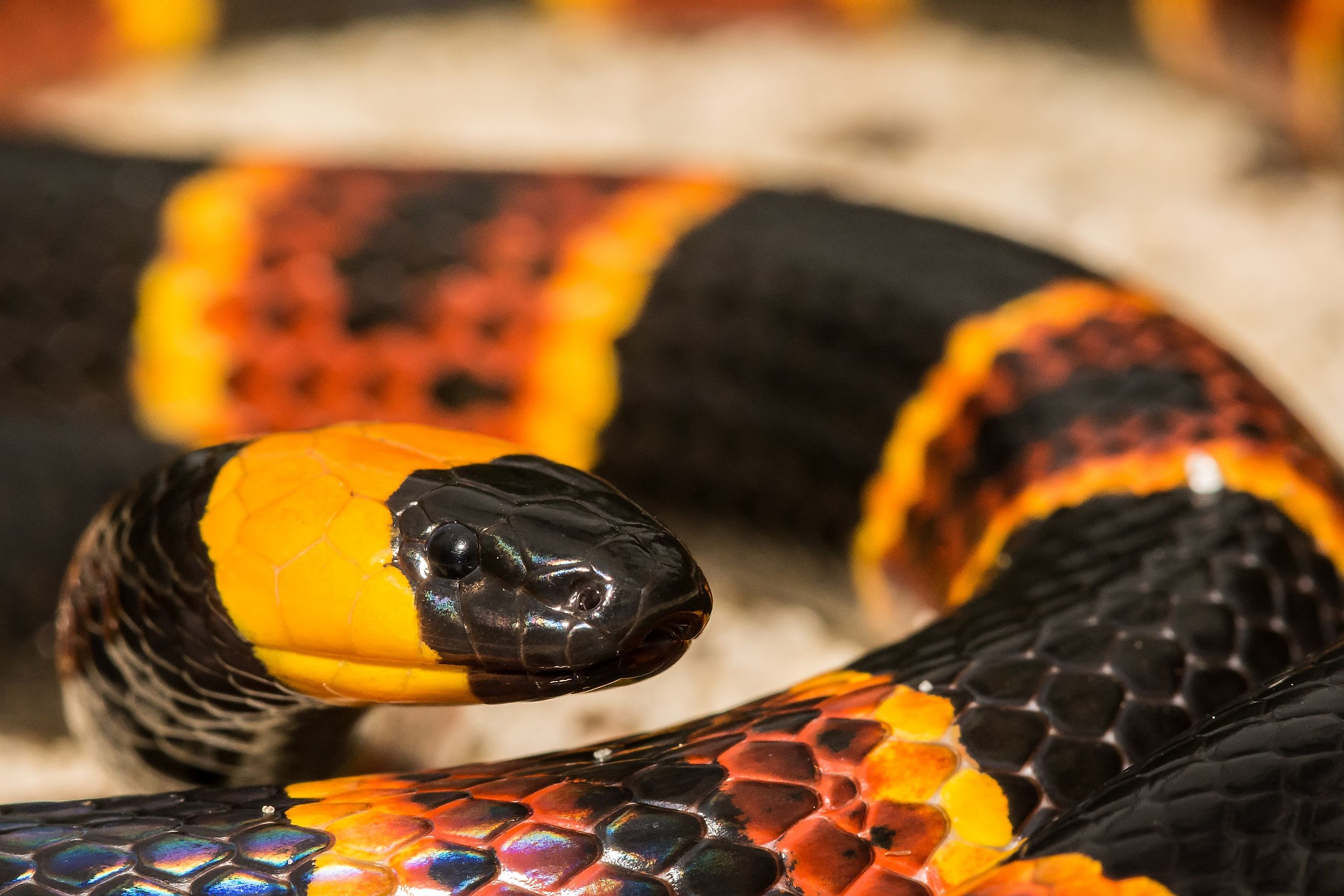
Where Coral Snakes Live In The United States
Three types of coral snake live in the United States, spread out in a patchy band across the southern states that reaches the Atlantic Coast in the Southeast and the Arizona desert in the Southwest. Although tens of millions of people live in these areas, most will never see a coral snake. Out of the roughly 7,000 to 8,000 venomous snakebites reported each year in the country, fewer than 100 are from coral snakes. In the seventeen years that Velagapudi and colleagues studied the National Poison Data System, from 2006 to 2022, not a single coral snake bite caused a death.
This result is mostly because of the snakes' own habits, not just luck. Coral snakes spend much of their time underground or hidden under leaves. Their short, fixed fangs often can't reach skin through clothing, and about a quarter of their bites don't inject any venom. So, where these snakes live is more important to gardeners, hikers, and dog owners than to people worried about deaths, since the risk is real but limited to certain areas.
Three Snakes Across The Southern Map

Carl Linnaeus first described the eastern coral snake in 1766, calling it Coluber fulvius. In 1853, Spencer Fullerton Baird and Charles Girard described the coral snake of Texas separately, as Elaps tenere. Later scientists folded it back into the eastern species, and field guides listed it as a subspecies of the eastern coral snake for many years, until genetic research in the 2000s showed they were separate species. This discovery changed the range maps. Now, there are three recognized coral snake species in two genera: the eastern coral snake (Micrurus fulvius), the Texas coral snake (Micrurus tener), and the Sonoran coral snake (Micruroides euryxanthus). Each species lives in a different region. All three are part of the cobra family, Elapidae, and they are the only elapids native to North America.
Where The Eastern Coral Snake Lives

The eastern coral snake has the largest range of the three species and is the one most people imagine. Biologists have found it in southeastern North Carolina, down through South Carolina and all of Florida, then west through Georgia, Alabama, and Mississippi into eastern Louisiana. This snake sticks to the Coastal Plain, where it prefers well-drained sandy soil, pine flatwoods, scrub, and hammocks that rise just above wetter areas. It often stays hidden in loose soil or under logs, coming out most after heavy rain or in spring when searching for a mate. Florida is central to this story, not only because the snake is found throughout the state, but also because many people garden, hike, and walk their dogs in its habitat. Researchers at the Savannah River Ecology Laboratory and other places have found that the eastern coral snake mainly eats other snakes and slender lizards, so it stays low in the ground cover where people might reach with bare hands. Its known range could expand in the next few decades, as climate models suggest the Coastal Plain population may move north.
Where The Texas Coral Snake Lives

The second species is named after its home state. The Texas coral snake lives in eastern and southern Texas, western Louisiana, and southeastern Arkansas, and its range stretches south into northeastern and central Mexico. There is a gap between its range and that of the eastern snake, running through western Mississippi and Louisiana, where neither species is found reliably. This gap led researchers to reconsider whether the two snakes should be grouped together. The Texas coral snake is slightly larger than its eastern relative and can deliver a greater quantity of venom, with one account reporting 10 to 12 milligrams per bite. Despite this, it is equally reluctant to bite. It turns up in many settings, including moist woodlands and suburban yards, and in Texas it often hides under boards and stones, which are common spots for people working in their yards to put their hands.
Where The Sonoran Coral Snake Lives

The third species lives in the desert and does not share its range with the other two. The Sonoran coral snake, also known as the Arizona coral snake, is found in central and southern Arizona, extends into extreme southwestern New Mexico, and continues south into Sonora and Sinaloa in Mexico. It is the smallest of the three, a slender snake that rarely grows longer than two feet. This species lives in arid and semiarid areas, including desertscrub, grassland, and the lower edges of oak woodland. In the low deserts of western Arizona, its presence is recorded only in scattered patches. This is not because the snake is rare, but because few people search those washes at night for a thin snake that mostly comes out after dark and after rain. According to the Arizona-Sonora Desert Museum, there are no recorded human deaths from this species. Its small mouth and shy nature make serious bites uncommon, but its venom is strong, so no one should handle it.
How Often Coral Snakes Bite People

There isn't much data on coral snake bites, and the numbers have stayed about the same for years. Coral snakes make up less than one percent of venomous bites in the US. From 2006 to 2022, Florida and Texas together reported about 90 percent of all coral snake bites, with April being the busiest month. A 1987 study of 39 eastern coral snake victims showed that the neurotoxic venom can cause slurred speech, drooping eyelids, muscle weakness, and, in the worst cases, breathing failure that requires a ventilator. These symptoms can show up hours after a bite that seemed minor at first, so doctors take every confirmed coral snake bite seriously, even if the wound looks harmless. Only one coral snake death has been recorded in recent memory. In 2009, Norris and his team documented the first confirmed death from a coral snake bite in the United States in more than four decades, the result of a 2006 bite. The victim had been bitten by an eastern coral snake but did not seek medical attention. Florida and Texas account for the highest numbers of venomous snake bites in the country, making them particularly important states for understanding snakebite risk.
Treatment for coral snake bites sits in a strange spot. The only antivenom licensed in the US, North American Coral Snake Antivenin, has not been manufactured since the mid-2000s, and no replacement has been licensed to take its place. To keep supplies on hand, the FDA has repeatedly extended the expiration date on the remaining stock after stability testing rather than let it lapse. Antivenom is now held back for patients who develop symptoms, while hospitals in the Southeast lean on supportive care, watching patients closely and helping them breathe if the venom takes hold. That shift has not raised the death rate, though it has meant more patients end up on a ventilator. It is an unusual situation for a wealthy country, and it means getting medical help quickly is more important than ever.
Telling A Coral Snake From Its Harmless Mimics

Several harmless snakes mimic the coral snake's banding, and their imitations are convincing enough that people often mistake them for the real thing, or vice versa. In the Southeast, the scarlet kingsnake and scarlet snake both have the same red, black, and yellow colors. Out in the desert, shovel-nosed and ground snakes resemble the Sonoran coral snake. The old rhyme, 'red touching yellow kills a fellow,' works well in the Southeast to tell the coral snake apart from its local lookalikes, but it doesn't hold up in most other places. This has led more than one confident traveler to make a mistake. In South America, where dozens of coral snake species live, the color rule doesn't work at all. In the United States, the best way to identify a coral snake is by its blunt, solid black snout and bands that go all the way around its body, with yellow rings touching the red on both sides. Looking at coral snakes across the Americas shows just how much their banding patterns can change once you leave the Southeast.
Staying Safe In Coral Snake Country

The basic rules are easy to follow and match where coral snakes are found. People usually come across these snakes when reaching into leaf litter, lifting boards or logs, or weeding by hand. Wearing gloves and using a tool to turn things over offers good protection. Paying attention to where you put your hands and feet, especially in the sandy pine areas of the Southeast or the rocky desert washes of Arizona after summer rain, helps avoid most risks. If given space, a coral snake will almost always move away. Most bites happen when someone tries to pick up or kill the snake. If you are bitten, or even think you might have been bitten by a banded snake in coral snake territory, go to a hospital right away. The venom takes time to show symptoms, and early treatment is best. In Florida and Texas, dogs are often involved in serious cases, so keep pets away from yard debris too.
The Bottom Line
Three coral snake species live in three separate corners of the southern map, and the danger they pose stays small for anyone who leaves them alone. This makes serious encounters uncommon, though their venom means any bite must be taken seriously. People living or spending time in their range should learn to recognize them by their physical markings rather than relying on color rhymes that do not apply to every species. Giving these snakes space and seeking immediate medical attention after a suspected bite are the most important precautions. Their reputation may make them seem like a constant threat, but understanding their behavior makes it easier to avoid unnecessary encounters and coexist with them safely.