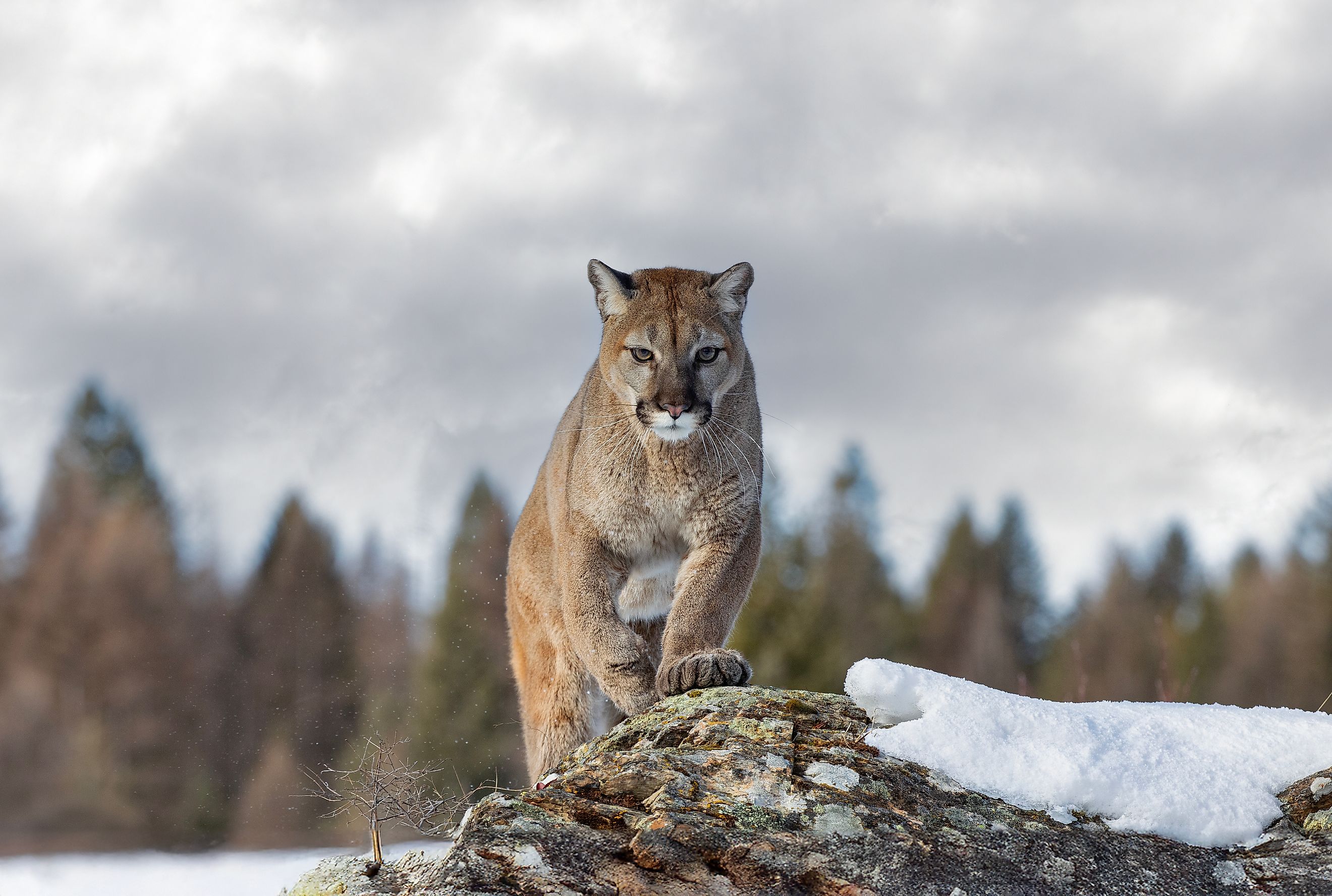
The Most Mountain Lion-Dense States In The United States
When people ask which states have the most mountain lions, they are usually referring to total population. Density, however, tells a different story. It measures how many animals occupy a given area, and the two figures do not always align. A large state may support thousands of mountain lions spread across vast stretches of land, while a smaller region with ideal habitat may hold a much greater concentration. Wildlife agencies estimate that the United States is home to roughly 20,000 to 40,000 mountain lions, with nearly all of them living west of the Great Plains. Their local concentrations depend largely on prey availability, terrain that provides cover for hunting, and the degree of hunting pressure permitted by state regulations.
Getting an accurate picture of mountain lion density across the country is difficult. No state wildlife agency maintains a reliable statewide count, largely because these elusive animals are difficult to track across such extensive territories. Instead, researchers estimate populations within specific study areas using GPS collars, camera traps, and genetic sampling. Their findings are generally expressed as the number of animals per 100 square kilometers. Although these estimates cannot establish a precise ranking for entire states, they offer the clearest available evidence of where mountain lions reach their highest concentrations. The following states stand out based on these local density estimates, habitat conditions, and broader population data.
Colorado

Colorado holds the strongest claim to the densest overall population in the lower 48. Colorado Parks and Wildlife estimates between 3,800 and 4,400 independent adult lions statewide, a figure that excludes dependent kittens. Colorado is especially well suited for mountain lions. About 57 percent of the state offers suitable habitat, and the large herds of mule deer and elk provide plenty of prey. A multi-year Western Slope density study using GPS collars and motion cameras reinforced the picture. The agency confirmed a robust population, with lion numbers in some areas exceeding what its models had predicted. Older official ranges spanned 3,000 to 7,000 animals, but the collar-based work has narrowed the credible estimate upward in prime western habitat.
California

California carries one of the largest populations in the country, and its best habitat supports high local densities. Recent state-affiliated work estimates on the order of several thousand adults statewide, with a minimum of roughly 3,500 for recent years and older studies ranging to 6,000. Density studies in the Sierra Nevada show how concentration shifts with the seasons. Minimum density in one central Sierra study area ran about 0.87 lions per 100 square kilometers in summer and 1.42 in winter, the rise driven by home ranges contracting as deer move to lower elevations. California's 1990 ban on sport hunting removed a major source of mortality, and the state's coastal ranges and foothills hold some of the most concentrated populations outside the Rockies.
Montana

Montana produces some of the highest documented local densities in the United States. Snow-tracking and genetic sampling in the Garnet Range yielded minimum density estimates around 3.6 to 3.7 lions per 100 square kilometers, with some methods indicating still higher numbers and a comparable study reporting values above 5. Those figures sit well above most of the continent. A broader synthesis of North American research found total densities clustering between about 2.0 and 3.24 lions per 100 square kilometers across unhunted and lightly hunted populations, which places Montana's forested western valleys near the top of the range. Prey abundance and extensive cover across the state sustain lions well beyond its western mountains.
Utah, Nevada, and Arizona

The Great Basin and desert Southwest states hold dense pockets of lions wherever rugged terrain and deer overlap. Utah's population spans much of the state's mountain country, and Nevada and Arizona both support healthy numbers in their mountain ranges and isolated desert peaks. Arizona's "sky islands," forested highlands rising out of desert, function as concentrated habitat where lions, deer, and javelina coexist in a compact footprint. In these areas, lion density usually follows where prey are found. When deer are more plentiful, lions live closer together. Across all three states, the pattern is the same, with lions scarce in open flats and concentrated in the broken high ground.
New Mexico

New Mexico's importance to this story is partly scientific. The longest and most detailed field study of the species in the country took place in the state's San Andres Mountains, documented in the book Desert Puma. That decade-long work recorded densities ranging from about 0.8 to 2.1 lions per 100 square kilometers, a benchmark that researchers across the West still cite. The state's mix of desert basins and high country supports a population estimated around 3,500 animals, with concentrations highest in mountain blocks that combine cover and deer.
Wyoming, Idaho, Oregon, and Washington

The northern tier of the West rounds out the dense-population states. Wyoming and Idaho both carry established populations in the thousands, spread across forested mountains and river canyons where elk and deer are plentiful. Oregon and Washington sustain large and stable numbers in the Cascades and the Blue Mountains, with Washington's lions distributed across most of the state. None of these states approaches the local peaks recorded in Montana, but each holds continuous, well-connected habitat that keeps densities moderate to high across large areas rather than confined to isolated blocks.
The Density Paradox: Texas and Florida

Two states show why total count misleads. Texas holds a significant and widespread population, yet its documented densities are among the lowest on the continent. Studies in South and West Texas recorded roughly 0.27 to 0.43 lions per 100 square kilometers, far below most North American estimates. The animals persist in the Trans-Pecos and South Texas brush country, but thinly, and Texas remains the only state with a breeding population that manages the cat as non-game rather than as a regulated game species.
Florida, by contrast, has only a few hundred mountain lions left. Known as Florida panthers, this genetically distinct population survives in a small pocket of habitat across the southern peninsula. Its density within that remnant range is meaningful, but its statewide footprint is a fraction of what the western states hold.
What the Pattern Reveals
The densest mountain lion country in the United States is not simply the biggest or the wildest. It comes down to three factors working together: plentiful deer and elk, rugged terrain that favors ambush hunting, and wildlife management practices that limit human-caused deaths. North Dakota's Badlands illustrate how much density can swing even within one landscape, where annual estimates ranged from a low near 0.45 to a high of 2.8 lions per 100 square kilometers over a twelve-year span. The lesson for any ranking is that density is a moving target, measured locally and shifting with prey and season. Colorado, California, and Montana stand out because they pair deep prey bases with vast suitable habitat, but the tightest concentrations anywhere in the country occur in specific mountain ranges, not across whole state lines.