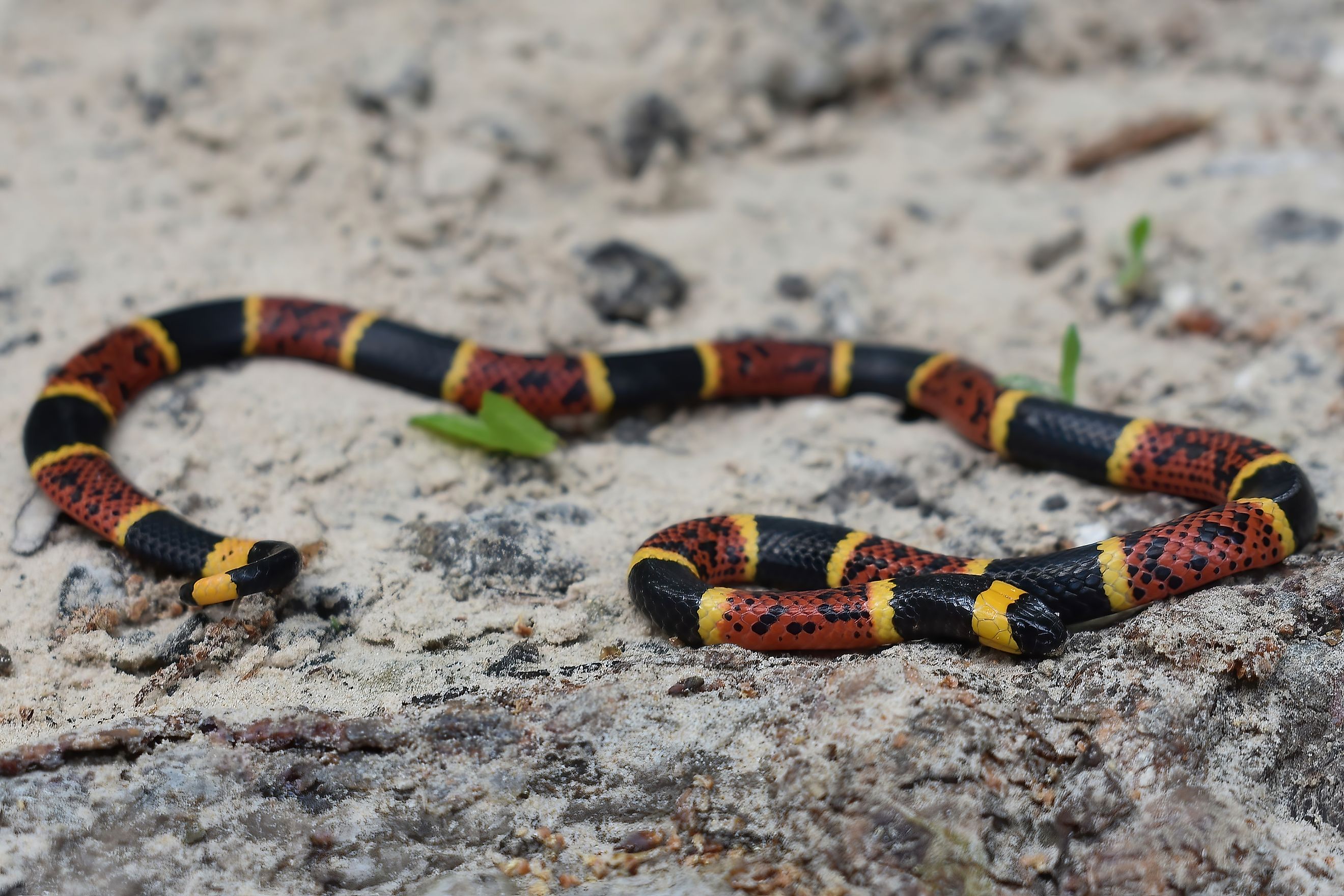
Texas Coral Snake
The Texas coral snake is a small, slender reptile with a reputation that far exceeds its size. Rarely longer than a walking cane and barely thicker than a pencil, it belongs to the same family as cobras and mambas and possesses highly potent venom. Despite this, it is generally shy and avoids confrontation, making bites uncommon even in areas where the species is found.
Known scientifically as Micrurus tener, the Texas coral snake is a secretive, burrowing predator found in the southern United States and northeastern Mexico. It spends much of its life beneath leaf litter, logs, and loose soil, emerging mainly after rain or during cooler parts of the day. Its red, yellow, and black rings serve as a warning to potential predators that this small snake possesses potent venom.
Part of what makes this snake so compelling is how rarely it lives up to the fear it inspires. For all the dread its bright bands provoke, the Texas coral snake is a retiring animal that would almost always rather hide than fight, and the record of harm it has done to people is remarkably thin. Understanding it means looking past the warning colors to the specialized hunter, the careful parent, and the regional legend underneath.
Taxonomic Classification

The Texas coral snake sits within the family Elapidae, the group of front-fanged venomous snakes that also includes cobras, mambas, kraits, and sea snakes. Within that family it belongs to the genus Micrurus, the New World coral snakes, which range across the Americas from the southern United States deep into South America. Its full scientific name is Micrurus tener, first described by the naturalists Spencer Baird and Charles Girard in 1853.
For much of the twentieth century, scientists treated this snake as a subspecies of the eastern coral snake (Micrurus fulvius), labeling it Micrurus fulvius tener. Later work recognized enough consistent differences in size, venom yield, and distribution to elevate it to full species status. Today Micrurus tener is accepted as a distinct species, and the Texas coral snake stands on its own in the record.
Several subspecies are recognized across its range, with the nominate form, Micrurus tener tener, occurring in Texas and neighboring states. The exact number has shifted as herpetologists apply modern genetic tools, and sources differ on how many varieties truly warrant separation. This kind of ongoing revision is common in snake taxonomy, where coloration can mislead and DNA often tells a more complicated story.
Physical Description
The Texas coral snake is a slender, smooth-scaled snake with a rounded head barely distinct from its neck. Most adults measure about 2 feet (60 cm) in length, though larger individuals can reach 3 to 4 feet (0.9 to 1.2 m). Females grow noticeably longer than males, and the body stays thin throughout life, rarely exceeding the width of an adult finger. The build is cylindrical and even, without the triangular head or heat-sensing pits that mark the venomous pit vipers of the region.
Color is this snake's defining feature. Broad bands of red and black are separated by narrow rings of bright yellow, and the rings wrap completely around the body. The snout is black, a detail that gave rise to the old warning about black lips. In the United States, the reliable rule is that the red bands touch the yellow bands, a pattern that separates true coral snakes from their harmless mimics. The red rings are often flecked with black speckles, and in parts of south Texas unusually dark, or melanistic, individuals turn up in which the pattern is heavily obscured.
Unlike the long, hinged fangs of a rattlesnake, the coral snake carries a pair of short, fixed fangs near the front of the upper jaw. These small teeth cannot be folded away and are not built for a fast strike. To deliver venom the snake must bite and hold, often making chewing motions to work the venom into the wound. This modest dental hardware is one of the main reasons that coral snake bites, while serious, so often fail to inject a dangerous dose.
Range and Habitat

Within the United States, the Texas coral snake lives across much of Texas and extends into Louisiana and Arkansas. Its range continues south across the border into northeastern Mexico, reaching as far as the states of Veracruz and San Luis Potosi. This gives the species a broad territory that spans coastal plains, humid forests, and dry interior country.
Habitat flexibility is one of the snake's strengths. It occupies thornscrub in south Texas, pine forests in the east, oak and juniper woodland on the Edwards Plateau, and the eastern edges of the Trans-Pecos. It also does well around people, turning up in suburban gardens, flower beds, and backyards where leaf litter and ground cover give it places to hide. In Mexico the species has been recorded at elevations approaching 6,500 feet (2,000 m).
Across all of these settings the snake favors moist ground and cover. It shelters under rotting logs, boards, flat stones, and piles of debris, and it spends much of its time underground or buried in loose soil and leaf litter. This hidden lifestyle keeps it out of sight for most of the year, which is why many longtime residents of its range have never seen one in the wild.
Diet
The Texas coral snake is a specialist hunter with an unusual menu. It feeds mainly on other snakes, especially small, slender ground-dwelling species, and this snake-eating habit sets it apart from most venomous snakes in its range. Lizards, particularly smooth-scaled skinks, round out the diet, and larger individuals will sometimes take smaller coral snakes.
Hunting is a slow, searching affair rather than an ambush. The snake probes through leaf litter and loose soil, using scent to track prey into burrows and crevices. When it finds a target it bites and holds, working its venom into the prey until the neurotoxins take hold and the animal stops struggling. Because its prey is often long and thin, the coral snake can swallow victims nearly its own length, working them down head first.
This diet makes the Texas coral snake an uncommon link in the food web. By preying on other snakes, including young or small individuals of species that people fear, it quietly influences the balance of reptile populations in the places it lives.
Behavior

Shyness is the hallmark of the Texas coral snake. It is a secretive, mostly solitary animal that avoids confrontation whenever it can. Active chiefly at dawn, dusk, and after rain, it spends the heat of the day and the cold of winter hidden underground. When uncovered it usually tries to flee or burrow away rather than stand its ground.
When truly cornered, the snake has a repertoire of bluffs. It may hide its head beneath coils of its own body while raising and curling the tip of its tail, which in some individuals resembles a second head and can draw a predator's attention away from the vulnerable end. Some coral snakes also make faint popping sounds by expelling air from the vent, a startling noise meant to buy a moment's escape.
For all its chemical weaponry, the Texas coral snake is reluctant to bite. Handlers and herpetologists describe it as docile, and records of bites usually involve people deliberately picking the snake up. Left alone, it is one of the most inoffensive venomous animals in North America.
Reproduction
Like most coral snakes, and unlike the live-bearing pit vipers of the same region, the Texas coral snake lays eggs. Breeding takes place in spring, and females deposit a small clutch, commonly between two and a dozen eggs, in late spring and early summer. The eggs are left in moist, sheltered ground, and the female provides no further care once they are laid.
Hatchlings emerge in late summer, already brightly banded and already venomous. From their first day they carry the same warning colors and the same neurotoxic defense as the adults, and contrary to a persistent myth that young snakes are harmless, the venom of a newborn coral snake is fully functional. Juveniles grow slowly, feeding on tiny snakes and lizards, and reach breeding size over the course of a few years.
In the wild the species is thought to live several years, and captive individuals have survived well beyond a decade. Its secretive habits make long-term study difficult, so much of what is known about its life span and reproduction comes from a modest number of observations.
Venom and Human Encounters

The venom of the Texas coral snake is a powerful neurotoxin that interferes with the signals between nerves and muscles. In a serious envenomation it can cause pain, tingling, drooping eyelids, slurred speech, and, in the worst cases, weakness of the muscles used for breathing. By several measures it ranks among the most potent snake venoms in North America, and a single bite can deliver roughly 10 to 12 milligrams of dried venom.
Despite that potency, the Texas coral snake poses little threat to people in practice. Its small fangs and deliberate biting style make it hard for the snake to inject much venom, and a large share of bites are dry, delivering no venom at all. Coral snakes of all three North American species together account for well under 1 percent of venomous snake bites in the country. Remarkably, there is no confirmed record of anyone dying from a Texas coral snake bite. The single documented coral snake fatality in the United States in the modern era came from the related eastern coral snake in Florida.
Medical care still matters, because the effects of a true envenomation can be delayed and severe. Antivenom developed for the eastern coral snake also works against the venom of the Texas species, and prompt hospital treatment reliably prevents the worst outcomes. The practical lesson is a simple one. Admire this snake from a distance and never try to handle it.
Importance to the World
As a predator of other snakes, the Texas coral snake occupies a specialized niche that few animals fill. By hunting small colubrid snakes and skinks, it helps regulate populations of the prey it targets and adds to the diversity of predators in southern woodlands, grasslands, and scrub. Its own body, in turn, feeds hawks, bobcats, raccoons, and other animals willing to risk its venom.
The snake's coloring has a reach beyond its own survival. Several harmless snakes, including some milk snakes and kingsnakes, closely imitate its red, yellow, and black bands. This resemblance, a textbook example of Batesian mimicry, lets defenseless species borrow the coral snake's dangerous reputation and gain protection from predators that have learned to leave the bright rings alone.
Threats and Conservation

The Texas coral snake is listed as Least Concern on the IUCN Red List, the category used for species that are widespread and not currently at risk of extinction. Its populations are considered stable across its broad range, helped by its ability to live in many habitats, including land that people have altered. The species was assessed as Least Concern in 2007, and that status has held up in later reviews.
No single threat endangers the snake as a whole, though local pressures exist. Habitat loss from development and intensive land clearing can reduce the leaf litter, logs, and ground cover the snake depends on. In Arkansas, where it occupies only a narrow slice of the state, the continued removal of forest could make the species vulnerable at the edge of its range. The snake is not protected in Texas and may be legally collected with a hunting license.
For now, the outlook is stable. The Texas coral snake's secretive habits, its tolerance for suburban edges, and the sheer size of its range all work in its favor, and it faces nothing like the decline seen in many of the world's reptiles.
Takeaway
The Texas coral snake is a secretive animal whose dangerous venom contrasts with its generally retiring behavior. Its red, yellow, and black bands advertise a potent defense, while its tendency to prey on other snakes gives it a distinctive place among the region's predators. Bites are uncommon, and the species remains widespread across much of its range. It is likely to continue inhabiting the southern United States and northeastern Mexico, usually hidden beneath leaf litter or loose soil and encountered far less often than its reputation might suggest.
Fun Facts
- Red touches yellow. The best-known rhyme, "red touch yellow, kill a fellow, red touch black, friend of Jack," reliably sorts coral snakes from mimics in the United States but fails for many tropical coral snakes, whose banding follows no such rule.
- It eats other snakes. The Texas coral snake is one of the few venomous snakes in its range that hunts other snakes as its main prey, swallowing them head first.
- Nobody has died from its bite. There is no confirmed fatality from a Texas coral snake bite on record, despite the venom's strength.
- It fakes a second head. When threatened, the snake hides its real head under its coils and waves its blunt, curled tail as a decoy to confuse predators.
- Its mimics borrow its warning. Harmless milk snakes and kingsnakes copy its bright bands to scare off predators, a classic case of Batesian mimicry.
Quick Facts
- Common name: Texas coral snake
- Scientific name: Micrurus tener
- Family: Elapidae
- Order: Squamata
- IUCN status: Least Concern (assessed 2007, population stable)
- Length: About 2 feet (60 cm) on average, up to 3 to 4 feet (0.9 to 1.2 m)
- Build: Slender and lightweight, rarely thicker than an adult finger
- Lifespan: Several years in the wild, more than a decade in captivity
- Diet: Carnivore, mainly other small snakes and lizards
- Venom: Neurotoxic, potent but rarely injected in quantity
- Reproduction: Egg-laying, clutches of about 2 to 12 eggs
- Range: Texas, Louisiana, and Arkansas, south into northeastern Mexico
- Habitat: Woodlands, thornscrub, grasslands, and suburban gardens with ground cover