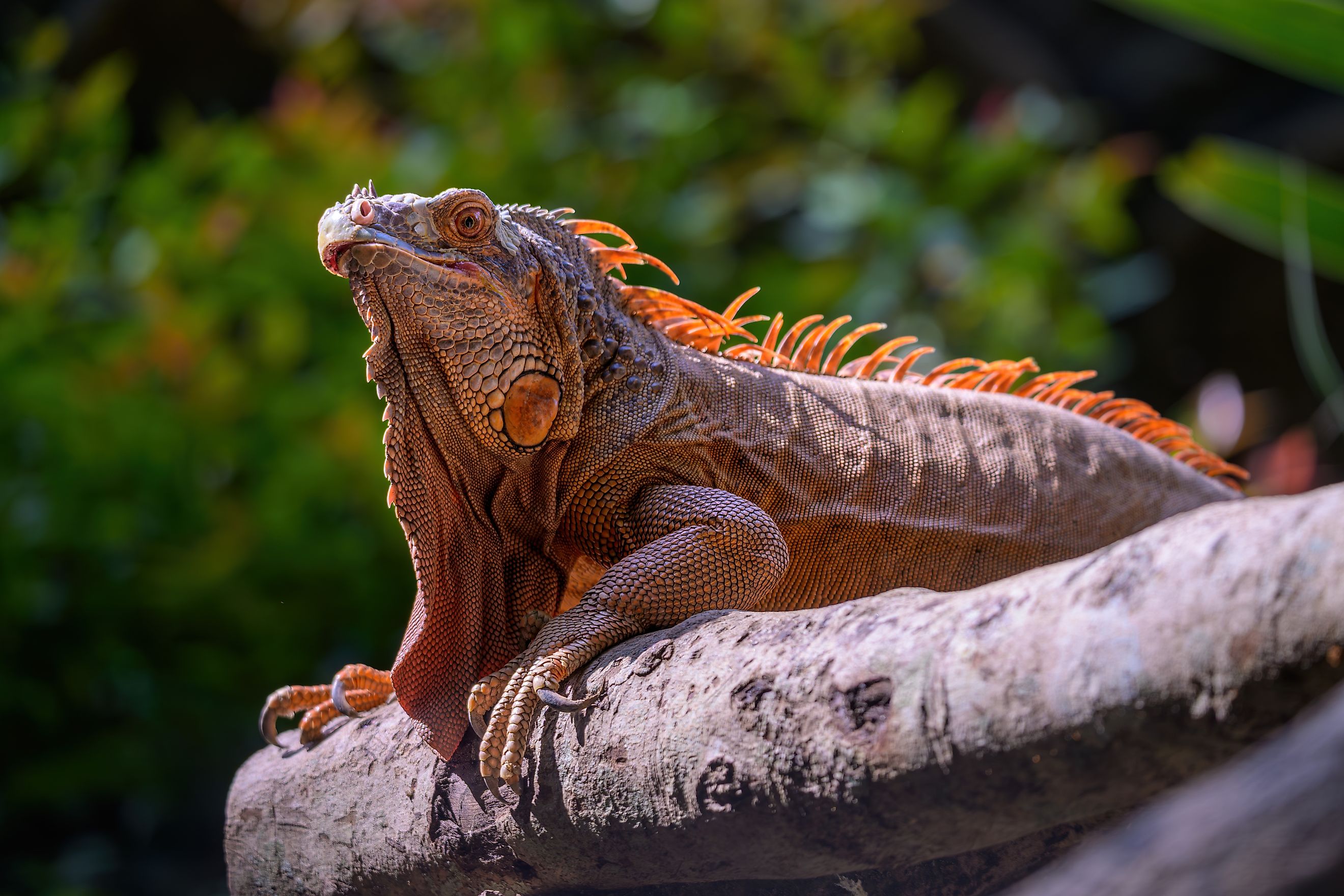
Why Iguanas Fall Out Of Trees In Florida Winters
Every few winters, a cold front sweeps into the Florida peninsula. The next morning, people in Miami, Fort Lauderdale, and the Palm Beaches find large green lizards lying still on sidewalks, driveways, and pool decks. Some have even fallen from the trees overnight. It looks like a mass casualty event, but most of these animals are still alive. These are green iguanas, tropical reptiles living far from their natural home, and their winter falls happen when their biology clashes with the occasional cold snap.
A Tropical Reptile in a Subtropical State

The green iguana (Iguana iguana) is not native to Florida. The species is native to Central America, tropical parts of South America, and some eastern Caribbean islands. It arrived in Florida through the exotic pet trade. Pet iguanas that escaped or were deliberately released have established breeding populations, and the subtropical climate of the southern and central parts of the state lets these large plant-eating lizards survive and reproduce. Today the animal is firmly established. Green iguana populations now stretch along the Atlantic Coast through Broward, Martin, Miami-Dade, Monroe, and Palm Beach counties, and along the Gulf Coast in Collier and Lee counties.
These are substantial animals, and the largest can exceed 6.6 feet (2 meters) in length and weigh up to about 13.2 pounds (6 kilograms). A falling iguana of that size is a genuine hazard to anyone standing below. The reason they are up in the trees in the first place is straightforward. Many of Florida's iguanas sleep in trees to avoid predators, and frost-stunned individuals plunge to the ground after losing their grip on the branches above.
The Physiology Behind the Fall

The core of the explanation is that iguanas are ectotherms, often called cold-blooded. They do not generate meaningful internal body heat and instead take their temperature from their surroundings. In a warm climate this works beautifully. During a cold snap it becomes a liability.
When frigid air plunges south into subtropical North America, temperatures across Florida can fall below 45 degrees Fahrenheit (7.2 degrees Celsius), rapidly lowering the body temperature and metabolic rate of resident reptiles and driving them into a state of dormancy. The lizard is not freezing in the literal sense of ice forming in its tissues. It is being shut down by the cold. As temperatures drop, the iguana's breathing slows and so does its metabolism, and this torpor causes it to lose muscle control. Because the animals live in trees, they fall out of them.
This immobility is best understood not as injury but as a survival response. The stunned state, known as torpor, is the iguana's natural defense against the cold, and it actually helps the animal conserve energy. Once the weather warms, the iguana can essentially snap out of it. That is why wildlife officials repeatedly caution the public that a motionless iguana on the ground is usually alive, not dead.
How Cold Is Cold Enough

Iguanas can enter a cold-stunned state when temperatures fall below 50 degrees Fahrenheit (10 degrees Celsius), with severe effects occurring below 40 degrees Fahrenheit (4 degrees Celsius) during winter events. At the upper end of that range the animals grow sluggish and clumsy. As the mercury keeps dropping, they lose coordination entirely and cannot hold their perch.
Body size makes a difference. A large iguana carries more thermal mass and cools more slowly than a small one, which buys it time. Larger iguanas hold heat longer, while smaller iguanas are more vulnerable during cold snaps, and not all of them recover even after temperatures rise. Duration is the other decisive factor. A single chilly night usually stuns without killing. A prolonged freeze is a different matter, because the longer and colder the exposure, the more rigid and unresponsive the animal becomes, and recovery grows less certain.
The urban landscape complicates things, but this often plays out in the iguana's favor. Concrete and asphalt absorb heat during the day and radiate it back at night, creating pockets that stay a few critical degrees warmer than the open air. Many iguanas also shelter in the burrows they dig along canals and seawalls, and animals underground often ride out a cold snap unseen. The ones that make the viral videos are largely those caught sleeping out in the trees.
Lessons From the 2010 Freeze

The benchmark event in living memory arrived in January 2010 when a roughly two-week cold snap with temperatures below 41 degrees Fahrenheit (5 degrees Celsius) killed off many iguanas, along with Burmese pythons and other invasive species that thrive in South Florida's subtropical climate. Unlike a brief overnight chill, this was a sustained assault. A United States Geological Survey study found that the combination of duration and extreme cold was the key factor, and the extended period of low temperatures caused widespread reptile death across South Florida.
Even so, the die-off did not solve Florida's iguana problem. Populations rebounded quickly after the 2010 freeze, and experts say short cold snaps do little to reduce invasive iguana numbers because reptiles have survival mechanisms that let them lower their metabolism and conserve energy. Enough adults survive in refuges, and enough eggs remain buried and protected, for the population to recover within a few seasons.
Are Florida's Iguanas Getting Tougher

The most intriguing scientific development came from a cold morning a decade later. On 22 January 2020, subtropical South Florida experienced an extreme cold episode during which air temperatures dropped below the lower thermal limit of resident lizard populations. A research team led by biologist James Stroud happened to hold a rare piece of baseline data. The team had already measured the critical thermal minima of six co-occurring tropical and subtropical lizard species in Miami between October and November 2016, giving them a before-and-after comparison that is very hard to obtain in the wild.
The critical thermal minimum refers to the lowest temperature at which a lizard can still turn itself upright after being flipped onto its back. Below that point, the animal is functionally helpless. The pre-2020 measurements spanned a notable range across species. Different lizards in Miami tolerated temperatures between about 46 and 52 degrees Fahrenheit (8 to 11 degrees Celsius) before being stunned by cold.
What the researchers found after the freeze surprised them. The lizard community had converged on a lower tolerance, with all of the species able to withstand temperatures down to roughly 42 degrees Fahrenheit regardless of their previous ability to handle cold. The shift was not a fleeting reaction either. The new, lower thermal limits remained consistent when the team re-sampled the animals ten weeks after the cold event. The findings were published in the journal Biology Letters.
Crucially, the scientists stopped short of claiming the iguanas had evolved. The shifts toward tolerating significantly lower temperatures were so large that the team found it unclear whether natural selection was responsible, leaving open the question of how exactly the change was accomplished. The alternative explanation is physiological acclimation, a within-lifetime adjustment rather than an inherited one. The distinction is not academic. It speaks to whether tropical, cold-blooded animals can withstand the sharp temperature swings that a changing climate is expected to deliver more often.
What It Means for Florida
Residents are advised to leave cold-stunned iguanas alone or handle them very carefully, since these animals can quickly recover and defend themselves with their claws, teeth, and strong tails. For the state, each freeze is seen as a chance to act, not a permanent solution. In early 2026, during a cold snap, Florida wildlife managers used the situation to their advantage. The Florida Fish and Wildlife Conservation Commission issued a temporary order that let people collect cold-stunned green iguanas without a permit. As a result, more than 5,000 of these invasive lizards were removed in just two days.
A falling iguana is more than just a strange winter sight. It shows how a tropical species is reaching the edge of what it can handle, reminds us how ectotherms work, and serves as a real-time example of how quickly animals can adapt when the climate changes.