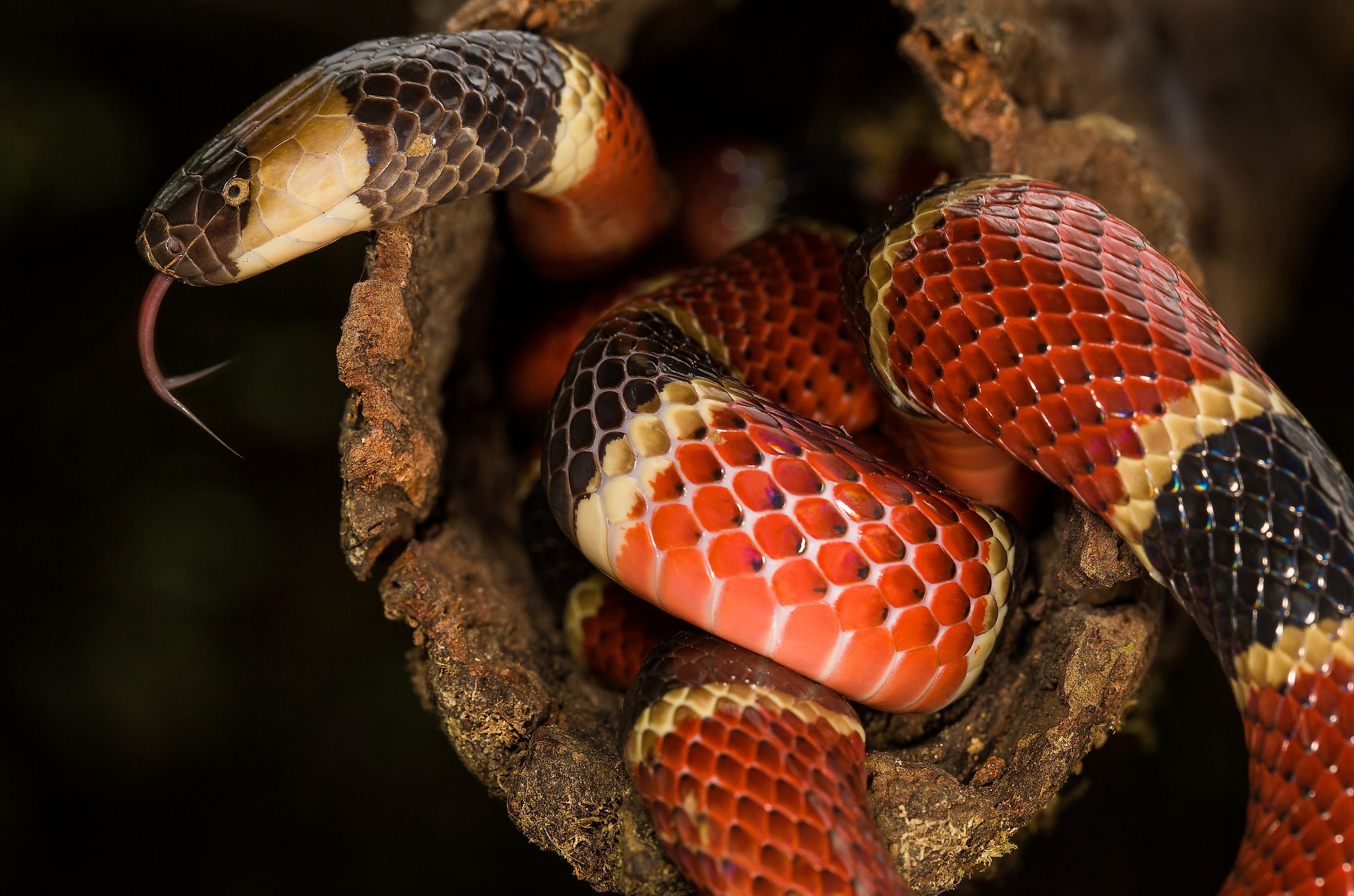
Coral Snake
Coral snakes comprise more than 100 venomous species primarily distributed across the Americas, although they are also found in parts of Asia and Africa. Despite their broad range, they are highly reclusive and rarely seen because they spend much of their lives concealed. When spotted, however, their most recognizable feature is a pattern of red, yellow or white, and black bands, a warning signal linked to their potent neurotoxic venom.
Highly diverse, most species inhabit forests, scrublands, grasslands, and tropical or subtropical environments with abundant ground cover. In these landscapes, they feed primarily on other reptiles, particularly small snakes and lizards, although some species also consume amphibians. Though often feared, coral snakes play a steady ecological role as predators within these systems.
Taxonomic Classification

Coral snakes belong to the family Elapidae, a group of venomous snakes that also includes cobras, mambas, kraits, and sea snakes. Within this family, what are known as "New World coral snakes" are classified primarily in the genus Micrurus, while a smaller number belong to Micruroides and Leptomicrurus. More than 80 species are currently recognized across the Americas, ranging from the southern United States through Central America and into South America. The best-known North American species is the eastern coral snake (Micrurus fulvius), found mainly in the southeastern United States.
Taxonomists continue to revise classifications of coral snakes as genetic studies reveal previously unrecognized relationships between various populations. Modern DNA analysis has helped greatly to clarify species boundaries and evolutionary histories, even leading to the reclassification of several regional forms in recent decades. Often compared to pit vipers, coral snakes are also distinguished by their fixed front fangs and their potent neurotoxic venom, which affects the nervous system rather than causing the extensive tissue damage often associated with viper bites.
Physical Description

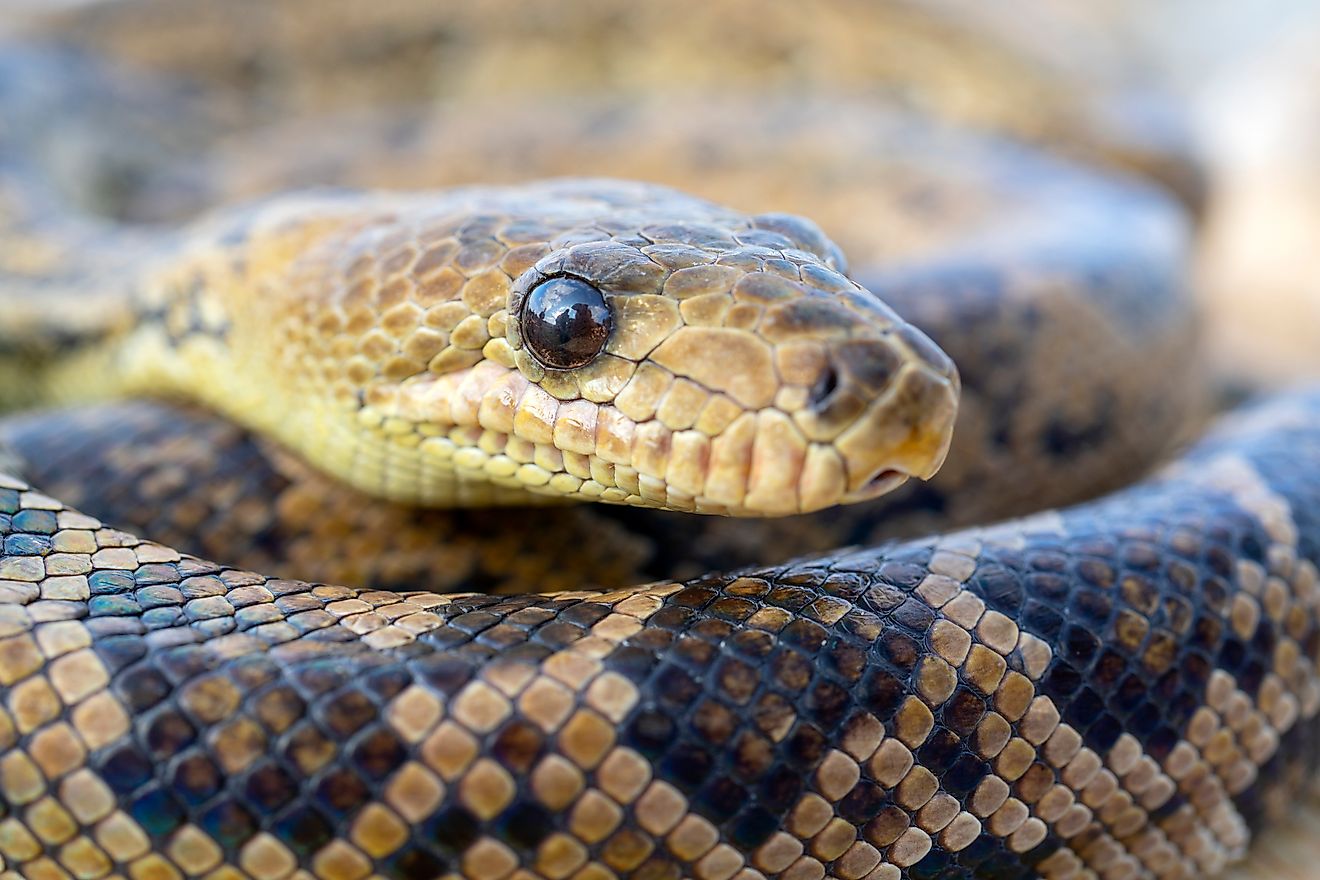
Visually standing out among most kinds of snakes, coral snakes are slender, smooth-scaled reptiles known for their striking color patterns. While coloration varies among both species and populations, the remarkably bright contrast of their stripes is a defining characteristic throughout much of the group. Most species display bands of red, yellow, white, and black that encircle the body, creating a highly visible warning signal to potential predators.
Adults are also generally smaller and more delicate in build than many other venomous snakes, with most measuring between 20 and 30 inches in length (51 to 76 cm), although some South American species, namely the Amazonian Coral snake, can grow closer to 60 inches. Their heads are relatively small and blend smoothly into the neck, too, giving them a streamlined appearance. Moreover, their tails are typically short and often display the same banded pattern as the rest of their bodies.
Range And Habitat

As mentioned, coral snakes occur throughout much of the Americas, with their distribution stretching from the southern United States to Central America and across large portions of South America. The greatest diversity is found in tropical or humid sub-tropical regions, particularly in countries such as Brazil, Colombia, Peru, and Ecuador, where numerous species occupy a variety of ecosystems. Although coral snakes are most diverse in the Americas, related species also occur in parts of Asia and Africa. In terms of the United States, coral snakes are limited primarily to the Deep South and Southwest, mostly inhabiting states such as Florida, Georgia, Texas, and Alabama, while the western coral snake is found in Arizona and portions of New Mexico.
They inhabit a broad range of biomes within these destinations, including pine flatwoods, hardwood forests, tropical rainforests, dry forests, scrublands, and grasslands. Most species prefer areas with abundant ground cover where they can remain concealed throughout large portions of the day. Leaf litter, fallen logs, burrows, and loose soil provide the bulk of this shelter, and areas with limited ground cover generally support lower densities of coral snakes because they provide fewer opportunities for shelter and foraging.
Behavior

These are secretive animals that spend much of their time concealed. Unlike many larger snakes that frequently bask in open areas, coral snakes tend to avoid exposure and are often active when conditions are cool or humid. Due to this, many coral snake species are most active at dawn, dusk, or during the night, although daytime activity can occur after rainfall. Coral snakes are also typically solitary and interact with others mainly during the breeding season.
Their movements are notably deliberate and unhurried, reflecting a lifestyle focused on hunting within tight spaces and overgrown vegetation. But when threatened, they usually attempt to escape rather than confront a potential predator. If cornered, coral snakes may hide their heads beneath coils of their body, raise or curl their tails, and engage in erratic movements to confuse attackers. Biting is generally a last-resort defensive response, and attacks on humans are exceedingly rare.
Diet

While many snakes rely heavily on rodents, birds, and different kinds of eggs, coral snakes commonly prey on smaller snakes, including earth snakes, blind snakes, and slender, easy-to-swallow species that share their habitats. Lizards also make up a significant portion of their diet, particularly skinks and small ground-dwelling species. Some coral snakes will consume frogs, salamanders, and occasionally the young of other vertebrates when the opportunity arises, too. By feeding on a variety of small vertebrates, coral snakes help regulate populations of reptiles and amphibians within the ecosystems they inhabit.
In order to first land a kill, they use their potent neurotoxic venom to immobilize prey. In contrast to delivering a strike and releasing the victim, they often maintain their grip while venom takes effect. This method is especially effective when subduing quick-moving reptiles that might otherwise escape before dying.
Reproduction

Coral snakes multiply through sexual reproduction, with most species being oviparous- laying eggs instead of giving live birth. Breeding typically occurs during the warmer months of the year, when males locate females using chemical scent trails. Courtship involves subtle, dance-like displays from the males, unlike aggressive combat seen in some other snake groups.
After mating, females lay clutches of eggs that usually number between 2 and 12, often in concealed locations such as fallen foliage, decaying logs, or underground burrows, where humidity and temperature keep stable. Clutch sizes can vary by species.
Coral snakes provide practically no parental care after laying eggs, leaving the embryos to develop independently, and incubation lasts several weeks, depending on environmental conditions. Hatchlings then emerge fully venomous and capable of hunting small prey shortly after birth, though they remain vulnerable to predators during early life stages in the forested environments where they occur naturally.
Threats

The coral snake faces a combination of natural and human-related threats across its range. Habitat loss from agriculture, urban expansion, and resource extraction operations, mainly logging, reduces the forest floor and the density of foliage they depend on. The fragmentation of these places isolates populations, limiting gene flow and increasing vulnerability to local decline. Climate change also alters temperature and humidity conditions critical to egg incubation and prey availability.
Road mortality is another significant issue in some regions, particularly where roads cut through forest or scrub habitats. Because coral snakes are often mistaken for other venomous snakes, they are also frequently killed on sight by humans, despite their generally reclusive nature. In some areas, collection for the pet trade occurs, too, although it is less common than for other reptiles like bearded dragons and pythons. On the other hand, natural predators, including birds of prey and larger snakes, also take a toll, especially on juveniles.
Together, these pressures can reduce local populations and affect the long-term viability of some species. Although many assessed coral snake species are currently classified as Least Concern by the International Union for Conservation of Nature (IUCN), conservation status varies considerably across the group. Species with restricted distributions, such as the Critically Endangered Roatán coral snake (Micrurus ruatanus), are particularly vulnerable to habitat loss and other environmental pressures.
Importance for Ecological and Medical Studies

Coral snakes play a notable ecological role as predators within their typical tropical and subtropical ecosystems. They help regulate other animal populations, in their case, smaller reptiles and amphibians, particularly burrowing snakes and ground-dwelling lizards. But because they occupy a somewhat specialized niche and have a relatively narrow diet, coral snakes also serve as up-front indicators of ecosystem health in some regions, as numbers of amphibians and reptiles (or lack thereof) often correlate directly with these snakes' presence.
Their venom has also attracted scientific interest, particularly in neurological and pharmacological research. Compounds derived from coral snake venom have been studied for potential applications in pain management and nerve function disorders. Overall, coral snakes represent an important component of biodiversity. Protecting them supports broader conservation goals since their presence often signifies intact habitats with sufficient prey diversity, moisture levels, and vegetation that adjacent flora and fauna similarly need.