Where The Coral Snake Rhyme Stops Working
Every kid raised in coral snake country learns the same couplet: red touch yellow, kill a fellow; red touch black, friend of Jack. The rhyme is genuinely good, a piece of folk herpetology that correctly separates America's venomous coral snakes from their harmless banded lookalikes, and generations have used it to walk away calmly from kingsnakes. It also comes with an expiration map that almost nobody teaches alongside it. The rhyme's warranty is valid, roughly speaking, inside the United States and nowhere else; it collapses completely a step south of the border, where venomous coral snakes wear every pattern the rhyme calls safe; it throws false alarms in the Arizona desert; and it fails even at home when a snake skips its own dress code or a hiker's memory swaps the colors. This is the field guide to the fine print, which is to say, a tour of where the most famous safety rhyme in American nature quietly stops working.
Why The Rhyme Works At All

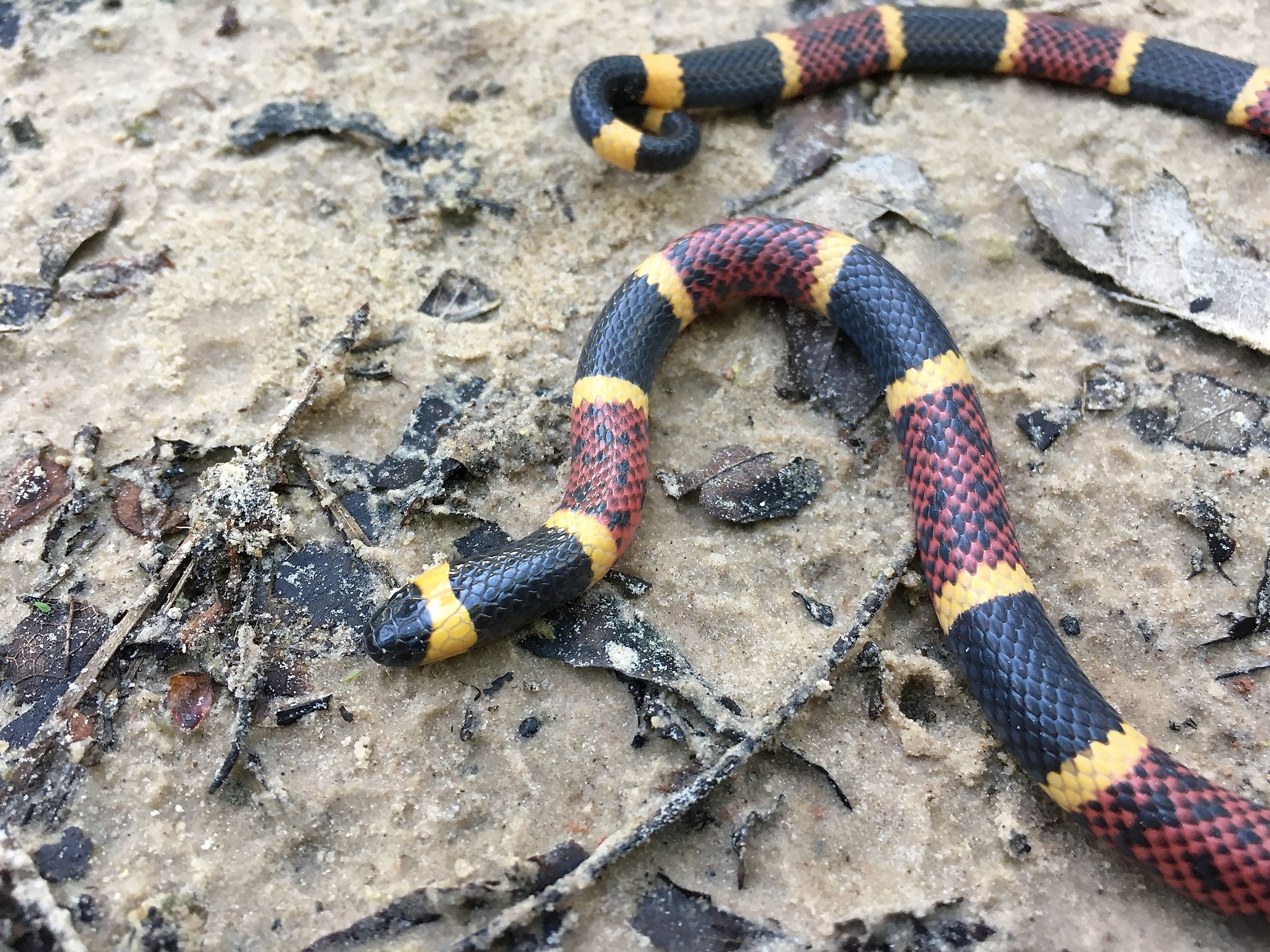
The United States hosts three coral snakes, the eastern coral snake of the Southeast, the Texas coral snake of the south-central states, and the small Sonoran coral snake of the desert Southwest, and all three happen to wear the same uniform: red and black bands separated by narrow rings of yellow or white, so that red always touches yellow. Their famous lookalikes, the scarlet kingsnake, the milk snakes, and the scarlet snake, wear the colors in a different order, red bordered by black, and that lucky consistency is the entire engineering of the rhyme. In the US, as a matter of pattern, it simply works.

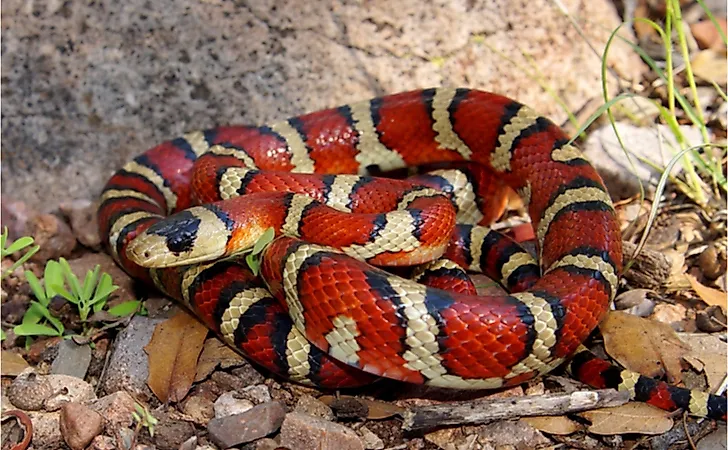
The lookalikes exist because the costume pays. The resemblance is a textbook case of Batesian mimicry, harmless species evolving to advertise a danger they do not possess, since a predator that avoids anything in coral colors spares the mimics along with the models. The milk snakes and kingsnakes are freeloading on the coral snake's reputation, and the rhyme is humanity's workaround, a cheat code for reading the forgery. The trouble is that the cheat code was written for one country's snakes.
The Warranty Expires At The Rio Grande

Cross into Mexico and keep going, and the rhyme does not merely weaken; it inverts into a hazard. Latin America is the coral snake family's true kingdom, home to dozens upon dozens of species against the US's three, and their wardrobe ignores the North American rules entirely: there are dangerously venomous coral snakes whose red bands touch black, corals with no red at all, bicolored corals in black and white or black and yellow, and species whose bands run incomplete or whose colors vary within a single population. A traveler applying the childhood rhyme in Costa Rica or Brazil can talk themselves into handling a lethal snake that the rhyme just certified as a friend of Jack.
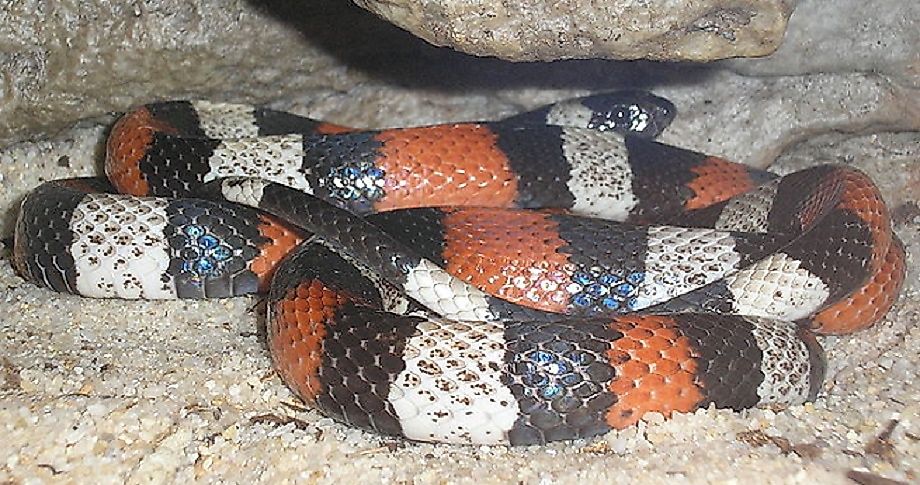
The mimics complicate the far side of the ledger too, with tropical milk snakes and false corals wearing every arrangement of the same three colors, some matching their local venomous models band for band. Herpetologists working in the American tropics state the rule without ceremony: south of the US border, no color shortcut distinguishes a coral snake from its imitators, and the only safe policy is treating every red-black-and-yellow snake as off-limits. The rhyme is not folk wisdom there. It is a US regional product that should never have been exported.
The Desert's False Alarms

Inside the US, the rhyme's shakiest territory is the Southwest, and the problem runs in the opposite, more forgiving direction: false positives. The deserts of Arizona and New Mexico are home to small, harmless ground snakes, shovel-nosed snakes, and sand snakes whose banding plays loose with the rulebook, with some western shovel-nosed snakes carrying red saddles that reach or crowd their pale yellow bands, flunking the rhyme despite being as dangerous as a shoelace. A strict rhyme-reader in the Sonoran Desert will occasionally sentence an innocent snake, which matters because frightened people kill snakes the rhyme condemns.

The genuine article out there, the Sonoran coral snake, does wear regulation colors, but it is a shy, pencil-thin burrower under a foot and a half long whose bite, while medically significant, has never been recorded killing anyone, and which surfaces mostly on summer nights after rain. The desert's honest summary: the rhyme still identifies the real coral correctly, but it also flags harmless neighbors, and the region's snake identification runs better on shape and size than on the couplet.
The Exceptions At Home

Even in the rhyme's home range, biology declines to sign a guarantee. Coral snakes, like all animals, occasionally produce aberrant individuals, and the records include melanistic eastern corals gone nearly patternless black, albinos with the warning colors washed out, and snakes whose bands fuse, break, or misalign until the famous sequence is unreadable, each one a venomous snake the rhyme cannot score. Such individuals are rare, documented curiosities rather than a common hazard, but they exist in exactly the encounters where someone is leaning hardest on a memorized couplet.
The commonest failure at home, though, is not the snake's error but the reader's. The rhyme survives in the wild in a dozen mutated versions, red touches black venom lack, yellow kills a fellow, red and yellow deadly fellow, and surveys of what people actually recall find the colors routinely swapped, reversed, or mangled under stress, which converts a decent mnemonic into a coin flip at the worst possible moment. A safety rule that must be remembered perfectly to work at all is, in human hands, a fragile tool.
What The Mimicry Science Adds

The deeper reason the rhyme was always going to be a local product comes from the evolution of mimicry itself. Researchers studying scarlet kingsnakes have shown that the forgery is sharpest where the real coral snakes live or recently lived, with mimics near the model's range matching its ring widths closely while populations far from any coral drift toward sloppier costumes, since nothing punishes a bad fake where no predator ever learned the original. Mimicry, in other words, is a local negotiation between models, mimics, and predators, run separately in every region.
That is precisely why no universal color rule can exist: each coral snake species and its local imitators settle on their own uniform, and a rhyme summarizing one region's settlement describes nothing beyond it. The US couplet works because three American corals happened to converge on one pattern, a regional coincidence that the rest of the hemisphere never agreed to.
The Rules That Travel

So what should replace the rhyme where it fails? The advice herpetologists give works on every continent and requires no color wheel: never pick up a banded tricolor snake, anywhere, period, since no coral snake can envenomate a person who stays a step away; coral snakes are retiring burrowers that bite almost exclusively when handled, and the US's tiny annual count of coral bites is dominated by people who grabbed one on purpose. A photo from distance will get a confident identification from any local wildlife resource faster than a couplet recited over a moving snake.
The rhyme can stay in the toolkit at home, used for what it does well, telling a watching hiker in Georgia that the banded beauty on the trail is a kingsnake, and retired from every job beyond that. The universal version fits in six words and never fails anywhere: if you do not know, let it go.
A Local Poem For Local Snakes

So the coral snake rhyme stops working at the Rio Grande, where dozens of Latin American corals wear the forbidden patterns; it wobbles in the Arizona desert, where harmless shovel-nosed snakes flunk a test they never took; and it carries an asterisk even in Georgia and Texas, where aberrant corals and misremembered verses can beat it. None of that makes the rhyme worthless, only regional, a good local poem about three well-dressed American snakes that was never written to survive translation. Learn it, enjoy it, and staple the fine print to it: the couplet identifies coral snakes in one country, and keeping your hands to yourself identifies them in all of them.