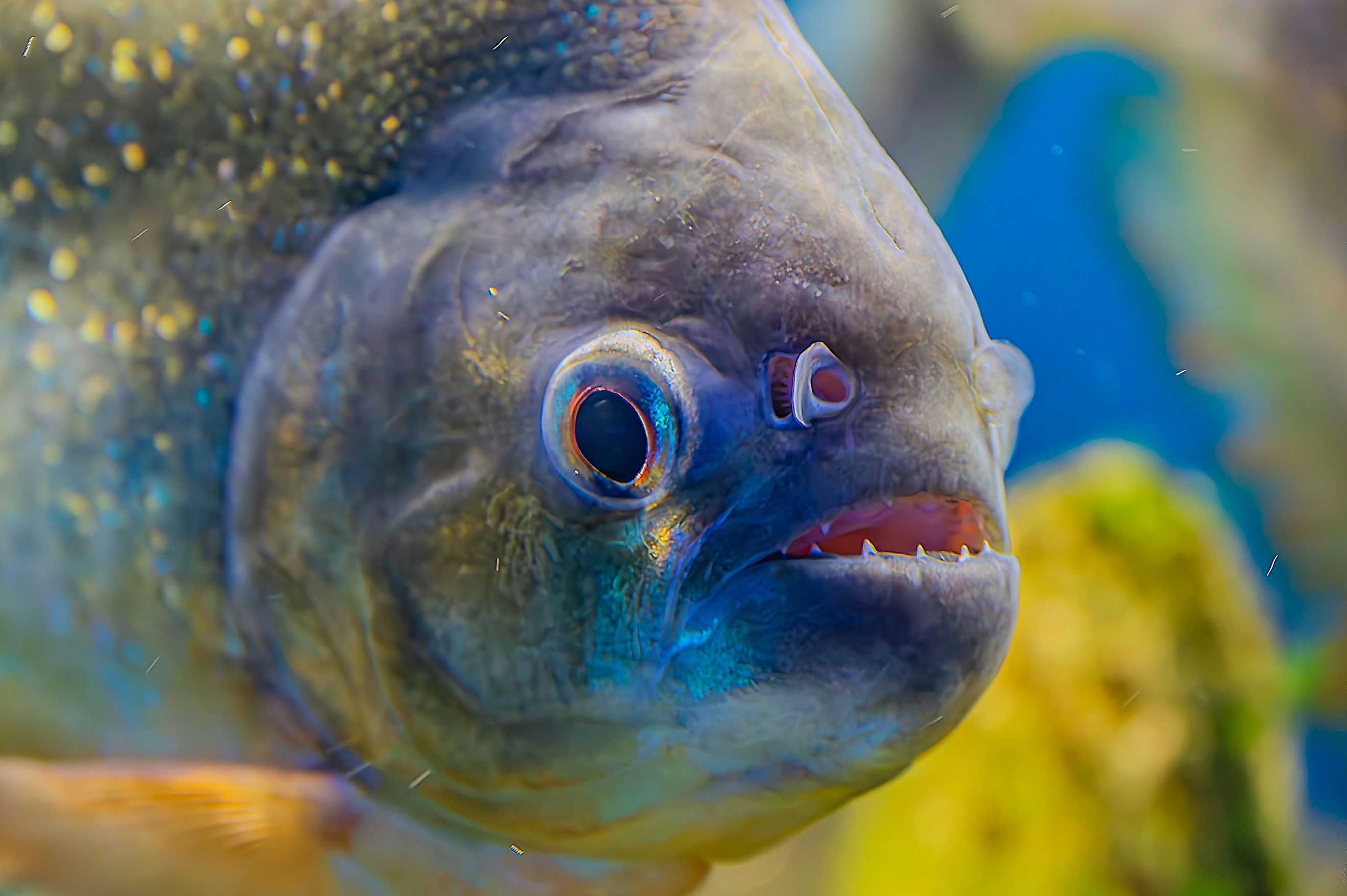
Piranha
The black piranha has the strongest bite relative to body size of any living animal, yet piranhas as a group kill far less often than their reputation suggests. These South American freshwater fish are opportunistic feeders that scavenge more than they hunt, and most of the roughly 30 to 60 recognized species pose little threat to people. The gap between what piranhas actually do and what films and folklore claim they do is one of the widest in the animal world.
Piranhas belong to the subfamily Serrasalminae, part of the family Serrasalmidae, which also contains the plant-eating pacus and silver dollars. They live only in the rivers, floodplains, and lakes of tropical South America, east of the Andes. Their name traces to a serrated keel that runs along the belly, and their most studied feature is a jaw built to shear flesh, scales, and in some species fruit and seeds.
This profile covers the group broadly, then draws on well-documented species such as the red-bellied piranha (Pygocentrus nattereri) and the black piranha (Serrasalmus rhombeus) to show how varied these fish really are.
Taxonomic Classification

Piranhas are ray-finned fish (class Actinopterygii) in the order Characiformes, the group that also holds tetras and hatchetfish. Within that order they sit in the family Serrasalmidae, a Neotropical family of around 90 to 100 valid species across roughly 16 to 17 genera, which includes pacus, piranhas, and the large tambaquis. The family name means "serrated salmon family," a reference to the saw-edged keel along the belly of these fish.
Not every serrasalmid is a piranha. Most authorities classify the "true" piranhas into four genera, which include Pygocentrus, Serrasalmus, Pristobrycon, and Pygopristis. The exact species count is contested because juveniles are hard to link to adults and genera are difficult to diagnose, so published totals span roughly 30 to more than 60 depending on the author. The genus Pygocentrus holds the "true" or "red" piranhas, including the red-bellied piranha (Pygocentrus nattereri) and the piraya (Pygocentrus piraya) of Brazil's São Francisco basin. The genus Serrasalmus contains many smaller species collectively called pirambebas.
Molecular work continues to reshuffle the group, and some genera remain unresolved. One outlier is the wimple piranha (Catoprion mento), a scale-eater whose two rows of upper teeth set it apart, which is why many specialists do not count it as a true piranha. The family also has a notable fossil member, the extinct Miocene giant Megapiranha paranensis, known from a single fragment of upper jaw found in Argentina.
Physical Description

Piranhas have a deep, laterally compressed body shaped like a rhombus, a blunt head, and a heavy lower jaw. Most species stay under about 2 feet (60 cm), and the majority fall between 6 and 13 inches (15 to 33 cm). The red-bellied piranha reaches roughly 13 inches (33 cm) and about 3 pounds (1.4 kg). The black piranha is one of the largest, with specimens exceeding 20 inches (51 cm).
The defining feature is the dentition. True piranhas carry a single row of triangular, tricuspid, serrated teeth that interlock with their neighbors, forming a continuous cutting edge that regenerates as a full row rather than tooth by tooth. This design produces a clean, scissor-like bite that removes bite-sized pieces of flesh, fin, or scale.
Coloration varies by species, age, and location. The red-bellied piranha is silver-gray with a red to orange throat and belly, a color that intensifies in mature adults. The black piranha is gray to nearly black and is marked by red eyes, which give it the alternate name redeye piranha. Sexual dimorphism is subtle in most species, though females are often larger and less brightly colored than males.
Range and Habitat

Piranhas are native only to freshwater habitats in South America, east of the Andes. Their combined range spans the Amazon, Orinoco, Paraguay-Paraná, São Francisco, and Essequibo basins, plus the coastal rivers of northeastern Brazil and the Guianas. The red-bellied piranha alone ranges across latitudes between about 9 degrees north and 34 degrees south.
They occupy rivers, streams, floodplain lakes, and seasonally flooded forest. The red-bellied piranha favors whitewater rivers and is largely absent from blackwater systems. Preferred conditions run to a pH of about 5.5 to 7.5 and water temperatures near 73 to 81 degrees Fahrenheit (23 to 27 degrees Celsius). Seasonal flooding drives much of their movement, feeding, and breeding, as rising water opens up submerged vegetation and new foraging grounds.
Piranhas have been introduced outside their native range through the aquarium trade, and populations occasionally turn up in waters far from South America. These introductions are usually short-lived or actively removed. One Serrasalmus species established a breeding population in a pond in southern Florida before being eradicated in 1977.
Diet

Most piranhas are omnivores, and biologists often describe them as opportunistic carnivores rather than pure predators. Their diet includes fish, insects, crustaceans, worms, and carrion, alongside seeds, fruit, and other plant matter. Young piranhas take smaller prey such as copepods, crustaceans, and insects. Some species lean heavily toward plants, and a few subsist largely on them.
Much of what piranhas eat is taken without killing the source. Several species specialize in nipping the fins and scales of larger fish, tissue that heals and regrows, which makes prey a renewable resource. The wimple piranha is an extreme example of this specialization, feeding primarily by biting scales from other fish in a strategy known as lepidophagy. Across most species, scavenging on dead or dying animals outweighs active predation, though piranhas are strongly drawn to the smell of blood.
Feeding intensity depends on food supply. A red-bellied piranha consumes roughly one-eighth of its body mass per day under normal conditions. When water levels drop and prey concentrate in shrinking pools, competition rises, and piranhas will take chunks from larger animals or even from other piranhas. The dramatic "feeding frenzy" is real but uncommon, and it is tied to scarcity rather than to any constant appetite for large prey.
Behavior

Piranhas are often seen in groups, called shoals, and this behavior is widely misread. Field and experimental research on the red-bellied piranha indicates that shoaling functions mainly as defense against the animals' own predators, not as cooperative hunting. In one study, piranhas in shoals of eight recovered their resting breathing rate faster after a simulated predator attack than fish in shoals of two, evidence that grouping reduces individual risk and stress.
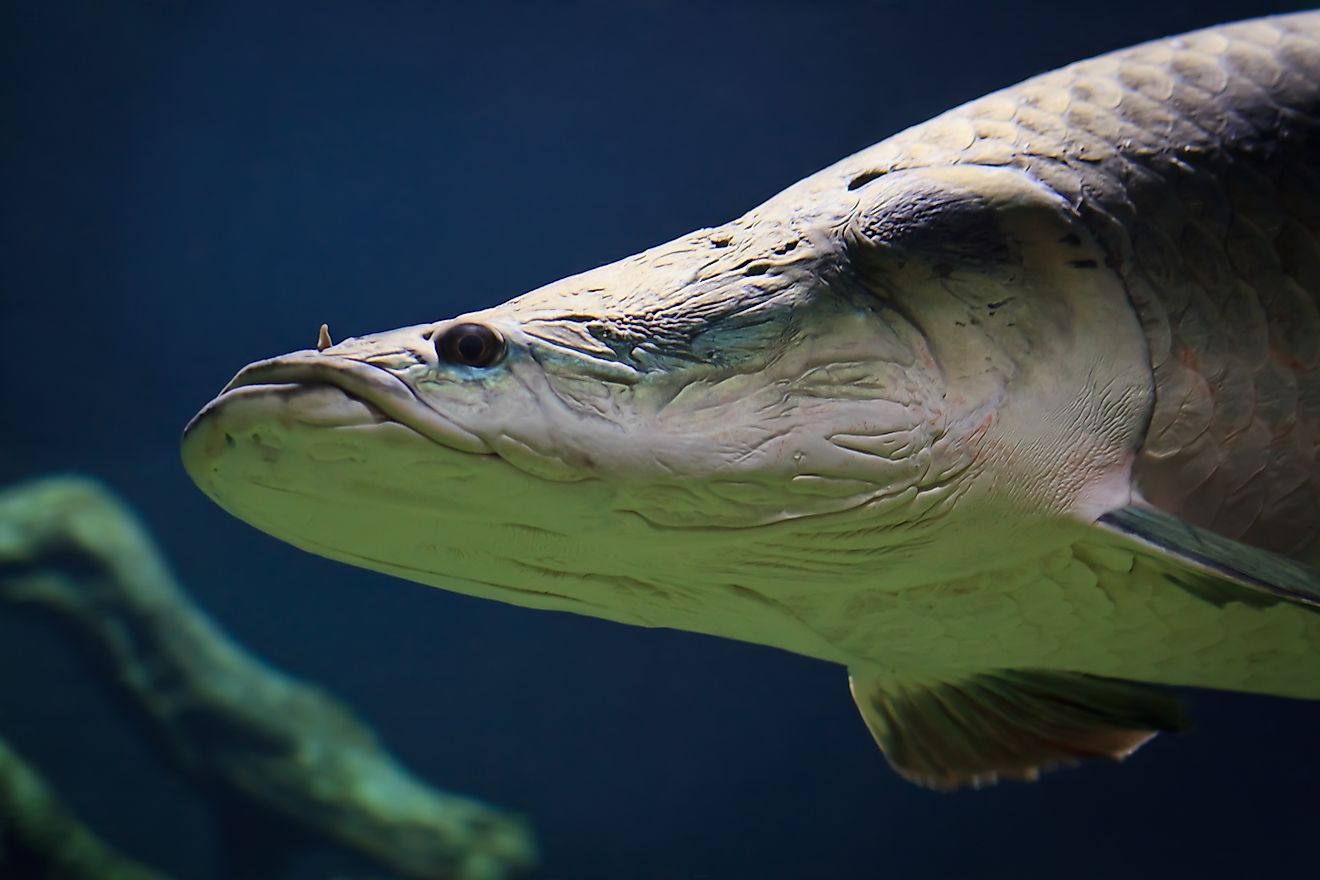
Those predators are numerous. In the flooded forests of the Amazon, piranhas are hunted by caimans, river dolphins, large piscivorous fish such as the arapaima, and wading birds. Grouping also helps in the low-water season, when crowding into oxygen-poor pools raises predation risk. Within a shoal, larger, sexually mature fish tend to occupy the protected center while smaller individuals feed at the edges.
Activity shifts with size and time of day. Larger red-bellied piranhas are most active at dawn and dusk, often ambushing prey from vegetation, while smaller fish forage during daylight. Piranhas also communicate with sound, producing barks, croaks, and drumming noises using the swim bladder, and these calls sometimes accompany aggressive interactions. Studies of shoaling behavior found no clear evidence of the constant cannibalism their reputation implies.
Reproduction

Breeding is closely linked to the seasonal flood cycle. As rains raise water levels and flood marginal vegetation, piranhas move into shallow, plant-rich areas to spawn. In the red-bellied piranha, males excavate bowl-shaped nests roughly 6 inches (15 cm) across in the substrate among submerged grasses, then guard the eggs and developing young. Some populations breed twice a year, and females in certain river basins spawn more than once within a single season.
Parental care from the male, unusual among the fish most people associate with pure aggression, improves survival of the eggs and fry. Juveniles grow quickly where food is plentiful. Lifespan in the red-bellied piranha reaches about 10 years or more, with the longest documented ages coming from captive fish.
Importance to the World

Piranhas are a working part of South American river ecosystems. As scavengers, they consume dead and dying animals and help recycle organic matter, which keeps waterways from accumulating carrion. As predators, they regulate populations of smaller fish, and as prey they support caimans, dolphins, large fish, and birds. Their fin- and scale-cropping habits shape the behavior and defenses of the species they feed on.
The broader Serrasalmidae family also contributes to seed dispersal, though that role belongs mainly to the fruit-eating pacus and tambaquis rather than to the flesh-eating piranhas. Economically, piranhas are a subsistence and commercial food fish across much of their range, caught in quantity by local fishers. Their teeth have long been used as cutting tools by Indigenous peoples of the Amazon, and the red-bellied piranha is a staple of the ornamental aquarium trade.
Threats and Conservation

The best-studied piranha species are not currently in danger. The red-bellied piranha, black piranha, and piraya are all assessed by the IUCN as Least Concern, and several are locally abundant. There is no family-wide conservation crisis, but the picture is uneven, because many serrasalmid species have never been formally evaluated and basic life-history data are missing for most of them.
The clearest broad threat is habitat degradation. Deforestation in the Amazon, damming, and alteration of river systems reduce the flooded forest and floodplain habitat that piranhas depend on for feeding and spawning. Localized overfishing adds pressure in areas where piranhas are heavily harvested for food. Because so many species are data-poor, monitoring is the main conservation need, alongside protection of the intact river-and-floodplain systems that support the whole family.
Takeaway
Piranhas are far more varied and far less dangerous than their reputation allows. They are efficient scavengers, cautious shoaling fish that group together for their own safety, and in many cases part-time vegetarians. Their engineering, a self-sharpening row of interlocking teeth backed by outsized jaw muscles, is record-setting, but it is used far more often on carrion, fins, and seeds than on anything large. The well-known species remain secure for now, and the main task ahead is filling the data gaps on the many that are poorly studied while protecting the flooded-forest river systems that the entire family relies on.
Fun Facts

- Strongest bite for its size: A 2012 study measured an anterior bite force of about 320 newtons (roughly 72 pounds) in the black piranha, the strongest recorded for any bony fish and equal to about 30 times the fish's own body weight.
- The man-eater myth has an author: Theodore Roosevelt popularized the image of piranhas stripping a cow to the bone after locals staged a demonstration during his 1913 to 1914 South American expedition, using fish that had been penned and starved for days.
- A scale specialist: If it counts as a true piranha, the wimple piranha would be the smallest, surviving almost entirely by biting scales off other fish.
- An extinct giant: The Miocene Megapiranha paranensis is estimated to have bitten with a force between 1,240 and 4,749 newtons, enough to crush bone.
- They make noise: Piranhas bark, croak, and drum using the swim bladder, often during confrontations with other fish.
Quick Facts
- Grouping: Subfamily Serrasalminae (family Serrasalmidae)
- Order: Characiformes
- Representative species: Red-bellied piranha (Pygocentrus nattereri); black piranha (Serrasalmus rhombeus)
- IUCN status: Best-known species assessed as Least Concern
- Length: Most under 2 feet (60 cm); black piranha to about 20 inches (51 cm)
- Weight: Red-bellied piranha up to about 3 pounds (1.4 kg)
- Lifespan: About 10 years or more
- Diet: Omnivorous, opportunistic carnivore
- Range: Freshwater South America, east of the Andes