Kakapo
The kakapo is the heaviest parrot on Earth and the only member of its family that cannot fly. This moss green, owl faced bird waddles across the forest floors of New Zealand at night, a survivor from an ancient world that has vanished almost everywhere else. It is one of the rarest birds alive, and its slow recovery from the edge of extinction ranks among the most closely watched conservation stories anywhere.
Native only to New Zealand, the kakapo evolved for millions of years in a land without ground dwelling mammal predators. That long isolation shaped an animal unlike any other parrot, large, flightless, nocturnal, and remarkably long lived. When humans and the predators they carried with them arrived, the very traits that had served the kakapo so well became fatal weaknesses. Today every surviving bird is known by name and tracked by a dedicated recovery team.
Taxonomic Classification

The kakapo carries the scientific name Strigops habroptilus, described by the ornithologist George Robert Gray in 1845. It belongs to the order Psittaciformes, which contains all parrots, but it sits within its own ancient lineage. Scientists place it in the superfamily Strigopoidea and the family Strigopidae, a group of New Zealand parrots whose only other living members are the kea and the kaka. Some authorities split those two birds into a separate family, Nestoridae. The genus name Strigops means owl face, a reference to the disc of fine feathers that rings the bird's eyes.
Genetic and fossil evidence suggests the kakapo split from other parrots very early, more than 30 million years ago, which makes it one of the most evolutionarily distinct birds in the world. It has no close living relatives outside its own small family. The common name comes from the Maori language and translates roughly as night parrot, a fitting description of a bird that spends its days hidden and its nights on the move. Because of that early divergence, the kakapo is often studied as a window into how island parrots evolved long before people reached the region.
Physical Description

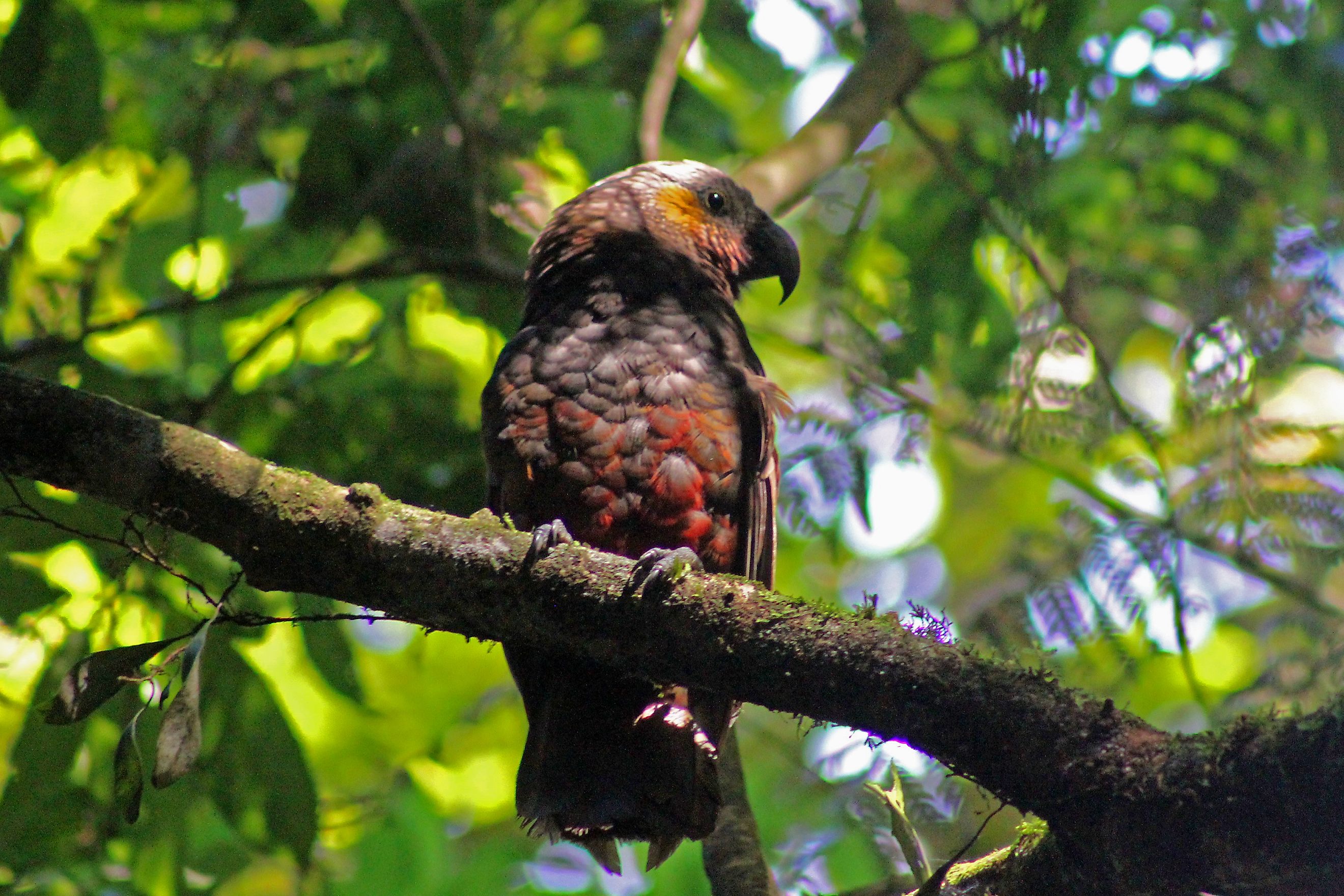
The kakapo is built like no other parrot. Males can reach about 25 inches (64 cm) in length and weigh up to roughly 9 pounds (4 kg), which makes the species the heaviest parrot in the world. Females are noticeably smaller, usually weighing around 3 pounds (1.5 kg). For comparison, the largest flying parrot, the hyacinth macaw, tops out well below the weight of a large male kakapo. That heft is part of what keeps the bird grounded.
Its plumage is a soft moss green mottled with black, brown, and yellow, a pattern that blends almost perfectly into the leaf litter and undergrowth of a native forest. The face is flat and framed by a disc of delicate feathers, giving it a strong resemblance to an owl. A pale, stout bill and sturdy gray legs complete the look.
Because the kakapo does not fly, its body has changed in telling ways. Its wings are short and weak, useful mainly for balance and for cushioning a clumsy jump down from a tree. The breastbone lacks the deep keel that anchors the powerful flight muscles of other birds, and the wing muscles themselves are much reduced. Scientists describe this as a classic case of island gigantism, in which animals living on islands with few predators and steady food tend to grow larger and shed the costly ability to fly.
Range and Habitat

Before people arrived, the kakapo lived across much of New Zealand. It ranged through northern forests and southern ranges alike, turning up in habitats as different as coastal scrub and subalpine tussock. It favored dense native forest where it could feed and hide, but it proved adaptable to a wide band of country. That broad former range has now collapsed to a small handful of carefully guarded sites.
Every living kakapo today resides on a small number of predator free islands in the far south of the country, along with a fenced mainland sanctuary. The main strongholds are Whenua Hou (Codfish Island), Pukenui (Anchor Island), and Te Kakahu (Chalky Island). These rugged, remote places were chosen because they can be kept clear of the rats, stoats, and cats that devastate the species elsewhere. Spreading the birds across separated islands also spreads the risk, so that a single disease outbreak or disaster cannot wipe out the entire population at once.
Diet

The kakapo is entirely herbivorous, feeding on fruits, seeds, leaves, buds, roots, and rhizomes from a wide range of native plants. It has a distinctive way of eating. Rather than swallowing tough foliage whole, the bird grips a leaf or stem in its bill and chews out the nutritious juices, leaving behind a small ball of fibrous material still attached to the plant. These chewed remains are a reliable sign that a kakapo has been feeding in an area.
One plant matters more than any other to the species. The fruit of the rimu tree, a tall native conifer, is rich in the nutrients female kakapo need to raise young. The bird's entire breeding cycle is tied to the boom and bust fruiting of this tree, a link that shapes the survival of the species in ways that reach far beyond simple nutrition.
Behavior

The kakapo is nocturnal and largely solitary, spending its days resting in cover and emerging after dark to feed and travel. It moves on foot, often covering long distances along well worn trails, and it climbs trees with surprising skill, using its bill and strong feet to haul its bulky frame up into the canopy. When it wants to come down, it typically half climbs and half parachutes to the ground with its stubby wings.
When startled, a kakapo tends to freeze and rely on its camouflage rather than flee. Against the native birds of prey it evolved alongside, this stillness worked well. Against introduced mammals that hunt by scent, it offers no protection at all, a mismatch that helps explain the steep decline of the bird. The kakapo is well known for being gentle and curious around people, a trait that has made it a favorite of conservationists but has also left it defenseless.
Reproduction

The kakapo has one of the most unusual breeding systems of any bird, and it is the only parrot known to use a lek. In a lek, males gather at traditional display grounds and compete to attract females, who visit only to mate and then leave to raise the young alone. Male kakapo dig shallow bowl shaped depressions in the earth, connected by cleared tracks that can run many yards, and they defend the best sites from rivals.
To advertise themselves, males inflate a special air sac in the chest and produce a deep, resonant booming call. This low sound can carry for several miles on a still night, and a single male may boom for hours after dark, night after night, across three or four months of the breeding season. A female drawn to a bowl mates with the winner, then departs to nest on her own.
Breeding does not happen every year. Female kakapo generally nest only when the rimu tree produces a heavy fruit crop, an event known as masting that occurs once every two to four years. A female lays one to five eggs and usually manages to fledge a single chick. Birds mature slowly, with males often not breeding until their teens, and the species is thought to live for 60 to 90 years, with some estimates suggesting that individuals may approach a century. That long life is one reason a small population can persist while recovery efforts slowly rebuild its numbers.
Conservation and Importance

The kakapo is listed as Critically Endangered on the IUCN Red List, and its recovery is one of the most intensive conservation programs anywhere. The population fell to roughly 51 birds in the mid 1990s, at which point the species was effectively extinct in the wild and confined to managed islands. Under the Kakapo Recovery Programme, run by New Zealand's Department of Conservation together with the Maori iwi Ngai Tahu, numbers have climbed back into the low hundreds. By early 2026 the population stood at around 240 birds, though further gains still depend on the rimu tree's irregular mast years, which trigger breeding only once every few seasons.
Every bird carries a radio transmitter, nests are monitored around the clock, and staff step in with supplementary feeding, artificial insemination, and hand rearing when needed. The species still faces steep challenges, including low fertility, disease, and a narrow genetic base left by its population bottleneck. For Ngai Tahu the kakapo is a taonga, a treasured species with deep cultural meaning, and its fate carries weight far beyond biology. As a large fruit and seed eater, the kakapo also helped shape the native forests it once ranged across, dispersing seeds and cropping vegetation as it fed.
Takeaway
The kakapo is a living reminder of how strange and specialized life can become when it evolves in isolation. Everything about the bird, its bulk, its flightlessness, its nighttime habits, its booming courtship, and its extraordinary lifespan, reflects millions of years spent in a world without ground predators. That same specialization made it desperately vulnerable the moment that world changed. Its survival now rests almost entirely on human care, and each breeding season is watched with a mix of hope and caution. The slow climb from about 51 birds toward a self sustaining population shows what focused conservation can achieve, even as it underlines how much work still remains before the night parrot is truly safe.
Fun Facts

- Heaviest parrot alive. A large male can weigh up to about 9 pounds (4 kg), far more than any parrot that can still fly.
- Booming across the valley. A displaying male's low call can travel several miles on a calm night, produced by an air sac he inflates in his chest.
- Almost a century old. Kakapo are among the longest living birds, thought to reach 60 to 90 years, with a few possibly approaching 100.
- An owl in disguise. Its flat, feather ringed face gives it an owl like look and inspired the genus name, which means owl face.
- Every bird has a name. With so few left, each living kakapo is individually named and tracked by the recovery team.
- A famous character. A kakapo named Sirocco became a worldwide celebrity after an unforgettable on camera encounter with a wildlife film crew.
Quick Facts
- Common name: Kakapo (also called owl parrot or night parrot)
- Scientific name: Strigops habroptilus
- Family: Strigopidae (order Psittaciformes)
- IUCN status: Critically Endangered
- Length: up to 25 inches (64 cm)
- Weight: males up to about 9 pounds (4 kg), females around 3 pounds (1.5 kg)
- Lifespan: roughly 60 to 90 years, possibly up to 100
- Diet: herbivore, feeding on fruits, seeds, leaves, buds, and roots
- Range: New Zealand, on predator free islands and a fenced mainland sanctuary
- Population: about 240 in early 2026, up from a low of roughly 51 in the mid 1990s