Gelada
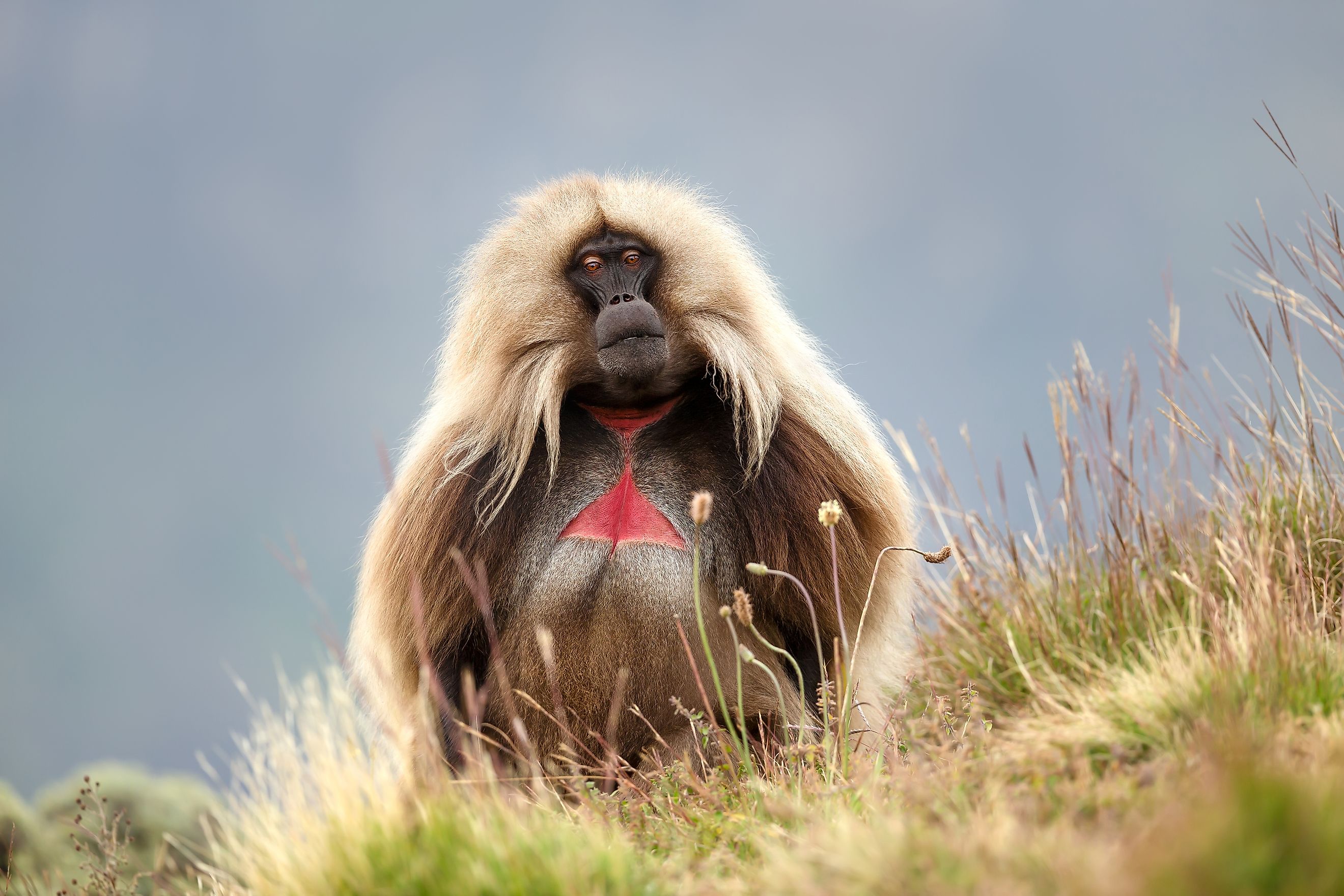
The gelada (Theropithecus gelada) is the only primate on Earth that lives almost entirely on grass, and it does so at some of the highest elevations any monkey calls home. Found only in the highlands of Ethiopia, this stocky, thick-maned Old World monkey grazes across cold mountain meadows by day and retreats to sheer cliff faces at night. Males wear a vivid, hourglass-shaped patch of bare red skin on the chest, a feature that earned the species its popular nickname, the bleeding-heart monkey.
Often called the gelada baboon, the animal is not a true baboon at all. It is the last survivor of a once-widespread group of grass-eating primates whose fossil relatives ranged across Africa and into Asia. Today the gelada endures in a narrow band of Afroalpine grassland, where its complex social life, constant chatter, and remarkable grazing adaptations make it one of the most studied and most unusual monkeys in the world.
Taxonomic Classification

The gelada belongs to the family Cercopithecidae, the Old World monkeys, and is the sole living member of the genus Theropithecus. The German naturalist Eduard Rüppell described the species in 1835. Its genus name comes from Greek words meaning beast-ape, a nod to the powerful build and formidable canines of adult males.
For much of the twentieth century, taxonomists grouped the gelada in with the true baboons of the genus Papio. Since 1979, researchers have placed it in its own genus, though genetic work continues to probe how closely the two lineages are related. What sets the gelada apart is clear enough in the field. Its shorter, higher muzzle looks more like a chimpanzee's than a baboon's, and the bright chest patch has no equivalent among Papio species.
Scientists currently recognize a northern gelada (Theropithecus gelada gelada) and a southern or eastern form (Theropithecus gelada obscurus), sometimes called Heuglin's gelada. A distinct population east of the Rift Valley, the Arsi gelada (Theropithecus gelada arsi), was proposed as a distinct form in 2016 and is treated as a conservation priority even though its formal status is still being worked out. Fossil members of the genus, including Theropithecus brumpti and Theropithecus oswaldi, grew far larger than the living species and once spread well beyond Ethiopia.
Physical Description

Geladas are large, robust monkeys built for a life spent sitting and grazing. They show strong sexual dimorphism, meaning males and females differ markedly in size. A male weighs roughly 40 pounds (18.5 kg) and can reach about 45 pounds (20.5 kg), while a female weighs closer to 24 to 28 pounds (11 to 13 kg). Head and body length runs about 27 to 29 inches (69 to 74 cm) in males and 20 to 26 inches (50 to 65 cm) in females, with a tufted tail adding another 12 to 20 inches (30 to 50 cm).
Dense fur covers the body in shades of brown and buff, paler on the underside and darker on the limbs. Adult males carry a long cape of hair across the back and shoulders that gives them a lion-like silhouette. The face is dark with pale eyelids that the animal can flash as a signal. Both sexes have the hourglass patch of bare skin on the chest, vivid red in males and duller in females. That patch works something like a mood ring, brightening with rising hormone levels. During estrus, a ring of fluid-filled blisters forms around a female's patch, a chest-based signal that stands in for the swollen rump seen in true baboons.
Two adaptations tie the gelada to its grazing life. Its fingers are short, strong, and unusually dexterous, well suited to plucking single blades of grass at speed. Beneath the rump sit thick pads of calloused skin over fat, called ischial callosities, that let the animal sit comfortably for hours while it feeds.
Range and Habitat

The gelada is endemic to Ethiopia, which means it lives nowhere else on Earth. Its range covers the grassy plateaus and deep gorges of the central Ethiopian Highlands, in regions such as Tigray, Gondar, Wollo, Shoa, and Arsi. The species occupies a striking vertical band, between about 1,800 and 4,400 meters above sea level (roughly 5,900 to 14,400 feet).
These are Afroalpine and sub-Afroalpine grasslands, cool high-country meadows dotted with widely spaced trees, thickets, and bushes and cut through by steep cliffs. The animals graze the open grassland during daylight and sleep on cliff ledges at night, where the rock offers protection from predators. Living high has advantages, including fewer competitors and fewer predators than the lowlands hold. The largest single stronghold is Simien Mountains National Park, home to a substantial share of the world's geladas. The historical range was wider, and suitable habitat has been shrinking as farms and settlements climb into the highlands.
Diet

No other primate eats the way the gelada does. Grass makes up close to 90 percent of its diet, a level of specialization found in no other monkey or ape. The animal eats both the blades and the seeds of grasses and tends to prefer the seeds when they are available. When grass grows scarce in the dry season, it digs up underground stems, rhizomes, and roots, and turns to herbs, flowers, and the occasional insect. Where farmland meets gelada country, the monkeys will also raid cereal crops.
A gelada feeds using a distinctive shuffle. It squats on its haunches and slides its feet forward without standing, plucking grass with quick, precise pinches of its fingers and moving along the ground a few inches at a time. Its teeth are so effective at grinding tough vegetation that biologists have compared its chewing efficiency to that of a grazing zebra. This grinding, grass-heavy strategy allows large herds to feed side by side across a single mountain meadow.
Behavior

Geladas are diurnal, active through the day and asleep on cliffs by night. They are among the most terrestrial of all primates, second only to humans in how little time they spend in trees. Their society is built in tidy layers. The basic unit is a reproductive group, often called a one-male unit, made up of a single breeding male, several related females, and their young. Surplus and younger males live in bachelor bands. Units that share a home range gather into larger bands, and bands can come together into herds that number in the hundreds.
Communication is where geladas truly stand out. They are among the most vocal primates known, with a large repertoire of grunts, calls, and rhythmic lip-smacks that shift in tone and timing with the social moment. Some researchers regard this lip-smacking chatter as one of the closest analogs to human speech found in any nonhuman primate. Geladas also speak with their faces and bodies. A male flips his upper lip back over his nostrils to bare his gums and teeth in a threat known as the lip flip, and both sexes flash their pale eyelids to signal dominance. Mornings often begin with long grooming sessions that keep social bonds strong.
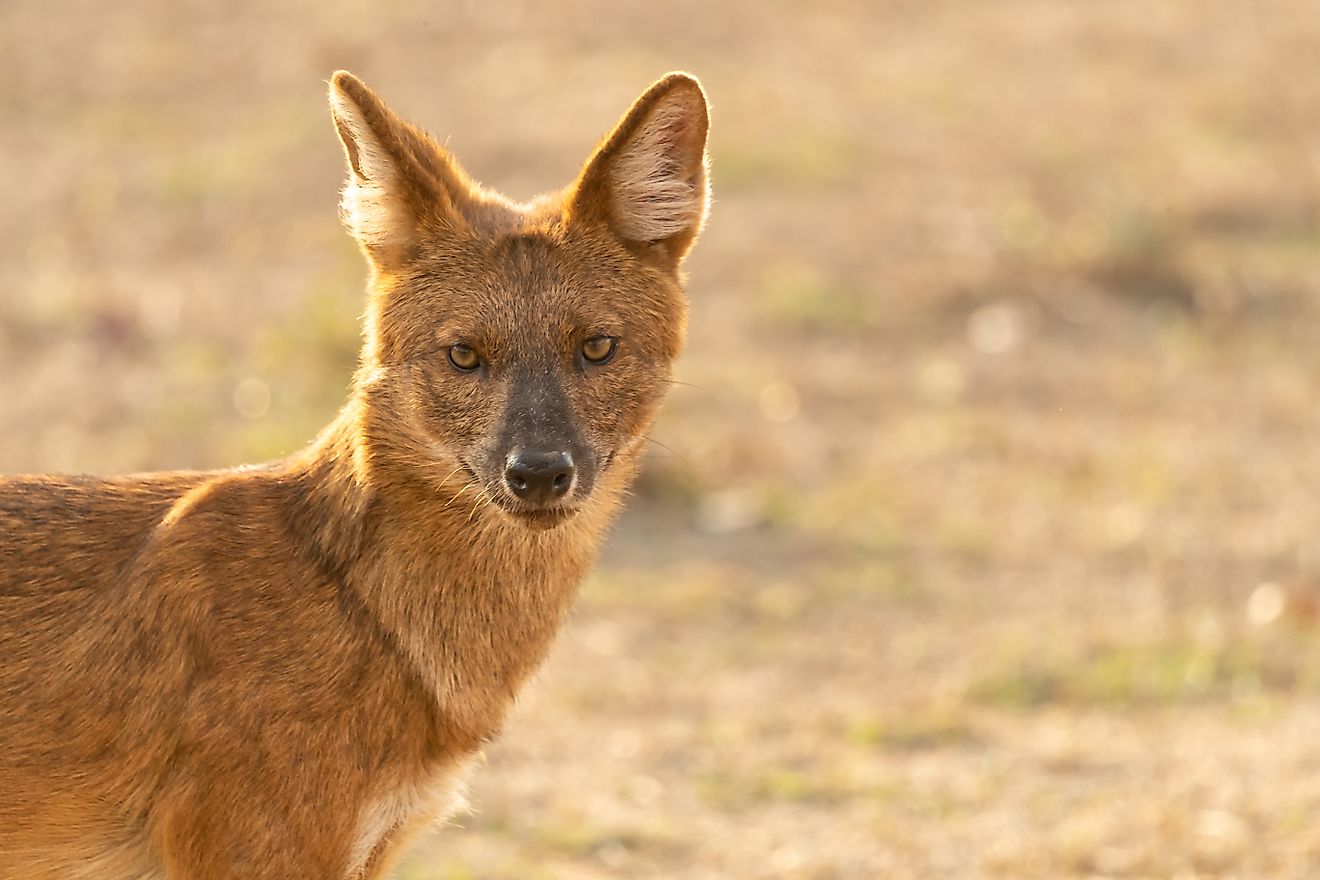
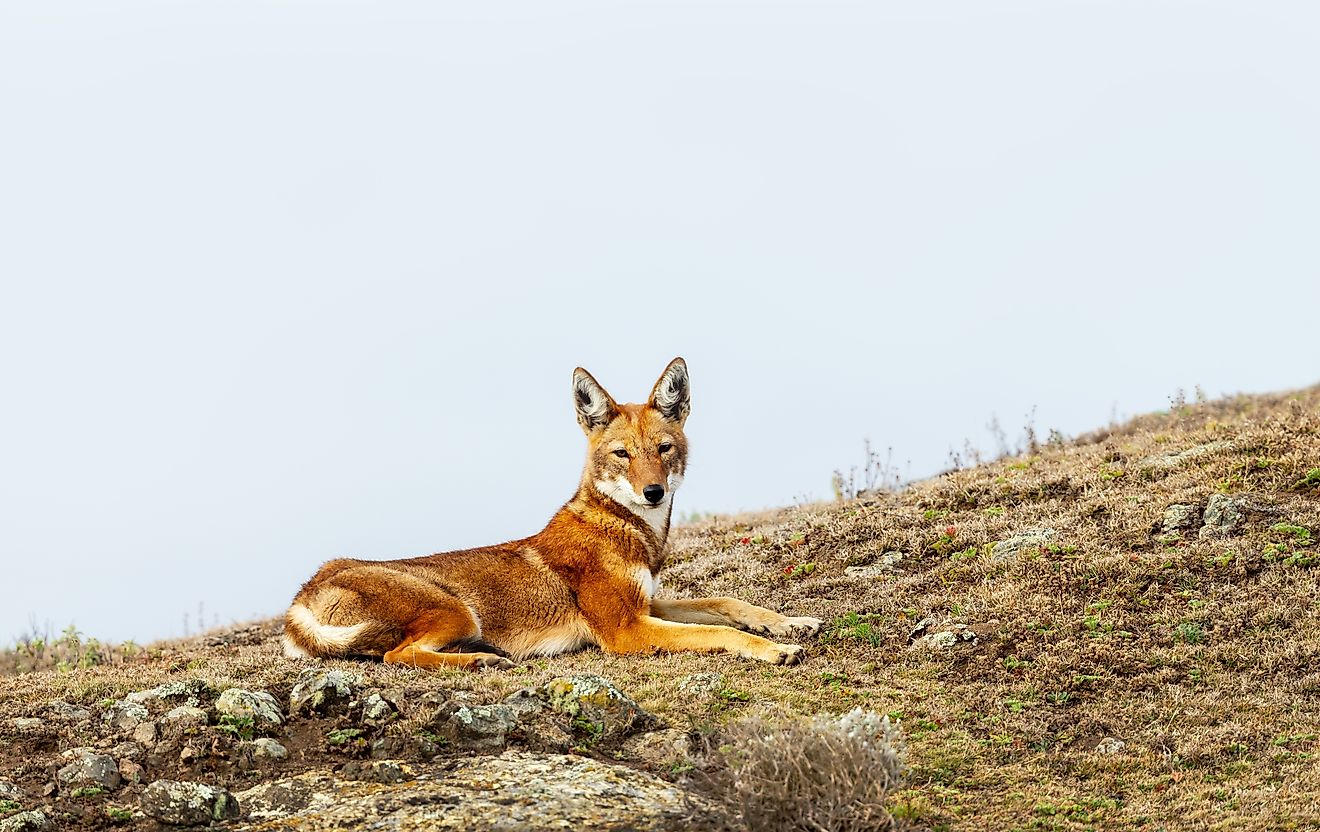
An unusual relationship plays out on these slopes. Ethiopian wolves regularly wander through grazing gelada herds without setting off alarm, and the monkeys largely ignore them, a tolerance seen in most encounters between the two species. The wolves appear to benefit from rodents flushed into the open by the feeding primates.
Reproduction

Female geladas reach sexual maturity around four to five years of age. Males mature a little later, at roughly five to seven years, but social competition usually keeps them from breeding until they are eight to ten years old and able to hold a reproductive unit. Breeding can occur year-round, though many populations show birth peaks tied to the rains.
The estrous cycle lasts about 35 days, and gestation runs roughly five to six months. A female almost always gives birth to a single infant, most often at night, and provides nearly all of its care. A newborn clings to its mother's belly for the first weeks of life before riding on her back, and weaning follows between 12 and 18 months. Females typically give birth about once every two years. In the wild, geladas average around 15 years of life, while individuals in captivity have reached close to 30.
Importance to the World

As the last grazing primate, the gelada occupies an ecological niche no other monkey fills. Its constant cropping helps shape the plant communities of the Afroalpine grasslands, and its habit of digging for roots and rhizomes turns and aerates the thin mountain soil. As prey, it supports highland predators, and as a foraging companion of sorts it contributes to the hunting success of the endangered Ethiopian wolf.
The gelada also contributes to the local economy through wildlife tourism. Large, approachable herds in the Simien Mountains attract visitors, generating income for surrounding communities and supporting conservation efforts. The species is also valuable to researchers as a modern example of how grass-eating primates live, while its speech-like vocalizations provide insight into the evolution of communication.
Threats

The IUCN Red List classifies the gelada as Least Concern, a status that reflects its still-large range and populations rather than a lack of pressure. Numbers have fallen sharply over the decades. Estimates put the wild population at around 440,000 in the 1970s and near 200,000 by 2008, and surveys suggest the trend is still downward. In and around Simien Mountains National Park, the largest known population dropped from about 10,000 in the 1970s to roughly 4,300 by the mid-2000s.
The main pressures are human. Highland grassland is steadily converted to farmland, grazing pasture, and settlement, and steep slopes are cultivated by hand well into gelada country. Planting fast-growing eucalyptus, which suppresses grass and strips topsoil, degrades the meadows the monkeys depend on. Where crops border their range, geladas are treated as pests and sometimes killed. Climate change adds a longer-term threat, as warming pushes the cool Afroalpine grasslands into a shrinking, higher band of the mountains.
Some populations are more fragile than the headline status suggests. The Arsi gelada east of the Rift Valley is the most precarious of all, surviving in only a few small, isolated groups that some researchers argue should be listed as endangered. Protected areas such as Simien Mountains National Park, Borena Sayint National Park, and community-managed sites like Guassa offer the strongest safeguards, and researchers continue to press for formal protection of key gorges and for clearer answers about the different subspecies.
Takeaway
The gelada is one of the few primates adapted almost entirely to life on open mountain grasslands. Unlike most monkeys, it feeds primarily on grasses, lives in open highland environments rather than forests, and spends most of its time on the ground instead of in trees. Its red chest, complex social structure, and speech-like vocalizations distinguish it from other primates, while its cold mountain habitat has so far shielded it from the steep declines affecting many related species. However, Ethiopia's highlands are increasingly being converted to farmland, used for livestock grazing, and affected by a warming climate. The gelada's future will depend on whether these grasslands remain intact. For now, its shuffling, chattering herds continue to cross the Roof of Africa, preserving a way of life once shared by a much wider range of grass-eating primates.
Fun Facts

- The only grass-grazing monkey alive. Grass makes up about 90 percent of the gelada's diet, a specialization shared by no other living primate.
- A chest that doubles as a mood ring. The bare red patch on the chest brightens with hormone levels and signals rank and readiness to mate, which is why the gelada is nicknamed the bleeding-heart monkey.
- Almost as chatty as we are. Geladas produce rhythmic lip-smacking calls that some scientists consider one of the closest known parallels to human speech among nonhuman primates.
- Zebra-grade chewing. Their teeth grind grass so efficiently that researchers compare their chewing to that of a zebra.
- Peaceful with wolves. Ethiopian wolves stroll through gelada herds unbothered, and the monkeys barely react, an unusual truce between predator and prey.
- Built to sit and eat. Thick calloused pads over fat on the rump let geladas graze while seated for hours, shuffling along without ever standing up.
Quick Facts
- Scientific name: Theropithecus gelada
- Family: Cercopithecidae (Old World monkeys)
- Genus: Theropithecus (only living species)
- IUCN status: Least Concern (population decreasing)
- Range: Endemic to the Ethiopian Highlands
- Habitat: Afroalpine and sub-Afroalpine grasslands near cliffs, 1,800 to 4,400 m (5,900 to 14,400 ft)
- Size: Head and body 20 to 29 in (50 to 74 cm), tail 12 to 20 in (30 to 50 cm)
- Weight: Males about 40 lb (18.5 kg), females about 24 to 28 lb (11 to 13 kg)
- Diet: Graminivore, mainly grass blades and seeds, plus herbs, roots, and rare insects
- Lifespan: About 15 years in the wild, up to about 30 in captivity
- Population: Roughly 200,000 and decreasing