Arapaima
The arapaima is one of the largest freshwater fish on Earth, a torpedo-shaped giant that can outgrow a grown person and still rise to the surface to gulp air much like a mammal. Native to the slow, oxygen-poor waters of South America, it survives where most large fish would suffocate, breathing air through a modified swim bladder that works like a lung. Riverside communities have known it for centuries as the pirarucu or the paiche, and scientists study it as a living relic whose body plan has changed little across millions of years.
To understand why the arapaima looks and behaves the way it does, it helps to know just how old its lineage is. This is a fish whose ancestors were patrolling tropical rivers long before many familiar animal groups appeared, and that deep history is written into where it sits on the tree of life.
Taxonomic Classification

The arapaima belongs to the order Osteoglossiformes, the bony-tongued fishes, an ancient lineage of ray-finned fish (class Actinopterygii). Within that order it sits in the family Arapaimidae, though some classifications fold it into a broadly defined Osteoglossidae, so the family placement is best treated with a little caution. The best-known species is Arapaima gigas, first described by Heinrich Rudolf Schinz in 1822 under the name Sudis gigas.
For a long time the genus Arapaima was considered monotypic, meaning A. gigas was thought to be its only member. Later work has complicated that picture. Modern revisions recognize several species, including A. arapaima, A. leptosoma, A. agassizii, and A. mapae, though the rarity of specimens and the loss of some original type specimens leave the boundaries between them unsettled. Many older studies were published under the name A. gigas simply because it was the familiar label, and researchers now caution that the widely studied fish across much of the Amazon may not be true A. gigas at all. The common names reflect the fish's cultural reach. Pirarucu comes from the Tupi words for fish and red, a nod to the reddish markings near the tail, while paiche is the name used across the Spanish-speaking Amazon.
Physical Description

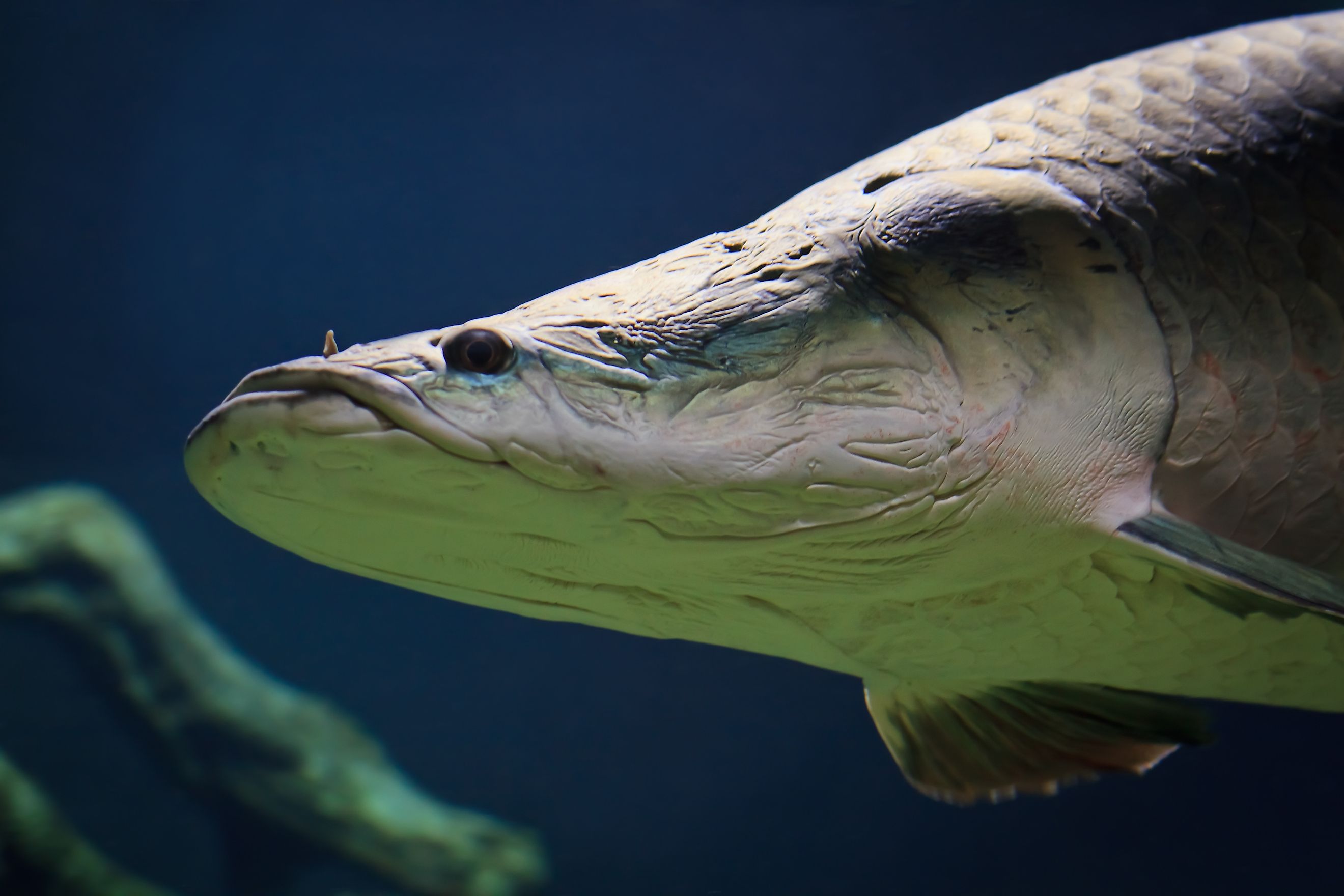
Arapaima are built on a grand scale. Reliable modern figures put them at up to about 10 feet (3 m) in length and 440 pounds (200 kg) in weight, with an average closer to 7 feet (2.1 m). Historical accounts describe individuals reaching 15 feet (4.5 m), though fish of that size are essentially unheard of today after generations of heavy fishing removed the largest animals.
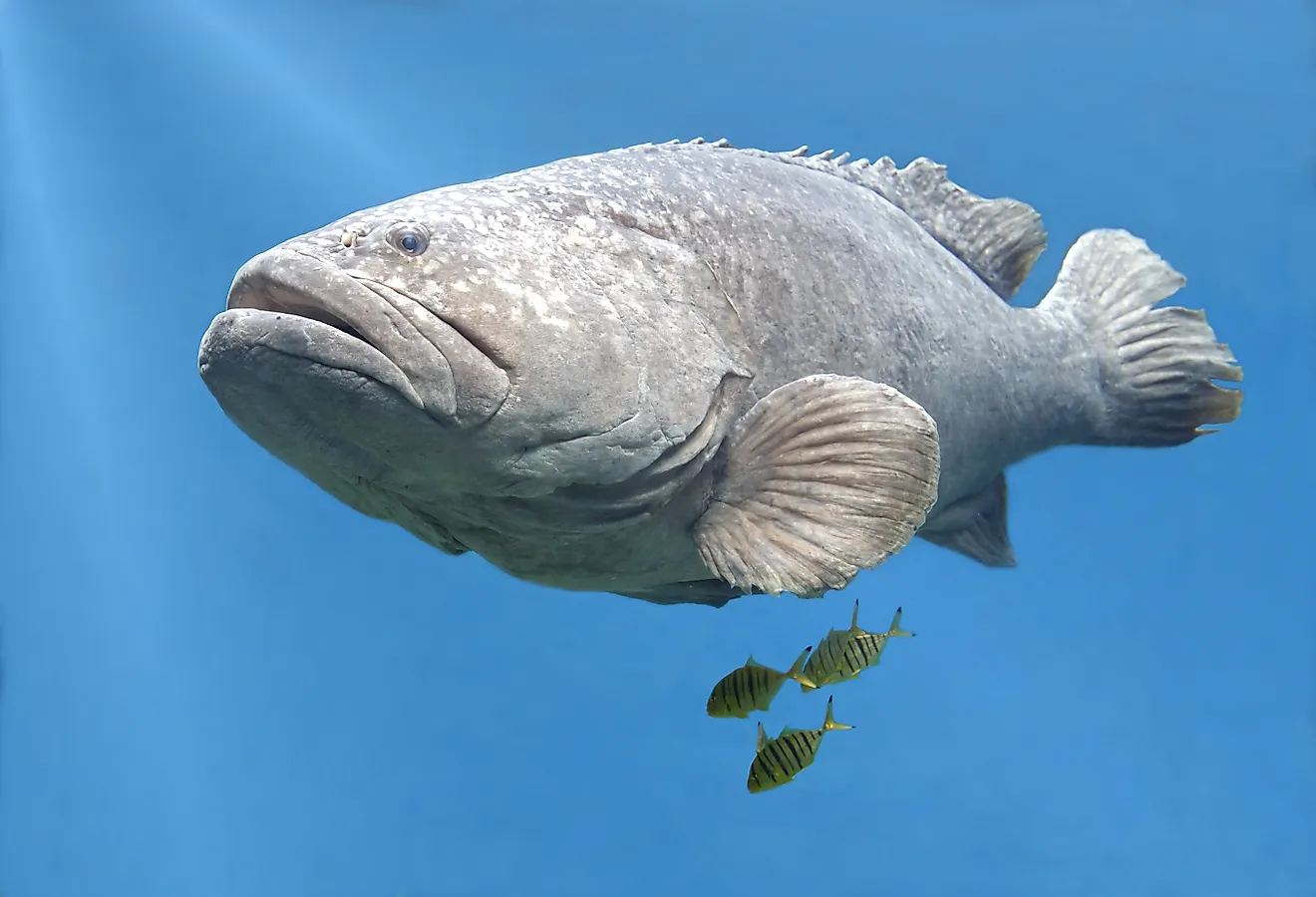
The body is long and cylindrical, tapering to a broad tail set well back for a sudden burst of speed. The head and forebody are dark metallic gray or green, shading to vivid red and orange flecks toward the rear, the feature that earned the "red fish" name. The scales are the arapaima's most studied trait. Each one carries a hard, mineralized outer layer over a tough, flexible inner layer of collagen fibers arranged in a cross-hatched pattern. That structure lets the scale bend under pressure without shattering, and it resists piranha bites well enough to have made arapaima armor a subject of serious materials research. The head is bony and flattened, and the mouth is large, upturned, and lined with a rough, tooth-covered tongue.
Range and Habitat

The arapaima is a South American fish, centered on the Amazon River basin across Brazil and Peru and extending into the Essequibo basin of Guyana. It favors calm, warm, often tea-colored waters, meaning floodplains, oxbow lakes, and slow river channels rather than fast open current. These are exactly the habitats where dissolved oxygen tends to run low, especially in the dry season when water levels drop and pools become isolated. The arapaima's air-breathing habit is what allows it to thrive there. In water that would drown other large fish, it simply rises and takes a breath. Its distribution has contracted around populated stretches of river, where fishing pressure has been heaviest for longest.
Diet

The arapaima is a carnivore and, for much of its life, an apex predator in its stretch of river. Its core diet is fish, supplemented by crustaceans and other aquatic animals. Larger individuals are opportunists that will also take birds, small reptiles, and small mammals, sometimes launching partly out of the water to snatch prey from low branches. Rather than chasing prey over long distances in murky water, the arapaima closes the gap and strikes at short range. It expands its mouth suddenly, creating a powerful inward rush of water that pulls the target in before it can escape. The bony tongue then presses the prey against the equally hard roof of the mouth and grinds it, working almost like a second set of jaws. Young arapaima start on tiny organisms and invertebrates and move to larger prey as they grow.
Behavior

The defining behavior is breathing. Arapaima are obligate air-breathers as adults, meaning they must surface to fill the modified swim bladder that serves as a lung, or they will drown. Field observations record adults coming up roughly every 5 to 20 minutes, with young fish surfacing far more often. Laboratory work on small arapaima found that they draw the majority of their oxygen from air even when the surrounding water is well oxygenated. Each breath ends in a loud, distinctive gulp that carries a long way across still water, a sound familiar to anyone who has sat in a boat on an Amazon or Rupununi lake at dusk. Arapaima can be aggressive toward one another and toward other species, and when not actively hunting they may rest near the bottom or drift just below the surface.
Reproduction

Arapaima time their breeding to the river's seasonal rhythm. Pairs form and spawn during the low-water dry season, so that the young hatch into the food-rich flood season that follows. A pair builds a shallow nest on the bottom, often described as wok-shaped, where the female lays eggs a few millimeters across and the male fertilizes them externally. The eggs hatch in roughly four to five days.
What follows is unusual for a fish. Arapaima invest heavily in a small number of offspring. The male guards the young closely for a period that can stretch across several months, and the schooling larvae shadow his head as he moves. He secretes a substance from glands on his head that helps keep the young nearby, and both parents help aerate the water for the offspring, which still rely on gills at this stage. This level of sustained parental care is rare among large fish and is one reason the arapaima has drawn so much research interest, both for conservation and for aquaculture.
Importance to the World

The arapaima matters ecologically as a top predator that helps shape the fish communities of Amazonian floodplains. Its importance to people is just as large. Often called the cod of the Amazon, it has been a staple protein for Indigenous and riverside communities for centuries, prized for firm, nearly boneless meat that suits grilling and searing. A single large fish can feed many people. Its hard scales are used as tools, files, and craft material, and its bony tongue has long served as a natural rasp. Today the arapaima is also an important aquaculture species, valued for its fast growth, and it draws sport anglers to the region as a trophy catch.
Threats and Conservation

The same traits that make the arapaima remarkable also make it vulnerable. Because it must surface to breathe and does so noisily, a fisher with a harpoon or gillnet can locate and take it with relative ease. Decades of industrial harvesting left the arapaima complex overexploited and declining across much of its range, with the largest, fastest-growing individuals removed first. Habitat loss and pollution add further pressure.
The formal conservation picture is muddled by the taxonomy. Arapaima gigas is currently listed by the IUCN as Data Deficient, which reflects how little is settled about the species itself, and the genus is listed on CITES Appendix II, which regulates international trade. On the ground, the clearest good news comes from community management. Where fishing communities enforce minimum size limits, closed seasons, and counts of surfacing fish (the animals are easy to census precisely because they must come up for air), depleted populations have rebounded strongly. Guyana's North Rupununi and parts of the Brazilian Amazon offer working examples of a giant fish pulled back from the edge by the people who depend on it.
Takeaway
The arapaima is one of the most remarkable freshwater fish alive today. It ranks among the largest species in its environment, breathes air rather than relying solely on gills, raises its young with unusual care, and possesses scales tough enough to withstand attacks from piranhas. However, these same traits also make it vulnerable. Its large size, need to surface regularly, and value as food have made it an attractive target for fishing, causing many populations to decline. Recoveries in well-managed waters show that this trend can be reversed, but the species' future depends heavily on how responsibly people manage and harvest it.
Fun Facts

- Bulletproof scales. Arapaima scales are built in layers that flex without cracking and can resist piranha bites, which has made them a model for tough synthetic materials.
- It can survive out of water. Thanks to its air-breathing swim bladder, an arapaima can stay alive for around 24 hours out of the water.
- A living fossil. The arapaima's body plan has changed little across an estimated 23 million years.
- A tongue that works like sandpaper. The bony, rough tongue grinds prey against the roof of the mouth, and locals have long used dried arapaima tongues as a natural file.
- Airborne hunter. Large arapaima can lunge partly out of the water to grab birds and small animals off low branches.
- Fathers do the guarding. Male arapaima protect schools of young for months, and the larvae follow close to the father's head.
Quick Facts
- Scientific name: Arapaima gigas (best-known species)
- Family / Order: Arapaimidae / Osteoglossiformes
- Common names: arapaima, pirarucu, paiche
- IUCN status: Data Deficient for A. gigas, with the genus on CITES Appendix II
- Length: up to about 10 feet (3 m), historically to 15 feet (4.5 m)
- Weight: up to 440 pounds (200 kg)
- Diet: carnivore (fish, crustaceans, occasional birds and small animals)
- Range: Amazon and Essequibo river basins of South America
- Habitat: floodplains, oxbow lakes, and slow, oxygen-poor waters
- Notable trait: obligate air-breather with a lung-like swim bladder