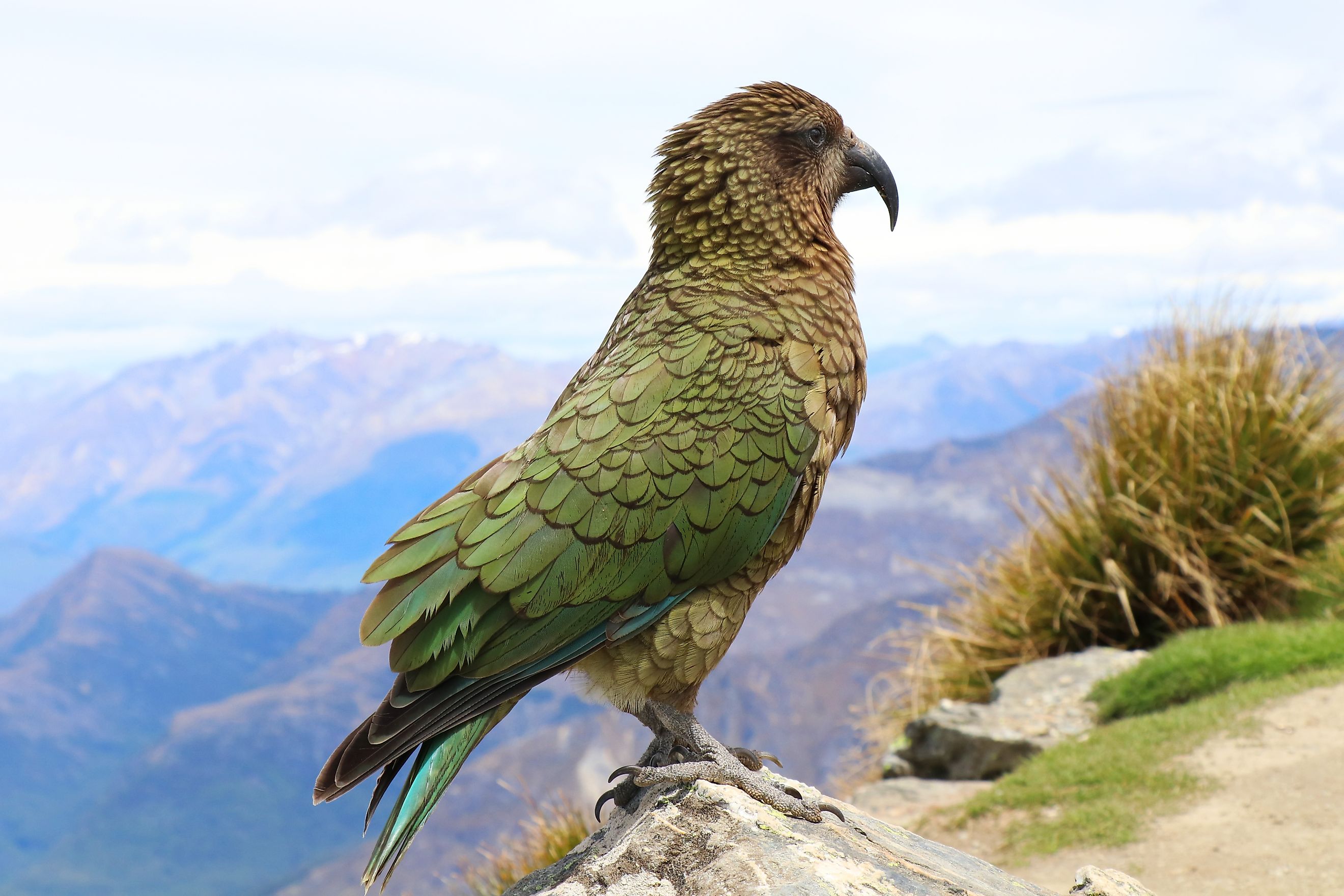
Kea
The kea is the only parrot on Earth that lives in the mountains, and it may also be the cleverest. Native to the rugged alpine ranges of New Zealand's South Island, this olive-green bird thrives in a world of scree slopes, snow, and biting wind, a habitat that few parrots could survive. Where its tropical relatives depend on warm forests, the kea has adapted to conditions more often associated with mountain goats than with bright, seed-cracking birds.
What truly sets the kea apart is its mind. Researchers rank it among the most intelligent birds alive, comparable in problem-solving ability to great apes and young human children. Kea can work together to solve puzzles, use tools, and outwit obstacles that stump most other animals. That intelligence, paired with an almost boundless curiosity, has earned the bird the nickname "the clown of the mountains" and a reputation for dismantling anything a careless hiker leaves unattended.
Yet the kea's story is not only one of wit and mischief. It is also a cautionary tale of persecution, recovery, and a still-uncertain future. Once hunted by the tens of thousands, the kea today is classified as Endangered, its population small and declining. This profile explains what makes the kea remarkable, how it lives, and why its survival matters.
Taxonomic Classification

The kea belongs to the order Psittaciformes, which contains all parrots and cockatoos, and to the family Strigopidae, a lineage found only in New Zealand. Its scientific name is Nestor notabilis, and it was formally described by the English ornithologist John Gould in 1856. The genus name Nestor comes from a wise counselor in Greek mythology, while the species name notabilis is Latin for "noteworthy," a fitting label for such a distinctive bird.
The kea shares its genus with the kaka (Nestor meridionalis), a forest parrot, and both are close relatives of the flightless, nocturnal kakapo (Strigops habroptilus). Together these birds form an ancient branch of the parrot family tree. Genetic evidence suggests the Strigopidae lineage split from other parrots tens of millions of years ago, following the separation of the landmass that became New Zealand from the supercontinent of Gondwana. In practical terms, the kea and its kin have been evolving in isolation for an extraordinarily long time, which helps explain how unusual they are.
Physical Description

The kea is a large, robust parrot. Adults measure roughly 18 to 20 inches (46 to 50 cm) in length and carry a wingspan of more than 3 feet (over 1 m), making them strong fliers well suited to gusting mountain air. Males are noticeably larger than females, up to about 20 percent heavier, and typically weigh close to 2 pounds (around 960 g) against roughly 1.7 pounds (around 780 g) for females. This makes the kea the largest flighted land bird in New Zealand and the country's second-largest parrot after the heavier kakapo.
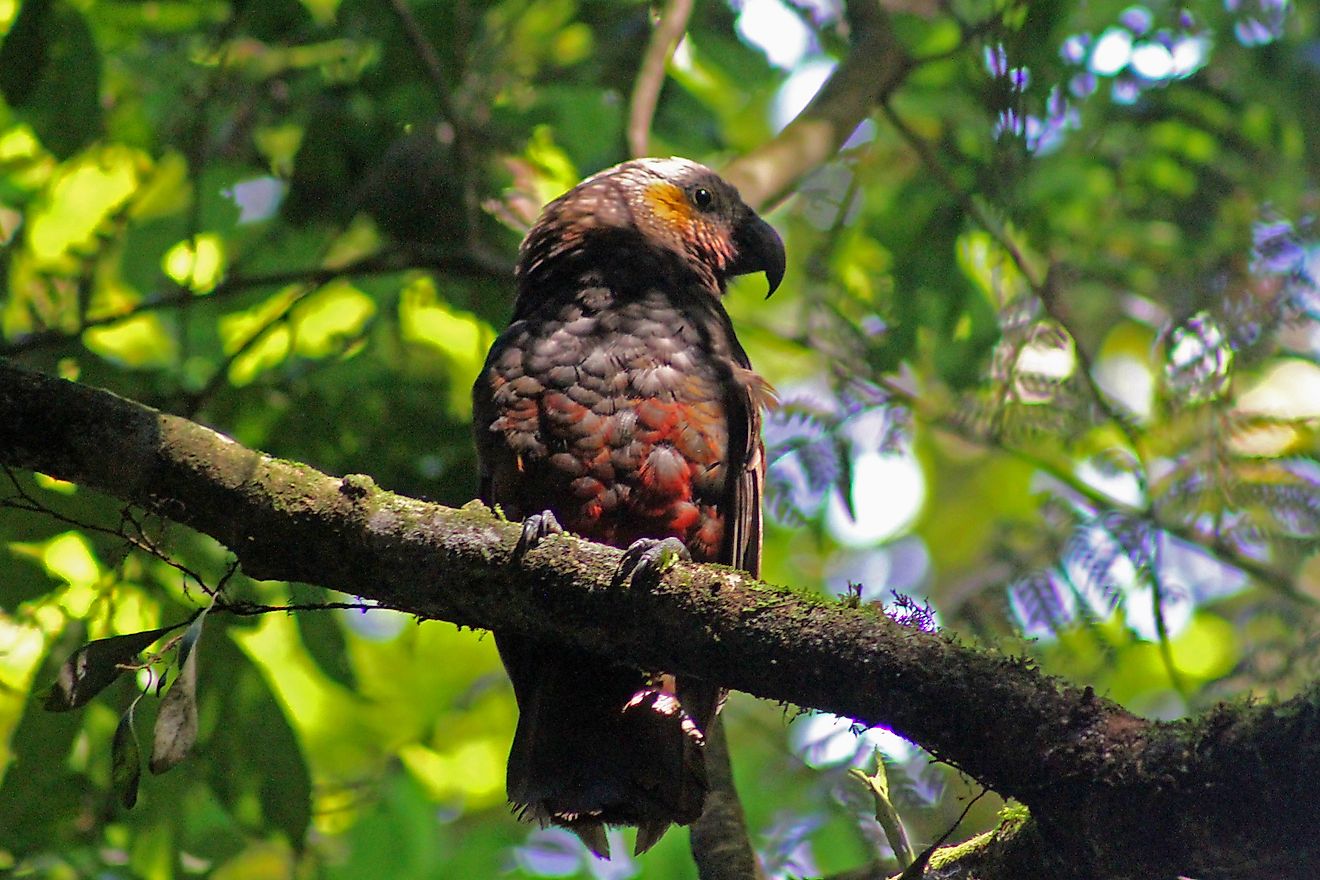
At rest the kea looks deceptively drab. Its plumage is mostly olive green, each feather edged in black to create a scalloped pattern that blends into rock and low vegetation. The drama is hidden until the bird takes flight, when it reveals brilliant orange-red underwings and rump feathers along with dull blue outer wing feathers. The beak is long, narrow, and strongly hooked, and it is longer in males, sometimes reaching more than 2 inches (about 5.5 cm). That powerful bill is one of the bird's most important tools, capable of tearing apart rotten wood, prying open containers, and stripping rubber from car fittings. Young kea can be told apart by the yellow skin around their eyes, bill, and nostrils, which darkens to black as they mature over their first few years.
Range and Habitat

The kea is one of many iconic birds found only in New Zealand, living across the mountainous spine of the South Island in areas such as Arthur's Pass and Aoraki (Mount Cook) National Park. It is most often associated with the southern beech forests and the subalpine scrub and alpine zones just above the treeline. Kea range widely in elevation, moving between forest, high meadow, scree, and open ridgeline, and they are among the very few parrots comfortable in snow.
The bird's current range is more restricted than it once was. Subfossil bones show that kea formerly occurred in lowland and coastal areas across much of the South Island, and even into the North Island, before the arrival of human settlers. Hunting and habitat change gradually pushed the population back into the high country. Today the kea occupies a comparatively narrow band of alpine and montane terrain, much of it within reserves and national parks.
Diet

The kea is an opportunistic omnivore with one of the most varied diets of any parrot. It feeds on dozens of plant types, taking leaves, buds, roots, berries, seeds, and nectar, and it supplements this plant matter with insects and grubs dug out of rotting logs and soil. The bird will also scavenge carrion when it finds it, an ability that helps it survive lean alpine winters when other food is scarce.
This flexible appetite is central to the kea's most infamous chapter. In the late 1800s, high-country sheep farmers accused the bird of attacking their flocks, and there is real evidence that kea will land on sheep and feed on fat around the back and kidneys, sometimes causing injury or infection. Such behavior appears to be uncommon and carried out by only some individuals, but it shaped the bird's reputation for more than a century. In modern times, the kea's appetite draws it toward people. It will raid unattended backpacks, tents, and vehicles, and it sometimes swallows human food scraps and rubbish, which can harm it.
Behavior

Kea are highly social, diurnal birds that live in loose groups of up to a dozen or more individuals. They are famous for their intelligence, and decades of research have documented abilities that are rare in the animal kingdom. Captive and wild kea solve multi-step puzzles, cooperate to obtain rewards, and use tools. In one striking field study, kea across a wide area learned to insert sticks into predator traps, and a disabled bird named Bruce was recorded using pebbles to preen himself after losing the upper part of his beak.
Much of this cleverness shows up as play. Juvenile kea in particular spend long periods manipulating objects, tumbling, and testing their surroundings, behavior that scientists link to the development of problem-solving skill. That same curiosity is what makes the bird a nuisance at ski fields and car parks, where flocks strip windshield wipers and roof racks apart, seemingly for the pleasure of it. Kea are also vocal, giving a loud, carrying "kee-aa" call, from which the Maori name for the bird is drawn, along with a range of whistles, warbles, and squawks.
Reproduction

Kea form long-lasting pair bonds and nest in a way that is unusual for parrots. Rather than seeking out tree hollows, they nest on or under the ground in natural cavities among rocks, roots, and burrows. Breeding typically begins in the cooler months, and the female alone incubates the eggs while the male forages and brings food to her and, later, to the growing chicks. A clutch usually contains two to four eggs.
Chicks develop slowly. They remain in the nest for several months before fledging, and young kea depend on adults for an extended period afterward. This slow reproductive pace, combined with the vulnerability of ground nests to introduced predators, is a serious problem for the species. Kea are long-lived to compensate, with wild birds reaching at least 30 years and captive individuals recorded at close to 50 years, but slow reproduction still leaves the population slow to recover from losses.
Importance to the World

As a wide-ranging omnivore, the kea plays several roles in its alpine ecosystem. By feeding on fruits and dispersing seeds, browsing vegetation, and consuming insects and carrion, it helps shape the mountain plant community and recycle nutrients in a harsh environment where few large foragers operate. Its presence is one thread in the web of a distinctive and isolated ecosystem.
The kea also has strong cultural significance in New Zealand. For the Maori, it was regarded as a guardian of the mountains, while today it is a widely recognized national symbol and an attraction for visitors to the country's alpine parks. That popularity can support conservation by generating public interest and encouraging funding for efforts to protect the species.
Threats

The kea is listed as Endangered on the IUCN Red List, with a population trend that continues to decline. Estimates of its numbers vary, but most fall in the range of roughly 3,000 to 7,000 birds, with the IUCN citing a figure near 6,000 total individuals and around 4,000 mature adults. Within New Zealand it is also classified as Nationally Endangered, one of the highest threat categories in the national system.
The bird's troubles began with direct persecution. Under a government bounty scheme that ran from the late 1800s into the 1970s, an estimated 150,000 kea were killed because of the sheep-attack reputation. The bird gained partial protection as its numbers fell and finally received full legal protection under New Zealand law in 1986. Persecution is no longer the main danger, but introduced mammalian predators such as stoats and possums now raid the kea's ground nests, killing eggs, chicks, and sitting females. Human-related hazards add to the pressure, including lead poisoning from old buildings and the ingestion of rubbish and unsuitable food. Conservation groups respond with predator control, lead-removal programs, public education aimed at discouraging feeding, and close population monitoring.
Takeaway
The kea is a rare combination of the tough and the brilliant, a parrot that has conquered a mountain world no other member of its family could handle and that meets it with a mind sharp enough to rival an ape. Its curiosity, cooperation, and tool use place it among the most remarkable birds ever studied, while its bright underwings and bold personality make it unmistakable to anyone lucky enough to see one. That same boldness, though, has always brought the bird into conflict with people, first as a hunted pest and now as a curious scavenger drawn to human waste. With fewer than 7,000 left and a population still falling, the kea's future depends on continued predator control, safer landscapes, and a public willing to admire the clown of the mountains without harming it.
Fun Facts

- Only alpine parrot on Earth. The kea is the world's single parrot species adapted to live and breed in high mountain environments, including areas that see regular snow.
- As smart as a young child. Studies place the kea's problem-solving ability on par with great apes and roughly a four-year-old human, and confirm that it can use tools and cooperate with others.
- Its name is a sound. The Maori word "kea" imitates the bird's loud, ringing "kee-aa" flight call.
- A flock has a colorful name. A group of kea is sometimes called a "circus" or a "curiosity," both nods to the bird's playful nature.
- Ground nesters. Unlike most parrots, kea nest in cavities on or under the ground rather than in tree hollows, which leaves them exposed to introduced predators.
Quick Facts
- Scientific name: Nestor notabilis
- Family / Order: Strigopidae / Psittaciformes
- IUCN status: Endangered (population decreasing)
- Length: 18 to 20 inches (46 to 50 cm)
- Wingspan: More than 3 feet (over 1 m)
- Weight: Around 1.7 to 2 pounds (about 780 to 960 g)
- Lifespan: 30 or more years in the wild, up to about 50 years in captivity
- Diet: Omnivorous (leaves, roots, berries, seeds, nectar, insects, and carrion)
- Range: Alpine and montane regions of the South Island of New Zealand