Emerald Tree Boa
The emerald tree boa (Corallus caninus) is a colorful, sizable, and solitary constrictor snake of South America. This non-venomous tree-dweller is well adapted to rainforests, relying on its predominantly green coloration to camouflage during the day, heat-sensing pits to target small prey in the cover of night, and utilizing its prehensile tail to anchor securely onto branches at all times. Even though this species exists in healthy populations and is listed as Least Concern by the International Union for Conservation of Nature, it has evolved visual trickery to ward off its primary natural predator, birds of prey. Let's forge our way into the Amazon Basin to learn more about the visually-striking, yet rarely seen, emerald tree boa.
Taxonomic Classification

Swedish naturalist Carl Linnaeus first described the emerald tree boa in 1758 as Boa canina, and it has carried the name Corallus caninus since 1893. In 2009, a revision split the populations south of the Amazon River and west of the Rio Negro into a separate species, reviving the name Corallus batesii that English zoologist John Edward Gray had coined in 1860 in honor of fellow countryman and naturalist Henry Walter Bates. The full taxonomy of the emerald tree boa is as follows.
Kingdom: Animalia
Phylum: Chordata
Class: Reptilia
Order: Squamata
Suborder: Serpentes
Family: Boidae
Genus: Corallus
Species: C. caninus
Expanding on the more obvious Latin categories such as "animal" and "reptile," the emerald tree boa belongs to the order Squamata, a large order of reptiles that includes lizards and snakes. It also belongs to the family Boidae, aka "boas," and the genus Corallus, which refers to nine species of boas living in Central and South America, as well as the West Indies.
Physical Description

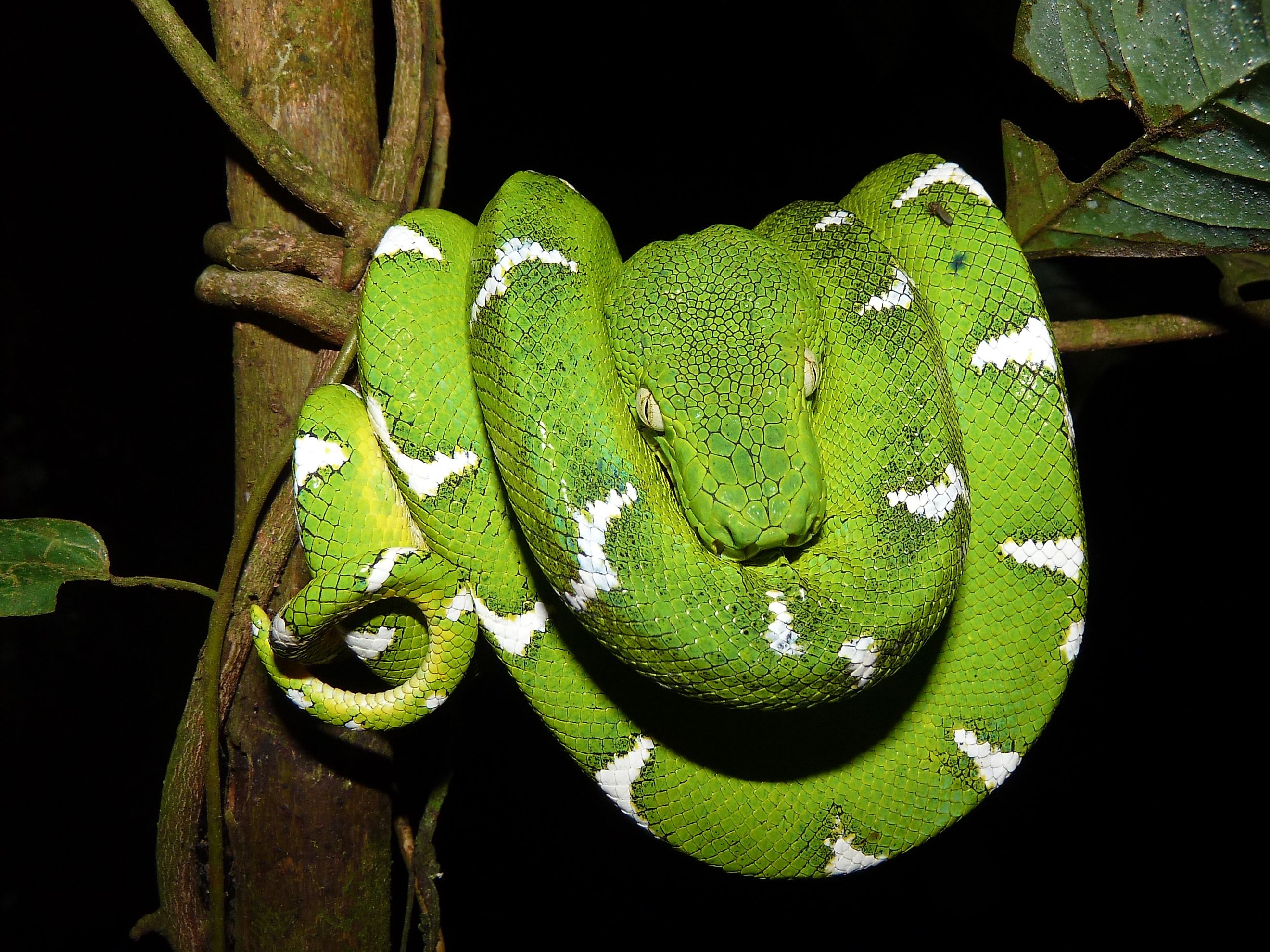
As the name suggests, emerald tree boas tend to exude a vibrant verdant coloration. With that said, it is more of a bright green than emerald, and this only emerges after about 10 to 12 months. Juveniles can be any combination of red, orange, and/or yellow, possibly for the purpose of mimicking regional vipers. In addition to the green dorsal coloration, which is sometimes punctuated with white markings, mature emerald tree boas have either pale-yellow or white bellies. Variations occur across sub-regions.
Able to reach in excess of six feet and four pounds, with females being the larger sex, this boa also boasts quite a large head relative to its neck. Labial heat-sensing pits line the upper and lower lips, which, when opened, reveal sharp, backward-angled teeth that are particularly well-suited for restraining ambushed prey prior to constriction.
Range And Habitat

Endemic to the Amazon Basin and the Guiana Shield of northern South America, the emerald tree boa can be found in parts of Colombia, Venezuela, Brazil, Ecuador, Peru, Bolivia, French Guiana, Guyana, and Suriname. More specifically, mature rainforests at altitudes between sea level and about 2,600 feet provide the preferred habitat for emerald tree boas. With that said, this adaptable boa is sometimes found in second-growth forests and swamps.
Behavior & Diet

Both nocturnal and arboreal, the emerald tree boa uses its elevated vantage point for both self-defense and ambush tactics. During the day, it coils around a branch with its head resting in the middle of its body, but will occasionally descend to the forest floor to sunbathe. Able to blend in with the rainforest foliage, its otherwise eye-catching coloration keeps its sole natural predator, raptors, at bay.
At night, the emerald tree boa uses its prehensile tail to lock in a branch position and then drops its head down toward the ground, or simply a lower branch, waiting patiently for the heat signature of small and unsuspecting prey. Emerald tree boas subsist primarily on small mammals, birds, and other reptiles, which they constrict until their circulation fails, rather than subdue with venom, and then swallow whole.
Reproduction

Emerald Tree Boa (Corallus caninus) resting on a tree.
Similar to other boas, but unlike the majority of snake species, emerald tree boas are ovoviviparous, meaning they give birth to live young. Measuring up to 12 inches at birth and numbering upwards of 20 to a litter, juvenile emerald tree boas take upwards of one year to mature into their namesake coloration. And though this species takes one to two years longer to reach sexual maturity than other boids, at 4-5 years for females and 3-4 years for males, newborns are fully independent, quickly assuming a solitary existence. Females have a gestation period of seven months, and give birth once every two years or so.
Threats

If all goes well, it is estimated that emerald tree boas can live for an average of 15 years in the wild. However, the aforementioned predation at the talons of raptors is the biggest threat to individuals. As a species, the emerald tree boa is vulnerable to deforestation, which can fracture its habitat. And as with Burmese pythons, and other snakes of impressive girth or aesthetic, the illegal pet trade is another human-led issue for the emerald tree boa.
Both Beautiful and Terrifying
From the perspective of our nature-loving audience, the emerald tree boa is a captivating constrictor snake thriving in the exquisite, yet vulnerable, Amazon rainforest. Its enigmatic coloration and arboreal adaptations put it at the top of its class in regards to evolution's accidentally artistic endgames. But from the perspective of a precariously-perched bird or scurrying rodent, the emerald tree boa poses a painful death from the darkness above.
Humans hiking through the forests of South America need not fear the emerald tree boa, as it is non-venomous and solely on the hunt for small prey. But when it comes to loggers and illegal smugglers, the emerald tree boa does have just cause to fear us. Thankfully, to date, no threats have significantly impacted the beautiful emerald tree boa.