What Animals Live In The Amazon River?
The Amazon is the largest river on Earth by a wide margin, pouring about a fifth of all the water the world's rivers carry to the sea, and running a close second to the Nile in length. All that water feeds the largest rainforest on the planet, but it also hides a cast of animals you would not want to meet on a night swim: a caiman the size of a small car, a fish that gulps air, an eel that can stun a horse, and a snake heavy enough to crush one. Here are some of the most remarkable residents of the Amazon River and its tributaries.
Black Caiman

Melanosuchus niger is the Amazon's apex predator, full stop. This crocodilian patrols the basin's slow rivers, lakes, and flooded savannas, and a big one stretches past 5 metres and tips 450 kilograms, which makes it the largest predator in the entire river system and the biggest member of the alligator family. It eats more or less whatever it can catch, from fish and birds to mammals and other reptiles, drowning larger prey and swallowing smaller animals whole. It very nearly did not make it. Hunted relentlessly for its dark hide from the 1950s through the 1970s, the black caiman lost as much as 99 percent of its numbers in heavily harvested areas. Protection since the 1990s has turned that around, and the IUCN now lists it as Least Concern, one of the Amazon's genuine conservation wins.
Arapaima

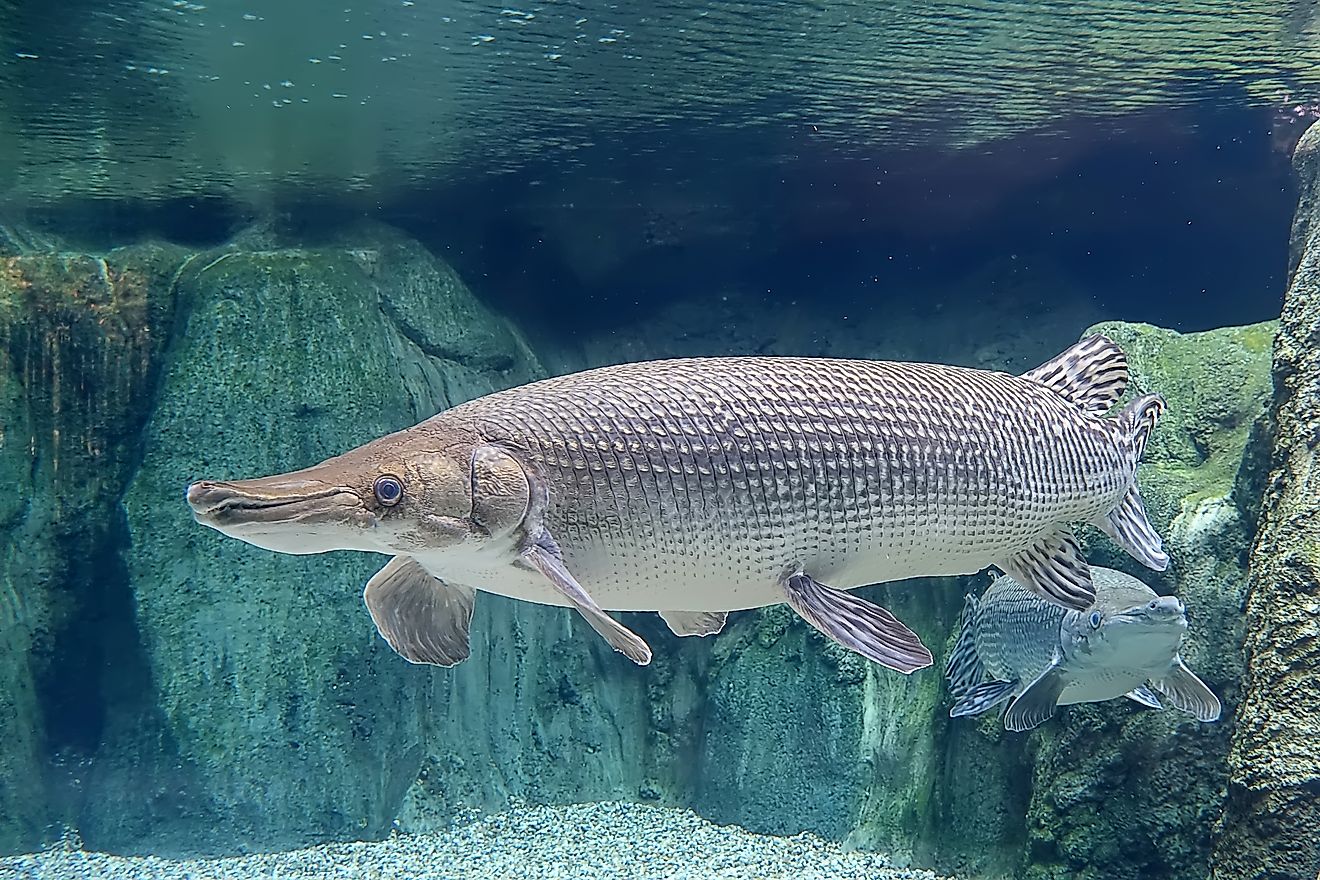
Arapaima gigas, known locally as the pirarucu, is one of the largest freshwater fish in the world and the giant of the Amazon. It can reach 3 metres, and the biggest historical specimens approached 4.5, weighing up to 200 kilograms, a figure that dwarfs almost anything else swimming in the river. Its torpedo body is armored in large blackish-green scales so tough that materials scientists study them for body-armor design. Here is the strange part: the arapaima has to breathe air. It surfaces every ten to twenty minutes for a loud, distinctive gulp, which unfortunately makes it an easy target for fishermen with harpoons. Heavy fishing has wiped it out of some stretches of the river entirely, and the IUCN lists it as Data Deficient. Its dried tongue is used in traditional medicine, and its bony scales are sold as nail files.
Electric Eel
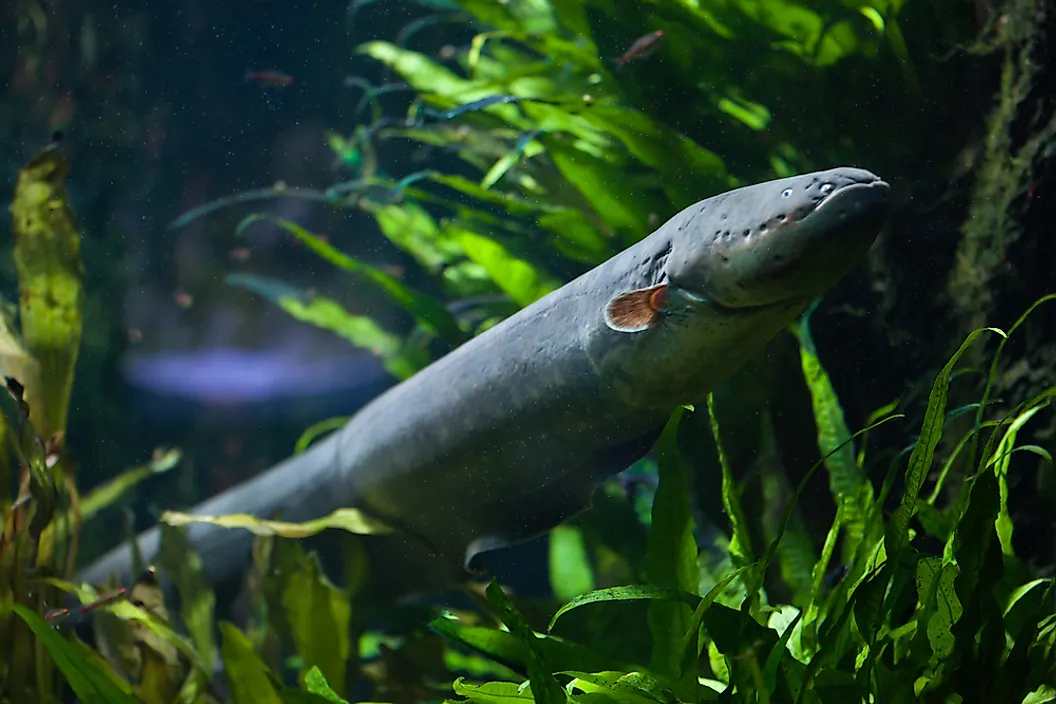
Despite the name, Electrophorus electricus is not an eel at all but a knifefish, and it is the largest of its order, growing to about 2 metres. It carries three pairs of electric organs down its long body, firing low-voltage pulses to navigate and sense prey, then high-voltage jolts to stun it. In 2019, scientists upended 250 years of taxonomy: what everyone had treated as a single species turned out to be three. One of the new ones, Electrophorus voltai, can discharge up to 860 volts, the most powerful electric shock produced by any animal on Earth, enough to knock out something the size of a horse. Electric eels haunt the muddy bottoms and stagnant backwaters of the basin, hunting fish, invertebrates, and small mammals.
Amazon River Dolphin

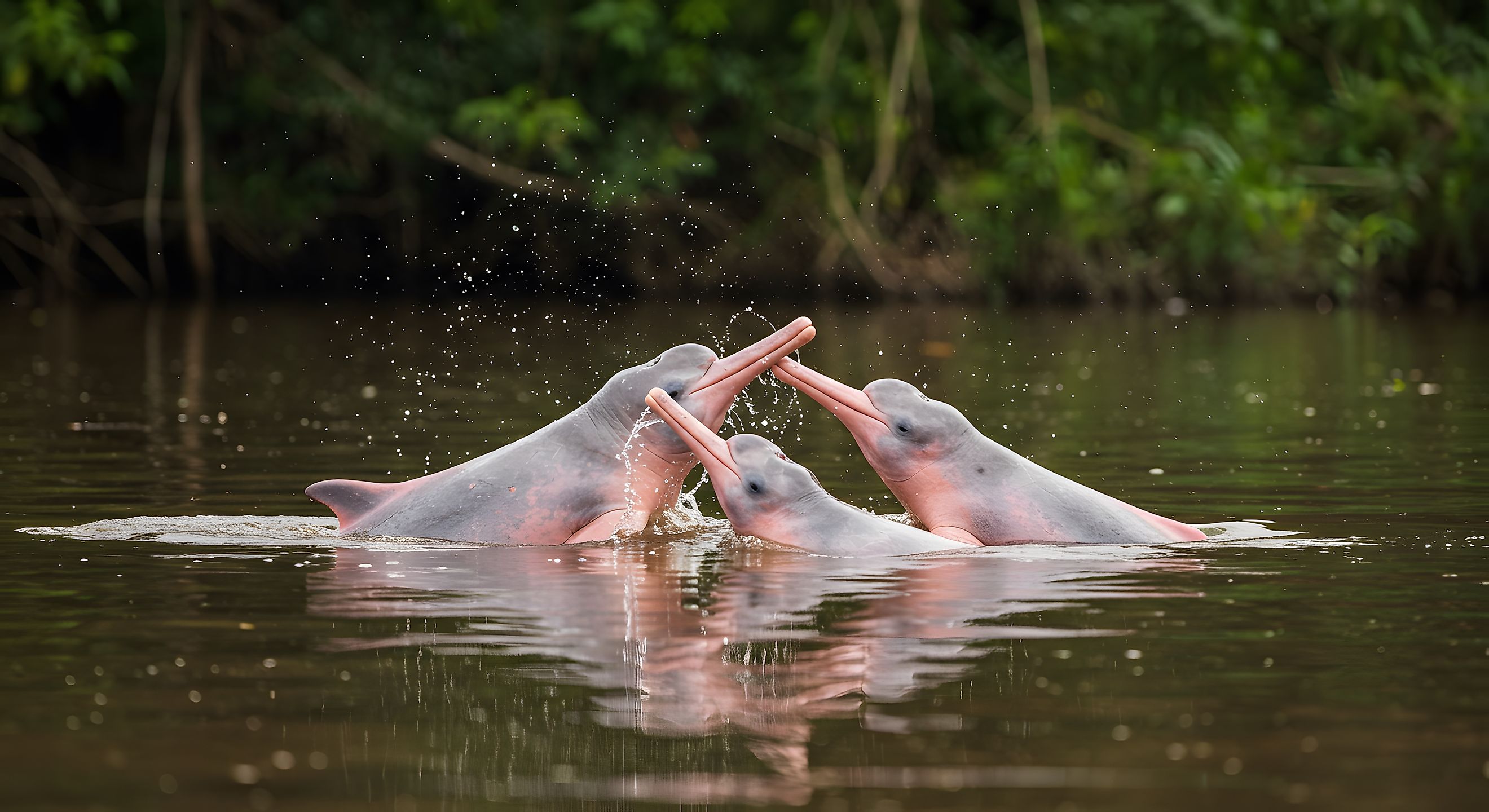
Inia geoffrensis, the boto or pink river dolphin, is the largest river dolphin in the world, reaching 2.5 metres and 185 kilograms. Adults really do turn pink, the males especially, their color deepening with age and the scar tissue of fighting. It is a genuine oddball among dolphins: its neck vertebrae are not fused, so it can turn its head to look around, and it is the only dolphin with molar-like back teeth, which it uses to crush armored catfish and river turtles. Its menu runs to more than 50 species of fish, plus crabs and turtles. Botos are curious and playful, known to swim upside down and nose at canoe paddles, but they are in trouble. Caught in fishing gear and killed for bait, the species was listed as Endangered by the IUCN in 2018, with a steadily declining population.
Giant Otter

Pteronura brasiliensis is the longest member of the weasel family, stretching up to 1.7 metres, and it behaves nothing like a solitary otter. Giant otters live in tight, noisy family groups of three to eight, hunting together by day and defending shared territory with a whole vocabulary of screams, whistles, and hums that has earned them a reputation as the loudest otters alive. Fish make up most of the diet, but the group will also take turtles, snakes, small caimans, and crabs, and a coordinated pack can even harass a caiman off its catch. Their downfall was their pelt. Decades of hunting for the dense, velvety fur crashed the population, and the IUCN now lists the giant otter as Endangered.
Green Anaconda

Eunectes murinus, the green anaconda, is the heaviest snake on Earth and among the longest of all snake species, regularly topping 5 metres, with exceptional individuals measured past 6. It is olive green with black blotches and orange-yellow bars along the head, and it spends most of its life in slow water: sluggish on land, but fast and near-invisible in a marsh, where it waits just under the surface and ambushes whatever comes down to drink. It kills by constriction, coiling around prey and squeezing until it suffocates, then swallows animals as large as capybaras, deer, and caimans. In 2024, a team of researchers proposed splitting the green anaconda into two species, a southern one that keeps the name E. murinus and a northern one they named E. akayima, though the genetic evidence behind the split is still debated.
Pacu

The pacu is not one fish but a group of serrasalmid species, the best known being the tambaqui, Colossoma macropomum. They are cousins of the piranha built along very different lines. Where a piranha carries a mouthful of blades, the pacu has flat, square, oddly human-looking teeth, all the better to crack the nuts and seeds that drop into the water, because these fish are mostly plant-eaters. They also grow much larger than piranhas, with specimens over a metre long and heavier than 40 kilograms. Sold to aquarium keepers as "vegetarian piranhas," pacu have been released into waterways well beyond South America, where they occasionally turn up as an unsettling surprise for anglers far from the Amazon.
Piranha

Nearly everyone knows the piranha, and nearly everyone has it wrong. The name covers a whole group of South American freshwater fish, the most famous being the red-bellied piranha, Pygocentrus nattereri, and the legend of a shoal stripping a cow to the bone in minutes is mostly Hollywood. Real research finds that most piranha "attacks" on people leave nothing worse than minor cuts, and that most species are in fact omnivores, eating plants and carrion as readily as live prey. That said, the reputation is not entirely undeserved: the black piranha packs one of the most powerful bites of any bony fish for its size, with jaws built to shear straight through flesh and bone. Fear the teeth, ignore the tall tales.
A River Built On Extremes
What ties these animals together is scale and strangeness. The Amazon grows the biggest freshwater fish, the heaviest snake, the largest river dolphin, and the strongest electric fish on the planet, all in the same warm, murky water. Many of them are also under pressure, from overfishing, hunting, damming, and pollution, and a few, like the black caiman, prove that the losses can be reversed when that pressure lets up. And the river holds thousands more species than the handful here, most of them small, unglamorous, and every bit as vital to keeping the whole system running.