Dugong
The dugong is the only large mammal on Earth that lives entirely at sea and eats nothing but plants. This gray, barrel-shaped grazer spends its life cropping underwater meadows of seagrass in the warm, shallow coastal waters of the Indian and western Pacific Oceans. Sailors once mistook these slow, rounded animals for mermaids, and the resemblance gave the whole order of sea cows its scientific name, Sirenia, after the sirens of Greek myth.
Despite that mythical reputation, the dugong (Dugong dugon) is a real and increasingly fragile animal. It can weigh nearly half a ton, live for seven decades, and travel long distances between feeding grounds, yet it reproduces so slowly that a single population can take generations to recover from a bad decade. Once found across the tropical belt between East Africa and the islands of the western Pacific, the dugong now survives in scattered remnant groups, with only a few remaining strongholds.
Taxonomic Classification

The dugong belongs to the order Sirenia, a small group of plant-eating marine mammals that also includes the three living species of manatee. Within that order it sits in its own family, Dugongidae, and it is the only member of that family still alive today. Its full scientific name is Dugong dugon, first formally described by Müller in 1776. The genus name was later fixed by Lacépède in 1799.
Sirenians are not closely related to whales, dolphins, or seals, even though all of them live in water. Their nearest land relatives are elephants, a kinship reflected in shared traits such as continuously replaced teeth and thick, sensitive skin. The dugong's closest cousin within its own family was Steller's sea cow (Hydrodamalis gigas), a giant cold-water sirenian that was hunted to extinction in the 18th century, only a few decades after Europeans first recorded it. That extinction left the dugong as the last of its evolutionary line, a fact that gives its conservation added weight.
Physical Description

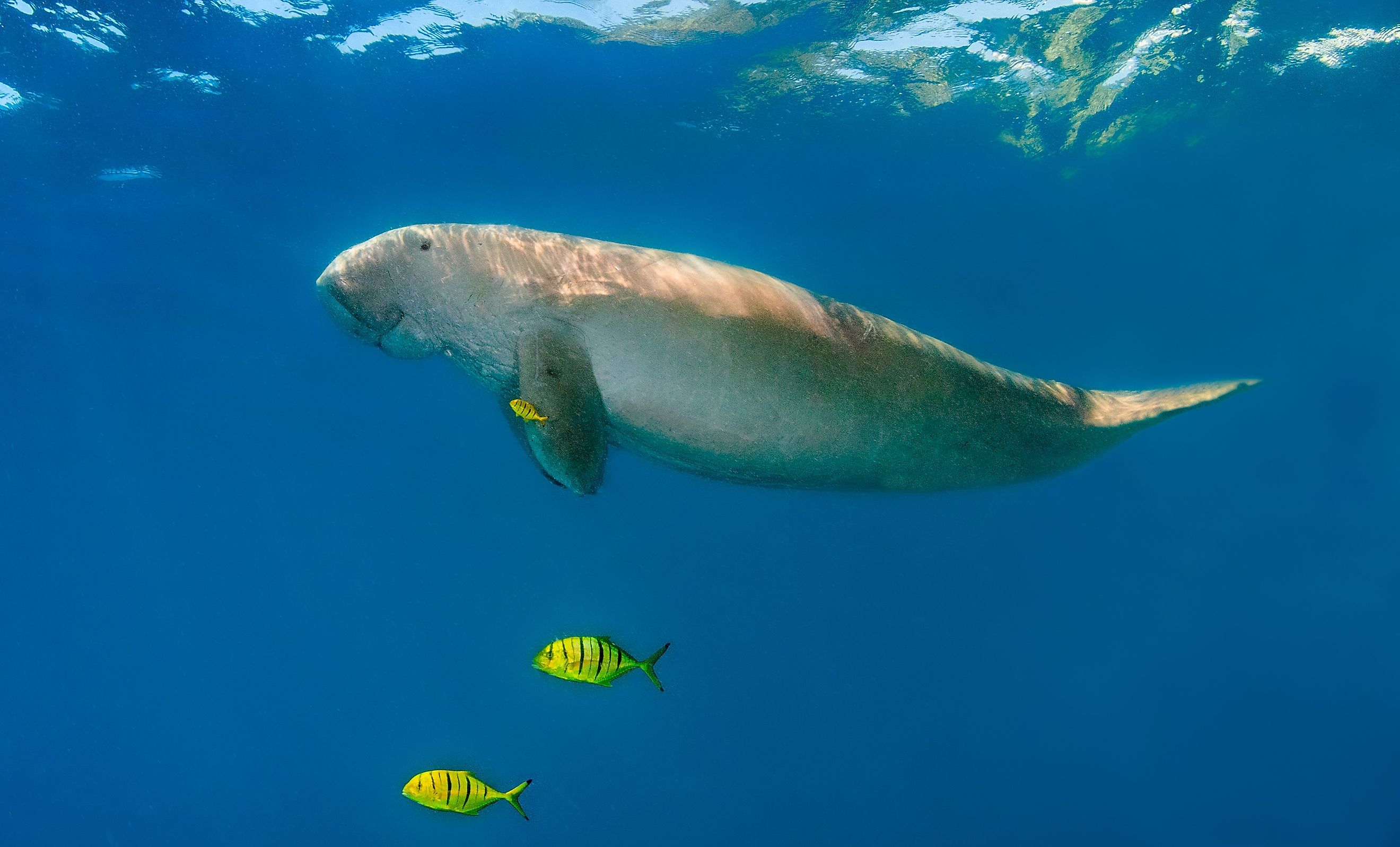
An adult dugong has a heavy, cylindrical body that tapers at both ends and rarely exceeds about 10 feet (3 m) in length, although unusually large individuals may approach 13 feet (4 m). A full-grown animal typically weighs between roughly 510 and 930 pounds (230 to 420 kg), and some heavier animals reach close to 1,100 pounds (500 kg). The skin is thick and smooth, pale at birth and darkening with age to brownish or dark gray. Algae growing on the skin can shift its apparent color still further.
The dugong's tail is its clearest field mark. It ends in a broad, fluked tail shaped much like a dolphin's, which separates it at a glance from the manatees, whose tails are rounded and paddle-shaped. Its forelimbs are short, nail-less flippers used for steering and for pulling itself along the seabed while feeding. The head is set low, with small eyes, no external ears, and a large, downturned snout tipped with a broad, muscular, bristled upper lip. That snout is a feeding tool, built for rooting seagrass out of the sediment. Males, and some older females, grow a pair of short tusklike incisors, and adults of both sexes often carry parallel scars across their backs from mating encounters.
Range and Habitat

The dugong ranges across the waters of some 40 countries and territories throughout the Indo-West Pacific, reaching the coast of East Africa in the west and Vanuatu and the islands of the western Pacific in the east. It is the only sirenian found across this vast region. Northern Australia holds by far the largest remaining populations and is considered the species' modern stronghold, while the Persian Gulf supports the second-largest concentration.
Wherever it lives, the dugong is tied closely to seagrass. It favors warm, shallow, sheltered waters such as broad bays, mangrove channels, and the protected flats around inshore islands, usually at depths of around 33 feet (10 m), though it can dive to about 128 feet (39 m) to reach deeper meadows. It is a strictly marine animal, unlike its manatee relatives, which often move into fresh water. Because its survival depends on seagrass, its distribution is patchy and follows the meadows, and the historical range has contracted sharply as those meadows have been lost.
Diet

The dugong is the world's only fully herbivorous marine mammal, and its diet is built almost entirely around seagrass. A single adult can consume tens of kilograms of vegetation in a day, with estimates commonly running up to about 66 pounds (30 kg) and, in some accounts, as high as 110 pounds (50 kg), roughly 10 to 15 percent of its body mass. It feeds both day and night, using the coarse, sensitive bristles on its upper lip to locate plants and its muscular snout to uproot whole seagrass shoots from the seabed. This style of feeding leaves distinctive cleared trails winding across the meadow.
Dugongs favor low-fiber, nutrient-rich seagrasses and will return to productive beds again and again. When seagrass is scarce, some populations, such as those in Moreton Bay in Australia, supplement their diet with invertebrates like sea squirts and shellfish, but plant matter remains the core of what keeps them alive.
Behavior

Dugongs are slow, deliberate animals that cruise at around 6 miles per hour (10 km/h) and surface every few minutes to breathe. They are usually seen alone or in mother-and-calf pairs, but where seagrass is abundant they may gather into loose herds of a hundred or more, and the largest recorded gathering numbered several hundred animals. They are shy and generally avoid boats and people, often responding to disturbance by shifting their feeding to quieter times or moving to less-traveled areas.
Eyesight is poor, so dugongs rely heavily on sound and touch. They communicate through a range of chirps, whistles, barks, and trills that carry through the water, and in some regions males produce complex whistling songs during the breeding season. Though they can travel long distances between feeding grounds, dugongs are not truly migratory, and they show a strong memory for productive meadows, returning to specific sites even after long journeys away.
Reproduction

Few large mammals reproduce as slowly as the dugong, and that pace is central to its vulnerability. Females may not bear their first calf until somewhere between 6 and 17 years of age, and both sexes reach maturity late. Breeding can occur year-round, and in some populations males compete in scrambling mating herds while in others they gather in display groups to sing for females.
After a long gestation of about 13 to 15 months, a female gives birth to a single calf, roughly 4 feet (1.2 m) long and weighing around 66 to 77 pounds (30 to 35 kg). Calves can swim and even nibble seagrass almost from birth, but they depend on their mother's milk to grow quickly and nurse for 18 months or more. During this time a calf stays close to its mother, often riding just above her back. A female may wait 3 to 7 years between calves, and over a life that can stretch to around 70 years she raises only a small number of young. Recorded lifespans reach up to about 73 years, with age estimated from growth layers in the animal's tusks.
Importance to Marine Ecosystems

The dugong functions as an ecosystem engineer in the seagrass meadows where it lives. By cropping and uprooting seagrass as it feeds, it shapes the structure and species mix of the meadow, a process sometimes described as cultivation grazing that can encourage the growth of the nutrient-rich seagrasses the dugong prefers. Healthy, well-grazed meadows in turn support fish, invertebrates, and other marine life, and they store large amounts of carbon in the seabed.
Because dugongs depend so completely on seagrass, they also serve as an indicator of coastal marine health. Thriving dugong populations point to healthy meadows, while declines often signal that those meadows are in trouble. The animal carries deep cultural importance too. Traditional Owners of the Great Barrier Reef have lived alongside dugongs for tens of thousands of years, and the species remains woven into coastal traditions across its range.
Threats and Conservation

The International Union for Conservation of Nature lists the dugong as Vulnerable on its global Red List, a status it has held since 1982, with a decreasing population trend recorded in the most recent global assessment. That single global label hides a harsher regional picture. Some subpopulations have been reassessed as Critically Endangered, including the one in East Africa, and the dugong is now considered functionally extinct in the waters of China. Only a few areas, notably northern Australia and the Persian Gulf, remain relatively secure. Estimates of the total number of dugongs left are difficult, with figures on the order of 100,000 animals often cited across the roughly 40 range countries.
The greatest single threat is accidental drowning in gill nets and other fishing gear, which entangles dugongs as bycatch. Loss and degradation of seagrass meadows, driven by coastal development, dredging, and water pollution, is a close second, and when meadows fail, dugongs breed poorly or not at all. Boat strikes, illegal hunting for meat, hides, and oil, and the effects of a warming ocean add further pressure. Natural predators such as sharks, killer whales, and crocodiles take some animals as well.
The dugong's slow reproduction means populations recover very slowly from any of these losses. Conservation efforts focus on protecting seagrass habitat, reducing bycatch through changes to fishing practice, and international protection under agreements such as the Convention on International Trade in Endangered Species. Sustained protection of shallow coastal waters remains the single most important step for the animal's future.
Takeaway
The dugong is a quiet survivor from an ancient branch of mammal life, the last of its family and the only marine mammal to feed entirely on plants. Its slow, seagrass-bound existence has made it both a shaper of coastal ecosystems and a sensitive gauge of their health. That same slowness leaves it poorly equipped to bounce back from the fishing gear, habitat loss, and pollution now pressing on it across much of its range. Whether the dugong endures will depend largely on whether the shallow seagrass meadows it needs are protected, and its fate stands as a clear measure of how well we care for the tropical coastal seas it calls home.
Fun Facts

- They inspired the mermaid myth. The order Sirenia is named after the sirens of Greek legend, and generations of sailors are thought to have mistaken dugongs and their relatives for mermaids.
- Their closest land relative is the elephant. Despite living at sea, dugongs are more closely related to elephants than to whales, dolphins, or seals.
- They leave visible feeding trails. As a dugong uproots seagrass, it clears winding paths across the meadow that mark exactly where it has been grazing.
- They have tiny brains for their size. A dugong's brain makes up only about 0.1 percent of its body weight, roughly 10.5 ounces (300 g) in an animal that can weigh nearly half a ton.
- The last of their family already lost a giant cousin. The dugong's nearest relative, Steller's sea cow, was hunted to extinction in the 18th century, leaving the dugong as the only living member of the family Dugongidae.
Quick Facts
- Scientific name: Dugong dugon
- Family and order: Dugongidae, order Sirenia
- IUCN status: Vulnerable (decreasing trend), with some subpopulations Critically Endangered
- Length: up to about 10 feet (3 m), rarely near 13 feet (4 m)
- Weight: about 510 to 930 pounds (230 to 420 kg), occasionally near 1,100 pounds (500 kg)
- Lifespan: up to about 70 to 73 years
- Diet: herbivore, feeding mainly on seagrass
- Range: shallow coastal waters of the Indo-West Pacific, spanning East Africa and the western Pacific, across about 40 countries and territories