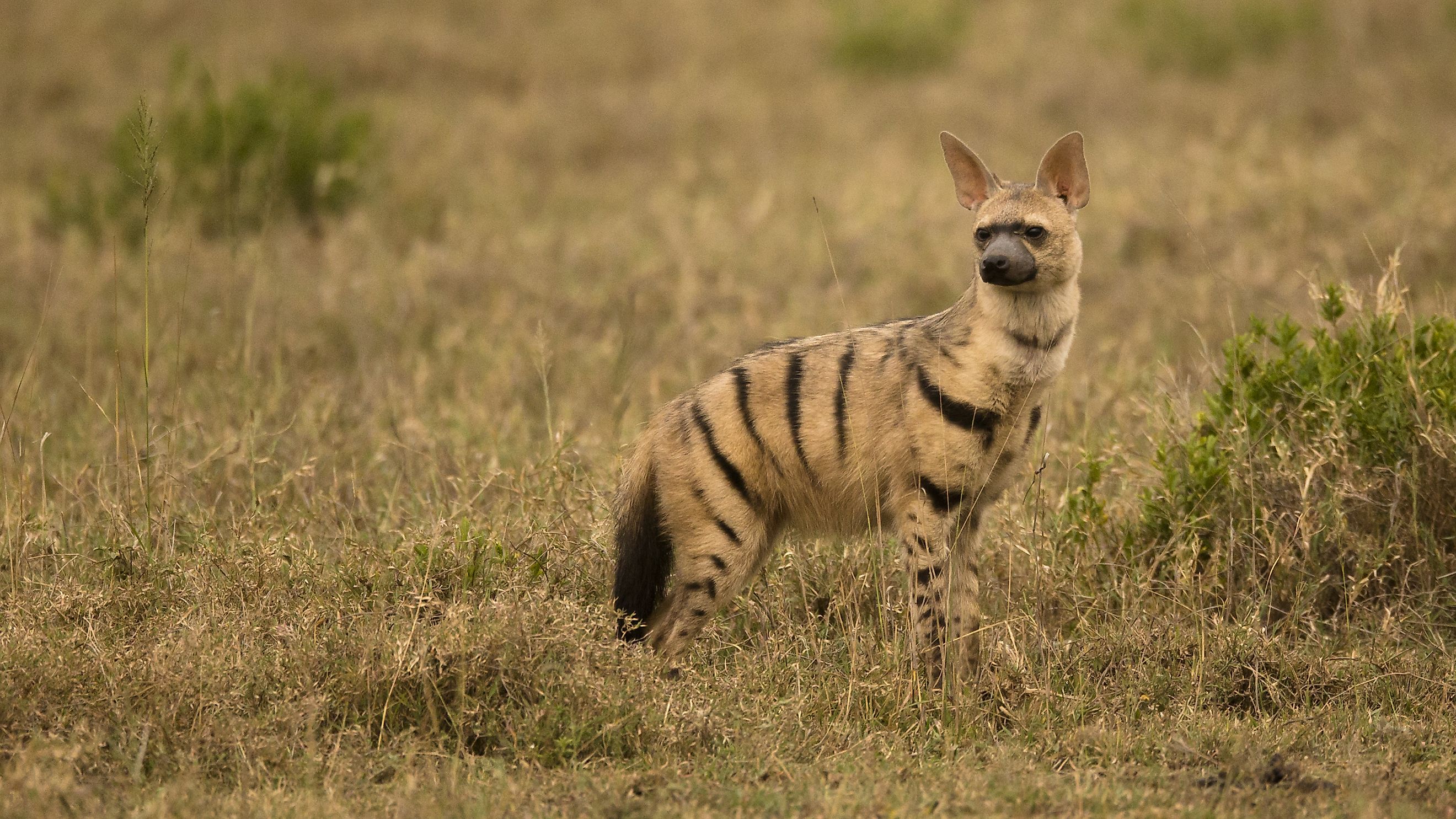
Aardwolf
The aardwolf is the oddball of the hyena family, a slender, striped insect eater that survives almost entirely on termites rather than the flesh and bone that fuel its larger cousins. Native to the dry savannas of Eastern and Southern Africa, this shy, nocturnal mammal can lap up as many as 300,000 termites in a single night with a long, sticky tongue built for the task.
Despite a name that translates as "earth-wolf" from Afrikaans and Dutch, the aardwolf is neither an aardvark nor a wolf. It belongs to the family Hyaenidae, making it a true relative of the spotted, brown, and striped hyenas, yet it has abandoned their predatory lifestyle almost completely. The result is one of Africa's most specialized carnivores, an animal that hunts insects with the patience of a foraging anteater and defends its ground with scent rather than teeth.
Taxonomic Classification

The aardwolf carries the scientific name Proteles cristata, first described by the Swedish naturalist Anders Sparrman in 1783. It sits within the order Carnivora, the family Hyaenidae, and its own subfamily, Protelinae, of which it is the only living member. Among the four surviving hyaenid species, molecular studies place the aardwolf as the most basal, meaning it branched off earliest from the common ancestor of the group.
Two subspecies are traditionally recognized. Proteles cristata cristata occupies the southern range, while Proteles cristata septentrionalis, described by Rothschild in 1902, occupies the northeastern range. Recent genetic work has complicated this picture. A 2021 study found that the eastern and southern populations differ enough that some authorities, including the American Society of Mammalogists, now treat them as two separate species, Proteles cristatus and Proteles septentrionalis.
The aardwolf's evolutionary history is unusually murky. Genetic evidence suggests the lineage split from other hyenas roughly 15 million years ago, yet the oldest fossils that clearly resemble the modern animal date to only about 4 million years ago. That long gap has earned the aardwolf a reputation as something of a "ghost lineage," a creature whose deep past remains poorly recorded in stone.
Physical Description

The aardwolf looks like a small, delicate striped hyena, and that resemblance is no accident. An adult measures roughly 22 to 32 inches (55 to 80 cm) in head and body length, with a bushy tail adding another 8 to 12 inches (20 to 30 cm). It stands about 16 to 20 inches (40 to 50 cm) at the shoulder and typically weighs 15 to 22 pounds (7 to 10 kg), though large individuals can reach 33 pounds (15 kg). Eastern animals tend to run heavier than their southern counterparts. Whatever the region, the aardwolf is the smallest living member of the hyena family.
Its coat is pale buff to yellowish brown, marked with bold vertical black stripes on the body and dark banding on the legs. A long mane of coarse hair runs down the neck and back and can be raised on command. When an aardwolf erects this mane, its silhouette swells dramatically, letting a timid animal appear far larger and more dangerous than it truly is. The tail is bushy with a black tip, and the lower legs are dark.
Below the surface, the aardwolf's specialization becomes obvious. Its cheek teeth have shrunk to simple pegs, useless for chewing meat but adequate for a diet of soft insects. The canines remain, though the animal relies on them for fighting rivals rather than killing prey. The front feet bear five toes each, one more than the four found on other hyenas, and the tongue is broad and muscular, coated with hardened papillae that stand up to the bite of angry termites.
Range and Habitat

The aardwolf occupies two widely separated regions of Africa, a distribution that mirrors its split into eastern and southern forms. The southern population ranges across parts of Angola, Zambia, Botswana, and Namibia, reaching east into Mozambique and south into South Africa. The northeastern population runs through central Tanzania, Kenya, and northeastern Uganda, up through Ethiopia and Somalia, then narrows along the coast of Eritrea and Sudan to reach the extreme southeast of Egypt. A broad belt of wet woodland across central Africa separates the two, keeping them apart.
Within these regions, the aardwolf favors dry, open savanna and grassland where annual rainfall stays below about 31 inches (80 cm). It avoids true desert and dense forest alike, since both fail to support the surface-foraging termites it depends on. Rocky outcrops, scrub, and short-grass plains suit it well, especially where old aardvark burrows offer ready-made shelter. The animal does not usually dig its own dens, preferring instead to enlarge and reuse the abandoned tunnels of aardvarks, porcupines, and springhares.
Diet

The aardwolf is one of the most narrowly specialized feeders among African mammals. Its diet consists almost entirely of harvester termites, and above all the snouted harvester genus Trinervitermes. Rather than tearing open mounds like an aardvark, the aardwolf waits for termites to forage on the surface at night and licks them straight off the ground with its sticky tongue. A single animal can consume as many as 250,000 to 300,000 termites in one night.
This feeding style depends on acute hearing and a good memory for productive foraging sites, which the animal revisits rather than searching afresh each night. Crucially, the aardwolf takes only part of a colony before moving on, a restraint that lets the termites recover and keeps the food supply steady. Trinervitermes defends itself by squirting noxious terpenes from its soldiers, and as an aardwolf works through a foraging column the proportion of soldiers rises. Eventually the chemical assault becomes too much and the animal leaves, but its tough tongue and unusual tolerance for the toxins let it feed where most predators cannot.
Cold weather poses the biggest dietary challenge. Termites forage less when temperatures drop, and during winter an aardwolf may find only a fraction of its usual meal. To cope, it sometimes shifts to daytime foraging or switches to other harvester termites that stay active in the cold.
Behavior

Aardwolves are nocturnal and, for the most part, solitary. Each animal or breeding pair holds a territory of roughly 0.4 to 1.5 square miles (1 to 4 square km), which it patrols and marks with obsessive regularity. Using secretions from its anal glands, an aardwolf deposits streaks of musky paste on grass stems and rocks, sometimes marking its boundaries up to 200 times in a single night. Shared latrines, or middens, reinforce these chemical signposts, warning neighbors to keep their distance.
Confrontation is not the aardwolf's strong suit. Slow and lightly built, it prefers to avoid a fight rather than start one. When threatened, it raises its mane to look twice its real size, releases a foul-smelling secretion, and may bolt while doubling back on its own tracks to confuse a pursuer. Only when defending a den or territory against another aardwolf does it fall back on its canines, and even then serious injury is rare. Much of its life is spent alone in the dark, moving quietly between termite patches and returning to a burrow before dawn.
Reproduction

Aardwolves form monogamous pairs that share and defend a common territory, though males will sometimes seek matings beyond their own bond, which can spark clashes with neighboring males. Breeding is seasonal and timed to coincide with peak termite activity, falling in the cooler or rainy months depending on the region. After a gestation of about 89 to 92 days, the female gives birth to a litter of two to five cubs, most often two or three, in the safety of a burrow.
The cubs are born with their eyes open but otherwise helpless, weighing only about 7 to 12 ounces (200 to 350 g). They stay underground for their first six to eight weeks, guarded closely by the father while the mother forages nearby. Supervised foraging begins around three months of age, and the young are usually weaned and largely independent by four months, though they may linger in the parents' territory until the next breeding season. Sexual maturity arrives at roughly two years. In the wild an aardwolf typically lives 7 to 10 years, while captive animals have reached about 15.
Importance to the World

Though it rarely draws the attention given to Africa's big predators, the aardwolf plays a quiet but useful role in savanna ecosystems. By feeding heavily on harvester termites, it exerts a steady, top-down pressure on insect populations that would otherwise strip grasses and alter soil dynamics. A single aardwolf can remove tens of millions of termites over the course of a year, making it a natural check on species that farmers often regard as pests.
That service earns the animal a measure of goodwill. Many landowners view aardwolves as harmless and even beneficial, since they take termites rather than livestock. The aardwolf also forms part of the food chain in its own right, falling prey to predators such as jackals and serving as one more thread in the web of savanna life. In this way a small, retiring insectivore helps hold together an ecosystem far larger than itself.
Threats and Conservation

The aardwolf is classified as Least Concern on the IUCN Red List, and its population is considered stable and widespread across a large range. It occurs in numerous national parks and reserves, and international trade is not a significant concern, so the species is not listed on CITES. Compared with many African carnivores, the aardwolf is in a reassuring position.
That relatively secure status does not mean the aardwolf faces no pressures. Habitat loss from expanding agriculture and development can fragment its range, and the animal is sometimes killed by dogs, struck on roads, or poisoned by pesticides aimed at locusts and termites. In some areas it is hunted for its fur or for use in traditional medicine, and it occasionally suffers from being mistaken for a stock-killing predator, a case of mistaken identity for an animal that could not harm a lamb if it tried. Even so, its ability to thrive on farmland and its reliance on abundant termites have helped it hold its ground where many larger carnivores have declined.
Takeaway
The aardwolf has carved out an unusual niche among Africa's hyenas. Rather than pursuing large prey, it feeds almost entirely on termites, using its long, sticky tongue to gather them in large numbers. Small and secretive, it relies on specialized feeding habits and scent marking to defend its territory rather than the physical strength associated with larger carnivores. Its stable conservation status is notable at a time when many African carnivores face growing pressures. The aardwolf demonstrates that survival can depend on exploiting a food source and way of life that other predators largely leave untouched.
Fun Facts

- Neither aardvark nor wolf. The name means "earth-wolf" in Afrikaans and Dutch, but the aardwolf is a true member of the hyena family.
- The smallest hyena. Among the four living hyaenid species, the aardwolf is by far the smallest and slightest.
- A 300,000-termite appetite. In one night of foraging, a single aardwolf can lap up as many as 300,000 termites.
- Built-in toxin tolerance. The aardwolf can stomach the noxious terpenes that harvester termites use to repel almost every other predator.
- A ghost lineage. Genetics suggests the aardwolf split from other hyenas around 15 million years ago, yet clear fossils appear only about 4 million years back.
- One extra toe. Unlike other hyenas, which have four toes on the front feet, the aardwolf has five.
- A marking machine. An aardwolf may scent-mark its territory up to 200 times in a single night.
Quick Facts
- Common name: Aardwolf
- Scientific name: Proteles cristata
- Family: Hyaenidae (order Carnivora)
- IUCN status: Least Concern
- Length: 22 to 32 inches (55 to 80 cm), plus an 8 to 12 inch (20 to 30 cm) tail
- Shoulder height: 16 to 20 inches (40 to 50 cm)
- Weight: 15 to 22 pounds (7 to 10 kg), up to 33 pounds (15 kg)
- Lifespan: 7 to 10 years in the wild, up to 15 in captivity
- Diet: Insectivore, mainly harvester termites
- Range: Eastern and Southern Africa