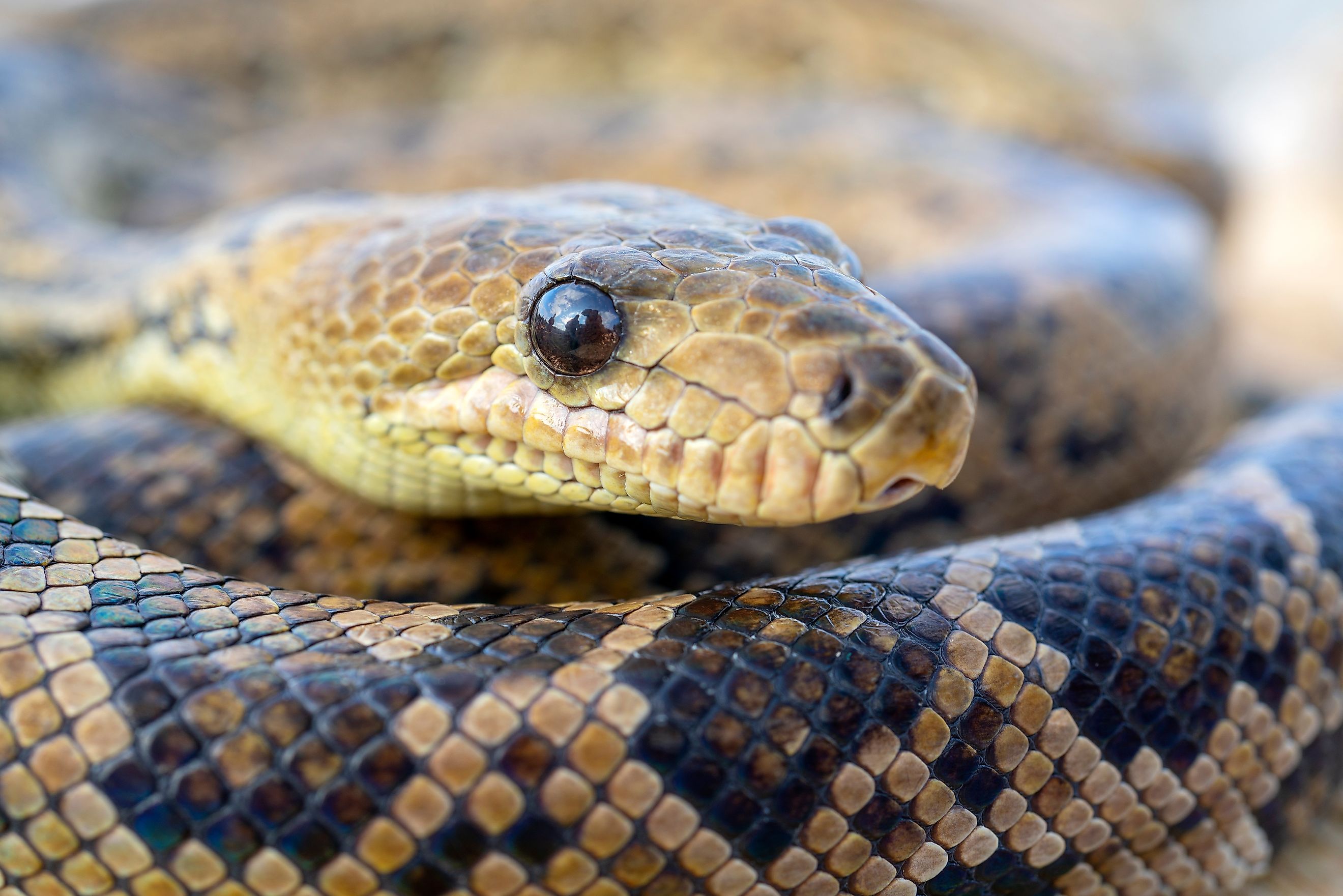
Cuban Boa
The Cuban boa (Chilabothrus angulifer) is the largest native land predator on the island of Cuba and one of the biggest snakes found anywhere in the West Indies. Heavy-bodied and unhurried, it can stretch beyond 13 feet (4 m) in length and, in exceptional historical cases, closer to 18 feet (5.5 m). It kills not with venom but with muscle, coiling around prey and tightening its grip until the animal can no longer breathe.
Known to Cubans as the Majá de Santa María, this snake is found nowhere else on Earth. It lives in the forests, scrublands, and cave systems of Cuba and a scattering of its offshore islands, where it has become a flagship reptile of the Greater Antilles. What makes it remarkable is not only its size but its behavior, because researchers have documented Cuban boas doing something almost no other snake is known to do, which is hunting together in coordinated groups.
Taxonomic Classification

The Cuban boa belongs to the family Boidae, the true boas, within the order Squamata (lizards and snakes). It was first described in 1840 by the French naturalists Jean-Théodore Cocteau and Gabriel Bibron, who placed it in the genus Epicrates as Epicrates angulifer. For well over a century that was its accepted name.
That changed in 2013, when a molecular study of West Indian boid snakes by Reynolds and colleagues reorganized the group. The Caribbean boas were moved into the resurrected genus Chilabothrus, giving the species its current name, Chilabothrus angulifer. The genus name comes from Greek roots meaning "lips without pits," a slightly ironic label, because this species does in fact possess heat-sensing labial pits. The species name angulifer refers to the angular shapes in its dorsal pattern.
No subspecies are currently recognized. The Cuban boa stands as a single, well-defined species, part of an ancient lineage of Caribbean boas whose ancestors colonized the islands from the mainland tens of millions of years ago.
Physical Description

This is a large, muscular, thick-bodied snake. Most adults measure somewhere between 6.5 and 13 feet (2 to 4 m), and the biggest individuals push past that. Reliable accounts describe animals of roughly 15 feet (4.5 m), and the longest recorded specimen reached about 18.5 feet (5.65 m). A heavy adult can weigh as much as 66 pounds (30 kg), which places the Cuban boa among the most substantial snakes in the Western Hemisphere outside of the giant anacondas and pythons.
Its ground color is usually a yellow-brown or tan, overlaid with dark brown to black angular blotches that run along the back and sides. This patterning breaks up the animal's outline against leaf litter, tree bark, and pale limestone rock, making a resting boa hard to spot. Freshly shed individuals often show a faint iridescent sheen across the scales, a rainbow-like luster that catches the light. Coloration varies by region, tending to look darker and more cryptic in eastern Cuba and paler toward the west.
The head is broad and distinct from the neck, the snout is dark, and the pupils are vertical slits, all features suited to a nocturnal ambush hunter. Females grow larger and heavier than males on average, while males tend to have proportionally longer tails and more prominent cloacal spurs, small clawlike remnants of hind limbs that are used during courtship.
Range and Habitat

The Cuban boa is endemic to Cuba, meaning its entire natural range sits within that single country. Beyond the main island, it occurs on Isla de la Juventud and across several satellite archipelagos, among them los Canarreos, los Colorados, and the Sabana-Camagüey chain of cays.
Within this range it is a habitat generalist. It turns up in rainforest, cloud forest, evergreen and semi-deciduous forest, thorn forest, and coastal scrub, at elevations between sea level and about 3,980 feet (1,214 m). It is especially associated with karst country, the pitted limestone landscapes riddled with caves and crevices that give the boa both shelter and hunting grounds. This broad tolerance lets the species persist even in fragmented and human-altered terrain, including farmland edges, where smaller and pickier snakes would struggle.
Diet

The Cuban boa is a carnivore and an opportunistic ambush predator. Its diet shifts as it grows. Juveniles take smaller prey such as lizards and frogs, while larger adults tackle warm-blooded animals including rodents, hutias (large native Caribbean rodents), birds, and bats. Analysis of hundreds of prey records has shown that mammals and birds together make up the great majority of what these snakes eat, with cold-blooded prey forming only a small share.
Being non-venomous, the boa relies on constriction. It strikes, seizes the prey in its jaws, and throws coils of its body around the animal, tightening with each exhalation until circulation stops. It then swallows the meal whole, head first. Because it is a generalist, the Cuban boa adjusts its hunting style to its surroundings. In wild settings it favors sit-and-wait ambush, while snakes living near people tend to forage more actively, moving in search of the rats and other prey that human settlements attract.
Behavior

Cuban boas are mainly nocturnal and crepuscular, most active in the dark and at dusk. During the day they shelter in rock crevices, hollow logs, dense vegetation, animal burrows, and caves, which helps them avoid overheating and drying out. They are strong climbers, which is why the species is sometimes called the Cuban tree boa, and they move comfortably between the ground and the branches.
For most of its life the boa is solitary. The striking exception is its cave hunting, documented in a landmark 2017 study by biologist Vladimir Dinets in Cuba's Desembarco del Granma National Park. There, boas gather at the entrance passages of bat caves and hang from the ceiling, snatching Jamaican fruit bats out of the air as the colony streams in and out at dusk and dawn.
What Dinets found was that when more than one boa was present, the snakes did not simply crowd the same spot by chance. Later arrivals positioned themselves relative to boas already in place, spreading out to form a living fence across the passage that blocked the bats' flight path. Group hunts organized this way were always successful, and the more snakes took part, the less time each needed to catch a meal. A lone boa, by contrast, sometimes went hungry. This is the first documented case of coordinated hunting in any reptile, a discovery that upended the old assumption that snakes are strictly solitary foragers.
Reproduction

Unlike many reptiles, the Cuban boa does not lay eggs. It is viviparous, giving birth to fully formed live young. Females are typically biennial breeders, reproducing roughly every other year, and they take five or more years to reach breeding size. In this species, a female's ability to reproduce is governed by her body size rather than strictly by her age.
The mating season generally runs through April, May, and June. Males compete for access to females and engage in ritualized combat, wrestling for position, and courtship itself is needed to trigger the female's reproductive cycle. Gestation in the wild lasts about 150 to 180 days, with the exact length shaped by the temperatures the pregnant female experiences. Births usually take place in September and October. Litter sizes in the wild usually run between two and about 22 young, with larger females producing larger litters and larger babies. The newborns are independent from the moment of birth and can hunt small prey on their own. Cuban boas are long-lived, reaching 20 to 30 years or more, and captive individuals have continued reproducing past the age of 30.
Importance to the World

As the largest native terrestrial predator in Cuba, the Cuban boa occupies a key place in its island food web. By preying on rodents and other small mammals, it helps keep those populations in check, a service that carries real value around farms and settlements where rats can damage crops and stores. Its hunting of bats, birds, and native rodents links several parts of the ecosystem together and makes the species an important regulator of Cuban wildlife.
The boa is also valuable as an umbrella species. Because it needs large, connected stretches of forest and undisturbed cave country to thrive, protecting its habitat automatically shelters the many other endemic animals that share those places, such as bats, hutias, smaller reptiles, and amphibians. Land set aside for the island's biggest snake ends up guarding whole communities of Cuban wildlife. That role, combined with the animal's size and fame, makes it a natural flagship for conservation, a recognizable species that can rally public interest and funding toward the karst forests and limestone landscapes that so much of Cuba's unique fauna depends on.
Threats and Conservation

On the IUCN Red List, the Cuban boa was assessed as Least Concern in 2021, reflecting its wide distribution across the island and its broad habitat tolerance. That relatively secure global rating, however, masks real local declines, and the species is far from free of pressure.
Habitat loss and fragmentation from agriculture, development, and deforestation continue to shrink and divide its forests. The snake is also killed directly by people, sometimes out of fear and sometimes because it takes poultry or is regarded as a nuisance. Collection for the exotic pet trade removes animals from the wild, and introduced predators such as rats, cats, mongooses, and dogs can prey on young boas and compete for food. Researchers have noted that the spectacle of cave-hunting boas is becoming harder to witness, because only the most remote caves still hold healthy groups of them. Cuba's network of protected areas offers some refuge, and national environmental law provides a legal framework for safeguarding native wildlife, but sustained monitoring remains important for keeping local populations stable.
Takeaway
The Cuban boa is more than a large, secretive ambush predator. Its cooperative hunting behavior has challenged long-standing assumptions about reptile cognition, showing that snakes are capable of coordinating their actions to catch prey. As Cuba's top native land predator, it helps shape the island's ecosystems and regulate populations of animals that can become agricultural pests. Its current Least Concern status indicates that the species remains widespread, but continued forest loss and declines in some cave-dwelling prey populations could create local pressures. Protecting Cuba's karst forests and cave systems will help maintain the habitats that support this distinctive constrictor.
Fun Facts

- It hunts in packs. The Cuban boa is the only snake known to coordinate its hunts, forming a living wall across cave passages to trap bats in flight.
- Lips without pits, except it has them. Its genus name Chilabothrus translates roughly to "lips without pits," yet this species actually carries heat-sensing labial pits.
- It gives birth to live young. Rather than laying eggs like most snakes, the Cuban boa bears fully formed babies that can hunt from day one.
- It can outlive a family dog many times over. Individuals routinely reach 20 to 30 years, and some have reproduced past the age of 30.
- It shimmers after shedding. A freshly molted boa shows a faint iridescent, oil-on-water sheen across its scales.
- It is a Cuban original. The species lives naturally nowhere else on the planet, making it a true island endemic.
Quick Facts
- Common name: Cuban boa (also Cuban tree boa, Majá de Santa María)
- Scientific name: Chilabothrus angulifer
- Family: Boidae
- Order: Squamata
- IUCN status: Least Concern (assessed 2021)
- Length: commonly 6.5 to 13 feet (2 to 4 m); largest recorded about 18.5 feet (5.65 m)
- Weight: up to about 66 pounds (30 kg)
- Lifespan: 20 to 30 years or more; over 30 in captivity
- Diet: carnivore (rodents, hutias, birds, bats, lizards, frogs)
- Reproduction: viviparous, litters of roughly 2 to 22 young
- Range: endemic to Cuba, Isla de la Juventud, and nearby island cays
- Habitat: forests, scrub, and karst cave country at sea level up to about 3,980 feet (1,214 m)