10 Animals With The Strongest Bites
Here is the first thing to know about "strongest bite" lists: almost none of these numbers were actually measured. Bite force, the pressure an animal's jaws generate, gets reported in pounds per square inch (psi), and for a handful of animals scientists really did strap a sensor between the jaws and read the dial. For most of the rest, the famous figures are educated guesses, computer models, or numbers that got repeated online until they hardened into "fact." So think of this less as a strict leaderboard and more as a tour, with a clear note each time about whether a number was measured, estimated, or is frankly just legend. We will start with the animal that holds the actual record, then work through the heavy hitters.
Saltwater Crocodile - 3,700 psi (measured)

Start with the champion, because this one is not a guess. In a decade-long study, paleobiologist Gregory Erickson and his team placed a bite-force sensor between the jaws of live crocodilians, and a 17-foot saltwater crocodile (Crocodylus porosus) clamped down at 3,700 psi. That is the strongest bite force ever directly recorded in any living animal, full stop. Scale that up to the largest historical individuals and researchers think 7,700 psi is plausible, though no one has measured a monster that size and lived to publish it.
The saltwater crocodile is the world's largest living reptile, reaching around 1,000 kilograms, and it uses that bite to grab prey and haul it into a spinning "death roll." Here is the strange twist: the muscles that snap a croc's jaws shut are ferociously strong, but the muscles that open them are so weak a person can hold the snout closed with their bare hands. Salties will take just about anything that comes to the water's edge, from fish and turtles to wild boar and buffalo.
Nile Crocodile - around 5,000 psi (estimated)

The Nile crocodile (Crocodylus niloticus) is smaller than its saltwater cousin, yet it is often credited with an even higher bite, with figures near 5,000 psi floating around. Treat that number with care: it is an estimate scaled from measurements of smaller animals, not a reading taken from a giant. What is solid is that crocodilian bite force tracks body size almost perfectly, so a truly enormous Nile croc could bite harder than a mid-sized saltie even if the species tops out smaller.
Nile crocodiles live across sub-Saharan Africa in fresh water, though they tolerate brackish conditions too. They are ambush hunters with the patience to wait out almost anything, and they live in loose hierarchies where the biggest animals eat first. The largest on record pushed past a thousand kilograms.
American Alligator - 2,980 psi (measured)

The other member of the measured club is the American alligator (Alligator mississippiensis). A 13-foot wild specimen registered 2,980 psi on Erickson's sensor, second only to the saltwater croc among animals actually tested. Alligators live in the southeastern United States, with smaller populations in Mexico and a separate species in China. Unlike crocodiles, they lack the glands to expel salt, so they stick to fresh water.
They are opportunists that often eat only once a week. Young alligators are the energetic ones, even snatching birds from just above the water, while older gators settle into an ambush routine of fish, snakes, and any mammal that wanders too close. Florida logs the most alligator bites on people in the country, and with that kind of jaw pressure, a serious bite is no small thing.
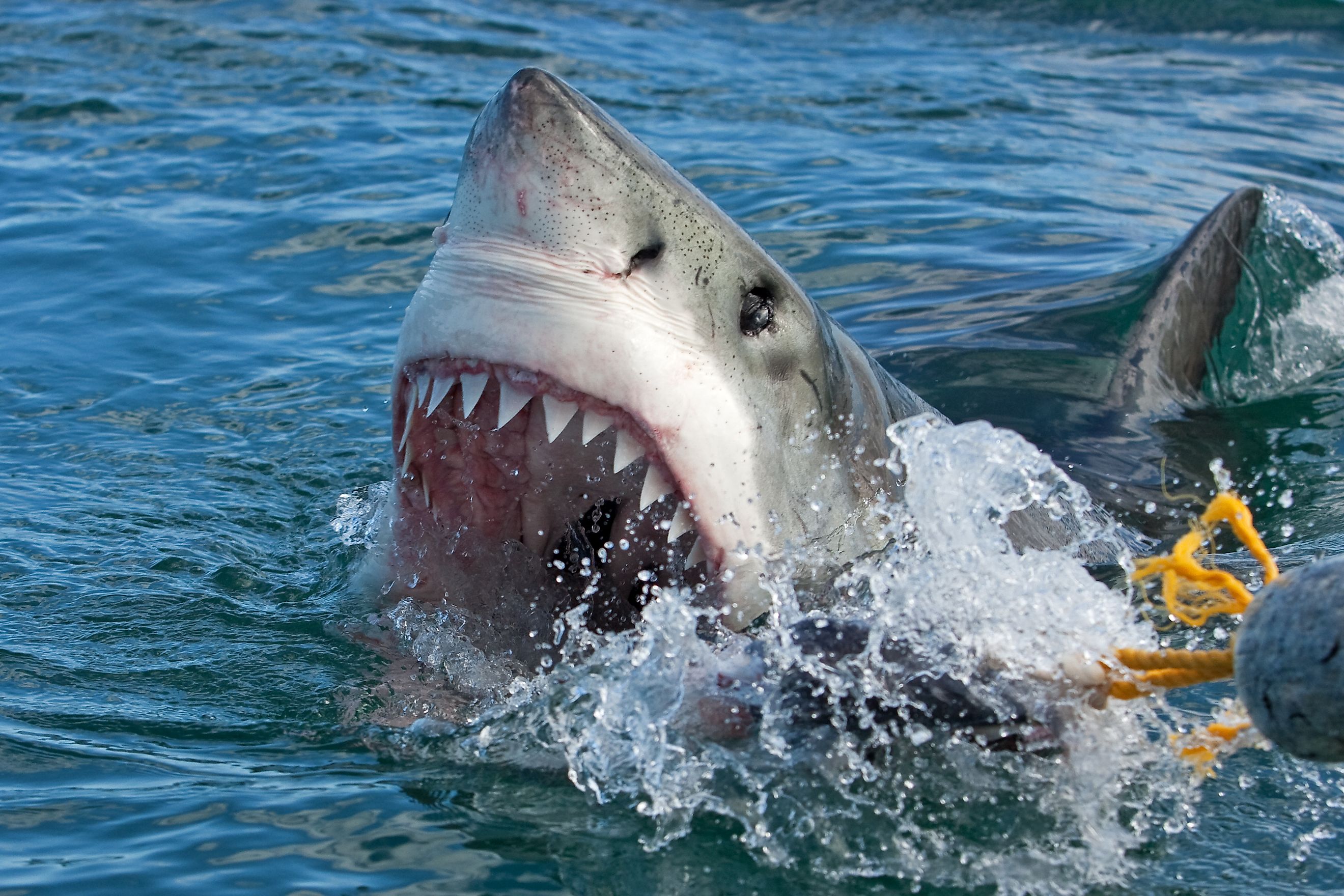
Great White Shark - around 4,000 psi (estimated by model)

This is the number most people have heard, and it deserves an asterisk. The oft-quoted 4,000 psi comes from a 2008 study that built a digital model of a very large 21-foot great white (Carcharodon carcharias) and calculated what its jaws could theoretically produce. No one has ever measured a live great white's bite, and typical 11-to-15-foot individuals would come in far lower, closer to 1,200 psi. So the shark's fearsome reputation is real, but the headline figure is a projection, not a reading.
Great whites do not chew. They use serrated teeth to shear prey into chunks they swallow whole, which means they never needed crocodile-grade crushing power in the first place. They hunt seals and sea lions across the world's coastal oceans, can exceed 20 feet, and, despite the movies, remain poorly understood. Conservation groups list them as vulnerable, hit by decades of finning and trophy hunting.
Hippopotamus - around 1,800 psi (measured in females)

The hippo (Hippopotamus amphibius) is the plot twist of any bite-force list: it is a committed vegetarian with one of the most powerful jaws on land. Females have been measured at around 1,800 psi. The males, fittingly, proved too aggressive to test, so their true number is anyone's guess. The word "hippopotamus" comes from Greek for "river horse," which undersells things considerably.
A hippo did not evolve that bite for salad. It uses those jaws, which can gape 180 degrees and carry tusks up to two feet long, to fight rivals and warn off predators, and it is famously willing to use them. Hippos weigh up to 8,000 pounds, hit 30 miles per hour over short distances, and are considered among the most dangerous large animals in Africa. They are also the third-largest living land mammal, and their numbers sit around 115,000 to 130,000.
Jaguar - around 1,500 psi (estimated)

Pound for pound, the jaguar (Panthera onca) has the strongest bite of any big cat, estimated around 1,500 psi. Most cats go for the throat; the jaguar just bites through the skull. That same bite punches through turtle shells and caiman hide, prey almost nothing else can crack. Jaguars range from the southwestern United States down through Central and South America, growing to nearly two meters long and around 100 kilograms.
They are opportunists that eat everything from fish and lizards to deer-sized mammals, and they will happily take prey heavier than themselves. Deforestation, farmland expansion, and poaching are steadily squeezing their range and their food supply.
Gorilla - around 1,300 psi (estimated)

Here is another vegetarian with a startling estimate attached: roughly 1,300 psi for the gorilla (genus Gorilla). Gorillas live in the tropical forests of equatorial Africa and spend most of their time on the ground, using those jaws mainly to strip bark and grind tough vegetation, with the occasional ant, snail, or grub for variety. Fruit and even flowers are treats when in season.
Gorillas barely need dietary protein, since bacteria in their gut synthesize much of what they require, yet they still reach 200 kilograms and can stand as tall as a person. They share roughly 98 percent of their DNA with humans, close enough that a human cold can make them seriously ill. Mountain gorillas remain endangered, with just over a thousand individuals left in the wild.
Polar Bear - around 1,200 psi (estimated)

Estimated near 1,200 psi, the polar bear (Ursus maritimus) has the strongest bite of any bear, which fits an animal that survives one of the harshest environments on Earth. Polar bears rule the Arctic marine food chain and live mostly on ringed seal, feasting hard when hunting is good because lean stretches of three or four months are routine. Most of that hunting is patience: sitting motionless beside a hole in the ice, waiting for a seal to surface.
They are the most carnivorous bears, though a stranded polar bear will nose around for berries or seaweed on land. Their real trouble is the ice itself. As the Arctic warms and sea ice forms later each year, the hunting platforms they depend on are vanishing, forcing longer fasts and drawing hungry bears toward coastal towns.
Grizzly Bear - 900 to 1,200 psi (estimated)

The grizzly (Ursus arctos horribilis) lands in the 900-to-1,200 psi range, a hair behind its polar cousin. Grizzlies are North American omnivores, and despite the fearsome reputation they are estimated to eat a diet that is largely vegetation, berries, roots, grasses, and fish, rounded out with deer or moose when the opportunity appears. They are just as happy to scavenge another animal's kill.
Before winter, a grizzly may pack away up to 90 pounds of food a day to build the fat it needs to hibernate. They are not the most agile hunters, so they often target the sick or injured, but with that bite, claws, and bulk, a grizzly can hold down large prey and crack heavy bone with ease.
Spotted Hyena - around 1,100 psi (measured range)

The spotted hyena (Crocuta crocuta) closes the list with around 1,100 psi, a genuinely strong bite for its size and one built for a specific job: cracking bone to reach the marrow inside. That comfortably beats a lion, which comes in near 650 to 1,000 psi, and hyenas will happily muscle lions off a kill. For the record, hyenas are neither dogs nor cats. They sit in their own family, Hyaenidae, within the cat-like branch of the carnivores, so they are closer kin to felines than to canines despite the doggish look.
Hyenas live across sub-Saharan Africa and into parts of Asia, and they are scavengers as much as hunters, taking down prey when they can and cleaning up carrion when they cannot. Their teeth and guts are built to process bone, so very little of a carcass goes to waste.
So Where Does That Leave the Orca and the Human?
You may have noticed a famous name missing. The orca, or killer whale (Orcinus orca), is often crowned the hardest biter alive, with an eye-popping 19,000 psi splashed across the internet. The catch is that no one has ever measured it. That figure is an estimate built on the animal's size and muscle, and plenty of scientists consider it inflated. An orca is unquestionably a devastating predator, powerful enough to flip seals and take on great white sharks, but its real bite force remains an open question, so it does not belong on a list of confirmed record-holders. It is the perfect example of a number that became "fact" through sheer repetition.
As for us, humans bite at roughly 120 to 160 psi, which is enough for a sandwich and not much of a threat to anything else here. That is more than twenty times weaker than a saltwater crocodile. The sensible takeaway from all of this is the obvious one: admire these jaws from a comfortable distance, and leave the biting contests to the professionals.