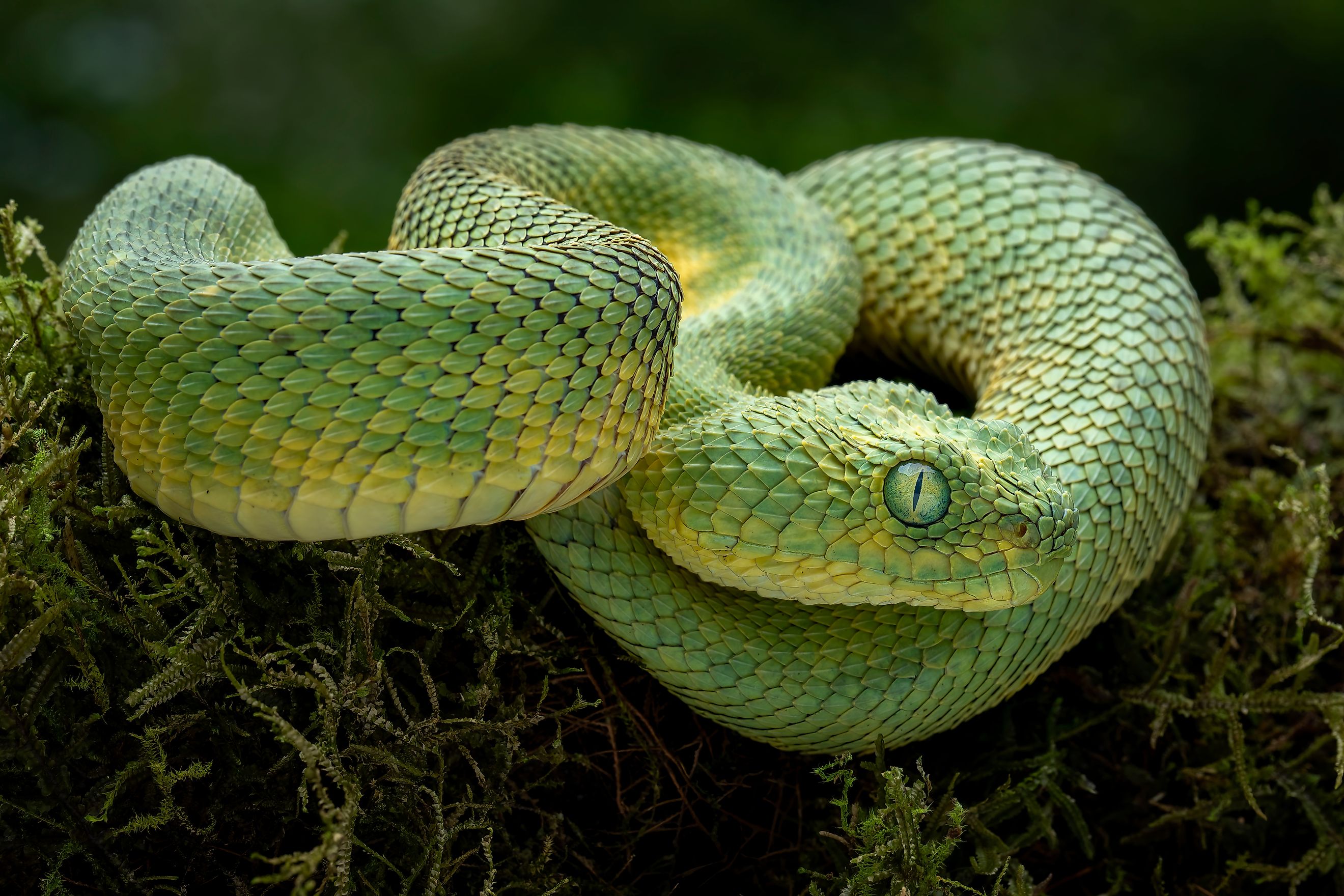
Green Bush Viper
The green bush viper (Atheris squamigera) is one of Africa's most visually striking venomous snakes, a tree-dwelling ambush hunter wrapped in rough, overlapping scales that give it an almost dragon-like profile. Found across the rainforests of West and Central Africa, this relatively small viper spends its life coiled among low branches and flowering shrubs, waiting for prey to wander within striking range.
Though it rarely exceeds a couple of feet in length, the green bush viper commands attention for its potent hemotoxic venom and its remarkable color variation, which spans vivid green, yellow, and other shades. It is a snake far better known to reptile enthusiasts and toxinologists than to the general public, yet it plays a quiet and important role in the forest ecosystems it calls home. Its very name has shifted more than once over the years as naturalists worked to pin down exactly where this snake belongs among the world's vipers.
Taxonomic Classification

The green bush viper belongs to the family Viperidae, the group that contains the true vipers, and sits within the subfamily Viperinae. Its genus, Atheris, comprises the African bush vipers, a cluster of arboreal snakes found only in sub-Saharan Africa. The full scientific name is Atheris squamigera, with the species epithet drawn from Latin roots meaning "scale-bearing," a fitting reference to its heavily keeled hide.
American herpetologist Edward Hallowell first described the species in the mid-1850s, originally placing it in the genus Echis based on a specimen collected near the Gabon River. Later revisions moved it into Atheris once its arboreal adaptations and relationships were better understood. The species carries a long list of historical synonyms, a reflection of how often early naturalists reshuffled African viper taxonomy.
Today no subspecies are formally recognized, although several were proposed over the years and some populations remain debated by specialists. The snake goes by a handful of common names, including variable bush viper, leaf viper, and Hallowell's green tree viper, each hinting at either its coloration or its leafy habitat.
Physical Description

The green bush viper is a compact snake. Adults average roughly 18 to 24 inches (46 to 60 cm) in total length, and exceptional individuals can surpass 31 inches (78 cm). Females typically grow larger than males. Despite its modest size, the animal has a stout, muscular build suited to gripping branches.
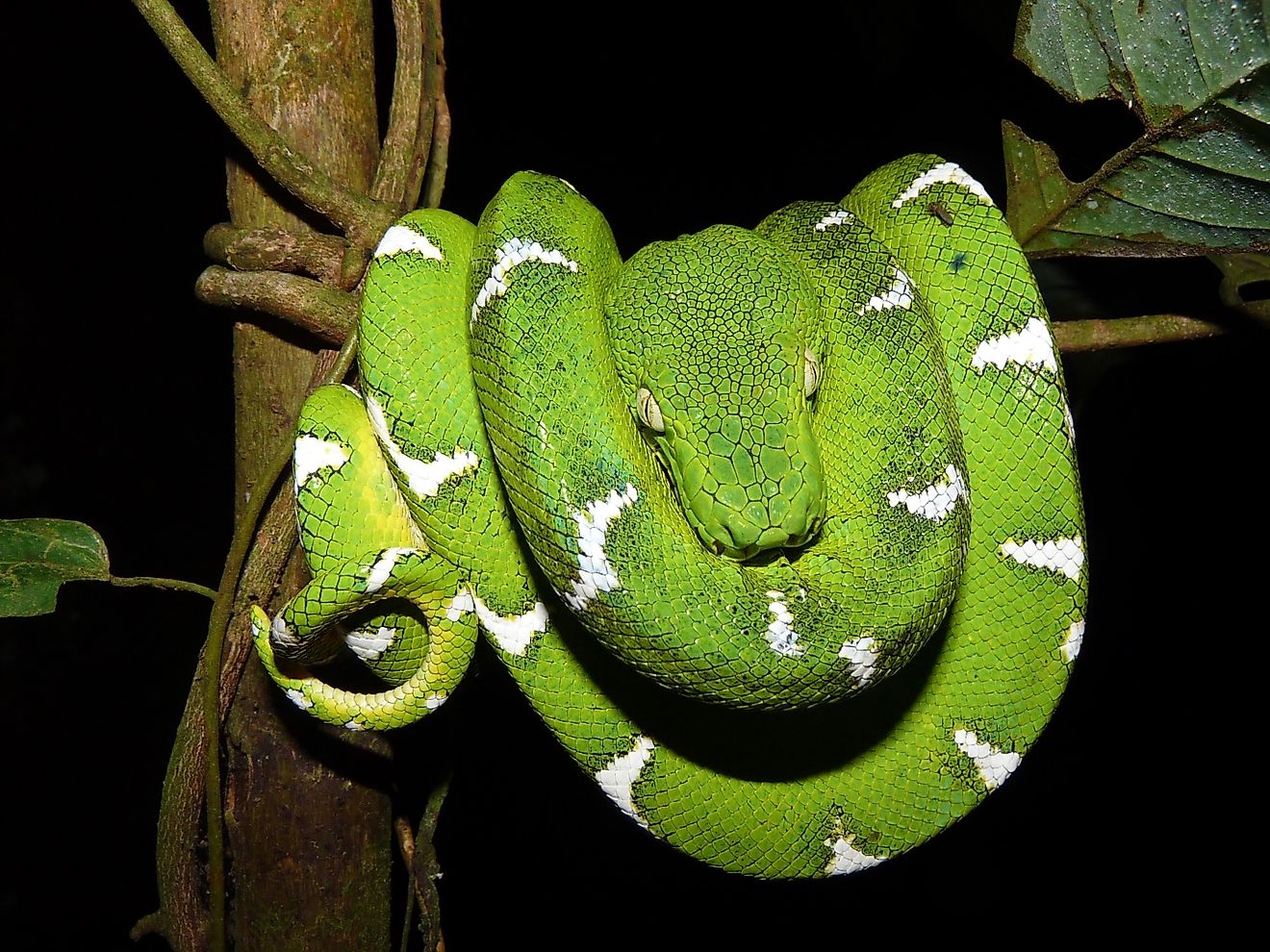
Its most distinctive feature is the coat of strongly keeled, overlapping scales that cover the body and head. Each scale carries a raised ridge, giving the snake a bristly, textured look often compared to overlapping leaves or the scales of a mythical dragon. The head is broad, flat, and triangular, clearly set off from the narrow neck, and the mouth opens with a wide gape that allows the viper to swallow surprisingly large prey.
Coloration is where the species earns its "variable" nickname. Most wild individuals are some shade of green, which provides excellent camouflage among foliage, but the palette can include yellow, olive, bluish, and reddish tones. Captive breeding has produced an even wider spectrum. Newborns tend to emerge darker, often brown or olive, and shift toward adult coloring as they mature. A prehensile tail rounds out the body plan, acting as an anchor that lets the snake dangle and reach between branches with ease.
Range and Habitat

The green bush viper occupies a broad band of equatorial Africa. Its range stretches across countries including Ghana, Togo, Nigeria, Cameroon, Gabon, the Democratic Republic of the Congo, Angola, Uganda, and western Kenya. This wide distribution makes it one of the more far-ranging members of its genus.
The species is a creature of the rainforest. It favors low, dense vegetation, flowering bushes, and thickets, usually within reach of the forest floor rather than the high canopy. Records place it most often at lower elevations, commonly between about 100 and 400 meters, in habitats where humidity stays high and small prey is plentiful. In some reserves the snake is locally abundant, taking advantage of the tangled undergrowth that keeps it hidden from predators and unsuspecting prey alike.
Because it depends so heavily on moist, thickly vegetated forest, the green bush viper is closely tied to the health of Central and West African woodlands. Where the forest thins, its ideal ambush cover disappears.
Diet

As a nocturnal ambush predator, the green bush viper spends its nights coiled in wait rather than actively roaming for food. When a target strays close enough, the snake strikes in a matter of milliseconds, injecting venom through two hollow front fangs and then holding on or tracking the prey until the venom takes effect.
Small mammals form the core of its diet. Shrews and rodents are frequent meals, and the snake will also take birds, frogs, lizards, and other small reptiles when the opportunity arises. Juveniles lean more heavily on reptiles and amphibians before graduating to warm-blooded prey as they grow. The hemotoxic venom does double duty, first subduing the prey and then beginning to break down its tissues to aid digestion.
One striking detail sets this viper apart from many of its relatives. Cannibalism has been documented in the wild, with adults occasionally consuming smaller members of their own species. This behavior, while not the norm, underscores just how opportunistic the green bush viper can be when food is scarce.
Behavior

The green bush viper is a solitary, largely nocturnal animal. During daylight hours it tends to rest quietly among branches or foliage, relying on its camouflage to stay unnoticed, and it becomes active after dark to hunt. Its lifestyle is both arboreal and, to a lesser extent, terrestrial, though it clearly favors life off the ground.
This is not an aggressive snake by nature, but it is defensive and will not hesitate to strike if cornered or handled. When threatened, it may inflate its body and produce a rasping sound by rubbing its keeled scales together, a warning display shared by several members of the genus. Its prehensile tail and superb grip let it hold fast to thin branches even while lunging at prey or an intruder. Because it stays hidden and moves little, the green bush viper can be difficult to spot in the wild, which is part of why detailed field observations of its behavior remain relatively scarce.
Reproduction

Reproduction in the green bush viper is closely linked to the wet season and to high humidity, without which breeding rarely succeeds. Females reach sexual maturity later than males, at around 42 months of age compared with roughly 24 months for males. Mating generally occurs once a year.
Unlike egg-laying snakes, this viper is viviparous, meaning it gives birth to live young. After a gestation period of about two months, a female produces a litter that typically numbers between seven and nine neonates, though a single successful pairing can yield as many as 19. The newborns arrive fully formed and are abandoned almost immediately, receiving no parental care whatsoever.
That lack of care is possible because the young are born self-sufficient and already venomous, capable of hunting small prey from their earliest days. This head start helps offset the risks of a solitary life in a forest full of predators.
Venom and Human Encounters

The green bush viper delivers a hemotoxic venom that attacks the blood and tissues. Recorded bites in humans have caused dizziness, nausea, headache, swollen lymph nodes, and painful local swelling. More serious envenomations can trigger a drop in blood platelets, disrupted clotting, destruction of red blood cells, internal bleeding, and even kidney failure. Fatal cases have been reported, though they are uncommon and often poorly documented.
Complicating matters, no antivenom is manufactured specifically for Atheris bites. In practice, physicians have sometimes turned to antivenom developed for the saw-scaled vipers of the genus Echis, which has shown partial success in neutralizing the venom. Anyone bitten needs prompt medical care, since the effects can unfold over many hours.
Importance to the World

Within its forest home, the green bush viper serves as a natural check on populations of rodents and other small animals. By preying on shrews, rats, and mice, it helps regulate species that might otherwise multiply unchecked, a service that ripples outward through the ecosystem.
The snake is also part of the food web itself. Its main predators are other snakes, including larger vipers and, notably, other green bush vipers. Beyond its ecological role, the species draws considerable interest in the reptile-keeping community for its color variety and unusual appearance, and its potent venom makes it a subject of ongoing toxinological study, where compounds from viper venom sometimes point toward medical applications.
Threats and Conservation

The green bush viper is currently listed as Least Concern on the IUCN Red List. It is widespread across its range and locally common in suitable habitat, and its overall population is considered stable, although no precise global estimate exists.
The main long-term concern for the species is habitat loss. As Central and West African rainforests are cleared for agriculture, logging, and development, the dense, humid undergrowth the snake depends on shrinks. For now its broad distribution buffers it against serious decline, but continued deforestation could gradually erode the strongholds where it thrives. Collection for the exotic pet trade adds a smaller layer of pressure, though captive breeding supplies much of that demand.
Takeaway
The green bush viper is highly adapted to life in the rainforest canopy. Its small size allows it to disappear among dense foliage, while its potent venom makes it a formidable ambush predator despite its diminutive build. Variable coloration provides effective camouflage, while a prehensile tail helps it maintain a secure grip on branches as it waits for prey. Its young are also capable of hunting independently soon after birth, giving them little reliance on parental care. Although the species is not currently considered at immediate risk of extinction, its long-term survival remains closely tied to the health of the forests it inhabits.
Fun Facts

- A snake of many colors. The name "variable bush viper" comes from its wide color range, which spans green, yellow, olive, blue, and reddish shades, with captive breeding expanding the palette even further.
- Born ready. Newborn green bush vipers are venomous and fully independent from birth, hunting on their own without any help from their mother.
- Lightning strike. This viper can launch an ambush strike in a matter of milliseconds, far faster than the human eye can follow.
- Built-in grip. Its prehensile tail works like a fifth limb, anchoring the snake to thin branches while it reaches or lunges.
- It eats its own. Cannibalism has been documented in the wild, with larger individuals occasionally preying on smaller members of their species.
- Dragon in miniature. The rough, ridged, overlapping scales that cover its body have earned it comparisons to a tiny dragon and made it a favorite in the reptile-keeping world.
Quick Facts
- Scientific name: Atheris squamigera
- Family: Viperidae (subfamily Viperinae)
- Order: Squamata
- Common names: green bush viper, variable bush viper, leaf viper
- IUCN status: Least Concern (population stable)
- Length: 18 to 24 inches (46 to 60 cm), rarely over 31 inches (78 cm)
- Distinguishing feature: rough, strongly keeled overlapping scales
- Diet: small mammals, birds, frogs, and small reptiles
- Venom type: hemotoxic
- Reproduction: viviparous, 7 to 9 young on average, up to 19
- Range: West and Central Africa
- Habitat: lowland rainforest and dense vegetation