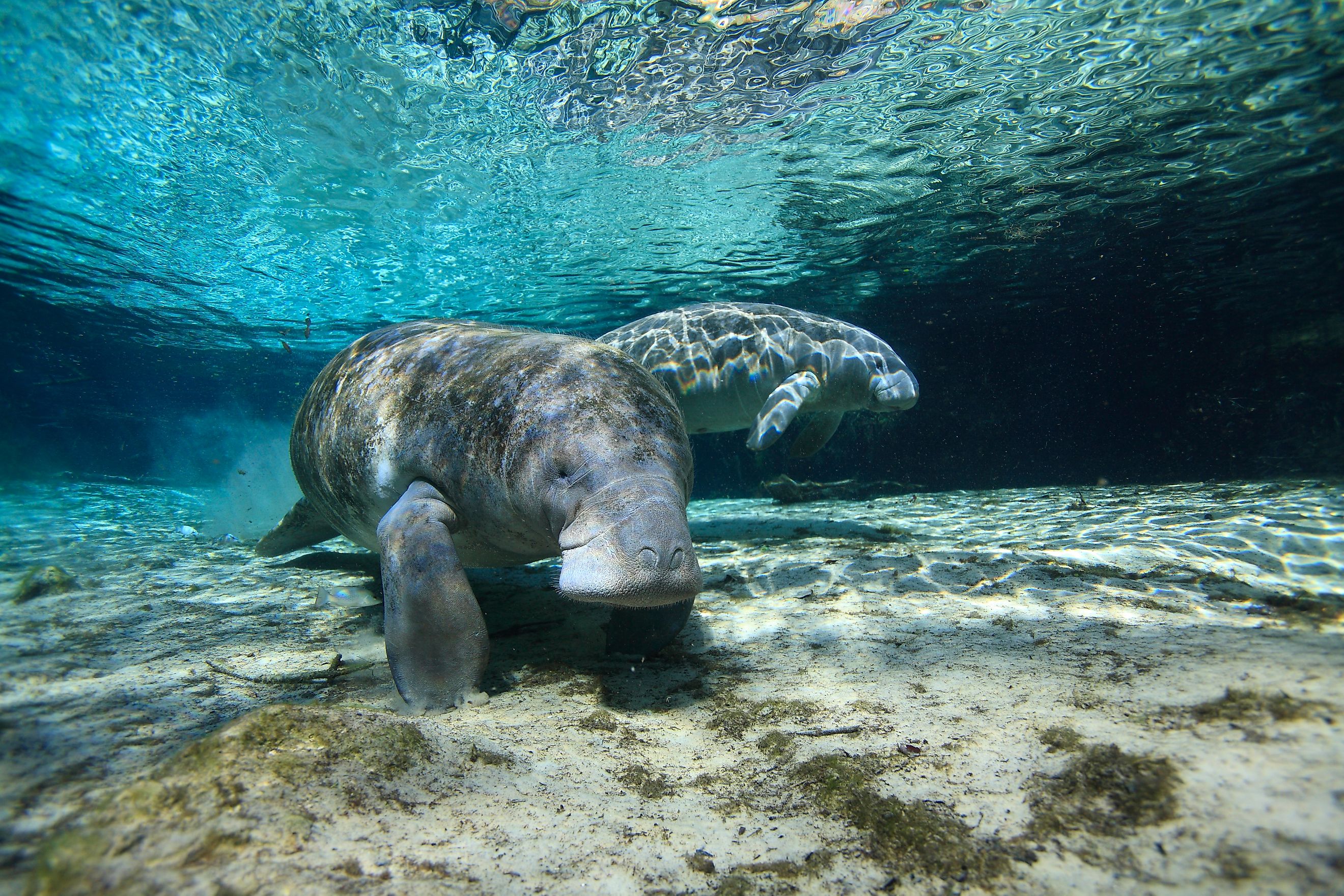
Where Manatees Travel Farthest North
Almost every record of a manatee far beyond its usual range begins with a person who was not expecting one. A kayaking family off Rhode Island, a snorkeler in a Massachusetts harbor, a worker watching the warm outfall of a power plant in Florida all turned a stray animal into a data point. The northern boundary of the manatee's world has been fixed less by the animals than by the people who reported them, compared their scar patterns against old photographs, and in a handful of cases fastened a satellite tag to a thick gray fluke and followed along. How far north a manatee has traveled has a firm answer on record, and reaching it means tracking both the animal and its observers.
The Animals Behind the Question

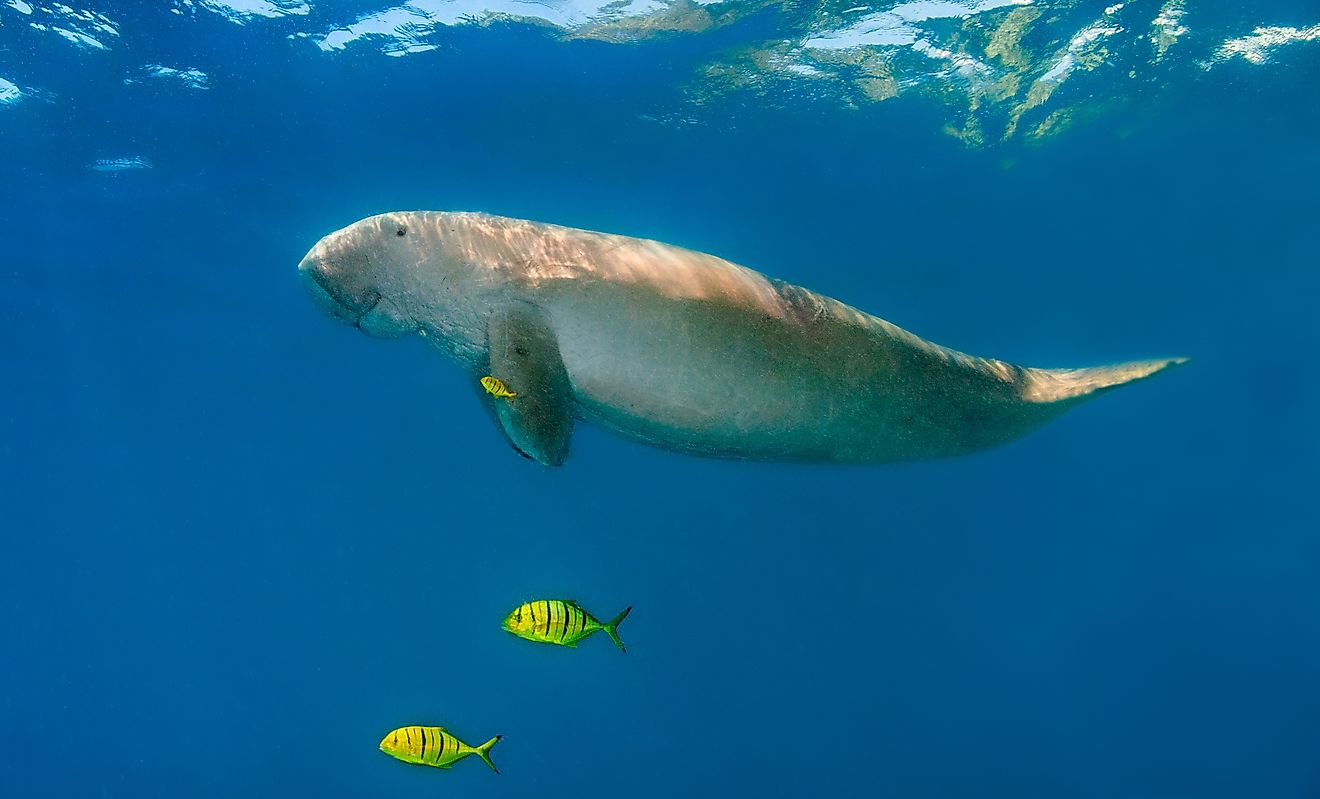
Three species of manatee live today, and only one of them makes long cold-water journeys. The West African manatee keeps to the coasts, lagoons, and rivers of western Africa, ranging as far north as Mauritania and as far south as Angola, and the Amazonian manatee stays in the fresh water of South America, grazing through the Amazon basin it shares with the Amazon river dolphin and rarely straying from the equator. The far-ranging traveler is the third species, the West Indian manatee, and within it the Florida subspecies, which spends winters in the warm springs and industrial discharges of peninsular Florida and the rest of the southeastern United States. The Antillean subspecies carries the same lineage south through the Caribbean to the Atlantic coast of Brazil, but it stays in warm water. The fourth and final living sirenian, the Indo-Pacific dugong, lives oceans away and never makes the trip.
The Summer Push Up the Coast

Temperature is the main reason manatees head north during the warmer months. When coastal waters rise above about twenty degrees Celsius, or sixty-eight Fahrenheit, they leave their winter homes and follow seagrass and eelgrass beds along the shore, eating as they travel. The warmer water near the Gulf Stream lets them feed farther up the eastern coast before the cold stops them. Most summers, manatees from Florida reach as far north as the Carolinas and Delaware Bay on the Atlantic side, and as far west as Texas on the Gulf of Mexico. The U.S. Fish and Wildlife Service says that sometimes their summer range even reaches Massachusetts. When the water cools in autumn, the manatees head back to Florida. If one stays too long, it faces real danger, as the records show.
Chessie, and the Record on Paper

The best-known wanderer is a male manatee named Chessie, whose story is well documented. In July 1994, he turned up in the cold waters of Chesapeake Bay, and he showed no sign of heading south as winter approached. Save the Manatee Club pledged six thousand dollars toward his rescue, according to its former executive director Judith Vallee, and that October he was flown to Florida, fitted with a satellite transmitter, and released. The next summer he headed north again, back through the Chesapeake and on to Point Judith, Rhode Island, farther north than any manatee had then been tracked. He was spotted again in Virginia in 2001 and back in Maryland in 2011. Each time, biologists identified him by the scars on his back. In June 1996, researchers tracked him as he crossed into Georgia and then lost his transmitter near Beaufort, North Carolina. He wore the tag loosely. Later, his transmitter went silent near Jacksonville. Monica Ross from the Clearwater Marine Aquarium believed an alligator mistook the floating tag for food, which shows that manatees face dangers besides the cold.
Chessie got his name from a legendary Chesapeake Bay sea serpent that people claimed to see in the 1970s and 1980s. The creature appears in coloring books and local stories, but there are no confirmed sightings. Unlike the sea serpent, the manatee is well documented, but even Chessie did not travel the farthest north.
Chessie's record did not stand. In August 2006, a manatee that onlookers nicknamed Marvin worked its way up the coast, up the Hudson River past Manhattan in New York, into a Warwick marina on the Rhode Island coast where it drank from a drainage pipe, and on to Falmouth, on the southern shore of Cape Cod, where a snorkeler watched it graze on eelgrass. Cathy Beck, a wildlife biologist with the U.S. Geological Survey, called the Falmouth sighting the northernmost manatee documented at the time. Two years later the record moved again. In late September 2008, a manatee crossed into Cape Cod Bay and reached East Dennis, on the cold northern side of the Cape, around the first of October, the farthest north any manatee has been recorded. It had stopped at the same Point Judith drainage pipe the 2006 animal used, though this one was missing its left front flipper, so whether the two were the same manatee was never resolved. A third manatee came close off Falmouth in 2016. The Buzzards Bay National Estuary Program, which tracks local sightings, still counts the 2008 arrival in Cape Cod Bay as the northernmost on record.
Why They Cannot Stay

When a manatee travels this far north, it faces real danger, not because of its behavior, but because of its body. Manatees are tropical mammals with very low metabolic rates and little blubber, so they cannot survive cold snaps like seals and whales can. Studies from Duke University and research published in Diseases of Aquatic Organisms show that manatees start to suffer when water temperatures drop below twenty degrees Celsius. Prolonged exposure below this point leads to cold stress syndrome, which causes metabolic, nutritional, and immune problems and is the main natural cause of death for manatees. A PeerJ study also points to twenty degrees as a strict limit for where manatees can live. The extremely cold winters of 2010 and 2011 killed hundreds of Florida manatees, showing how quickly conditions can become deadly. The 2008 manatee that reached Cape Cod Bay faced a different problem. Once it was inside the bay, it could not find its way back around the Cape. A Florida rescue group intervened on October 12, but the animal died on the long drive south, and wildlife officials later judged that it should have been treated locally before any attempt to move it.
The Hazard That Is Not The Cold

For much of the year and across most areas, boats are the main danger to manatees. In 2024, Florida biologists recorded 565 manatee deaths, with 96 caused by watercraft. In 2025, there were 632 deaths, and about a quarter of the animals examined had died from collisions. These numbers are lower than in 2021, when about 1,100 manatees died, mostly from starvation after seagrass disappeared in the Indian River Lagoon. A 2020 review by the Florida Fish and Wildlife Research Institute found that only about four percent of adult manatee carcasses had no watercraft scars, and one in four showed marks from ten or more separate strikes. This shows that adult manatees often survive boat strikes many times, not just once.
Laws have recognized the danger to manatees for about fifty years. The Marine Mammal Protection Act of 1972, the Endangered Species Act of 1973, and the Florida Manatee Sanctuary Act of 1978 all make it illegal to feed, harass, chase, or harm manatees. In 2017, the Fish and Wildlife Service reclassified the manatee as threatened rather than endangered, and after the 2021 die-off many conservationists asked the agency to reconsider, leaving the question of whether manatees are endangered openly disputed.
If You Meet a Wanderer

If you're out on the water in New England in late summer and spot a large gray back near your boat, you're witnessing something rare, not dangerous. Manatees don't bite or charge, and they spend their days grazing. Don't feed it or offer fresh water from a hose or dock, since this can teach manatees to approach boats and marinas, which are risky places for them. It's important to keep your distance, give the manatee space, and let it graze without disturbance. Boaters should follow posted slow-speed zones, use polarized sunglasses to reduce glare and spot manatees more easily, and remember that seagrass beds may hide feeding animals. If you see a manatee that looks cold, injured, or stranded, report it to Florida's wildlife hotline at 1-888-404-3922 in the south, or to the regional stranding network in the Northeast, and let the experts handle it. Many far-north sightings are only known because people reported them instead of getting too close, and that's still the most helpful thing you can do. A calmer place to watch one is inland, among the US lakes where manatees swim in from the sea.
The Northern Limit
The farthest north a manatee has ever been recorded is Cape Cod Bay, where one arrived in the fall of 2008. We know about that visit, and the 2006 wandering that preceded it, only because kayakers, snorkelers, and biologists took note. The real boundary for manatees is the cold, not the animals themselves. Manatees follow warm water and seagrass up the coast during summer, then head back to Florida before the water drops below twenty degrees, which is as cold as they can handle. Those that time their return right spend the winter in Florida's springs. The few that stay too long end up as rescues or, sadly, as carcasses that add to the record. As coastal waters get warmer in the coming decades, people might spot manatees even farther north than Cape Cod Bay during summer. Still, the twenty-degree limit will stay the same, and the next northern record will likely be set by a manatee that someone happens to notice.