Electric Eel
The Amazon River and its surrounding freshwater systems in South America host many interesting and dangerous animals. Electric eels can deliver powerful shocks, up to 860 volts in Electrophorus voltai, and may leap from the water to shock large, partially submerged threats. The electric eel can produce both strong and weak electrical pulses, which it uses for a variety of tasks, including communication and defense. Despite its remarkable hunting skills, the electric eel is often underappreciated for its unusual role in South America’s freshwater ecosystems. Learn more key facts about one of northern South America’s most unusual freshwater predators.
Taxonomic Classification
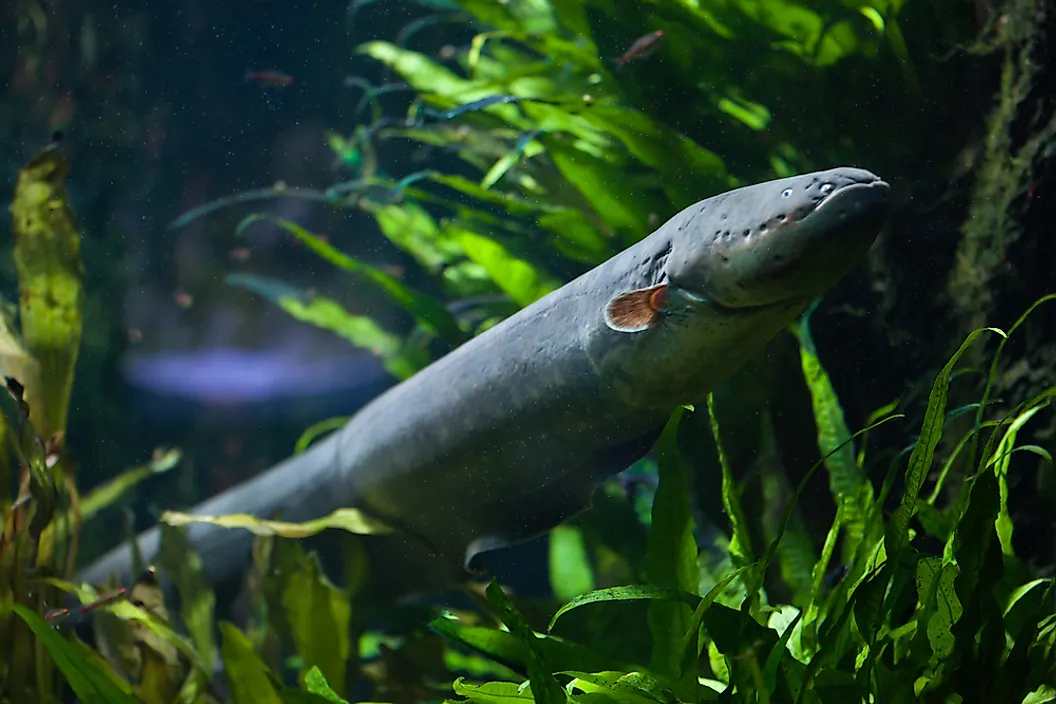
Electric eels are vertebrate fishes in the class Actinopterygii, order Gymnotiformes, family Gymnotidae, subfamily Electrophorinae, and genus Electrophorus. Actinopterygii refers to ray-finned fish, a class of fish that makes up about 99% of all living fish species. These fish are characterized by rigid, ray-shaped fins. In the electric eel, the most important fin for movement is the elongated anal fin on the underside of its body.
Gymnotiformes are a group of knifefishes within the broader ostariophysan lineage, making electric eels, South American freshwater fish in the family Gymnotidae, more closely related to catfish and carp than to true eels.
The family Gymnotidae are naked-back knifefishes, which lack dorsal and pelvic fins and move using an elongated anal fin. Electric eels are also placed in the subfamily Electrophorinae; their genus name, Electrophorus, derives from Greek roots meaning “electricity bearer.”
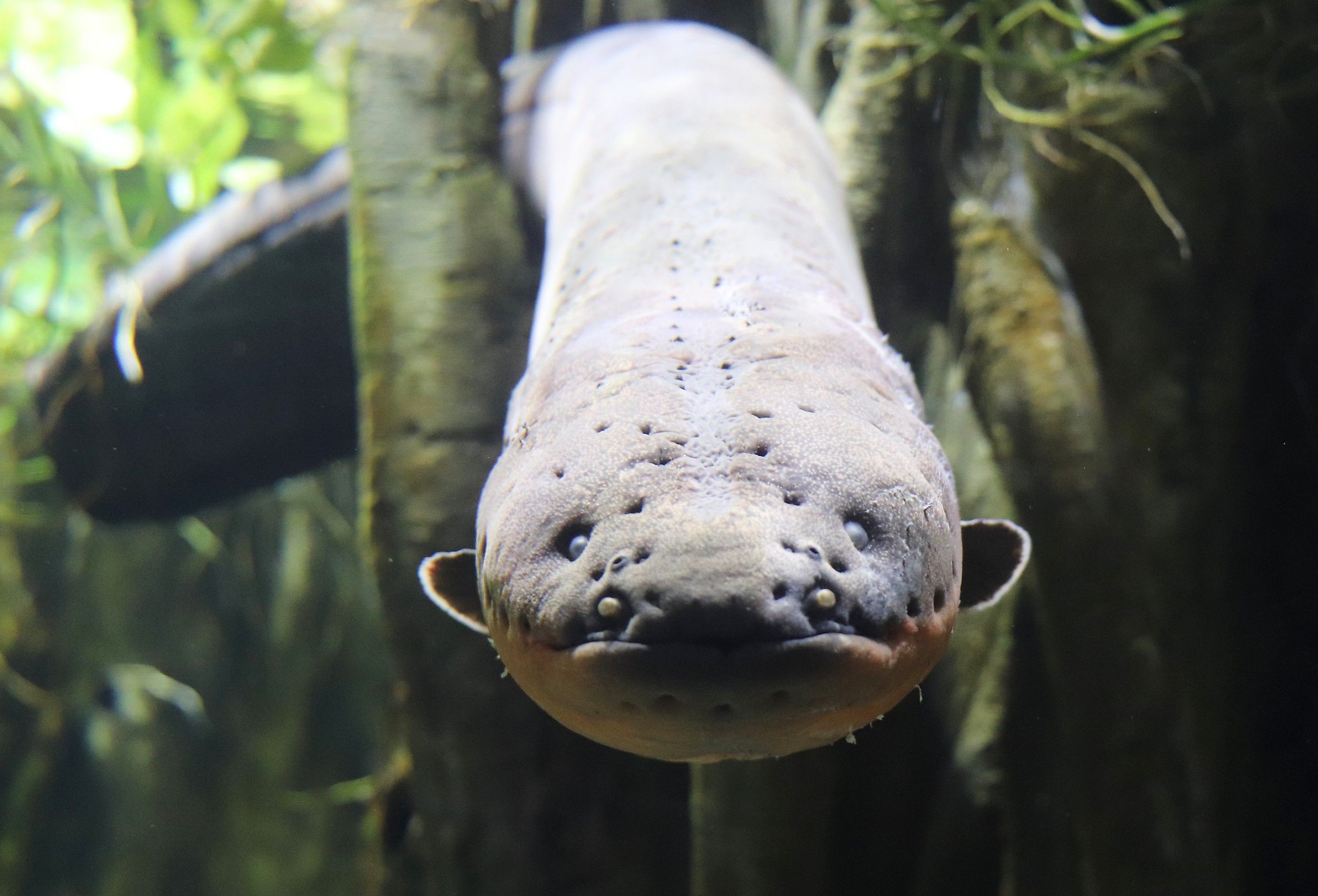
There are three recognized species of electric eel: Electrophorus electricus, Electrophorus voltai, and Electrophorus varii. Electrophorus electricus is the most commonly known species of electric eel and has a U-shaped head and flattened skull. Electrophorus voltai has a more egg-shaped head compared to other electric eel species. Electrophorus varii features a thicker skull and more variation in its head shape.
Physical Description

The electric eel has a slender, snake-like body and a flattened head and can grow to be approximately 6 to 8 feet in length. Its body features a reduced caudal fin and lacks pelvic and dorsal fins, instead relying on an elongated anal fin to maneuver through the water. Its thick, scale-less skin usually ranges from dark gray to brown in color, with the underside of the body being a yellow-orange color.
The electric eel has three specialized electric organs: the main electric organ, Hunter’s organ, and Sachs’ organ. These electric organs take up about 80% of the fish’s overall body, while its remaining organs are tightly packed into the front portion of the body.
Range and Habitat

Electric eels are widely distributed across parts of northern South America, living in quiet, slow-moving bodies of water in places such as Brazil, Venezuela, Colombia, Ecuador, and Peru. These bodies of water include oxbow lakes, streams, ponds, and the flooded forest floor of the Amazon Rainforest. Electric eels occur across parts of northern South America, including habitats associated with the Amazon and Orinoco systems, though the three recognized species have different regional ranges. The eels often prefer side channels and slow-moving waters, and they may also live farther inland where seasonal flooding creates access to food.
During the rainy season, rivers swell and expand, reconnecting lakes and ponds into larger bodies of water. During this time, juvenile electric eels may disperse, traveling to new territories and creating their own habitats away from their nesting areas. Once the dry season arrives and the water recedes, these eels can become isolated in the smaller bodies of water left behind.
Because the water is often poorly oxygenated, electric eels have adapted to thrive within their environment. The eels are obligate air breathers, meaning they must breach the water’s surface to take in oxygen. Their mouths are heavily vascularized, with many folds that increase surface area and allow them to absorb oxygen during short trips above the water’s surface. This means that, despite having gills, electric eels rely heavily on air breathing rather than breathing underwater through their gills.
Food

Adult electric eels are generalist carnivores, meaning they eat a wide variety of animal prey rather than relying on a single prey species. Their diet generally consists of fish, crustaceans, insects, and small vertebrates, such as reptiles and small mammals. Juvenile electric eels primarily feed on invertebrates, while newly hatched eels may eat the remaining unhatched eggs in their nests.
Electric eels have motion-sensitive hairs along their bodies that, after weak electric discharges pass through the water, can help them detect movement from nearby animals. Once they have determined the location of nearby prey, they send a series of electric pulses to stun and consume it. Because water conducts electricity, the increased surface area of a body of water can reduce the intensity of shocks delivered through the water. Because shocks delivered through water may be less intense for a large, partially submerged predator, an electric eel may leap partly out of the water and press against the threat to deliver a more concentrated shock.
Behavior

Electric eels are largely nocturnal creatures, preferring to hunt and feed at night. They use their electric organs to produce strong and weak pulses, generating more than 800 volts at times. Electrophorus voltai has been found to produce a 860-volt discharge, the highest known bioelectric discharge in a living animal. These pulses are used for hunting and defense, while weaker discharges support electrocommunication and electrolocation in dark, muddy water. The stronger the charge of each pulse, the more energy it uses. Stronger discharges are created using the main electric organ and part of Hunter’s organ.
Electric eels use their large anal fin to maneuver in the water and are able to swim forward, backward, and hover in place.
Reproduction

Electric eels use their lower-voltage electric organs to send discharges in order to communicate. These pulses and signals vary across sexes and individuals, conveying information about sex and sexual receptivity to other eels in the area.
Sexually mature female electric eels will lay between 1,200 and 1,700 eggs during each dry season. Male electric eels construct nests made with their saliva and guard the larvae until the rainy season, when the larvae leave their nests and spread out to different areas as ponds and rivers converge into larger bodies of water.
Importance to the World

As generalist carnivores, electric eels occupy an important predatory role in the slow-moving freshwater habitats where they live. Adults feed on a wide range of prey, including fish, crustaceans, insects, amphibians, reptiles, and small mammals, while juveniles rely more heavily on invertebrates. Their hunting strategy is especially important to science because it shows how electricity can be produced and controlled by living tissue: electric eels use high-voltage discharges to interfere with the nervous systems of nearby animals, causing involuntary muscle contractions that can immobilize prey or force hidden fish to twitch and reveal their location. Researchers have also documented rare social hunting behavior in Electrophorus voltai, with groups of electric eels herding small fish into shoals before launching coordinated electric strikes.
Electric eels have also played an unusually large role in science. Their electric organs helped early researchers study animal electricity, later contributed to research on acetylcholine receptors and voltage-gated sodium channels, and continue to inspire studies of bioelectricity, electric-organ evolution, and soft power sources. Recent bioengineering work has even used the electric eel as a model for artificial electric organs made from stacked hydrogels, while modern genome research has produced a high-quality reference genome that may help explain how these fish evolved such powerful electric discharges.
Threats

As powerful predators with the ability to stun opponents, adult electric eels have few natural predators. While they are in their juvenile stage and unable to produce stronger electrical pulses, young electric eels may fall prey to fish and aquatic birds that hunt in their habitat. Once they reach adulthood, their predators are fewer in number. Electric eels are currently assessed as Least Concern by the International Union for Conservation of Nature's Red List, with no known major widespread threats, although local habitat degradation or human capture may affect some populations.
Electric eels can harm humans, but verified severe cases are rare. A 2025 clinical report described two human injuries from electric eels in the Amazon, including one fatal case. Electric eels can discharge enough electricity to jolt or severely injure a person, and zoo staff use protective equipment when working near them, but most documented risk comes from being stunned in water rather than from the shock directly killing a person.
Electric Eels: Final Thoughts
While electric eels are most commonly known for their capacity as powerful freshwater predators, their ability to use electricity to communicate and navigate through dark waters remains equally remarkable. Using specialized electric organs and electroreception, electric eels can detect prey, communicate with potential mates, and navigate through murky water. This, along with their role in local food webs, makes electric eels among the most fascinating fish in northern South America.