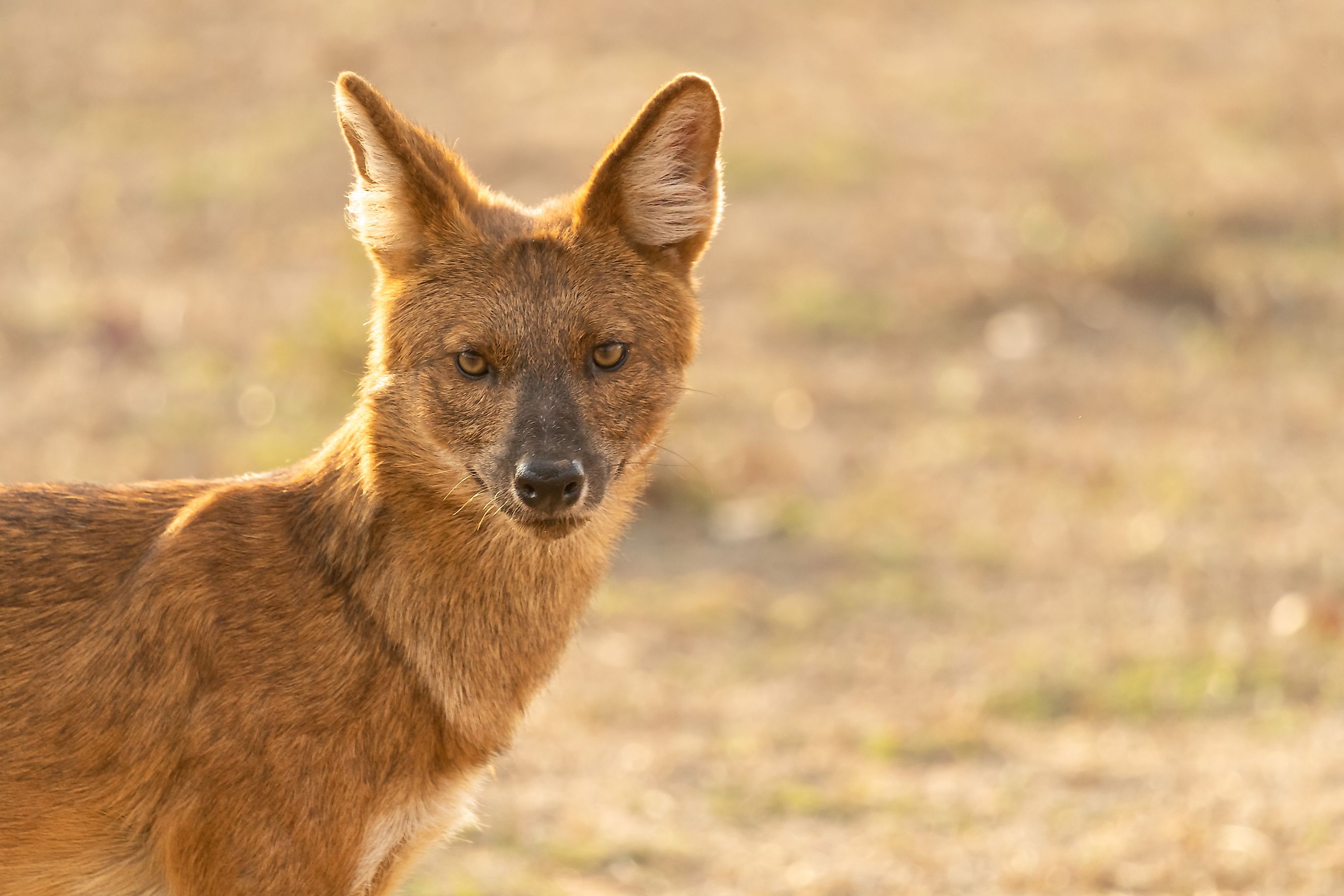
Dhole
The dhole (Cuon alpinus) is one of Asia's most efficient pack hunters and one of its least familiar predators. Often called the Asiatic wild dog, the Indian wild dog, or the whistling dog, this rusty red canid coordinates its hunts with an eerie whistle rather than the howl of a wolf, and a pack working together can bring down prey ten times the weight of a single animal. Despite that prowess, most people have never heard of it.
The dhole is the only living species in the genus Cuon, which sets it apart from every other wild dog on Earth. It ranges across the forests, grasslands, and mountains of South and Southeast Asia, from India and Nepal through Myanmar, Thailand, and Indonesia. Long ago its ancestors roamed across Asia, Europe, and North America, but the modern dhole occupies only a fraction of that former territory.
Today the species is listed as Endangered on the IUCN Red List, with fewer than 2,500 mature individuals believed to remain in the wild. Understanding this remarkable predator matters, because its decline signals wider trouble for the forests it helps hold together.
Taxonomic Classification

The dhole belongs to the family Canidae, the same family that includes wolves, foxes, jackals, and domestic dogs. Within that family it sits in the subfamily Caninae and the tribe Canini, yet it stands alone in its own genus, Cuon, named by Brian Hodgson in 1838. The species was first described by the German naturalist Peter Simon Pallas in 1811, which gives the animal its full scientific name, Cuon alpinus (Pallas, 1811).
Being the sole surviving member of Cuon makes the dhole unusual among canids. Its closest living relative is the African wild dog (Lycaon pictus), and the two share several traits linked to a strict meat-eating lifestyle. The dhole also differs from most other dogs in its dentition, carrying forty teeth rather than the forty-two typical of the family, because the last lower molar on each side is reduced or absent. Female dholes carry more teats than other canids as well, an adaptation suited to raising large litters.
Historically, naturalists proposed splitting the dhole into a northern and a southern species, and later work recognized as many as eleven subspecies based on differences in coat length and color. Modern authorities generally treat the dhole as a single species with a handful of regional forms, though genetic study continues to refine that picture.
Physical Description

The dhole is a medium-sized canid, roughly the size of a German shepherd but with the long legs and pointed muzzle of a fox. Head and body length runs about 35 to 44 inches (88 to 113 cm), with a bushy tail adding another 16 to 20 inches (40 to 50 cm). Adults stand around 20 inches (50 cm) at the shoulder.
Weight varies by sex and region. Males typically weigh 33 to 44 pounds (15 to 20 kg), while the smaller females weigh 22 to 29 pounds (10 to 13 kg). Sexual dimorphism is modest, and in the field individuals can be hard to tell apart because the species is so uniformly marked.
The coat is the dhole's most recognizable feature. Adults wear a rusty red to reddish-brown coat over a paler throat, chest, and belly, and the bushy tail ends in a dark, usually black, tip. The eyes are amber, and the rounded ears carry lighter fur inside. Color shifts across the range, with northern dholes tending toward lighter, longer fur and southern animals showing a deeper red. Pups are born a sooty brown and take on adult coloring at about three months of age.
Range and Habitat

The dhole once ranged across much of Asia, Europe, and North America during the Pleistocene, but it retreated to its current territory roughly 12,000 to 18,000 years ago. Today it survives in scattered, fragmented populations across South and Southeast Asia, including India, Bhutan, Nepal, Bangladesh, Myanmar, Thailand, Cambodia, Laos, Vietnam, Malaysia, Indonesia, and parts of southern China.
Within that range the dhole proves highly adaptable. It occupies dense tropical rainforest, dry deciduous forest, thick scrub, open grassland, and even high alpine zones, where it has been recorded above 9,800 feet (3,000 m). This flexibility once helped the species thrive across an enormous area, and it remains one reason surviving populations persist in such varied landscapes. In India and Nepal, the network of tiger reserves has become important to the dhole's survival, since the protected forests that shelter tigers also support the prey and cover that dholes need.
Diet and Hunting

The dhole is a hypercarnivore, meaning meat makes up at least seventy percent of its diet. Its favored prey is medium to large hoofed mammals, especially deer. In India, the spotted deer, or chital, is a primary target, while in Thailand packs often pursue sambar. Dholes also take wild pigs, hares, wild goats, and rodents, and they will eat berries, insects, and lizards when the opportunity arises.
Hunting is a cooperative effort, and it is where the dhole excels. A pack can pursue and pull down animals many times the size of a single dhole, working as a coordinated unit over long chases. Rather than seizing prey by the throat as many canids do, dholes often attack larger animals from the rear. The pace of feeding is startling. An adult can consume around 9 pounds (4 kg) of meat in an hour, and a small group can dispatch a deer in a matter of minutes. Dholes rarely fight over a carcass, competing instead through sheer speed of eating. They are also fond of water and will often race to a stream to drink after a meal.
Behavior and Communication

Dholes are among the most social of all wild dogs. They live in packs that usually number five to twelve animals, though groups of twenty-five or more have been recorded, and separate packs sometimes merge into large temporary clans for hunting. A single dominant, monogamous pair typically leads the group, yet overt aggression within a pack is rare, and even the dominant animals can be hard to identify by behavior alone.
Communication sets the dhole apart from every other canid. Instead of barking or howling, dholes produce an eerie whistle that carries well at ground level through dense forest, along with a repertoire of clucks, screams, chatters, and yaps. That whistle is so distinctive that it can be used to identify individual animals, and it gives the species its common nickname, the whistling dog. Packs use these calls to stay coordinated during hunts when thick cover blocks their view of one another.
Physically, dholes are athletic in ways that support their lifestyle. They are fast runners, strong swimmers, and impressive jumpers, able to leap more than 7 feet (2.1 m) straight up. Pack members greet one another with nose-touching and body rubbing, use communal latrines to mark territory, and maintain the social bonds that make coordinated hunting possible.
Reproduction

Within a pack, breeding usually falls to a single dominant pair, and the rest of the group helps raise the young. After a gestation of roughly 60 to 63 days, the female gives birth in a den to a large litter, commonly five to eight pups and sometimes as many as ten or twelve. The extra teats that female dholes carry help support these sizable broods.
Cooperative care is a hallmark of the species. Subordinate pack members bring food to the mother and pups, and young dholes are allowed to feed first at a kill until they are about a year old. Pups reach sexual maturity at roughly one to three years of age, and in an unusual twist for a pack animal, it is often the females that disperse to join or form new packs. In the wild, dholes typically live around 10 to 13 years, and individuals in captivity have reached about 16 years.
Importance to the Ecosystem

As an apex predator and hypercarnivore, the dhole plays a keystone role in the forests it inhabits. By preying on deer, wild pigs, and other hoofed mammals, it helps regulate herbivore numbers, which in turn shapes vegetation and supports the broader balance of the ecosystem. Where large predators like the dhole decline, prey populations can surge and trigger cascading effects through the food web.
The dhole also shares its habitat with tigers and leopards, competing with them for prey while targeting a somewhat different mix of species. This web of predators and prey is part of what keeps Asian forests healthy, and the dhole is a working part of that system rather than a bystander.
Threats and Conservation

The dhole is listed as Endangered on the IUCN Red List, based on the 2015 assessment, and its population is still declining. Estimates place the number of mature individuals between about 949 and 2,215, part of a total wild population thought to fall somewhere between 4,500 and 10,500 animals.
Several pressures drive the decline. Habitat loss and fragmentation, as forests are cleared for timber and human development, sit at the top of the list. The depletion of wild prey leaves packs with less to hunt, and dholes are sometimes persecuted by people who see them as a threat to livestock. Disease is another serious danger, since rabies and canine distemper can spread from domestic dogs into wild populations. Competition with tigers and leopards can further limit pack size in shared habitat.
Conservation efforts center on protecting large, connected tracts of forest, and the tiger reserves of India and Nepal have proved to be important refuges. The dhole receives legal protection in several countries, including under India's Wildlife Protection Act. Even so, patchy data on distribution and population trends across much of Southeast Asia makes the animal's true status hard to gauge, and researchers stress that better monitoring is needed to secure its future.
Takeaway
The dhole is one of Asia's most distinctive and least understood carnivores. The only surviving member of its genus, it is a cooperative pack hunter known for its whistling calls and ability to bring down prey many times its own size. In some of Asia's richest forests, it also plays an important ecological role by influencing prey populations and shaping the wider food web. Despite this, it receives far less attention than better-known predators such as the tiger and is quietly declining toward extinction. Protecting the forests, prey, and wildlife corridors it depends on would benefit not only this unusual wild dog but also the broader ecosystems it helps sustain.
Fun Facts

- The whistling dog. Instead of howling, dholes communicate with a high-pitched whistle so distinctive that researchers can identify individual animals by sound.
- A genus of one. The dhole is the only living species in the genus Cuon, and its closest relative is the African wild dog rather than any Asian canid.
- Fewer teeth than its cousins. Most members of the dog family have 42 teeth, but the dhole has only 40, an adaptation tied to its meat-shearing bite.
- Remarkable leaper. A dhole can jump more than 7 feet (2.1 m) straight up into the air, a skill that helps it hunt across rough terrain.
- Giant killers. Working as a pack, dholes can bring down prey ten times their own body weight and have even been known to fend off a tiger.
- A shrinking empire. During the Pleistocene, dholes ranged across Asia, Europe, and North America, one of the widest distributions of any wild dog.
Quick Facts
- Common name: Dhole (also Asiatic wild dog, Indian wild dog, whistling dog, red dog)
- Scientific name: Cuon alpinus
- Family: Canidae
- Order: Carnivora
- IUCN status: Endangered (2015 assessment, population decreasing)
- Population: fewer than 2,500 mature individuals (roughly 949 to 2,215)
- Length: head and body 35 to 44 inches (88 to 113 cm), plus a 16 to 20 inch (40 to 50 cm) tail
- Height: about 20 inches (50 cm) at the shoulder
- Weight: males 33 to 44 pounds (15 to 20 kg), females 22 to 29 pounds (10 to 13 kg)
- Lifespan: about 10 to 13 years in the wild, up to 16 years in captivity
- Diet: hypercarnivore, chiefly deer, wild pigs, hares, and other mammals
- Range: South and Southeast Asia, including India, Nepal, Myanmar, Thailand, and Indonesia