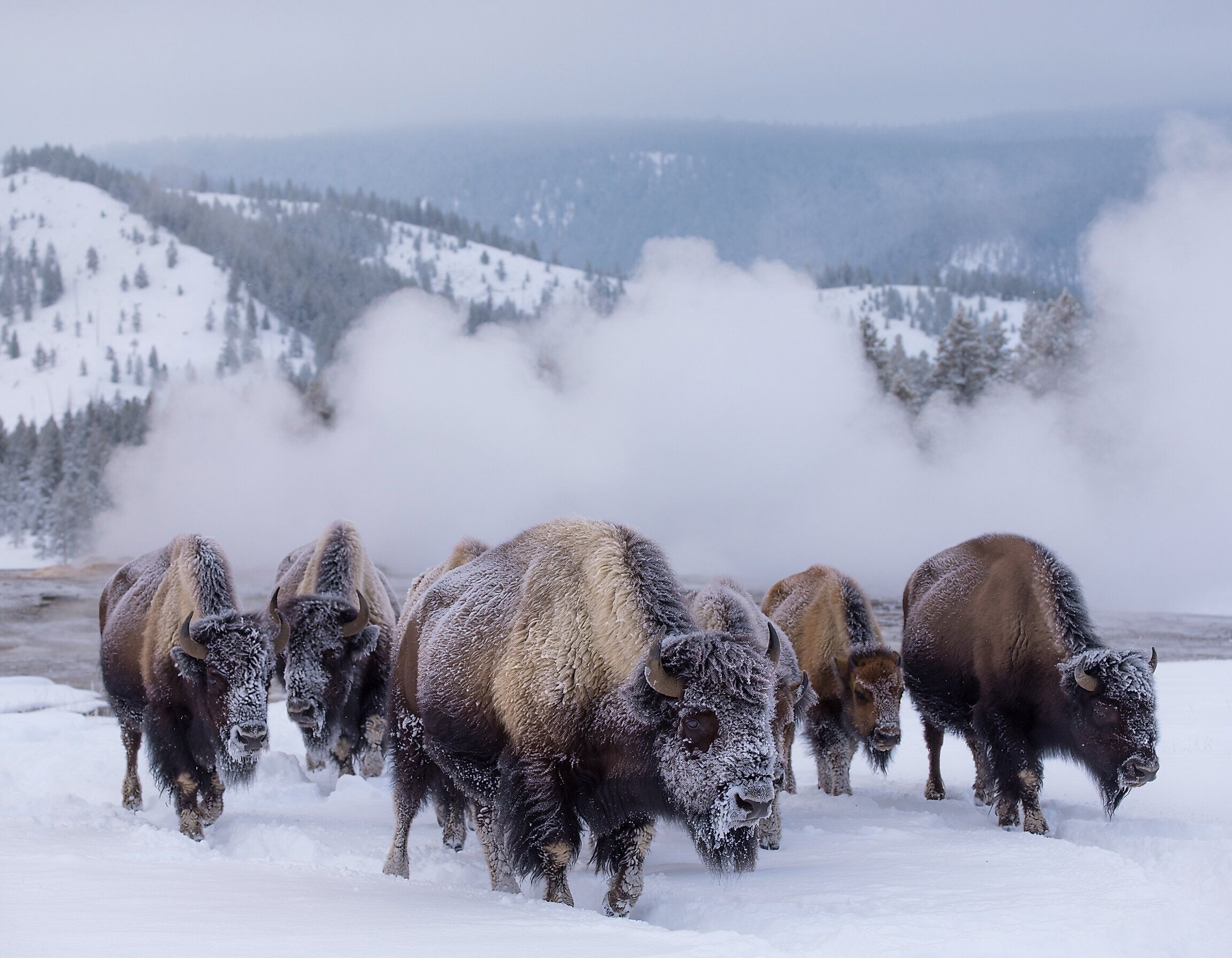
Why Yellowstone’s Bison Leave The Park Every Winter
Every winter, the animal on Yellowstone's unofficial coat of arms walks out of Yellowstone. As snow buries the park's high plateau, hundreds and sometimes thousands of bison file downhill toward the north and west entrances, past Gardiner's Roosevelt Arch and into Montana's lower valleys, following a migration older than the park, the state, and the country. The reason they leave is simple physics: the snow upstairs gets too deep to eat through. What happens when they cross the line is anything but simple, because the boundary of America's first national park is also where the wildest herd in the nation meets cattle politics, a disease the cattle gave them, and one of the longest-running wildlife disputes in the West. The bison, to their credit, just keep walking.
The Snow Pushes Them Downhill

Yellowstone sits mostly above 7,000 feet, and its interior valleys collect snow by the yard. A bison's answer to buried grass is brute force, swinging its massive head like a plow to sweep the snow aside, but the arithmetic turns against a 2,000-pound grazer as the drifts deepen: every bite costs more energy to uncover, and by midwinter the high plateau becomes a restaurant that charges more than the meal is worth. The park's geothermal flats keep a few patches cheap, which is why herds crowd the steaming ground along the Firehole, but warm dirt cannot feed thousands.
So the herds do what mountain wildlife has always done: they trade elevation for forage. The northern herd drifts down the Yellowstone River corridor toward the Gardiner basin, nearly 2,000 feet lower and far drier, where wind and sun keep grass within reach; the central herd funnels west down the Madison toward Hebgen Lake and West Yellowstone. The herds even borrow human infrastructure for the trip, walking the park's plowed and groomed winter roads in single file because packed snow costs a fraction of the calories that drifts do, which is why winter visitors so often meet a procession of frost-bearded giants commanding the lane. It is a textbook altitudinal migration, snow depth writing the itinerary, and the park boundary happens to sit in the middle of it.
The Oldest Herd In America

What makes the walkout matter is who is doing the walking. Yellowstone is the only place in the United States where wild bison have lived continuously since prehistoric times, and the modern herd descends from a group of roughly two dozen animals that survived the 19th-century slaughter by hiding in the park's remote Pelican Valley. From that couple-dozen-strong remnant, protected and painstakingly rebuilt, today's population has grown to roughly 5,000, the largest wild herd on public land in the country and the genetic wellspring for bison restoration everywhere.
These are also the bison that still behave like bison, moving in mass migrations, wintering by instinct rather than by fence line. That authenticity is precisely the problem: a herd that migrates like it is 1850 keeps colliding with a map drawn in 1872.
The Invisible Fence

The trouble at the boundary has a name: brucellosis. Roughly half of Yellowstone's bison carry exposure to this bacterial disease, which can cause cattle to abort and once cost the livestock industry dearly, and Montana's brucellosis-free status for its cattle herds is an economic asset the state defends hard. The bitter footnote is the disease's origin: brucellosis came to Yellowstone's wildlife from domestic cattle in the early 1900s. The bison are being policed for an infection people's livestock gave them.
For decades the policy at the line was blunt. Bison that left the park were hazed back, captured at the Stephens Creek facility near the north boundary, or shipped to slaughter, and in the brutal winter of 1996-97 more than a thousand were killed or shipped as starving herds poured out, a low point that still shapes the debate. Management since 2000 has run through an interagency plan balancing the park, the state, livestock interests, and tribes, with the herd's size itself managed partly through what happens each winter at the boundary.
The Elk Loophole

Here is the fact that keeps the controversy burning: there has never been a documented case of wild bison transmitting brucellosis to cattle. Every confirmed wildlife-to-livestock transmission in the Yellowstone region has come from elk, which also carry the disease, also leave the park, and do so by the tens of thousands, wandering ranch country all winter with no capture facilities, no hazing, and no boundary rules worth mentioning.
The asymmetry has practical roots, since elk scatter while bison arrive in conspicuous herds, and bison, unlike elk, are legally treated as livestock in parts of Montana law. But the science has steadily eroded the original rationale, and even the risk window is narrow: transmission requires contact with infected birth tissues in spring, not a bull walking a snowy road in January, and vaccination plus testing have pushed cattle cases in the region to rarities. Meanwhile the double standard grazes on in plain view, tens of thousands of elk drifting through the same ranchlands every winter unexamined. The bison pay the strictest price for the smallest documented risk, which is why the policy keeps bending.
A Better Way Out

The walkout's modern chapter is slowly turning the blockade into a doorway. Montana now tolerates bison year-round in zones beyond both winter exits, the Gardiner basin in the north and the Horse Butte country in the west, acknowledging what the maps long denied: the lower valleys are part of the herd's winter range. At the boundary, treaty hunts by tribal nations exercise rights that predate the park, making the migration's edge a place of harvest as well as management.
The brightest development is the Bison Conservation Transfer Program. Instead of slaughter, captured boundary bison can now enter quarantine, test their way to certified brucellosis-free status, and travel, alive, to the Fort Peck Assiniboine and Sioux tribes, who have forwarded hundreds onward to dozens of tribal nations rebuilding herds across the Plains. The animals that once left Yellowstone for a kill facility now leave it to restart bison country, one truckload at a time.
The Migration Remembers

Step back far enough and the winter walkout is the last working fragment of something continental. Bison once moved across the Great Plains in migrations measured in millions of animals and hundreds of miles, a system erased in a single generation; Yellowstone's herd kept the instinct alive inside the one landscape that never lost its wild bison. Every December, when the snow starts the engine and the herds point downhill past the arch, they are running the ancient program on the only hardware left. The park protects the bison for nine months of the year. The other three, the bison ask the rest of us how much room the oldest herd in America is allowed, and the answer, slowly, is becoming: more.