American Bison
The American bison is the largest land mammal in North America, and roughly 140 years ago it came within a few hundred wild animals of disappearing. Adult bulls weigh up to 2,000 pounds (900 kg) and stand about 6 feet (1.8 m) at the shoulder hump, which makes them heavier than any moose, elk, or grizzly bear on the continent. Their front half is deliberately oversized, with a muscle-built hump and elongated vertebral spines that power a head capable of sweeping through deep snow to reach grass.
Bison (Bison bison) are grazing ruminants native only to North America, once numbering in the tens of millions across grasslands that ran the length of the continent, with herds ranging as far south as Mexico and as far north as central Canada. Commercial slaughter in the 1800s cut the total population to fewer than 1,000 animals. The recovery that followed is one of the most cited conservation stories on the continent, and in 2016 the species was named the national mammal of the United States.
This profile covers what the animal is, how it lives, why it matters to grassland ecosystems, and where its recovery still falls short.
Taxonomic Classification

The American bison belongs to the family Bovidae, subfamily Bovinae, which places it alongside cattle, buffalo, and antelope. Its full chain runs Kingdom Animalia, Phylum Chordata, Class Mammalia, Order Artiodactyla (even-toed hoofed mammals), Family Bovidae, Genus Bison, species Bison bison. Carl Linnaeus described the species in 1758.
Two distinct subspecies are recognized, with the plains bison (Bison bison bison) inhabiting the open grasslands and the wood bison (Bison bison athabascae) favoring the forested regions of North America. The wood bison is the larger and darker of the two and occurs in the boreal regions of northwestern Canada and Alaska, while the plains bison ranges across the grasslands of the central United States and southern Canada. The American bison is one of only two living bison species. The other is the European bison, or wisent (Bison bonasus).
Despite the common name "buffalo," the American bison is not a true buffalo. True buffalo, such as the African Cape buffalo and the Asian water buffalo, sit in different genera. The buffalo label is a historical carryover from early European settlers and remains in wide use, including among many Indigenous nations, but the scientific term is bison.
Physical Description

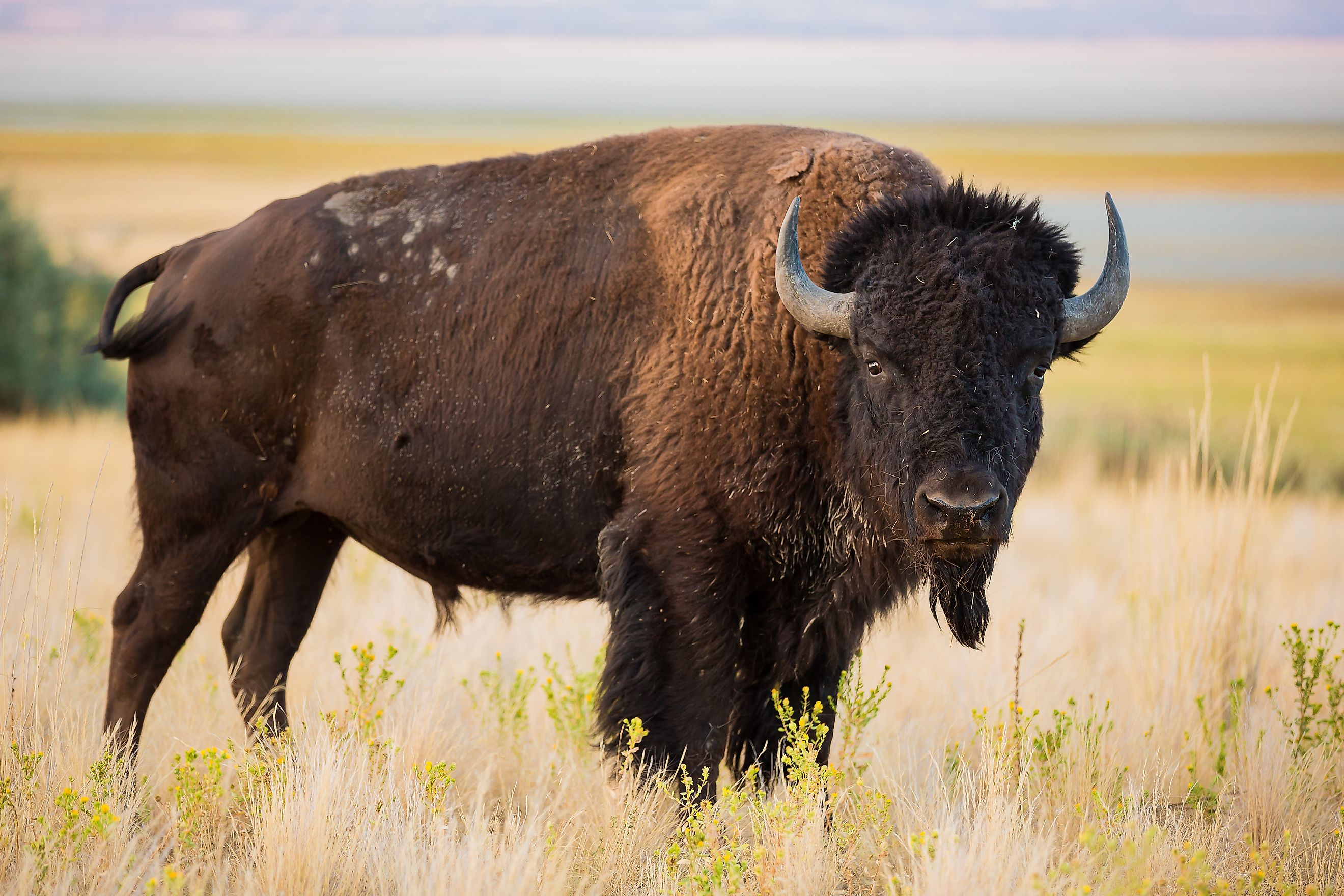
Size is the animal's most defining trait. Mature bulls reach 5.5 to 6.5 feet (1.7 to 2 m) at the hump and measure 10 to 12.5 feet (3 to 3.8 m) in length, and they typically weigh 1,000 to 2,000 pounds (450 to 900 kg). Exceptional individuals grow even larger. Cows are smaller, standing about 5 feet (1.5 m) and weighing up to about 1,000 pounds (450 kg). This is the clearest case of sexual dimorphism among North American land mammals of this size.
The shoulder hump is the most recognizable trait. It is built on tall spinal projections anchored by heavy muscle, and it supports the weight of the massive head. That construction lets a bison plow snow aside with side-to-side sweeps of the head to expose forage, an advantage no other large grazer on the plains shares to the same degree.
Both sexes carry a single pair of short, curved, hollow horns that grow throughout life and taper to sharp points. A dark brown coat covers the body, thickest and longest over the head, neck, shoulders, and forelegs, with shorter hair on the hindquarters. Bulls grow a dark beard roughly a foot (30 cm) long. The heavy front coat insulates the animal against blizzards, and bison typically face into winter wind rather than turning from it. In spring the coat sheds in ragged clumps as the animals roll and rub. Proportionate to body size, bison have an unusually large trachea, an adaptation to warm frigid inhaled air. Despite their bulk, they are fast, reaching about 35 miles per hour (55 km/h) and clearing obstacles from a standing position.
Range and Habitat

Before European colonization, bison ranged across roughly a third of North America. Their territory reached as far north as the Great Slave Lake region of Canada and as far south as Mexico, and it spanned the width of the continent between the eastern Appalachians and the Rocky Mountains. Estimates of that historical population land between 30 and 60 million animals, making bison the most abundant large herbivore the continent has known in recent geological time.
Their core habitat consists of the open grasslands of the Great Plains, spanning shortgrass, mixed-grass, and tallgrass prairies. Bison also use sagebrush country, river valleys, and, in the case of the wood bison, boreal meadows and forest openings across a colder northern range. The species tolerates extremes of summer heat and deep winter cold, which is one reason it spread across so many distinct ecosystems.
Today the picture is far narrower. Bison occupy well under 1 percent of their original range, and most surviving animals live in managed herds rather than free-roaming populations. Yellowstone National Park holds one of the few herds descended from bison that were never extirpated, numbering around 5,000. Public lands managed by the U.S. Department of the Interior support about 11,000 bison across 19 herds in a dozen states, which is roughly a third of the conservation, or non-commercial, animals in the country.
Diet

Bison are grazers built around a diet of grasses and sedges, supplemented with forbs and some woody plants. As ruminants, they crop vegetation quickly, then rest and regurgitate the material to chew it as cud, allowing a multi-chambered stomach and gut microbes to break down tough plant fiber. This lets bison extract nutrition from coarse, low-quality grasses that many other grazers cannot use efficiently.
Feeding is concentrated in the cooler parts of the day, with long midday periods spent resting and ruminating. In winter, bison rely on the snow-plowing sweep of the head to reach buried grass, which is why the muscular hump and heavy neck matter as much for feeding as for display. Their grazing is not uniform across the landscape. Bison favor recently burned or previously grazed patches, and that selective pressure shapes the plant community around them.
Behavior

Bison are social and are most active in the early morning and late afternoon. The basic social unit is a matriarchal group of cows, calves, and young animals. Mature bulls live apart for much of the year, either alone or in small bachelor groups, and rejoin the cow herds during the summer breeding season, when animals gather into much larger aggregations.
Wallowing is a signature behavior. Bison roll in shallow dirt depressions to shed hair, deter biting insects, and manage skin condition, and repeated use turns these wallows into persistent bare patches that collect rainwater and support distinct plant and insect communities. Bison undertake short seasonal movements in search of forage and water rather than long fixed migrations, and herds can cover substantial ground in a day. Communication runs on grunts, snorts, and the bellowing of bulls during the rut, along with body posture. Their apparent calm can be deceptive, as bison are fast, powerful, and unpredictable at close range, sometimes injuring more visitors in certain national parks than large predators do.
Reproduction

The breeding season, or rut, runs through the summer, roughly July into September. Bulls compete for access to receptive cows through bellowing, wallowing displays, and head-to-head shoving contests that test size and strength. A dominant bull will tend a single cow closely until she is ready to mate, then move on.
Gestation lasts about nine months, and cows give birth to a single calf in mid to late spring, timed to coincide with fresh grass growth. Newborns weigh 30 to 70 pounds (14 to 32 kg) and are cinnamon-red rather than dark brown, which earns them the nickname "red dogs." Calves stand within hours of birth and follow the herd quickly. They are weaned by about seven months but usually stay with the mother until they are a year old. In the wild, bison commonly live 12 to 15 years, though some reach 20 or more, and exceptional animals have lived well beyond that in protected settings.
Importance to the World

Bison are a keystone species of the North American grasslands, meaning their presence shapes the ecosystem out of proportion to their numbers. Grazing keeps dominant grasses in check and opens space for a wider mix of plants. Wallowing creates microhabitats that support amphibians, insects, and specialized plants. Hooves aerate and disturb soil, seeds carried in shaggy coats are dropped in new locations, and decomposing dung recycles nutrients back into the ground. Together these effects generate the patchy, varied prairie that many other species depend on, which is why bison are often described as ecosystem engineers.
There is also a climate dimension to keeping bison on the land. The prairies they depend on store most of their carbon underground, in deep roots and soil rather than in aboveground wood and leaves. That belowground carbon is more stable than carbon stored in forests. When grasslands burn, much of their carbon remains protected in the roots and soil, whereas forest fires can release a far greater share of the carbon stored aboveground. Native prairie grasses drive this, with some species rooting more than 10 feet (3 m) deep, and grassland and shrubland account for roughly a third of the carbon in the U.S. Great Plains. The main threat to that reservoir is conversion of prairie to cropland, which breaks up the root systems and releases stored carbon. Protecting large tracts of grazed native grassland for bison therefore also protects a durable carbon store.
Threats and Conservation

The IUCN Red List classifies the American bison as Near Threatened, based on the 2017 assessment. The rating reflects a species that has recovered in raw numbers but remains dependent on active conservation to persist. The IUCN Green Status assessment, which measures recovery against a species' historical role, rated bison as critically depleted with a recovery score of about 17 percent, because the animal no longer functions as a wild, self-sustaining part of most of its former range.
The population figures explain the gap. Total bison in North America number in the hundreds of thousands, but the overwhelming majority are commercial animals, many carrying cattle genes from past crossbreeding. The 2017 assessment counted roughly 31,000 bison in about 68 conservation herds, with only 11,000 to 13,000 mature individuals across the species. That is a small, fragmented base for an animal that once numbered in the tens of millions.
The main threats today include habitat loss and fragmentation, small and isolated herds with limited genetic diversity, and the dilution of wild bison genetics through historical cattle hybridization. Disease management is another major concern, particularly around Yellowstone, where brucellosis has led to contentious efforts to control bison that cross the park's boundaries. Conservation work focuses on expanding herd size and connectivity, maintaining genetically pure bison, restoring animals to tribal and public lands, and treating bison as wildlife on the landscape rather than only as livestock behind fences.
Takeaway
Nearly every feature that makes the bison distinctive is an adaptation to the open grasslands where it evolved. The powerful shoulder hump helps it push through snow, and the dense winter coat and heavy build let it graze efficiently while constantly moving across the plains. That history makes the animal a working part of the prairie rather than just an occupant of it. Where large herds graze and wallow across native range, the grassland reorganizes around them, supporting plants, insects, and birds that a fenced pasture does not. The bison's outlook now rests on returning it to that role at scale, and tribal nations, federal agencies, and private landowners are steadily rebuilding larger, better-connected herds on restored range.
Fun Facts

- National mammal: The American bison became the national mammal of the United States on May 9, 2016, joining the bald eagle as an official U.S. symbol.
- Red dogs: Calves are born cinnamon-red and darken to brown within a few months, a color shift that gives newborns their nickname.
- Built for winter: Bison have an unusually large trachea for their body size, which helps warm cold air before it reaches the lungs.
- Faster than they look: A 2,000-pound (900 kg) bull can run about 35 miles per hour (55 km/h) and jump from a standstill.
- On the money: The bison appeared on the U.S. nickel for 25 years and has featured on the Interior Department seal since 1917.
Quick Facts
- Scientific name: Bison bison
- Family / Order: Bovidae / Artiodactyla
- Subspecies: Plains bison (B. b. bison), Wood bison (B. b. athabascae)
- IUCN status: Near Threatened (2017 assessment)
- Height: Up to about 6 to 6.5 feet (1.8 to 2 m) at the hump
- Length: 10 to 12.5 feet (3 to 3.8 m) for bulls
- Weight: Bulls up to 2,000 pounds (900 kg); cows up to about 1,000 pounds (450 kg)
- Lifespan: 12 to 15 years in the wild, up to 20 or more
- Diet: Herbivore (grazer): grasses, sedges, forbs
- Range: North America (Great Plains grasslands; boreal regions for wood bison)