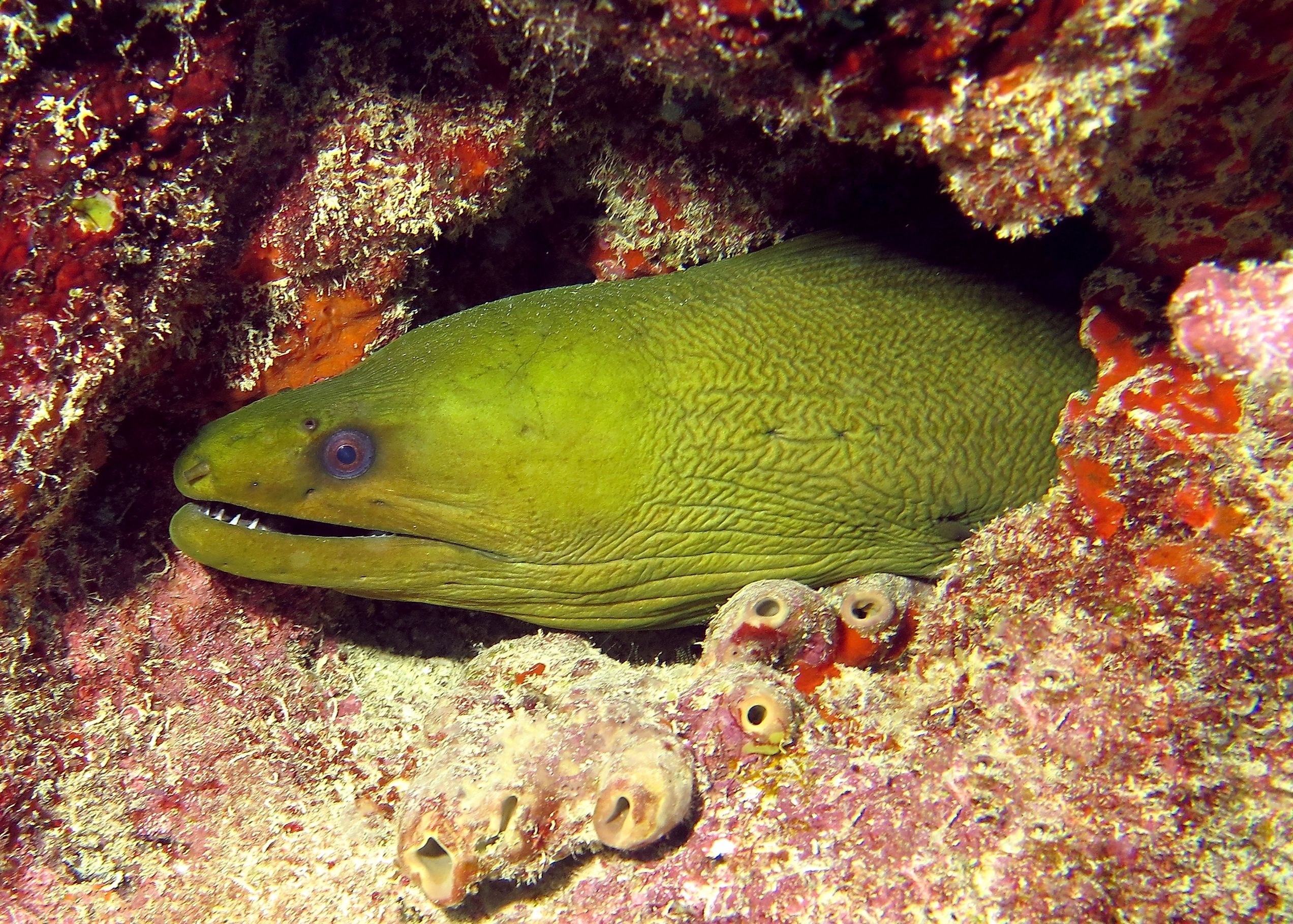
Green Moray Eel
The green moray eel (Gymnothorax funebris) is the largest moray of the tropical Atlantic and ranks among the largest moray eels on Earth, growing to lengths of about 8.2 feet (2.5 m). It patrols the coral reefs, rocky ledges, and mangrove shallows of the western Atlantic, ranging as far north as the northeastern United States and as far south as Brazil. Few reef fish look more formidable, and few are more misunderstood.
Its most surprising secret is hiding in plain sight. The green moray is not actually green. Its skin is a dull brown, and the vivid olive coloration that gives the animal its name comes from a yellow-tinted layer of mucus coating its body. Add a second set of jaws hidden in its throat, a powerful bite, and a habit of gaping its mouth open like a threat display, and the green moray becomes one of the most compelling predators in Atlantic waters.
Taxonomic Classification

The green moray belongs to the family Muraenidae, the true moray eels, which contains roughly 200 species distributed across tropical and temperate seas worldwide. Within that family it sits in the subfamily Muraeninae and the large, diverse genus Gymnothorax. The genus name joins two Greek words. Gymnos means naked and thorax means chest, a nod to the eel's scaleless, fin-reduced body. The Italian naturalist Camillo Ranzani formally described the species in 1839, assigning it the scientific name Gymnothorax funebris.
Like all morays, the green moray is a ray-finned fish (class Actinopterygii) in the order Anguilliformes, the group that unites the world's true eels. It shares that order with congers, garden eels, and hundreds of other elongated, snake-shaped fishes. The species has also collected a string of common names over the years, among them the black moray, green conger, and olive-green moray, though "green moray" remains the standard.
Physical Description

The green moray is built for a life spent squeezing through reef crevices. Its body is long, muscular, and laterally compressed, tapering to a point at the tail. A single continuous fin runs almost the entire length of the animal, beginning behind the head as a dorsal fin and merging with the anal and caudal fins near the rear. Unlike most bony fish, morays lack pectoral fins entirely, and their gill openings are reduced to small circular pores behind the head.
Adults commonly measure around 6 feet (1.8 m), with the largest confirmed individuals reaching about 8.2 feet (2.5 m). That size makes the green moray the biggest moray in the tropical Atlantic and one of the largest known anywhere. Reported weights climb to roughly 64 pounds (29 kg), carried on a thick, heavy trunk of muscle.
The famous green color is an illusion. Beneath the surface, the eel's skin is actually a drab brownish or gray shade. A thick coat of yellowish mucus covers that skin, and the combination of yellow slime over dark hide produces the uniform olive-green hue that divers recognize. The mucus does more than provide color. It shields the animal from parasites and bacteria and helps it slip through jagged rock without injury.
The head is heavy and blunt, and the mouth is lined with long, backward-curving teeth that grip struggling prey. Green morays often hold their jaws open, exposing those teeth, but the gesture is not aggression. It is simply how the eel breathes, pumping water across its gills.
Range and Habitat

The green moray is a western Atlantic species. Its core range stretches from the northern Gulf of Mexico and the Caribbean Sea through the Bahamas, the Florida Keys, and Bermuda, reaching as far south as Brazil. Individuals turn up along the eastern seaboard of the United States as far north as New Jersey and Long Island, New York, and a single stray was once recorded off Nova Scotia, most likely swept there by the Gulf Stream.
Within that range, the eel favors shallow to moderately deep coastal waters. It typically occupies depths of about 16 to 100 feet (5 to 30 m), though it has been found from near the surface down to roughly 165 feet (50 m). Coral reefs and rocky ledges are its classic habitat, but it also thrives in mangrove estuaries, tidal creeks, seagrass beds, harbors, and sandy or muddy bottoms, anywhere that offers dark holes and crevices for shelter.
Diet

The green moray is a carnivore and an ambush hunter. It preys mainly on fish, along with crustaceans such as crabs and shrimp and cephalopods such as octopus and squid. Rather than chase its meals, the eel lies coiled inside a crevice with only its head exposed, relying on a keen sense of smell to detect prey drifting past in the dark. When a target comes within reach, the moray lunges out and seizes it with the sharp teeth of its outer jaws.
What happens next is one of the strangest feeding mechanisms in the animal kingdom. Most fish swallow by suction, expanding the mouth to draw water and prey inward. Morays cannot generate strong suction, so they evolved a different solution. Hidden in the throat sits a second set of jaws, called pharyngeal jaws, armed with their own curved teeth. Once the outer jaws have a grip, these inner jaws shoot forward into the mouth, clamp onto the prey, and drag it back into the throat to be swallowed. Researchers at the University of California, Davis documented this raptorial behavior in 2007, and it remains the only known case of a vertebrate using a second, mobile set of jaws to both hold and transport its food.
Behavior

Green morays are mostly nocturnal and solitary. During the day they retreat into caves, ledges, and rocky holes, often leaving only the head visible as they rhythmically open and close the mouth to breathe. After dark they emerge to forage across the reef.
A 2021 tracking study in the mangrove bays of St. Croix found that most green morays keep to a modest home range, averaging around 14 acres (5.8 hectares), and stay faithful to it for long stretches. A few individuals, however, made dramatic one-night migrations out to offshore reefs and rocky submarine canyons, usually in winter or spring. The eels that left tended to be the larger animals, a hint that green morays shift their haunts as they grow.
For all their fearsome looks, green morays are not aggressive toward people. They are not venomous, and bites almost always happen only when an eel is cornered, provoked, or mistakes a hand for food.
Reproduction

The reproductive life of the green moray remains poorly understood, in part because the species has never bred in captivity and its spawning has rarely been observed in the wild. What scientists do know is that green morays reproduce through external fertilization at offshore spawning sites, where females release eggs and males release sperm into the open water.
A single spawning site may see millions of eggs released, though only a tiny fraction are fertilized and survive. The fertilized eggs hatch into transparent, leaf-shaped larvae known as leptocephali, which drift among the plankton for months, possibly a year or more, before settling onto a reef and transforming into juvenile eels. Close relatives are thought to spawn in the early months of the year, and green morays may follow a similar warm-season pattern.
Importance to the World

As a large, abundant predator, the green moray plays an important role in keeping reef and estuary ecosystems in balance. By feeding on fish, crustaceans, and cephalopods, it helps regulate the populations of smaller animals and removes the sick and the slow, a pressure that keeps prey communities healthy. Top predators like the green moray also have few natural enemies of their own, which places them near the summit of the reef food web.
The eel is largely absent from human menus, and for good reason. Green morays can accumulate the toxins responsible for ciguatera fish poisoning, which makes eating them risky. That natural chemical defense has spared the species much of the fishing pressure faced by other large reef predators.
Threats and Conservation

The International Union for Conservation of Nature lists the green moray as a species of Least Concern, an assessment last published in 2015. The eel is widespread, common across much of its range, and not targeted by any major fishery, which leaves it in a comparatively secure position among large reef predators.
That reassuring status comes with a caveat. Moray eels are difficult to count. They spend the daylight hours hidden in the reef, so the visual surveys used to census reef fish tend to undercount them badly, and the true size of green moray populations is not well known. Because the species depends so heavily on healthy reefs and mangroves for shelter, the ongoing degradation of those habitats through warming seas, pollution, and coastal development is the clearest long-term threat it faces.
Takeaway
The green moray's intimidating appearance can be misleading. Its exposed teeth are usually visible because it needs to move water across its gills, while its vivid green color comes from yellow mucus over naturally brown skin. Despite its heavy, muscular body, it spends much of its time wedged into crevices and holes in the reef. What truly sets this eel apart is its anatomy. It is a scaleless ambush predator with a second set of jaws in its throat, an unusual adaptation found among vertebrates. As one of the largest and most widespread predators in the western Atlantic, it helps regulate food webs across reefs and mangroves. The species remains common and secure, but its long-term prospects are closely linked to the condition of the habitats it depends on.
Fun Facts

- It is not actually green. The color comes from a yellow-tinted mucus layer coating its naturally brown skin.
- It has two sets of jaws. A second set hidden in the throat lunges forward to grab prey and haul it down, the only vertebrate known to feed this way.
- The open mouth is breathing, not menace. Morays gape almost constantly to pump water across their gills.
- Do not eat it. Green morays can carry the toxins behind ciguatera fish poisoning.
- One turned up off Nova Scotia. A single stray was recorded far north of its normal range, most likely carried there by the Gulf Stream.
- It is a record holder. The green moray is the largest moray in the tropical Atlantic and one of the largest morays on Earth.
Quick Facts
- Scientific name: Gymnothorax funebris
- Family: Muraenidae (order Anguilliformes)
- IUCN status: Least Concern (assessed 2015)
- Length: up to 8.2 feet (2.5 m), commonly around 6 feet (1.8 m)
- Weight: up to about 64 pounds (29 kg)
- Lifespan: roughly 10 to 30 years in the wild, up to 40 in human care
- Diet: carnivore, feeding on fish, crustaceans, and cephalopods
- Range: western Atlantic, New Jersey and Bermuda south to Brazil