Giant Freshwater Stingray
The giant freshwater stingray (Urogymnus polylepis) ranks among the largest freshwater fish on Earth, a disc-shaped river giant that can grow wider than a dinner table and heavier than a grizzly bear. In June 2022, a female caught in the Mekong River weighed roughly 661 pounds (300 kilograms) and stretched about 13 feet (4 meters) snout to tail, earning recognition from Guinness World Records as the largest freshwater fish ever documented.
Despite its size, the species remains one of the least understood large animals in the world. It spends its life pressed against the muddy and sandy beds of a few great rivers in Asia, hidden from view and rarely seen by people. This profile explains what the giant freshwater stingray is, where it lives, how it survives, and why its future is now in doubt.
Taxonomic Classification

The giant freshwater stingray belongs to the family Dasyatidae, the whiptail stingrays, within the order Myliobatiformes. Like sharks, stingrays are cartilaginous fish, meaning their skeletons are built from cartilage rather than bone. The species was first described by the Dutch ichthyologist Pieter Bleeker in 1852 under the name Urogymnus polylepis.
Its naming history is tangled. For decades the animal was widely known as Himantura chaophraya, a name applied in 1990, and later as Himantura polylepis. Researchers eventually recognized that these names referred to the same fish, and because Bleeker's description came first, Urogymnus polylepis became the accepted scientific name. A closely related population in northern Australia was once treated as the same animal but was split off in 2008 as a separate species, the freshwater whipray (Urogymnus dalyensis). Populations in New Guinea are also thought to belong to U. polylepis, though that remains unconfirmed.
Physical Description
Few freshwater animals reach the proportions of the giant freshwater stingray. Reliable records describe a disc width of up to about 7.2 feet (2.2 meters) and a total length, including the tail, of roughly 16 feet (5 meters). Verified weights approach 1,300 pounds (600 kilograms), and the record-setting individual landed in 2022 tipped the scales near 661 pounds (300 kilograms).
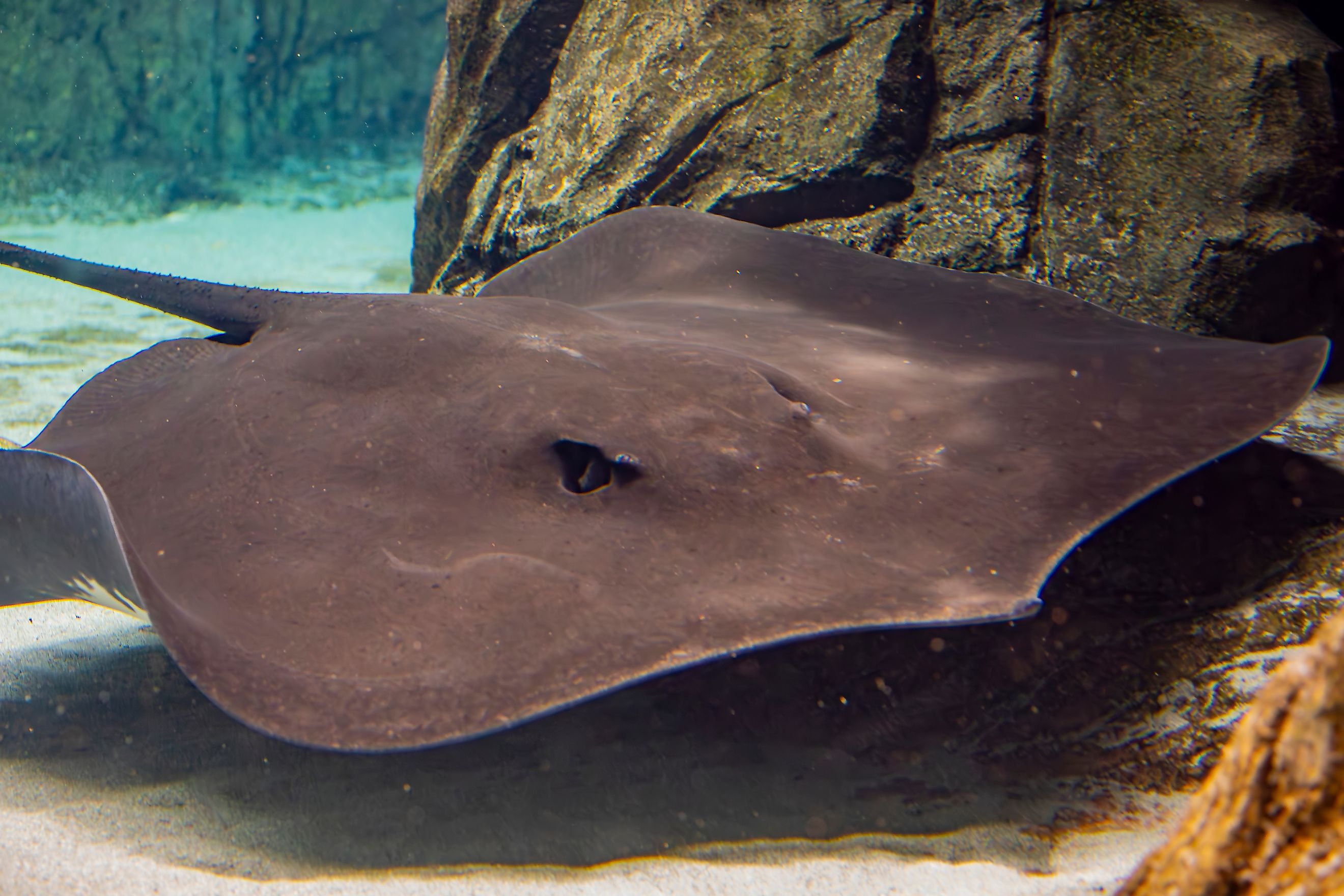
The body is a broad, flattened, oval disc formed largely by the pectoral fins, with a sharply pointed, protruding snout. Coloration is plain, a uniform grayish brown on top that helps the ray vanish against a river bottom, with a pale underside marked by dark bands along the rear edges of the fins. The eyes sit on top of the body, while the mouth and gill slits lie underneath.
The tail is thin, whip-like, and often as long as the body itself. Near its base sits the ray's defining weapon, a serrated spine that can reach about 15 inches (38 centimeters) in length. The spine is coated in toxic mucus and, driven by a powerful sweep of the tail, is strong enough to pierce bone. The barb sits close to the base of the tail rather than at the tip, which is where an experienced handler grips a captured ray to keep the tail from arching into a strike.
Range and Habitat

The giant freshwater stingray lives in large tropical rivers and estuaries across Southeast Asia and parts of Borneo. Its stronghold is the lower Mekong and the Chao Phraya basin in Thailand and Cambodia, and it also occupies the Mae Klong River. The Mekong itself runs through China, Myanmar, Laos, Thailand, Cambodia, and Vietnam, though the ray concentrates in the river's lower reaches rather than its mountainous headwaters.
Populations have also been reported farther west, in Bangladesh and India, and in the rivers of eastern Borneo, an island shared mainly by Malaysia and Indonesia. The historical range appears to have been far wider than the fragmented distribution seen today.
These rays favor slow-moving stretches of deep, murky water with soft sandy or muddy bottoms where they can bury themselves. Some individuals move between fresh and brackish water near river mouths, and researchers still debate whether the species ever ventures into the open sea, where its marine relatives live. Freshwater stingrays as a group are uncommon, turning up in only a scattering of river systems and a handful of lakes known to hold freshwater stingrays worldwide.
Diet
The giant freshwater stingray is a bottom feeder, and its diet reflects a life spent combing river floors. It preys mainly on benthic animals, including small fish, clams, crabs, shrimp, and other invertebrates buried in the sediment.
The ray locates hidden prey using electroreceptors, special sensory organs that detect the faint electrical fields given off by living animals. Once a target is found, the stingray pins it against the bottom and works it toward the mouth on its underside. As the largest predator in much of its range, an adult has few natural enemies apart from humans, and it helps regulate the populations of the smaller animals it hunts.
Behavior

Secretive and solitary, the giant freshwater stingray spends much of its time partly buried in sediment, with only its eyes and spiracles exposed. Spiracles are paired openings behind the eyes that let the ray draw in clean water to breathe while its mouth rests against the bottom. This buried posture, combined with its drab coloring, makes the animal very hard to spot.
The species is not aggressive toward people and uses its venomous spine only in self-defense. A cornered or hooked ray will lash its tail to drive the barb into a threat, and anglers who catch one face real danger from that spine. Because the fish hides so well and lives in cloudy water, scientists still know remarkably little about its daily movements, the size of its home range, or how it communicates.
Reproduction
Like other members of its family, the giant freshwater stingray gives birth to live young rather than laying eggs. Developing embryos are nourished inside the mother, and newborns emerge as miniature versions of the adults, complete with a working tail spine from birth.
Details of the species' reproductive cycle in the wild remain poorly documented, including how often females breed and how large a litter can be, though the available evidence points to small litters. Lifespan is likewise uncertain. Many stingray species live for around 15 to 25 years, and a fish this large is thought to be long-lived and slow to mature. Those traits leave the population slow to recover once its numbers fall.
Importance to the World
As one of the largest animals in its rivers, the giant freshwater stingray sits near the top of the food web and acts as a check on the smaller fish and invertebrates it eats. Healthy populations are a sign of a functioning river, and the species has become a flagship for freshwater conservation across the Mekong.
The 2022 record catch drew global attention and allowed scientists to attach the first acoustic tracking tag ever placed on the species, opening a window onto a fish that had been almost impossible to study. That same ray took the freshwater size record from a Mekong giant catfish caught in 2005, another threatened giant of the same river system. For local communities, the giant stingray carries cultural weight as a river icon, and its decline signals wider problems for the fisheries that millions of people depend on.
Threats and Conservation

The International Union for Conservation of Nature lists the giant freshwater stingray as Endangered. In some parts of its range, numbers have fallen by an estimated 95 percent, and local extinctions have already occurred. The animal's large size, late maturity, and small litters make it especially vulnerable, because adults removed from a river are not quickly replaced.
The pressures are many. Overfishing, both targeted and accidental, removes breeding adults faster than they can be replaced. Dams fragment rivers and block the movements the species needs. Sediment removal and declining water quality degrade the river bottoms it depends on. Pollution can be lethal in a single event. In 2016, wastewater leaking from an ethanol factory fouled the Mae Klong River in Thailand, killing dozens of giant stingrays. Few large individuals have been seen there since.
Conservation work now centers on river protection, careful catch-and-release handling, acoustic tagging studies, and research groups such as the Mekong-focused project that documented the record fish. These efforts aim to understand the species before it vanishes, but its long-term future depends on healthier, better-protected rivers.
Takeaway
The giant freshwater stingray is among the largest fish found in rivers, yet scientists still know relatively little about its life. It can grow to an enormous size, but it reproduces slowly and is becoming increasingly rare. Pollution, fishing and changes to river habitats threaten its survival in waterways such as the Mekong and Chao Phraya. Saving the species will require more than protecting the stingray itself. The rivers it depends on must remain healthy enough to support the many other animals and communities that rely on them.
Fun Facts
- Record breaker. The largest giant freshwater stingray ever documented weighed about 661 pounds (300 kilograms) and earned a Guinness World Records title as the biggest freshwater fish on record.
- Born armed. Newborn rays arrive with a working venomous spine already in place, looking like tiny copies of their parents.
- A sting that pierces bone. The tail spine can reach roughly 15 inches (38 centimeters), is coated in toxic mucus, and can drive through bone when the ray strikes.
- Living electricity detector. The stingray hunts buried prey by sensing the weak electrical fields produced by other animals, so it can find a meal it cannot see.
- The vanishing act. By burying itself in sediment with only its eyes exposed, this enormous fish can disappear almost completely against a river bottom.
Quick Facts
- Common name: Giant freshwater stingray
- Scientific name: Urogymnus polylepis
- Family: Dasyatidae (whiptail stingrays)
- Order: Myliobatiformes
- IUCN status: Endangered
- Disc width: Up to about 7.2 feet (2.2 meters)
- Total length: Up to about 16 feet (5 meters), including the tail
- Weight: Up to roughly 1,300 pounds (600 kilograms)
- Lifespan: Not well known, likely around 15 to 25 years or more
- Diet: Carnivore, feeding on fish, clams, crabs, shrimp, and other bottom invertebrates
- Range: Rivers and estuaries of Southeast Asia and Borneo, including the Mekong and Chao Phraya basins