Where Elk Spend The Winter
Elk were once grouped with the Eurasian red deer as Cervus elaphus, but now they are widely recognized as a separate species, Cervus canadensis. They are some of the most mobile large mammals in North America. Their year is shaped by the search for food that remains accessible under snow. In the warmer months, elk herds move up into high alpine and subalpine areas to graze on new growth. When autumn storms arrive, those areas become inaccessible. While a few bulls may stay in the deep-snow regions, most elk head down to lower meadows to find food during winter. The places they choose and how they survive there follow a clear ecological pattern that biologists have studied throughout the Rockies and beyond.
The Seasonal Descent

Across most of their range, elk are elevational migrants. In summer they occupy high subalpine and alpine ranges, and around September they shift to lower-elevation winter range, trading the grasses and flowering plants of the high country for woodier browse lower down. The trigger is snow as much as cold. Early heavy snow can push radio-collared elk downslope within days, and the final move to winter range often comes in a slow drift down the drainages in November.
Elk in the Clarks Fork herd near Yellowstone travel an average of 33 miles (53 km) one way between winter and summer range, with some animals covering as much as 67 miles (108 km). Others barely move at all, descending only a few thousand feet (roughly 600 to 900 meters) of elevation to reach a sheltered valley floor. Some populations split the difference, with certain individuals making long, low-elevation migrations and others making short moves that gain considerable altitude.
Partial Migration And Herd Fidelity

Herds do not always follow a single migration pattern. Many populations are partially migratory, meaning migrants and year-round residents mix on the same winter range. Individual elk can even switch migratory status between years, and they show strong fidelity to the same winter, summer, and breeding ranges across their lives. This loyalty to a learned winter range is important for conservation, because an elk that depends on one wintering ground cannot easily relocate when that ground is lost.
What Makes Good Winter Range

Good elk winter range is defined less by warmth than by access to buried food. Snow depth is the single factor that most limits elk distribution and movement, with depths of roughly 18 to 28 inches (46 to 71 cm) forcing animals to change where and what they eat. The solution is topography. Elk concentrate on high windswept ridges, where sun and wind strip the snow cover thin, and on south-facing slopes for the same reason. Low-elevation, south-facing ground with older forest nearby offers the combination they need, shallow snow for feeding and mature conifers for shelter.
Shelter matters in the hardest weather. Dense coniferous stands provide thermal cover and intercept snow, which becomes critical during severe winters. Elk often work both aspects within a single day, bedding on sunny south slopes during daylight and moving to dense timber on north-facing ground at night to conserve heat. The ideal winter range is a mosaic, open feeding ground laid against cover, rather than either one alone.
Feeding Through The Snow

Elk will paw through light snow to reach grasses and sedges, which they prefer when they can get at them. Once snow crusts over or reaches about 12 inches (30 cm), they move into shrub and conifer habitat, and depths beyond roughly 24 inches (61 cm) cut their mobility enough to drive them to lower forested ground. By then, elk rely more on shrubs, twigs, and other woody plants for food. In places like Rocky Mountain National Park, the winter diet leans heavily on willow and aspen rather than the grasses of summer. This browsing concentrated in a shrinking winter range is exactly what makes overabundant wintering herds so hard on streamside vegetation.
The Body In Winter

Like other northern deer, elk adjust their bodies to use less energy. All North American deer respond to winter with coordinated drops in metabolism and activity that deepen as conditions restrict access to quality forage. The effect is substantial. In closely studied red deer, resting heart rate in winter falls to roughly half the summer rate, voluntary food intake declines even when food is freely offered, and animals draw down stored body fat to fuel themselves.
Counterintuitively, eating less can be efficient. A reduced appetite shrinks the energetically costly gut, and the animal extracts nutrients from poor winter forage more efficiently than in summer, squeezing more from each mouthful during a season when the energy balance is unavoidably negative. Part of the savings comes from nocturnal hypometabolism, a nighttime dialing-down of heat production and energy use documented in several ungulates and most pronounced in late winter. Behavior reinforces biology. Elk in the poorest condition at winter's end select most strongly for sites that cut the cost of staying warm, trading forage quality for thermal relief when their reserves run lowest.
The National Elk Refuge

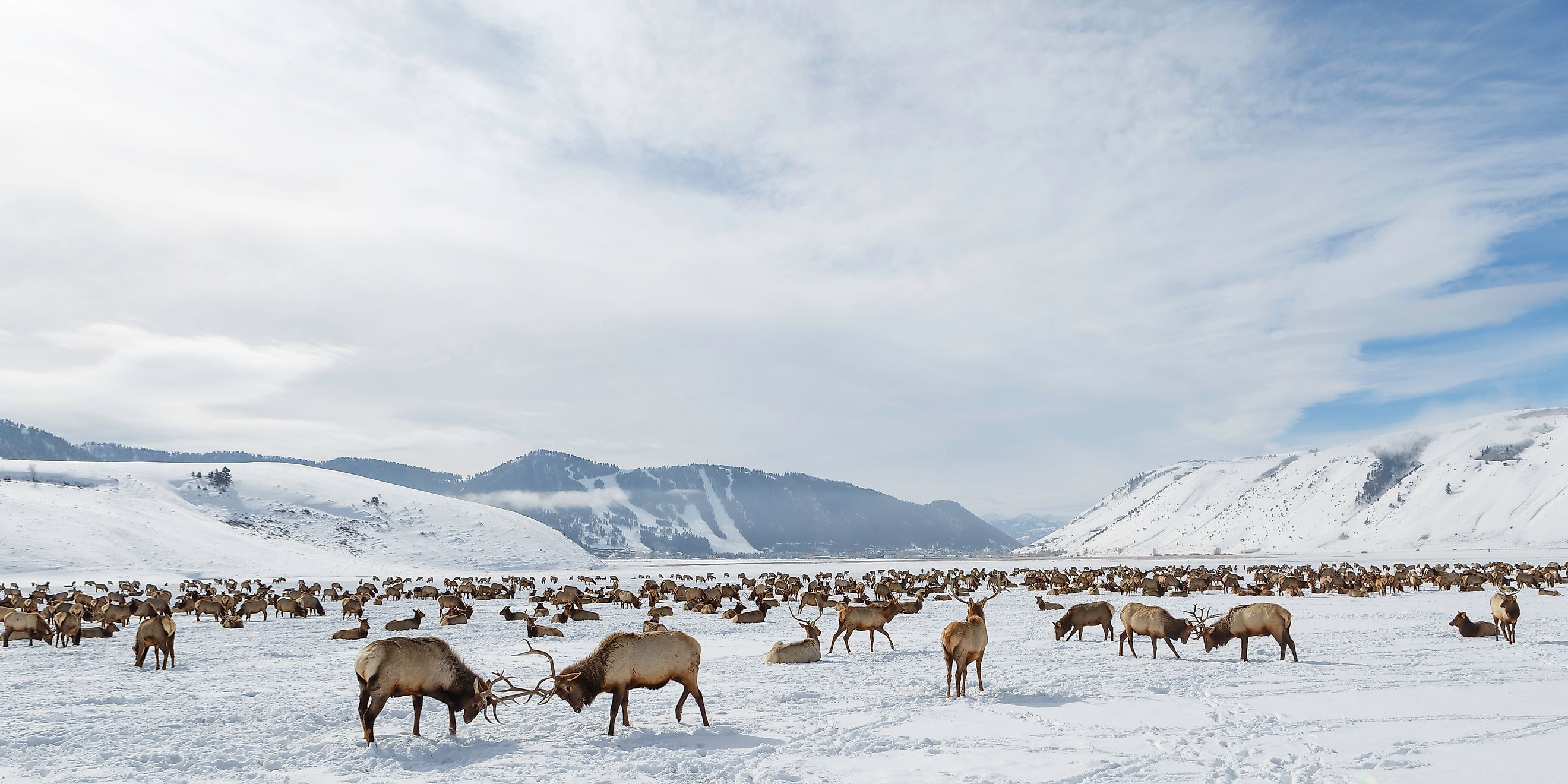
The most famous elk wintering ground in North America sits on the edge of Jackson, Wyoming. Roughly 7,000 to 8,000 elk from the Jackson herd spend the winter on the nearly 25,000-acre (about 10,100-hectare) National Elk Refuge. The refuge exists because the natural winter range largely disappeared. Loss of winter range in Jackson Hole to settlement and ranching led to supplemental feeding beginning in the winter of 1910 and 1911, and Congress established the refuge on August 10, 1912, to reduce winter starvation and the raiding of ranchers' hay. The underlying geography explains the whole arrangement. Much of Yellowstone's interior is a high plateau where deep snow makes winter survival difficult, so many elk historically migrated down to lower valleys like Jackson Hole, and feeding has propped up that pattern for more than a century.
Concern over chronic wasting disease, which spreads more readily where animals crowd together on feedlines, has pushed the Fish and Wildlife Service toward a goal of reducing the wintering refuge population to around 5,000 elk. Natural winter habitat on the refuge can support roughly 5,000 elk on its own, which is the target managers are trying to reach by leaning less on feeding.
Bottled-Up Range At Rocky Mountain National Park

A very different wintering story plays out in Colorado, where no one feeds the elk at all. In Rocky Mountain National Park, herds summer high on the tundra and drop in winter to the lower-elevation valleys of the park and the adjacent Front Range. The classic wintering grounds are the park's low meadows such as Moraine Park, Horseshoe Park, and Beaver Meadows. The trouble is that these animals have nowhere left to spread out. Where elk once scattered well below the present town of Estes Park, surrounding human development now bottles them up within the park's meadows.
Confining a herd to a small winter range concentrates its browsing. At its peak, the park held the highest recorded density for a free-ranging elk population not artificially fed, and the resulting pressure on willow and aspen prompted a management plan aimed at keeping 600 to 800 elk on the low-elevation winter range.
The Shrinking Map Of Winter Range
Winter is often the most difficult season for elk, and human activity can make survival even harder. Across northwestern Wyoming, settlement has cut off access to substantial portions of the animals' historic winter range. This loss helped create the Jackson feedgrounds and contributed to the concentration of elk in places such as Rocky Mountain National Park. Other pressures include disease transmission at feedgrounds, the return of wolves, which has changed where herds choose to spend the winter, and a warming climate. Milder winters and thinner snowpack are already causing elk to leave the National Elk Refuge earlier than they once did. As development and environmental changes continue to alter the landscape, herds have fewer options for finding suitable winter habitat. How these pressures will affect migration schedules and winter distribution across the Greater Yellowstone Ecosystem remains an open question.