Why Rattlesnakes Rattle And Cottonmouths Gape
Rattlesnakes and cottonmouths are close relatives. Same family, same subfamily, same heat-sensing pits, same hinged fangs, and largely the same problem: a venomous snake that bites a deer gains nothing, because the deer is not food and the snake has just spent venom it needs for hunting.
Both species solved it by inventing a warning. They did not invent the same one. Rattlesnakes went acoustic and built an organ for it. Cottonmouths went visual and simply open their mouths.
The Rattle Evolved Exactly Once

That is the first thing worth knowing. The rattle is a singular evolutionary event, found only in the genera Crotalus and Sistrurus, and nowhere else in the animal kingdom. Roughly 36 species have it, from the eastern diamondback down to the pygmies, every one descended from the snake that got it first.
Structurally it is simple and strange. The rattle is made of loosely interlocking keratin segments, the same protein as fingernails, and the segments are hollow. They do not contain anything. The sound is not a maraca full of seeds, it is the segments clicking against one another.

What moves them is a set of highly specialised tailshaker muscles, among the fastest-contracting muscles in any vertebrate, capable of sustaining the vibration for long periods without fatiguing.
They Were Shaking Their Tails First

The obvious objection to a structure like this is that a partial rattle seems useless. One segment makes no sound, so what was selection acting on before there was anything to hear?
Work published in 2016 answered that neatly, and it applies across the whole pit viper group. Tail vibration is widespread among snakes, including plenty with no rattle at all, and researchers found that species more closely related to rattlesnakes vibrate their tails faster and more often than distant relatives do.

The behaviour came first and the hardware arrived later. By the time anything resembling a rattle existed, the snakes had been performing the motion for a very long time. The rattle did not create the behaviour, it amplified one that was already there.
No, It Is Not One Segment Per Year

This is the most durable piece of folk wisdom about rattlesnakes and it is wrong. A new segment is added at every shed, not every year, and a snake may shed several times in a good season.
Segments also break off. Rattles snap against rocks and vegetation, so a long rattle means a snake that has shed often and been lucky, not a snake of a particular age. Counting them tells you nothing reliable.
Young snakes are the practical complication. A newborn carries only a button, which produces no sound at all, so the youngest and least predictable animals are also the quietest.
Someone Built A Robot Rattlesnake

Two explanations for the rattle have competed for a century. One holds that it deters large animals from trampling the snake, the hypothesis usually told with bison in it. The other holds that it started as a lure to draw prey closer.
Recent work tested the deterrence side directly, using a 3D-printed robotic rattlesnake capable of reproducing the full display, and presenting it to 38 species at the El Paso Zoo.

The result that matters is the comparison. Species that live alongside rattlesnakes showed significantly stronger fear responses than species that do not, which points to an evolved, innate aversion rather than a generic startle at a sudden noise.
The authors concluded the display does two jobs at once: a deimatic signal that startles anything, and an aposematic one that specifically warns animals with evolutionary history of rattlesnakes. It probably began as the first and became the second.
The Cottonmouth Went Visual Instead

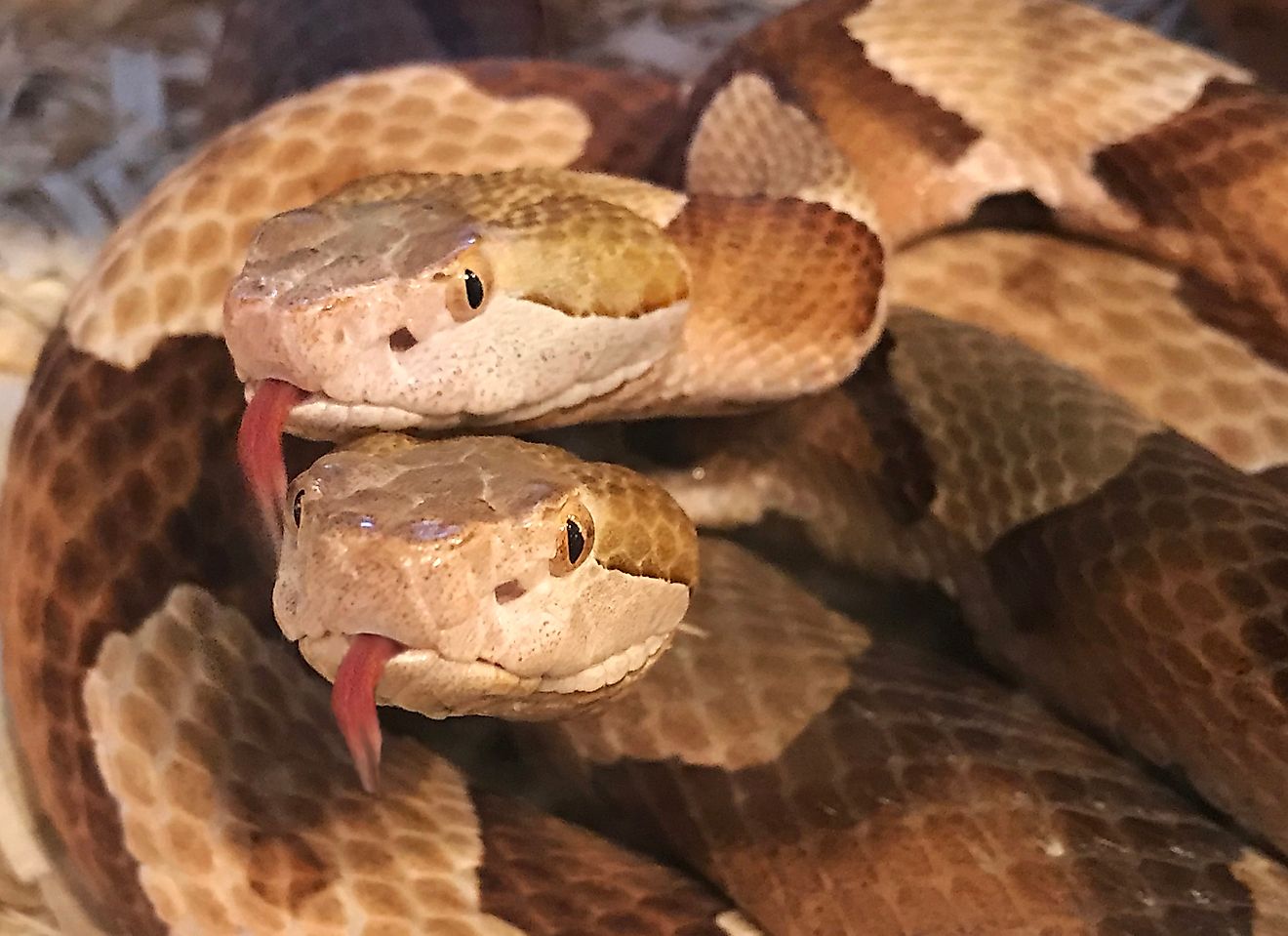
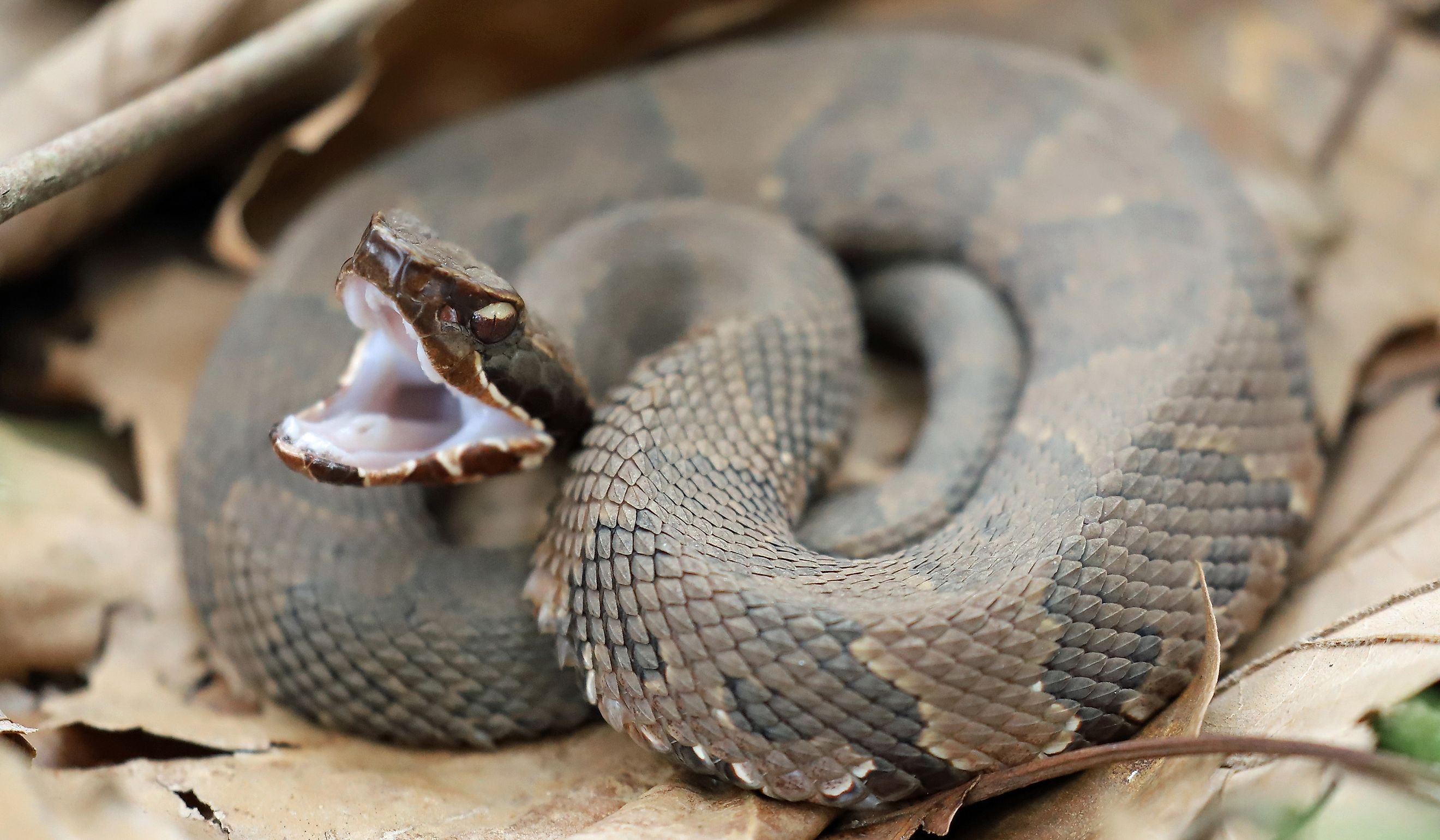
The cottonmouth took the other route entirely. It has no noisemaker. What it has is an oral lining so white it looks artificial, and it will throw its head back and hold the mouth wide open at anything that gets too close.

The display is the source of the name, and it is worth being clear about what it means. A gaping cottonmouth is not winding up to attack. It is the snake's equivalent of standing its ground and shouting, and the overwhelmingly common sequence afterwards is that the snake leaves.

Gaping itself is not a snake invention. Sharks do it, gulls do it, roosters do it. What cottonmouths added is the contrast: a mouth lining bright enough to function as a signal in low light and dense cover, which is exactly where the snake lives.
The Habitat Explains The Difference

Think about where each animal does its warning and the two strategies stop looking arbitrary.
Rattlesnakes are terrestrial and frequently occupy open country: sandhills, rock outcrops, prairie, pine savanna. The timber rattlesnake works hardwood forest, which is drier ground than any cottonmouth would choose. Sound carries there, it works around corners, it works at night, and it works when the snake is invisible under vegetation. An acoustic signal suits an animal whose main defence is already being impossible to see.

Cottonmouths are semi-aquatic, living along swamp edges, sloughs, and slow water. A snake that spends its time partly submerged, often with only the head above the surface, has one highly visible body part and the rest of it underwater. Signalling with the mouth is the only option that works from that position.
There is also a practical limit. A rattle is a tail structure that needs to stay dry and intact to function; constant immersion is not what it is built for.
Both Warnings Are Increasingly Optional

Neither display is guaranteed, and this is the part people get caught by. A rattlesnake that believes it has not been spotted will often stay silent, because camouflage is the first line of defence and rattling gives the position away. Plenty of people walk past rattlesnakes that say nothing, which is worth remembering on any southern dune path.
Size matters too. The dusky pygmy rattlesnake produces a sound often compared to an insect, audible only a few feet away, which makes a technically functional rattle practically useless as a warning to a person.

Cottonmouths are the same. A snake that feels unthreatened will slide into the water rather than perform, and the gape is reserved for situations where retreat has been cut off.
So the honest summary is that two closely related animals, facing the identical problem of being large, slow, and easy to step on, arrived at completely different answers shaped by where they live. One built the only acoustic warning organ in the animal kingdom. The other opens its mouth. Both are saying exactly the same thing, which is that you are too close and neither of you wants this.