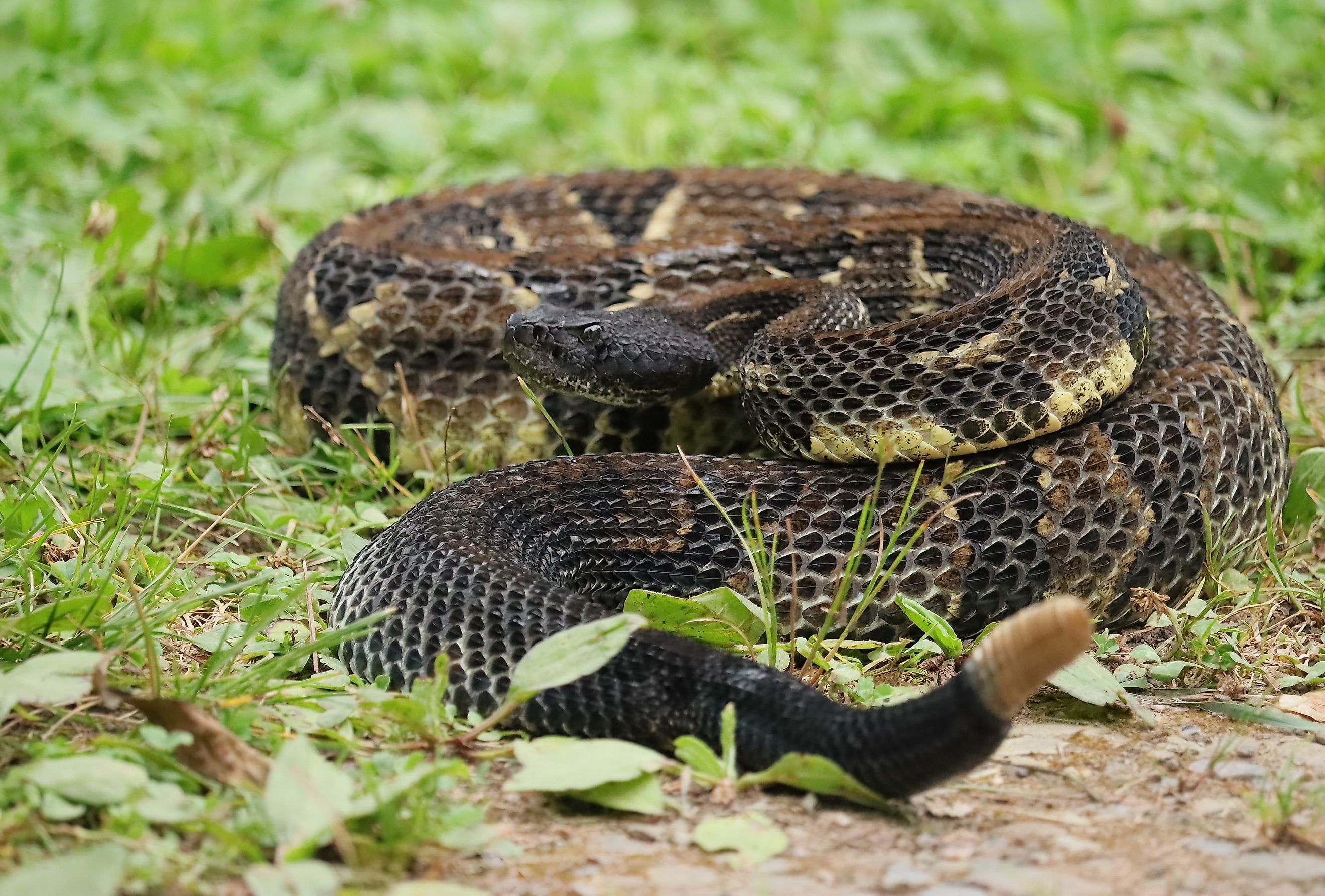
Timber Rattlesnake
Few North American snakes carry a reputation as heavy as their body. The timber rattlesnake (Crotalus horridus) is a thick, slow-moving pit viper of the eastern United States, and its species name, given by Carl Linnaeus in 1758, translates roughly to "dreadful." Yet the animal behind the name is famously reluctant to strike, spending most of its life coiled and motionless, trusting its camouflage over its fangs.
It is the only rattlesnake across most of the populous Northeast. Its range reaches as far north as southern New England and Minnesota and as far south as east Texas and northern Florida. Adults commonly stretch three to five feet, making this one of the larger venomous snakes east of the Mississippi. Where it survives in numbers, it quietly earns its keep by hunting the rodents that spread Lyme disease.
Taxonomic Classification

The timber rattlesnake belongs to the kingdom Animalia, phylum Chordata, and class Reptilia. It sits within the order Squamata, suborder Serpentes, and the family Viperidae, the vipers. More precisely it is a member of the subfamily Crotalinae, the pit vipers, named for the heat-sensing pit set between the eye and the nostril on each side of the head. Its genus, Crotalus, contains the true rattlesnakes.
Linnaeus described the species as Crotalus horridus in 1758, and no subspecies are recognized as valid today. Earlier classifications split the snake into a northern "banded" form and a southern "canebrake" form (once labeled C. h. atricaudatus), and both common names remain in local use. Modern work treats these as regional variants of a single species rather than distinct taxa, a reminder that snake taxonomy is still being reshaped by genetic study.
Physical Description

The timber rattlesnake is heavy-bodied and unmistakably built for ambush. Adults typically measure 36 to 60 inches (90 to 152 cm), and the record length for the species is 74.5 inches (189.2 cm). It is often ranked the third-largest venomous snake in the United States, behind the eastern and western diamondback rattlesnakes. Despite that length, it is not a heavy animal by mammal standards, with most adults weighing between 1.3 and 2 pounds (0.6 to 0.9 kg). Males grow larger than females, a modest example of sexual dimorphism.
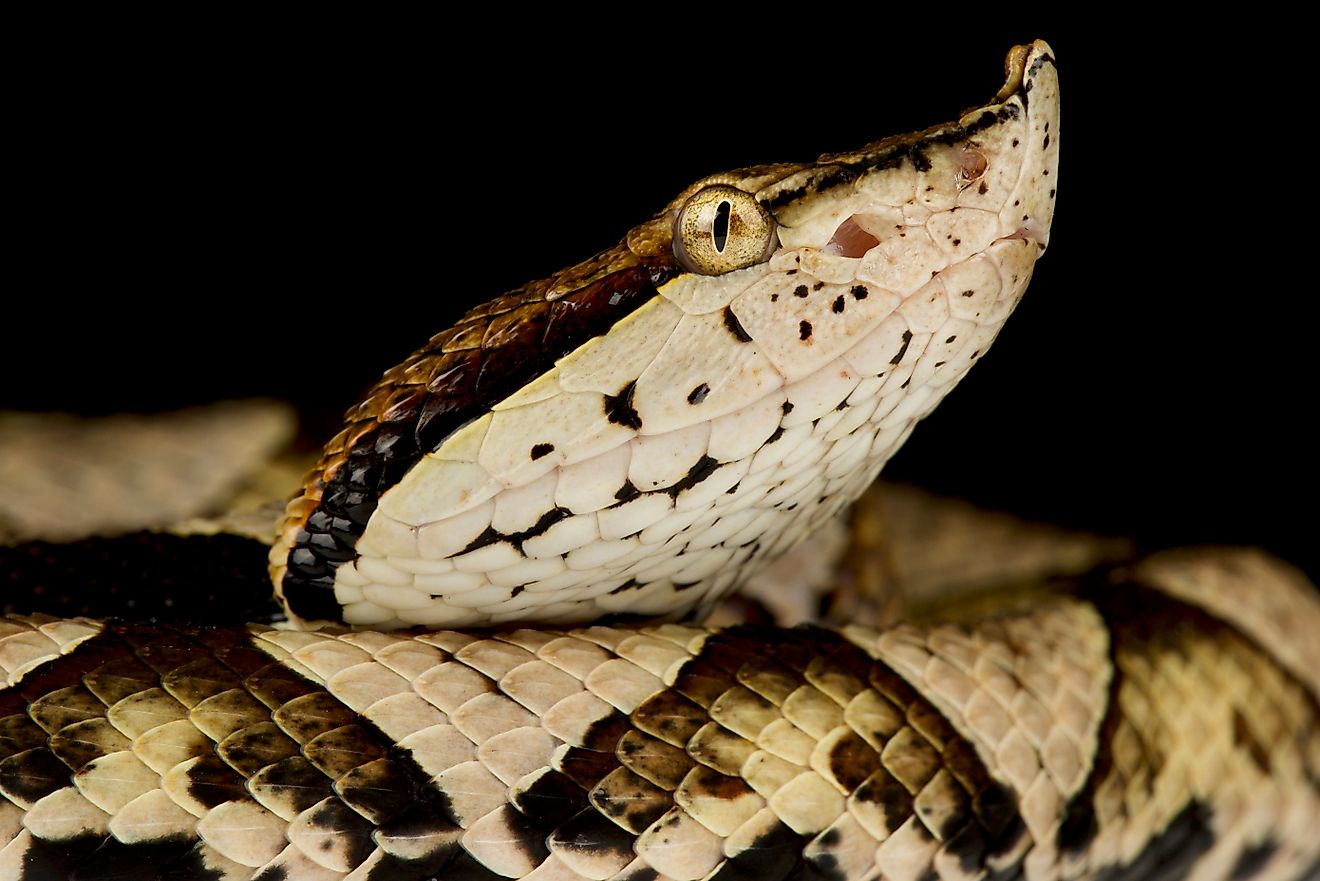
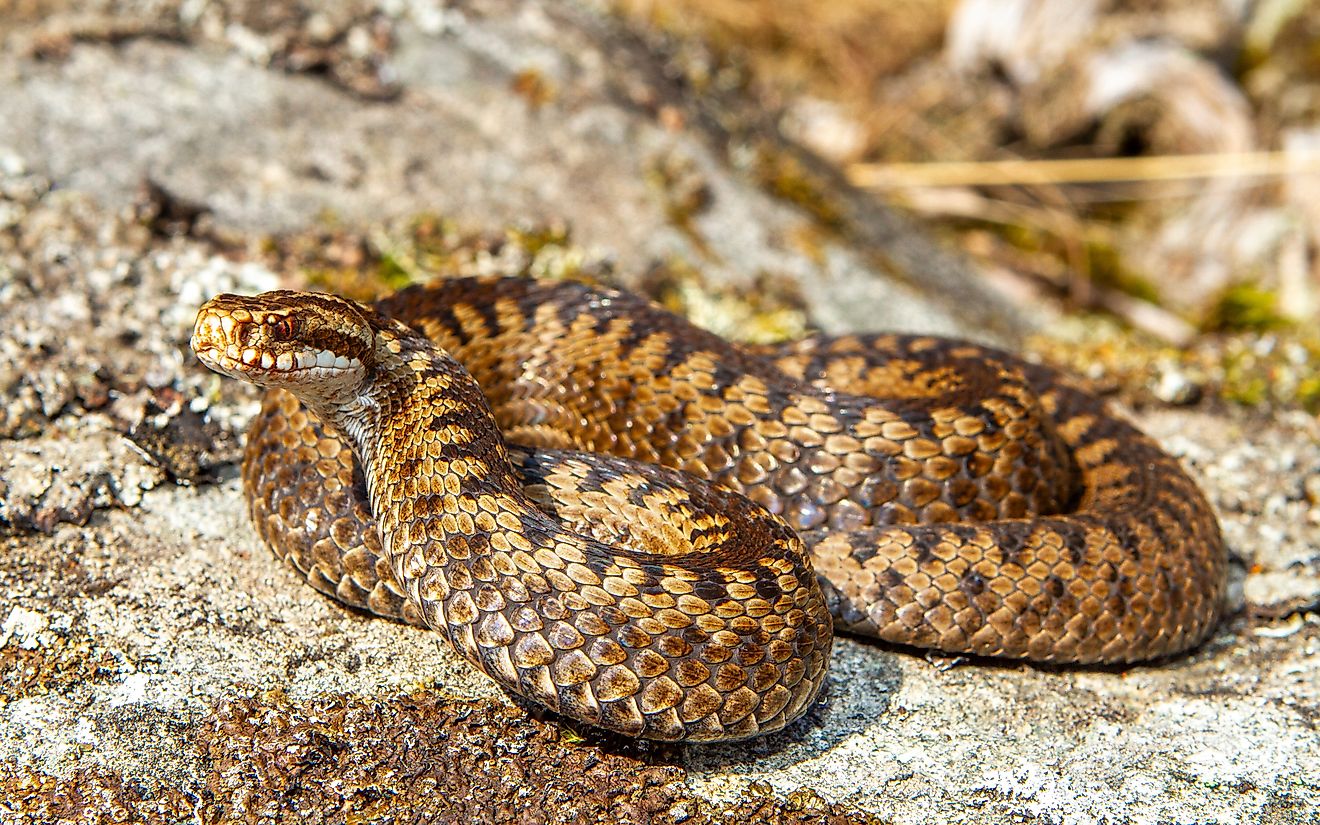
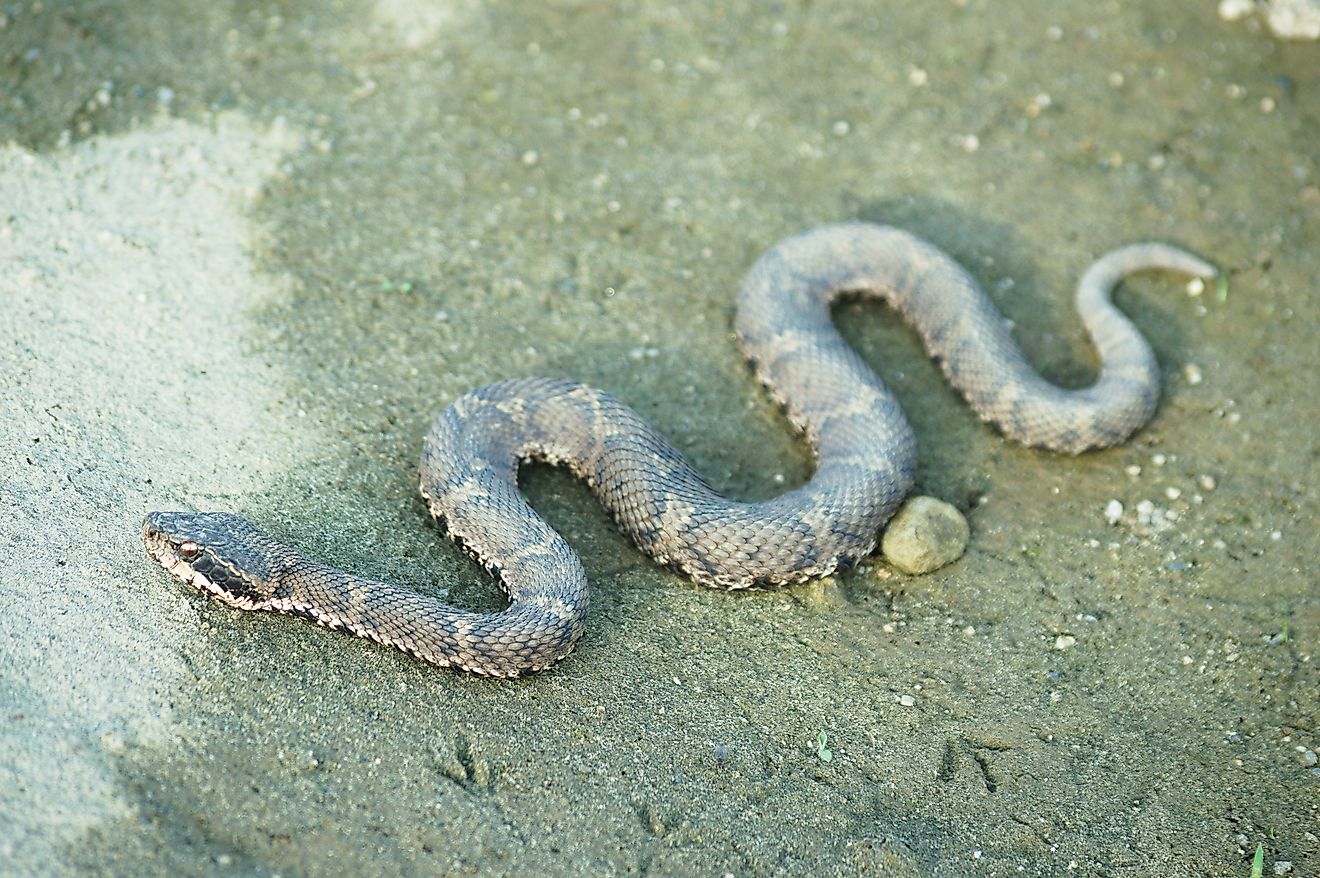
The head is broad and triangular, clearly wider than the neck, with vertical, cat-like pupils. Ground color ranges widely, spanning yellow and tan, brown and gray, and a nearly solid black in the melanistic morph. Across the back run 20 to 29 dark crossbands, often shaped like chevrons or a V, with jagged edges. Many individuals carry a rust or chestnut stripe down the spine. The tail is velvety black and ends in the rattle, a stack of loosely interlocking keratin segments that buzz when the snake vibrates its tail. A fresh segment is added at each skin shed, so the number of segments does not reveal the snake's age.
Range and Habitat

The timber rattlesnake is endemic to eastern North America. Its range spans much of the eastern United States. To the north it reaches southern New Hampshire and southern Minnesota, to the south it extends into east Texas and northern Florida, and to the west it runs to eastern Kansas and central Wisconsin. It is the only rattlesnake in most of the crowded Northeast and, after the prairie rattlesnake, the most northerly distributed venomous snake on the continent. The species once occurred in Ontario but was assessed as extirpated from Canada in 2001.
Habitat shifts with latitude. In the north the snake favors forested rocky hillsides, especially south-facing slopes with talus and deep rock crevices that serve as winter dens, known as hibernacula. In the south it occupies lowland hardwood forests, floodplains, and swampy canebrakes, the origin of the "canebrake" name. Across the range, the presence of suitable denning rock and prey-rich forest matters more than any single vegetation type.
Diet

Timber rattlesnakes are ambush predators, the classic "sit and wait" hunters. A snake will settle beside a log or at the base of a tree, sometimes resting its head against the trunk, and hold that position for hours or days until prey passes within striking range. Small mammals make up the bulk of the diet, including mice, voles, shrews, chipmunks, squirrels, and rabbits. Birds account for a small share, roughly 7 percent in one dietary study, with reptiles and amphibians taken only rarely.
The strike is fast and the venom does the rest. After envenomating prey, the snake releases it, then follows the scent trail using its flicking tongue and the vomeronasal organ in the roof of its mouth, swallowing the animal head first. Diet scales with body size, since a larger gape allows larger meals, and it shifts with reproductive state. Pregnant females eat little to nothing while carrying young, drawing instead on stored reserves.
Behavior

For an animal armed with potent venom, the timber rattlesnake is remarkably even-tempered. It is one of the more docile rattlesnakes, relying first on camouflage and stillness, and it often stays coiled or stretched out without rattling even when a person passes close by. A bite is a genuine medical emergency, but bites are uncommon because the snake goes out of its way to avoid confrontation. It is venomous rather than poisonous, meaning its toxin is delivered through a bite rather than absorbed through touch or ingestion.
Activity is seasonal and tied to temperature. In the north the active season runs roughly late April through mid-October, and snakes may spend up to seven months hibernating in communal dens that can hold 15 to 60 individuals, sometimes alongside other snake species. After emerging, the snakes disperse across the landscape to hunt. Males travel the farthest, up to about five miles (8 km) from the den, while gravid females move shorter distances to warm, open rock ledges suited to developing embryos. Notably, individuals show strong den fidelity, returning to the same wintering site year after year. During the mating season, rival males may engage in a ritual "combat dance," rising and twisting against each other in a test of strength.
Reproduction

Timber rattlesnakes reproduce slowly, which shapes much of their conservation story. Females reach sexual maturity late, generally between ages 7 and 13, while males mature earlier, around ages 4 to 6. Mating occurs mainly between mid-July and October. Females then store sperm through the winter, and fertilization follows in spring after they emerge from the den. Gestation lasts roughly four to five months.
The species is viviparous, giving birth to live young rather than laying eggs. Litters usually number 4 to 14, averaging about 9, and are born between late August and October. Neonates measure roughly 10 to 14 inches (25 to 36 cm) and arrive fully equipped, with working fangs, venom, and a single rattle segment called a pre-button. The young stay near their mother for only one to two weeks, until their first shed, then disperse. Because gravid females fast through pregnancy, they can lose around 40 percent of their body weight by the time they give birth, and most females produce only a handful of litters across a lifetime, often once every three to five years. Set against a natural lifespan that can exceed 30 years in the wild, that slow output leaves populations little slack to absorb heavy losses.
Importance to the World

As a generalist predator near the top of the forest food web, the timber rattlesnake helps regulate populations of mice and other small mammals. That role carries a direct human benefit. Because rodents are the main hosts for the black-legged ticks that transmit Lyme disease, snakes that eat those rodents help hold the disease in check. A University of Maryland study presented in 2013 estimated that a single timber rattlesnake removes the equivalent of 2,500 to 4,500 ticks from a forest site each year by consuming tick-carrying prey. The researchers noted that snake declines are steepest in the northern and upper-midwestern forests where Lyme disease is most common.
The species also occupies a notable place in American culture. The rattlesnake features in Native American art and ceremony as a symbol of strength and protection, and during the Revolutionary War it became an emblem of colonial defiance, appearing in the "Join, or Die" cartoon and on the Gadsden flag. A healthy timber rattlesnake population is widely treated as a sign of an intact, functioning forest.
Threats and Conservation

Globally, the timber rattlesnake is listed as Least Concern on the IUCN Red List, reflecting its wide distribution, and its NatureServe rank is G4 (apparently secure). That headline hides a more troubled local picture. The population trend is decreasing, the snake is extirpated from Canada, and it is listed as endangered or threatened in many northeastern and midwestern states, including New Jersey and much of New England.
The pressures are familiar. Habitat loss and fragmentation isolate dens and cut populations off from one another. Human persecution remains a major factor, from casual killing to the deliberate collection of snakes at their dens, and animals are still lost to the pet trade and to roundups. Roads add a steady toll of vehicle strikes, and an emerging fungal disease, ophidiomycosis, threatens some populations. The species' late maturity and infrequent breeding mean that recovery from these losses is painfully slow. Conservation measures now include legal protection in many states, protection of denning sites, public education to reduce needless killing, and, in some areas, careful reintroduction efforts. Wildlife agencies commonly offer a simple piece of advice. Do not disclose the location of den sites.
Takeaway
The timber rattlesnake is a study in contrasts. It is a venomous predator that would rather hide than fight, a globally secure species that is disappearing from state after state, and a much-feared animal that quietly plays an important role in protecting human health. Its slow, long life and infrequent breeding make it exquisitely sensitive to habitat loss and to the oldest threat it faces, deliberate killing by people. Protecting its forest dens, and tempering fear with understanding, will decide whether this ancient eastern viper keeps its place in North America's woodlands.