Why Hognose Snakes Play Dead
Playing dead is not the hognose snake's first move. It is the fourth, and it only happens after three other performances have failed. The snake flattens its neck into a cobra-like hood, hisses loudly enough to hear from several feet away, and lunges repeatedly with its mouth firmly shut. Only when none of that works does it convulse, roll onto its back, hang its tongue out and go limp. The whole thing is a sequence, and the last act contains a flaw that gives the game away.
It Pretends To Be A Cobra First

The opening move is impersonation rather than deception about being alive.
Confronted, the hognose flattens its neck and raises its head off the ground, producing a wide hood that resembles a cobra. It inflates its body and hisses loudly, which has earned it the nicknames blowing adder, spreading adder, hissing adder and puff adder.
Not one of those names belongs to it. The snake is harmless to people, and the display is a bluff borrowed from animals that are not.
Then It Strikes Without Biting

The second stage looks like an attack and is carefully engineered not to be one.
The hognose lunges with its mouth closed or barely open, usually stopping short, and almost never makes contact. Herpetologists call it a bluff strike, and a snake that has decided to bluff will keep bluffing rather than escalate to a real bite.
That is unusual. Most snakes that go through a threat display are warning you about what comes next. This one is not.
Only Then Does It Die

The famous behavior is a last resort, and it is theatrical in the fullest sense.
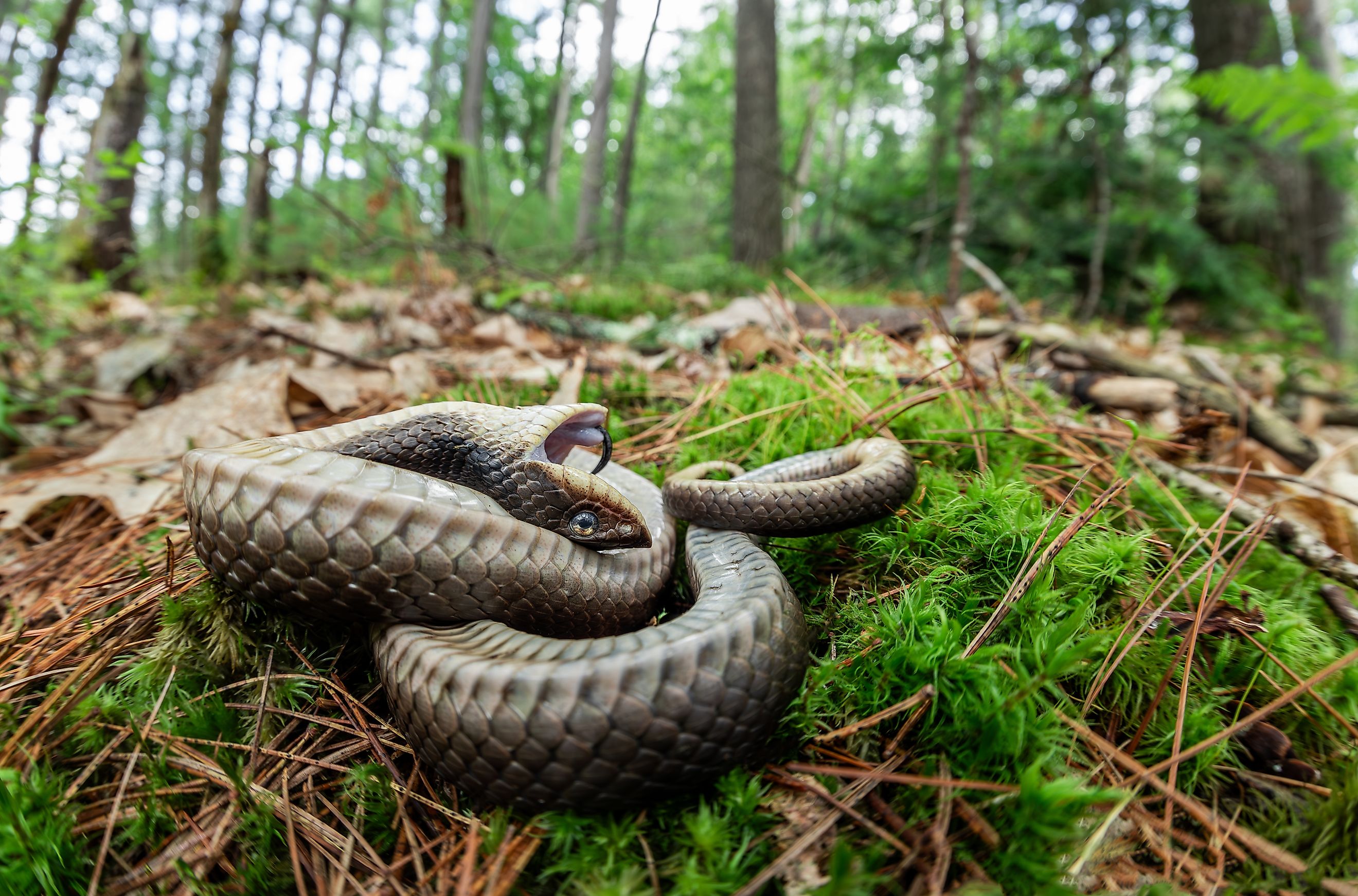
The snake writhes as if in agony, convulses, then rolls onto its back. The mouth gapes open, the tongue lolls out to one side, and the body goes completely limp and unresponsive to touch.
The technical term is thanatosis, a form of tonic immobility found across the animal kingdom from insects to mammals. Few species commit to it as thoroughly as this one.
The Smell Is Part Of It

Visual deception alone would not convince an animal that hunts by scent.
A feigning hognose releases foul musk from its cloaca and often defecates at the same time, smearing itself in the result. Many individuals also regurgitate recently eaten prey or digestive fluid.
The effect is to smell like something that has been dead a while. For a predator deciding whether a motionless snake is worth eating, the nose settles it faster than the eyes.
Sometimes It Bleeds On Purpose

The most extreme element of the display is physiological rather than behavioral.
In some cases small blood vessels in the mouth rupture, pooling blood in the oral cavity so that it appears at the lips. The term for deliberately rupturing one's own vessels is auto-hemorrhaging.
A limp snake with an open mouth, a hanging tongue and blood around it is a convincing corpse. The animal is producing that impression on demand.
Belly-Up Is The Whole Point

The position is not incidental to collapsing. It is the specific thing being imitated.
A genuinely dead snake usually ends up on its back, so the hognose puts itself there deliberately rather than simply falling over. Everything else in the display is arranged around that posture.
Which creates the opening for the detail everybody remembers about this animal.
Turn It Over And It Flips Back

This is the flaw in an otherwise excellent performance.
If you roll a feigning hognose onto its belly, it immediately rolls back onto its back, and will do so repeatedly if you keep interfering. One description has it insisting that it is really dead.
A genuinely dead snake stays where it is put. The one that corrects you is alive, which also makes this the simplest field test there is.
It Can Hold The Pose For Hours

Duration varies considerably and is not fixed by reflex.
The display can last minutes or hours depending on the perceived threat. Likelihood and duration both vary with intrinsic factors such as the individual's condition and extrinsic ones such as the type of predator and the setting.
Death-feigning has also been recorded frequently in water, which suggests the behavior is not tied to a particular surface or escape route.
All Three Species Do It Differently

North America has three hognose species and the performances are not identical.
Eastern, western and southern hognose snakes are all capable of death-feigning, with notable differences between them. The eastern is the most committed performer and the one most accounts describe.
Western hognose snakes are common in the pet trade, where keepers report the full sequence turning up in animals that have never met a predator.
The Snout Explains The Rest Of It

The upturned nose that gives the genus its name points to how the animal makes a living.
The hognose burrows by forcing its head into soil and moving it back and forth, and it preys extensively on toads, which it digs out. Toads inflate when threatened, and the snake has enlarged rear teeth to deflate them.
A specialist toad hunter that spends its time digging in open sandy ground is exposed to a great many predators. An elaborate bluff is cheaper than being fast.
The Short Answer

Hognose snakes play dead because most predators will not eat something that is already dead and starting to rot, and the snake produces every signal of that state on command. Belly-up, gaping, tongue out, limp, smeared in musk and feces, sometimes bleeding from the mouth.
It is the last stage of a four-part bluff that starts with a fake cobra hood and a strike that never lands. The one thing it gets wrong is the stagecraft: a dead snake stays where you put it, and this one keeps rolling back over to correct you.