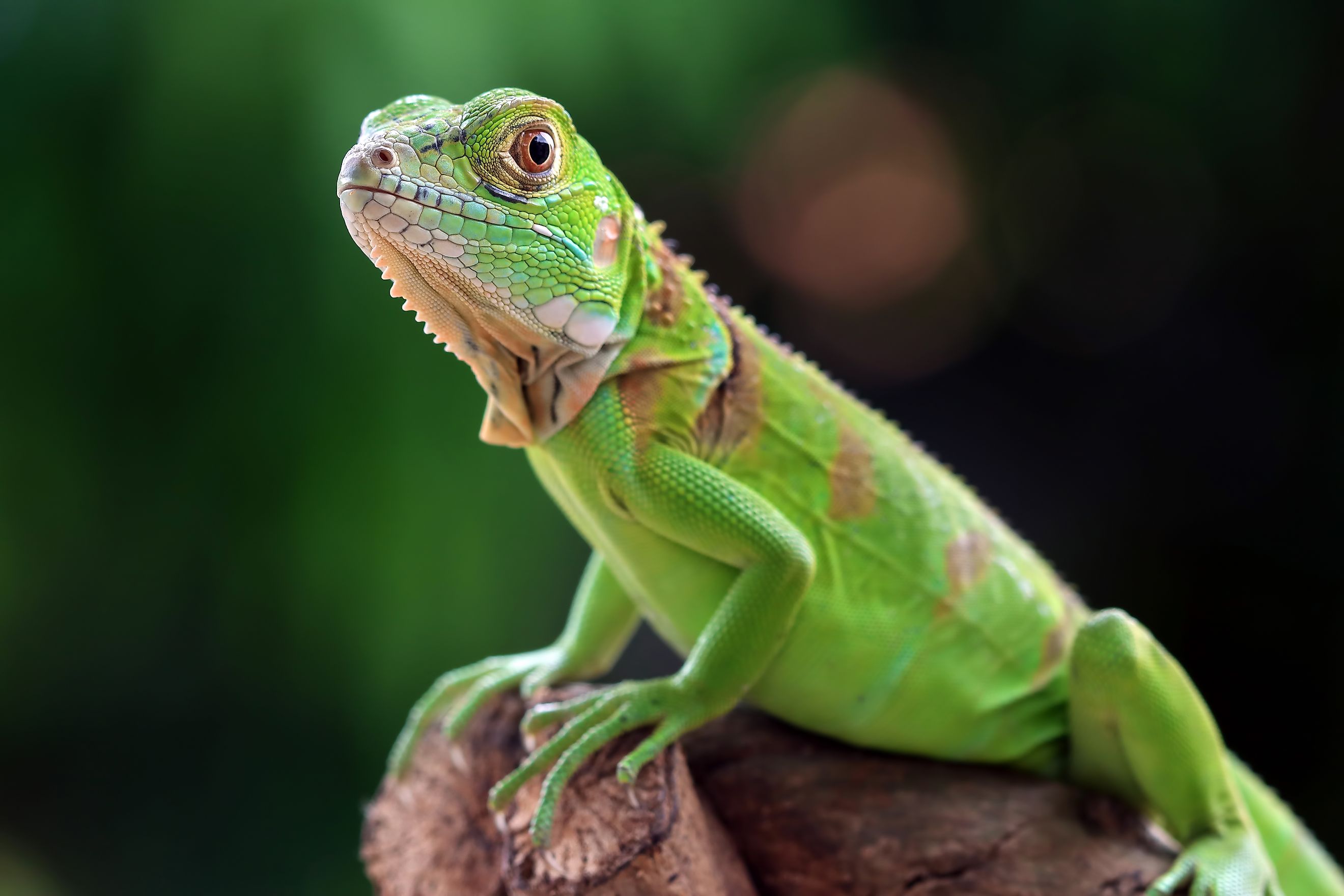
Iguana
Iguanas are scaly reptiles with varied colors that live in trees and can be considered invasive in some areas. These animals are commonly kept as exotic pets and are found across Central and South America. Iguanas are known for their distinctive defensive behaviors, high territoriality, and whip-like tails. They are among the most notable lizard species when it comes to unique adaptations and abilities. Thus, it is important to understand the needs and habits of iguanas to spread awareness about these complex creatures.
Taxonomic Classification

Iguanas are herbivorous lizards in the genus Iguana. Two well-known species are the green iguana and the Lesser Antillean iguana. Their scientific names are Iguana iguana and Iguana delicatissima, respectively. Green iguanas are known for their dark-striped tails and the large and scattered scales below their ear region. Lesser Antillean iguanas lack these features. These ectothermic creatures dazzle onlookers with their vibrant colors and threatening appearances, regardless of species.
Range And Habitat

Native to Mexico, Central America, South America, and the Caribbean, iguanas now live in a wide range of tropical areas, including Florida. Since iguanas are common household pets, they require habitats that mimic their natural conditions due to their complex nature. Growing up to six feet long, they require a large enclosure that allows for enough space for them to comfortably walk around. The size of the enclosure will vary as the iguana ages and grows. Iguanas often burrow in sunny areas to lay and incubate their eggs. A warmer temperature (77-89 degrees Fahrenheit) is needed to properly incubate the eggs.
Iguanas are arboreal, which means that they naturally climb trees. Trees are integral parts of their native ecosystems, which can be threatened by climate change or deforestation. These lizards are also ectotherms, meaning they cannot regulate their body temperature and rely on external sources to do so. In fact, in cooler weather, iguanas have been known to freeze in trees and fall out of them, a phenomenon called "cold-stunning". This happens because they lose muscle control and the ability to hold onto branches.
Food

Iguanas eat mostly dark-leafy greens and vegetables (80-90%), and fruit (10-20%). An iguana's natural climbing ability allows it to easily climb to reach fruits and vegetation in harder-to-reach places. The vegetation in an iguana's diet consists of leaves and vines. Some fruits include bananas, apples, and blueberries. They eat vegetables such as peas and broccoli. Their digestive systems are specially adapted to break down plant material, allowing them to extract nutrients from tough leaves and fibrous vegetation that many other reptiles cannot efficiently digest. Their diet is varied, but they are primarily herbivores.
Physical Description

Iguanas' colors range across deep reds, bright greens, tans, and blacks. Their coloration can vary by species, age, and environment. They have long toes and sharp claws that help them grip the trees where they spend most of their time. Their longer tails also allow them to balance themselves and grasp onto climbing surfaces. Iguanas have large dorsal spines that can help them to further regulate their body temperatures and protect them from predators. They can grow up to six feet long in their later adult years. Iguanas live 8-12 years in the wild and 15-20 years in captivity, given that their habitats promote their health and growth. The average adult weighs around 9 pounds, though some can exceed 18 pounds.
Behavior

An iguana's behavior changes in and out of mating season. During the breeding season, males become more territorial and aggressive, often displaying head bobs, extending their dewlaps, and engaging in dominance displays to attract females and warn off rivals. Outside of mating season, iguanas are generally calmer and spend much of their time basking, feeding, and resting. Their everyday behaviors include sunbathing to regulate body temperature, head bobbing to communicate with other iguanas, and remaining still to avoid detection by threats or predators. When an iguana feels threatened, it may puff up its body and extend its dewlap to appear larger and discourage potential attackers. Remaining still also allows iguanas to conserve energy as they soak up the sun to warm their bodies. Strong swimmers and skilled climbers, iguanas can quickly escape danger by diving into water or retreating high into trees.
Reproduction

Female iguanas typically reach sexual maturity between the ages of 2 and 4. They may lay eggs even without mating, meaning no male has been present. Breeding frequency varies by species and environmental conditions, though most species reproduce once a year upon reaching sexual maturity. Females lay 20-70 eggs per year during a synchronized nesting period. The eggs are cream-colored. As previously mentioned, female iguanas dig nesting burrows to lay their eggs, which then incubate underground. The heat incubates the eggs without the iguana having to be present. The eggs remain in these burrows for 90-120 days before hatching. Iguanas tend to reproduce annually throughout their lives.
Importance To The World

Iguanas can benefit their surroundings through the spread of seeds, nutrient cycling, and dietary habits. Since an iguana's diet consists of a variety of fruits, they expel seeds regularly. Once the digestion process is complete, iguanas deposit seeds in many areas, promoting the natural spread of plants. The digestion of an iguana has been known to aid the germination process, making it easier for plants to successfully sprout and thrive. Their fruit and vegetation-based diets also help clean up ecosystems, ensuring that rotten fruit isn't left to ferment on forest floors.
Threats

Iguanas, unfortunately, face many threats, both man-made and natural. These threats include habitat loss, poaching and collecting, and climate change. Habitat loss comes from deforestation, urban expansion, and fragmentation. Deforestation is the destruction of forest areas to expand communities or promote urbanization. Since iguanas primarily feed and live in trees, this wipes out a majority of their food and displaces them. Humans poach iguanas for their skin and for the exotic pet trade. Since some iguana populations are invasive outside their native range (removed from their natural habitats and introduced into foreign territories), they are also poached due to their large numbers and the lack of predators in certain areas. Fragmentation is the partial breaking up of an animal's habitat. This could be anything that interferes with an iguana's daily life, such as the construction of a highway in the middle of an iguana's territory.
Climate change is a factor that is unpredictable but can nonetheless disrupt an iguana's quality of life. As previously mentioned, iguanas cannot regulate their own body temperatures. This makes them dependent on the heat of their surroundings. Climate change can create erratic weather patterns, causing typically tropical areas to experience uncommon cold fronts that can trigger cold-stunning. This can cause stress in an iguana and be dangerous if it freezes in a tree and falls.
All On Iguanas
Iguanas are much more than the large lizards many people see basking in the sun. They play important roles in their ecosystems, including spreading seeds and helping maintain healthy plant communities. At the same time, they face challenges including habitat loss and climate change. By understanding how iguanas live, feed, and interact with their environments, we can better appreciate these remarkable reptiles and the role they play in the natural world.