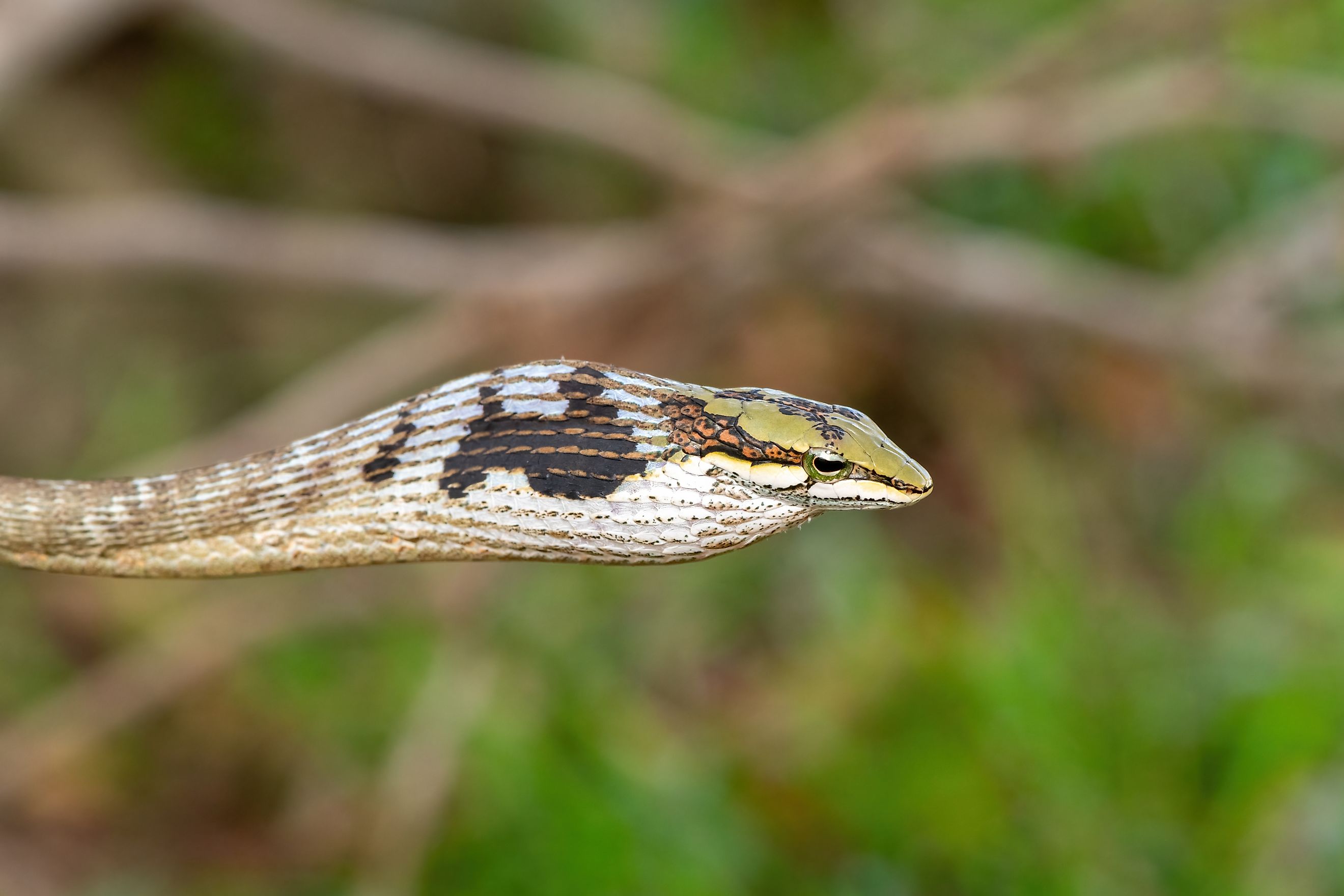
Twig Snake
The twig snake is exceptionally well camouflaged. When it lies motionless along a branch, its slender grey-brown body can resemble a dead stick so closely that birds, lizards, and even experienced field biologists may overlook it. This remarkable disguise is characteristic of the African snakes in the genus Thelotornis, a small group of rear-fanged, arboreal hunters found across sub-Saharan Africa. Also known as vine snakes or bird snakes, they have a delicate, almost ornamental appearance, yet possess some of the most dangerous venom found among colubrid snakes.
Twig snakes reward a closer look because they overturn a common assumption. For decades the entire colubrid family was treated as harmless to people, yet a handful of these back-fanged species proved capable of killing a healthy adult. The twig snake sits at the center of that reappraisal, both for its remarkable ecology and for the sobering medical history attached to its bite.
Taxonomic Classification

Twig snakes belong to the family Colubridae, the largest family of snakes, and within it to the subfamily Colubrinae. The genus Thelotornis was established by the Scottish zoologist Andrew Smith in 1849. Most authorities now recognize four species. The forest twig snake (Thelotornis kirtlandii) ranges through the forests of West and Central Africa. The savanna or southern twig snake (Thelotornis capensis) occupies drier country across southern Africa. The eastern twig snake (Thelotornis mossambicanus) is found in the southeast, from Kenya and Tanzania down toward Mozambique. The Usambara vine snake (Thelotornis usambaricus) is a more restricted form tied to the Usambara Mountains and nearby coastal forest of East Africa.
The common names hint at the confusion these animals cause. Vine snake, bird snake, and twig snake all refer to the same slim, arboreal build. Modern genetic study continues to refine the group, and some researchers argue that the four accepted species may hide further diversity, so the recognized total could rise as the evidence accumulates. What unites them is a rear-fanged (opisthoglyphous) arrangement, with the enlarged, grooved venom-conducting teeth set well back in the upper jaw rather than at the front of the mouth.
Physical Description

The twig snake is built for concealment. Its body is extremely slender and elongated, cylindrical in cross section, and often held rigid so that it reads as a twig or a hanging vine. Adults commonly measure about 3 to 4.6 feet (0.9 to 1.4 m) in total length, and the longest reliable records reach roughly 5.5 feet (1.7 m). The tail is exceptionally long, accounting for around a third to more than 40 percent of that total, which helps the snake balance and anchor across thin, springy branches.
Coloration is a study in bark and lichen. The ground color is usually grey or grey-brown, broken by faint pale and dark flecks, pinkish or greenish tints, and speckling that mimics weathered wood. The head is narrow, angular, and drawn out into a pointed snout. The most striking feature sits in the eye. Each pupil is horizontal and keyhole-shaped, an unusual form that grants the snake true binocular vision, a rare trait among serpents. That forward-facing depth perception lets a twig snake judge distance precisely and fix on prey that stays perfectly still.
Sexual dimorphism is modest. In the savanna twig snake both sexes mature at a similar size and reach a maximum of roughly 31 inches (80 cm) snout-to-vent length, though males tend to have longer tails, smaller heads, and thinner bodies than females of the same length. When alarmed, a twig snake can transform its slim throat, inflating it to expose bold black markings hidden between the scales, a sudden warning that breaks the twig illusion.
Range and Habitat

As a genus, Thelotornis is spread widely across sub-Saharan Africa, but each species holds its own territory. The forest twig snake keeps to the humid forests and forest edges of the west and center of the continent. The savanna twig snake, true to its name, favors savanna, open woodland, coastal thicket, and dry shrubland farther south. The eastern and Usambara forms occupy the woodlands and coastal forests of East Africa.
Across these settings the animals share a strong preference for structure they can hide within. They are semi-arboreal, spending much of their time in shrubs, bushes, and the lower branches of trees where tangled growth offers cover. A twig snake will also drape from a low branch and watch the ground below, ready to drop onto prey. This flexibility, using both the canopy and the space just above the leaf litter, lets the genus thrive in settings as different as thick forest and relatively dry bush.
Diet

Twig snakes are patient ambush hunters rather than active pursuers. A snake may hold a single pose for hours, swaying gently as though moved by a breeze, until a suitable target wanders within range. The binocular eyes then guide a fast, accurate strike, and the rear fangs work the venom into the wound as the snake chews down on its catch.
The menu is dominated by small, tree-living vertebrates. Lizards are the staple, especially chameleons and geckos, which the snake's depth perception is well suited to detecting even when they freeze. Frogs make up a large share as well. One detailed study of the savanna twig snake found that lizards accounted for close to two thirds of prey items and frogs for over a quarter, with the remainder made up of other small animals. The genus will also take nestling birds, the occasional small bird, small snakes, and sometimes rodents. The label bird snake is therefore a little misleading, since despite raiding nests on occasion, these snakes feed on birds far less often than the name suggests.
Behavior

Twig snakes are diurnal, hunting by sight during the day and relying on stillness and camouflage for defense at all hours. The signature behavior is the twig posture, a rigid, slightly swaying hold that erases the animal's outline against surrounding branches. Held this way, a twig snake is very difficult to spot, and its first line of defense is simply to remain unseen.
When that fails, the display escalates. A cornered twig snake inflates its throat to flash the dark banding between its scales, enlarging its apparent size, and some individuals flick a brightly colored tongue as an added warning. Birds frequently mob these snakes when they find one, and the throat-inflation response is often triggered by that harassment. The snakes are generally shy and retreating, quick to slip away from a threat, yet they can defend themselves sharply if handled or trapped.
Reproduction

Twig snakes are egg-laying (oviparous). Breeding is seasonal, with females developing eggs in spring and laying in the warmer months. Clutch size is modest, commonly four to ten eggs depending on the species, with six a frequent figure. The eggs are elongated, roughly 1.6 inches (4 cm) long, and the young hatch after an incubation of several months at a length of around 10 inches (25 cm), fully independent from the start. Females provide no parental care once the eggs are laid.
Sexual maturity arrives at a snout-to-vent length near 24 inches (60 cm), reached at about three years of age in the savanna species. Male-to-male combat has been reported in the group, which fits the observation that males and females grow to similar sizes rather than one sex dwarfing the other.
Venom and Danger to People

The twig snake's fearsome reputation rests on its venom, which is hemotoxic and strongly procoagulant. Rather than attacking the nervous system, it disrupts the blood's clotting machinery, driving the body to consume its own clotting factors until the blood can no longer clot at all. The result is prolonged, uncontrolled bleeding, both from the wound and internally, and in severe cases fatal hemorrhage. The effects are notoriously slow to appear, so a victim may feel little at first and badly underestimate the danger.
Two features make these bites especially serious. First, no commercial antivenom exists for Thelotornis. The antivenom made for the related boomslang (Dispholidus typus) offers little help, and laboratory work has shown it to be many times less effective against twig snake venom. Second, treatment can only be supportive and may require repeated transfusions over days. Fortunately, envenomed bites are rare in practice, because the fangs sit far back in the mouth and often cannot reach or breach human skin except in vulnerable spots such as the web between thumb and finger. Almost all serious cases have involved people directly handling the snakes.
The best-known victim was the German herpetologist Robert Mertens, bitten by his own captive twig snake in 1975. He died eighteen days later, and the diary he kept through his final illness, in which he reflected that such an end suited a herpetologist, remains one of the most cited episodes in the study of colubrid venom.
Importance to the World

Within their ecosystems, twig snakes act as specialized controllers of small arboreal animals. By preying heavily on lizards, frogs, and the occasional rodent or nestling, they help regulate populations of these species in the shrub and canopy layers where they hunt. They in turn serve as prey for larger predators, including birds of prey, so they occupy a useful middle position in the food web.
Their scientific value has grown in recent years. Because twig snake venom produces such a clear and powerful effect on blood clotting, researchers study it to understand coagulation itself and to search for compounds with medical potential. The genus has also become a standard teaching example of camouflage, ambush predation, and the once-overlooked danger of rear-fanged snakes.
Conservation and Threats

The twig snakes assessed by the International Union for Conservation of Nature are currently listed as Least Concern, reflecting wide distributions and populations that remain generally healthy across large parts of Africa. The savanna and eastern species in particular are considered widespread and reasonably common where suitable habitat survives.
That relative security should not be read as invulnerability. As forest-dependent and woodland species, twig snakes are exposed to the same pressures thinning wildlife across the continent, chiefly habitat loss from clearing, agriculture, and expanding human settlement. Their fearsome name also works against them, since snakes with a deadly reputation are often killed on sight regardless of how little threat they pose to a person who leaves them alone. Protecting the wooded and forested habitats these ambush hunters depend on is the surest way to keep their populations stable.
Takeaway
The twig snake is a lesson in how much can hide behind an unremarkable appearance. A slender grey form that looks like nothing more than dead wood turns out to be a precise, binocular-eyed predator armed with a venom potent enough to kill a person, all packaged in an animal that would rather stay hidden than fight. For most of the last century these snakes were dismissed as harmless, and correcting that mistake reshaped how scientists think about the whole colubrid family. Widespread and, for now, secure, the twig snake endures wherever African woodland still stands, rewarding the patient observer who learns to tell a living branch from a dead one.
Fun Facts

- It has real depth perception. The keyhole-shaped horizontal pupils give the twig snake true binocular vision, a rare ability among snakes that lets it lock onto prey holding perfectly still.
- The name is misleading. Despite being called the bird snake, it eats far more lizards and frogs than it ever eats birds.
- It sways like a branch. When hiding, the snake rocks gently back and forth, imitating a twig stirred by the wind.
- No antivenom exists. There is no commercial antivenom for a twig snake bite, and even boomslang antivenom does little to help.
- A famous scientist recorded his own death. Herpetologist Robert Mertens kept a diary as a 1975 twig snake bite killed him over eighteen days, remarking that it was a fitting end for a herpetologist.
- Its throat is a warning sign. A threatened twig snake inflates its neck to reveal bold black markings normally hidden between its scales.
Quick Facts
- Common names: Twig snake, vine snake, bird snake
- Scientific name (genus): Thelotornis
- Family: Colubridae (subfamily Colubrinae)
- Order: Squamata
- Number of species: Four commonly recognized
- IUCN status: Least Concern (species assessed)
- Total length: About 3 to 5.5 feet (0.9 to 1.7 m)
- Distinctive feature: Keyhole-shaped horizontal pupils with binocular vision
- Venom: Hemotoxic and procoagulant, with no antivenom available
- Diet: Lizards, frogs, small birds, occasional rodents and small snakes
- Habitat: Forest, savanna, woodland, and thicket
- Range: Sub-Saharan Africa
- Reproduction: Egg-laying, roughly 4 to 10 eggs per clutch
- Lifespan and maturity: Sexual maturity at about three years
- Lifestyle: Diurnal, semi-arboreal, ambush predator