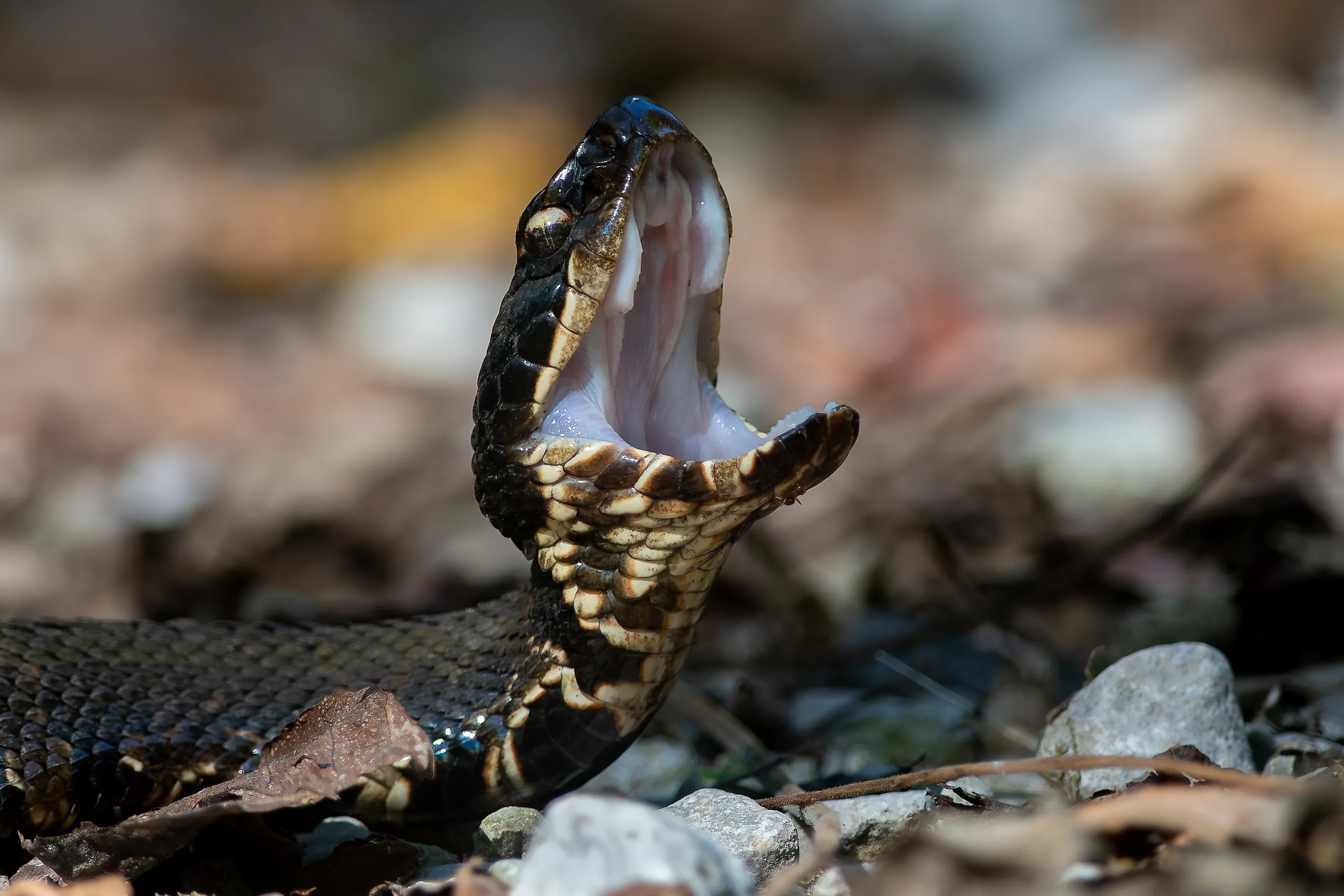
How Far North Water Moccasins Live
Water moccasins are heavy-bodied pit vipers that many people imagine coiled at the edge of a southern swamp. Their reputation often spreads farther north than the snakes themselves. The main thing to remember before heading near water is that these snakes only live as far north as about the 38th parallel. In the United States, the only country where they are found, the cottonmouth (which is also their other common name and the one herpetologists prefer) is limited to the lower Ohio and Mississippi valleys. Their range follows a rough line through southern Illinois, the southeastern corner of Missouri, and a few scattered spots in southern Indiana. On the Atlantic coast, their range ends in southeastern Virginia. North of this line, if someone claims to have seen a moccasin, it almost always turns out to be a harmless snake.
The Snake Behind the Name

Bernard de Lacépède named the cottonmouth Agkistrodon piscivorus in 1789. For nearly two centuries, naturalists recognized three subspecies, including a Florida form described by Howard Gloyd in 1969. This changed in 2015, when Frank Burbrink and Timothy Guiher combined the old subspecies and gave the peninsula's snakes their own species, Agkistrodon conanti, the Florida cottonmouth, found only in Florida and a part of Georgia. The snake at the northern edge is simply called the northern cottonmouth, and its species profile shows how it differs from similar snakes. The names matter because even experts can mix up the two, but it is the northern cottonmouth that lives farther north, not the Florida one.
The Northern Edge

The cottonmouth reaches its northern boundary along two main routes, each ending in a different place. One group moves up the floodplain forests of the Mississippi and lower Ohio, passing through western Kentucky and Tennessee, and into the cypress and tupelo swamps of southern Illinois. Here, near the Cache River and the 37th parallel, many southern species reach their northern limit. Missouri marks the northwestern edge of the range, with snakes surviving in the bootheel lowlands and along the Ozark border. Wildlife biologists there say that low winter temperatures set the limit. The range also touches the southeastern tip of Kansas and stretches west across Texas.
Indiana holds the northernmost records for the cottonmouth, where a small, isolated group survived for decades in the southern part of the state, separated from the main range. Researchers with the Indiana Natural Heritage Program tracked this population through the 1980s and called it one of the northernmost records for the species in North America. The snake is listed as state endangered in Indiana, with a tiny range and low numbers, and it may no longer be found there. Aside from this outlier, the true boundary is near the 38th parallel, and reports of moccasins farther north rarely hold up under close examination.
Why They Stop Where They Do

Cold draws the line, and it does so through simple physiology rather than any failure of nerve on the snake's part. A cottonmouth is ectothermic, meaning it takes its body heat from its surroundings, so it has to spend the coldest months in a frost-free refuge, a crayfish burrow or a rocky crevice or a deep bank hollow below the freeze. Where winters run long and the ground freezes hard and deep, a snake that cannot reach such shelter does not live to spring, and over many generations that single hard fact fixes the northern edge of the range about where it sits. The same ceiling holds the copperhead and several other southern reptiles at roughly the same latitude, which is why southern Illinois turns up again and again as the end of the line.
The Watersnake Problem

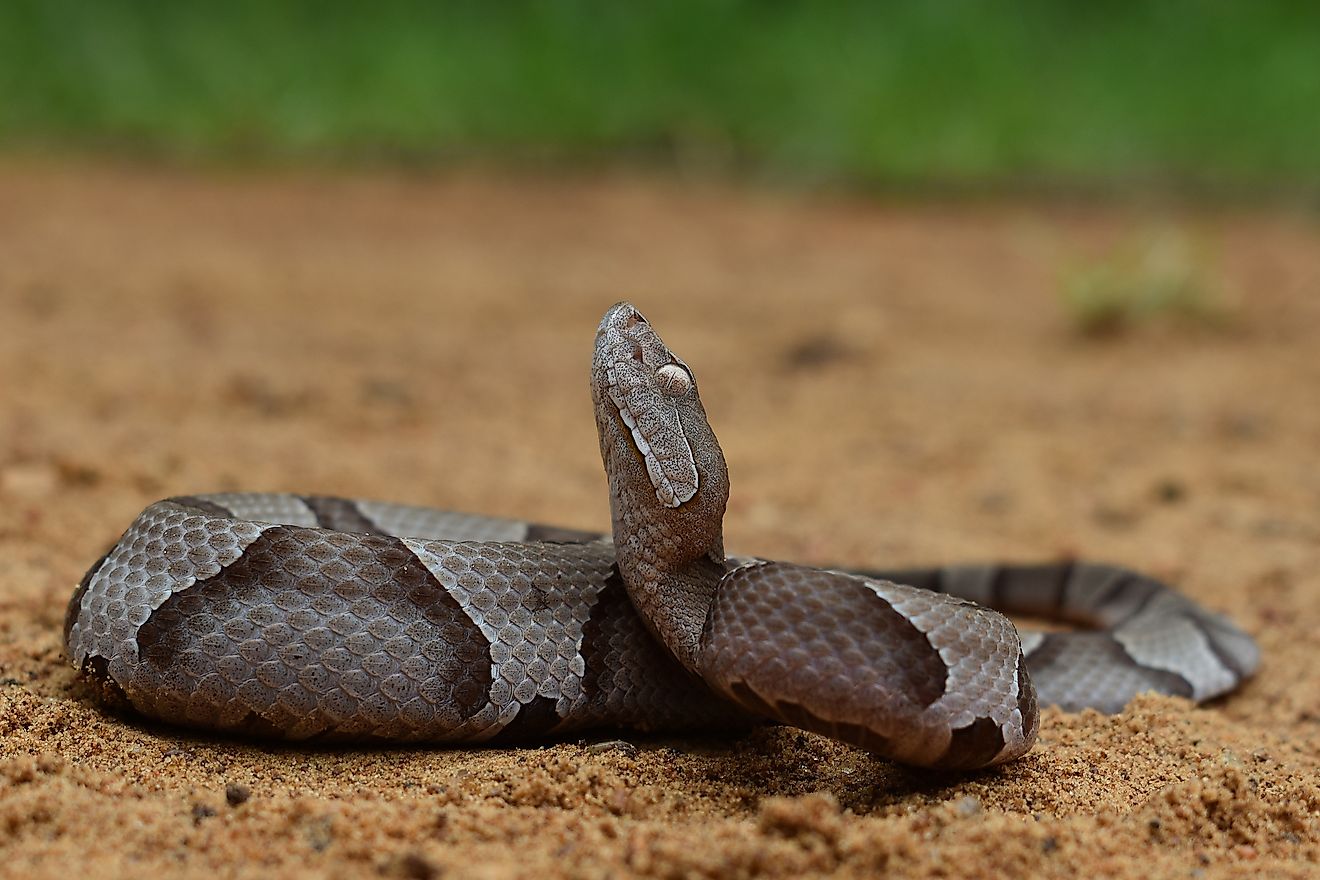
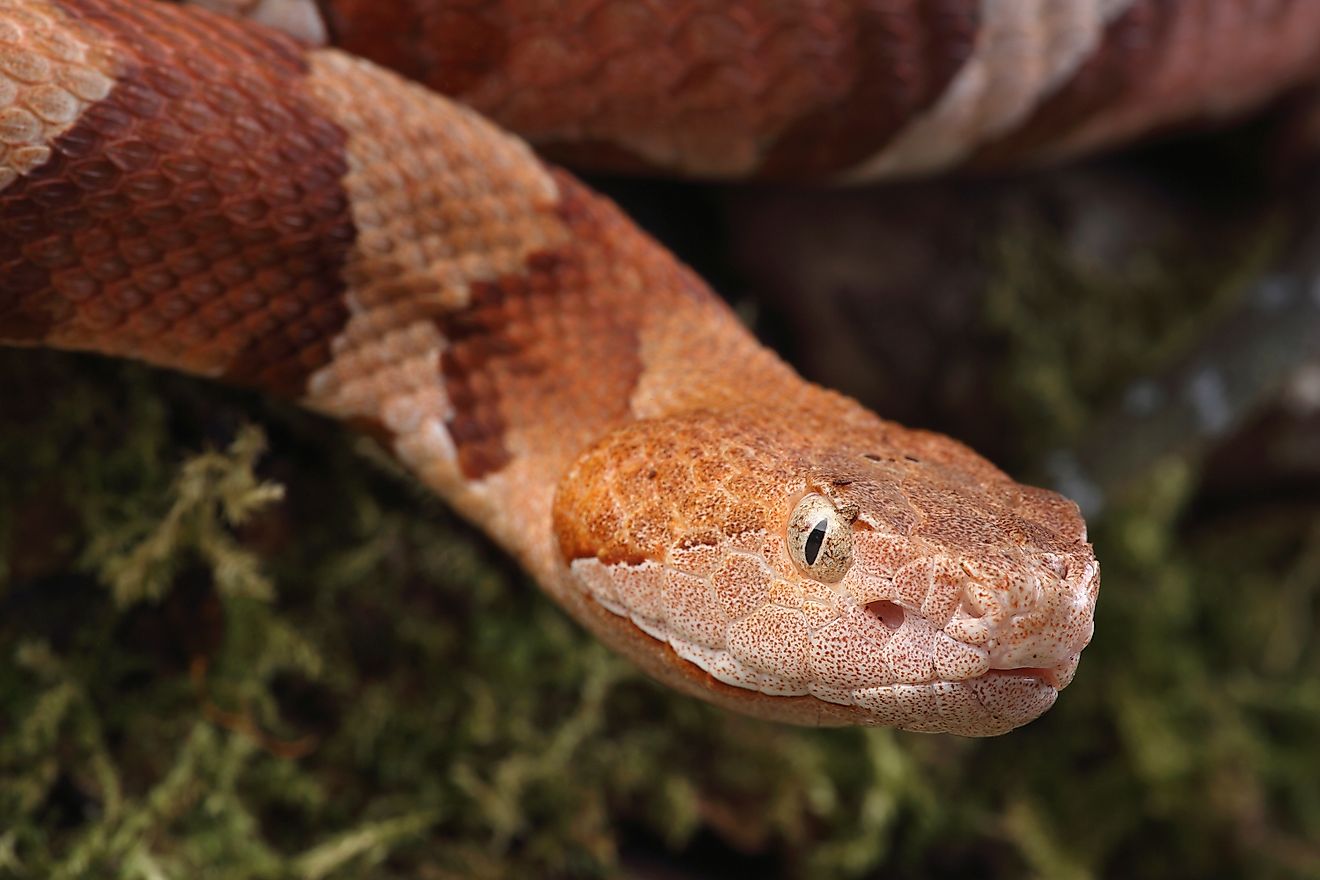
Most reports of moccasins from the north are actually cases of mistaken identity. The northern watersnake, Nerodia sipedon, is a thick-bodied, dark, and often bad-tempered but nonvenomous snake. It swims in the same ponds and rivers throughout much of the eastern continent and into Canada, and it is usually the real animal behind these sightings. Missouri's conservation agency points out that most semiaquatic snakes people see or kill, thinking they are cottonmouths, are actually harmless watersnakes. As a result, many innocent snakes have been killed just because they were suspected of being dangerous. It helps to know the differences before the next scare. A cottonmouth has a vertical, cat-like pupil, a broad head that is wider than its neck, a dark cheek stripe with pale borders, and it shows a white mouth when threatened. In contrast, a watersnake has a round pupil, a narrower head, and usually escapes into the water instead of standing its ground.
How Dangerous a Bite Really Is

Venom should be taken seriously, but it is also important to keep the statistics in perspective. Each year in the United States, about 7,000 to 8,000 people are bitten by venomous snakes. Cottonmouths are responsible for about 10 to 15 percent of these bites, which is less than copperheads or rattlesnakes. About a quarter of pit viper bites are dry, meaning they inject little or no venom. Thanks to modern antivenom and emergency care, deaths are rare, with only five or six people dying each year from all venomous snakebites nationwide. The states with the highest snakebite rates show where the risk is greatest, and fatal bites are uncommon. Still, a cottonmouth bite is not minor. Its venom can destroy tissue and cause lasting damage to a hand or foot. Even so, the numbers show that cottonmouths are not as deadly as their reputation suggests.
Staying Safe Near the Water

Nearly every serious cottonmouth bite follows a decision to handle, corner, or kill the snake, so the first rule is also the easiest, which is to leave it alone and give it room to leave. In cottonmouth country, mostly the swamps, sloughs, slow rivers, and lake margins of the Southeast, watch where you put your hands and feet around fallen logs and brushy banks, wear closed shoes near the water rather than going barefoot, and look before stepping over a log into cover you cannot see. If a bite does happen, keep the person calm and still, get them to a hospital without delay, remove rings and watches before swelling sets in, and keep the limb roughly level with the heart. Avoid cutting the wound, trying to suck out venom, packing it in ice, or tying a tourniquet, as it will do more harm than the bite. North of the 38th parallel the sensible worry is a slip on a muddy bank, not a moccasin, and the farther north you stand, the more surely the snake in the water is one that cannot hurt you.
The Bottom Line
The cottonmouth belongs to the warm, wet South, and it has stayed there for a plain reason, which is that it cannot outlast a hard northern winter. That single constraint draws a boundary near the 38th parallel. The line reaches the coast at the Virginia tidewater and closes inland in the swamps of southern Illinois and the relict colonies of southern Indiana. The fading Indiana records mark about as far north as the species has ever reliably reached. Step above that line and the arithmetic changes. The dark snake in the water is almost certainly a harmless watersnake, the odds of a dangerous encounter drop toward nothing, and the worry worth carrying is a slick bank underfoot rather than a moccasin in the shallows. Knowing where the range truly ends, and knowing the look-alike that accounts for most sightings beyond it, turns a feared animal back into what it mostly is, a shy predator keeping to its own southern water.