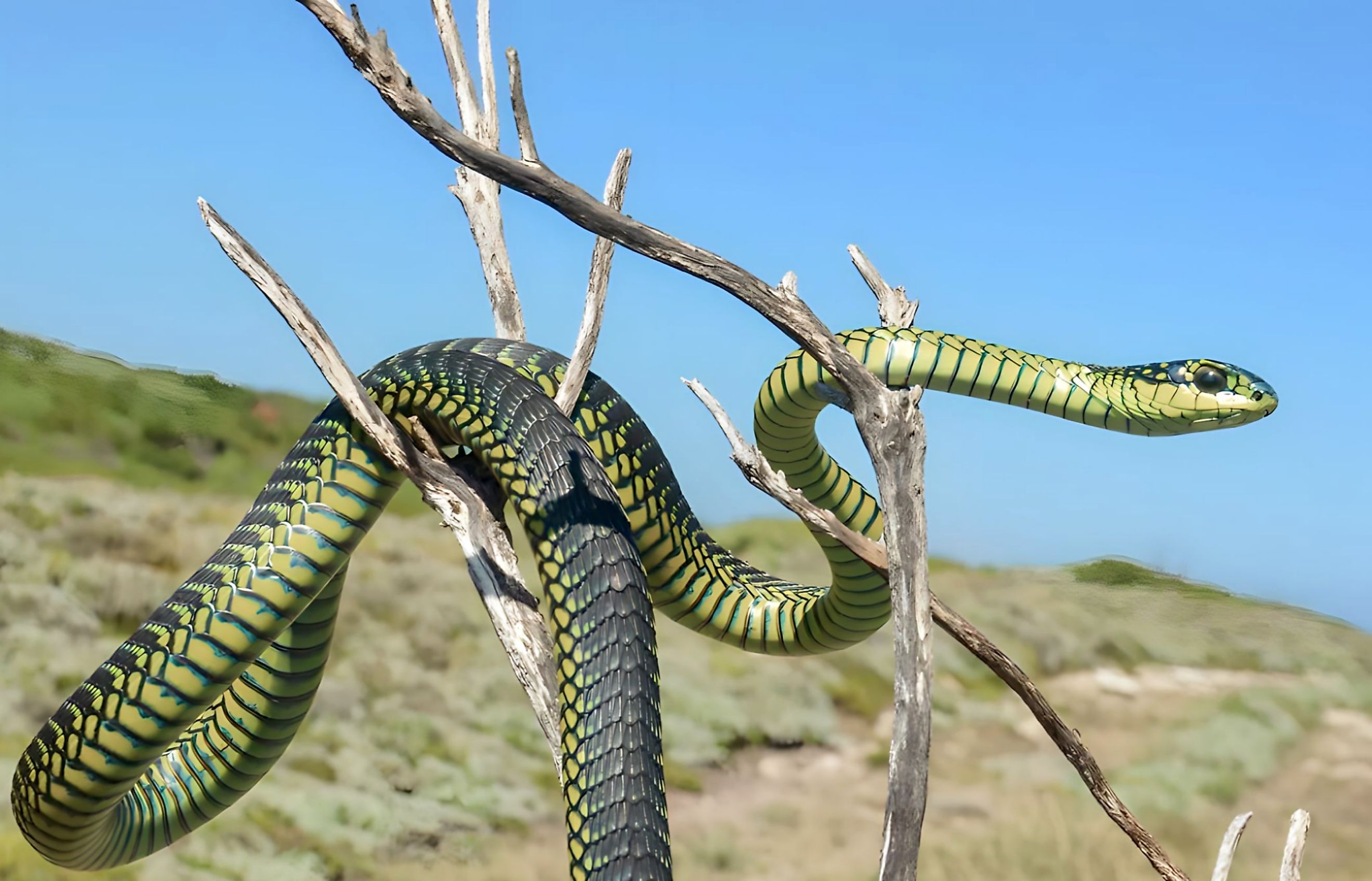
Boomslang
Few snakes have earned their fearsome reputation as strangely as the boomslang. For decades, scientists thought it was harmless until its slow-acting, blood-destroying venom killed a renowned herpetologist of the twentieth century. The boomslang (Dispholidus typus) is a large, agile, tree-dwelling snake native to sub-Saharan Africa. It is known for its huge eyes, bright green or brown coloration, and a bite that can cause uncontrollable internal bleeding in humans.
The boomslang is also shy and reclusive, preferring to hunt chameleons in the canopy rather than face something as large as a human. Its story balances danger and restraint, making this African tree snake one of the most fascinating reptiles on the continent.
Taxonomic Classification

The boomslang belongs to the family Colubridae, the largest snake family, within the order Squamata and the suborder Serpentes (the snakes). Its scientific name is Dispholidus typus, and it was first described by the Scottish naturalist Andrew Smith in 1828, originally under the genus Bucephalus. Today it is placed in the genus Dispholidus, of which it is the only widely recognized living species.
Over the years, herpetologists have identified numerous subspecies and color variations across the species' extensive range, with ongoing DNA research further clarifying the relationships among these populations. A distinctive feature that sets the boomslang apart from most colubrids is its dentition. It is rear-fanged, meaning its enlarged, venom-delivering fangs are located toward the back of the upper jaw instead of at the front like in cobras or vipers. This specific arrangement, known as opisthoglyphous, is a major reason why the species was underestimated for so long.
Physical Description

The boomslang is a slim, elongated snake adapted for arboreal living. Adults generally range from 3.3 to 5.2 feet (100 to 160 cm) in total length, including the tail, and some exceptional specimens can grow over 6 feet (183 cm). Despite its length, the snake remains lightweight, typically weighing between 0.39 and 1.12 pounds (175 to 510 grams), with an average weight of about 0.66 pounds (300 grams).
Two features immediately capture attention. The first is the head, which is short, clearly separate from the neck, and egg-shaped. The second is the eyes, notably large, providing the snake with keen, forward-focused vision that is rare among serpents. The pupils are round.
Coloration differs greatly and is influenced by sex, age, and local population. This species shows one of the most distinct examples of sexual dimorphism among African snakes. Adult males are usually bright leaf green, sometimes with black or blue edges on their scales, while females tend to be duller brown or olive. Juveniles look different, typically grayish with speckling and bright, iridescent green eyes. These colors offer excellent camouflage among foliage and bark, helping the snake avoid predators and catch prey.
Range and Habitat

The boomslang occurs across a broad swath of sub-Saharan Africa. It is most abundant in the southern and central parts of the continent, including countries such as Botswana, Namibia, Zimbabwe, Mozambique, Eswatini, and South Africa, and its range extends northward into parts of West and Central Africa.
True to its name, the boomslang prefers landscapes with trees and shrubs. It thrives in wooded grasslands, arid savannas, karoo scrub, and lowland forests, mainly hunting from the branches of low trees and thorny bushes. It usually avoids deserts and very dry areas, as it relies on vegetation for climbing and shelter. Throughout its range, the species has been found at a variety of elevations, from low scrublands to montane plateaus above 9,800 feet (3,000 m).
Diet

The boomslang is a carnivorous, tree-dwelling snake that primarily preys on chameleons, which it hunts with patience and accuracy. Its diet also features other small lizards, tree frogs, young birds, and eggs of birds and reptiles. Occasionally, it catches small mammals and has been known to eat other snakes, including its own species.
The hunting style relies on that remarkable eyesight. A boomslang will often sit motionless in a tree with the front portion of its body extended stiffly outward, scanning for movement below. When it detects prey, it strikes, works its rear fangs into the victim, and delivers venom that quickly subdues it. Like other snakes, the boomslang then swallows its meal whole, using flexible jaw joints and muscular contractions to move even bulky prey down toward the stomach. This appetite for birds and eggs is one reason the snake is so often found investigating weaver-bird colonies and other nests.
Behavior

The boomslang is diurnal, active during daylight hours, and almost entirely arboreal. It moves through branches with speed and grace, and its slender build lets it glide from one perch to the next. When it does descend, it comes to the ground to hunt, to bask, or to cross open stretches of habitat, and it will even move across roads and water in search of prey.
Despite its potent venom, this is a timid and solitary animal. Boomslangs flee from anything too large to eat and rarely stand their ground. When cornered or threatened, a boomslang may inflate its neck to display the vivid skin between its scales, a bluff meant to make it look larger and more alarming. Bites almost always occur only when people try to handle, catch, or kill the snake. During cool weather, boomslangs brumate, a reptilian form of dormancy similar to hibernation, and they often shelter in the enclosed nests of birds during these periods.
Reproduction

Boomslangs are oviparous, meaning they lay eggs rather than giving live birth. Mating has been observed during the warmer months, and males may engage in ritual combat for access to females. After mating, a female lays a clutch that usually numbers around 10 to 25 eggs, though larger clutches approaching 30 have been recorded. She deposits them in a hollow tree trunk, a rotting log, or damp vegetation, then leaves and provides no further parental care.
Incubation takes a relatively long time for a snake, generally two to three months. As in crocodiles and some turtles, the sex of the offspring is influenced by incubation temperature. Hatchlings emerge fully independent, measuring roughly 8 inches (20 cm) in length. They pose little danger to people at first, but they become capable of a serious, venomous bite by the time they reach about 18 inches (45 cm). Boomslangs typically reach sexual maturity at two to three years of age, and they generally live around eight years in the wild.
Venom and the Death of Karl Schmidt

The boomslang's venom is predominantly hemotoxic, and it is among the most potent produced by any colubrid snake. Rather than attacking the nervous system, it disrupts the blood's ability to clot. The venom triggers a runaway clotting process that consumes the body's supply of fibrinogen, a protein essential for stopping bleeding. Once that supply is exhausted, the victim can hemorrhage internally from major organs. Dangerously, the effects are often slow and delayed, sometimes taking many hours to become severe, and there can be a false lull before symptoms return in force.
That delay lies at the heart of the species' most famous incident. In 1957, the eminent American herpetologist Karl Patterson Schmidt was bitten on the thumb by a juvenile boomslang sent to Chicago's Field Museum for identification. Convinced that a young snake could not deliver a lethal dose, Schmidt declined medical treatment and instead kept a detailed diary of his own symptoms. He died of massive internal bleeding roughly a day later. His meticulous notes helped overturn the long-held assumption that boomslangs were harmless and cemented the species' reputation. A specific antivenom for boomslang bites is now produced, and it has made envenomation far more survivable when treated promptly.
Importance to the World

As an active predator of lizards, frogs, small birds, and rodents, the boomslang helps regulate the populations of the animals it eats, contributing to the balance of the woodland and savanna ecosystems it inhabits. It is, in turn, prey for larger animals, especially birds of prey, which places it firmly within the food web of sub-Saharan Africa. Like all snakes, it also plays a quiet role in keeping small-animal numbers, including some agricultural pests, in check.
Threats and Conservation

The boomslang is currently listed as Least Concern on the IUCN Red List, and its populations are considered relatively stable across its range. The species is not listed under CITES. This is a reassuring status, but it does not mean the snake faces no pressure. Habitat loss driven by deforestation and urban expansion reduces the trees and shrubland the boomslang depends on, and the snake is frequently killed on sight by people who fear its venom, despite its shy nature. Continued protection of woodland and savanna habitat is the surest way to keep this species secure.
Takeaway
The boomslang is a study in contrasts. Its venom is potent enough to have killed a leading scientist, yet the snake is so elusive that most people will never see one, much less be bitten by one. Its combination of keen eyesight, arboreal agility, striking sexual dimorphism, and remarkably dangerous venom makes it one of Africa's most distinctive reptiles. With a stable conservation status and a vital role in its ecosystems, the boomslang remains a snake best appreciated from a respectful distance, admired for the very traits that once caused it to be so badly misjudged.
Fun Facts

- Its name is literal. "Boomslang" simply means "tree snake" in Afrikaans and Dutch, a fitting label for such a committed climber.
- It documented its own killer. Karl Schmidt's diary of his fatal 1957 bite became a landmark record of boomslang envenomation and helped prove the snake was far from harmless.
- Temperature picks the sex. Like crocodiles, boomslang hatchlings develop as male or female depending on the temperature at which their eggs incubate.
- The eyes have it. The boomslang's unusually large eyes give it some of the best vision of any snake, which it uses to hunt by sight from the treetops.
- A very wide gape. To bring its rear fangs into play, a boomslang can open its mouth extremely wide, an adaptation that once fooled people into thinking it could not bite effectively at all.
Quick Facts
- Scientific name: Dispholidus typus
- Family / Order: Colubridae / Squamata
- IUCN status: Least Concern (population stable)
- Length: 3.3 to 5.2 ft (100 to 160 cm); some exceed 6 ft (183 cm)
- Weight: 0.39 to 1.12 lb (175 to 510 g); average about 0.66 lb (300 g)
- Lifespan: Around 8 years in the wild
- Diet: Carnivore (chameleons, lizards, tree frogs, nestling birds and eggs, occasionally small mammals)
- Range: Sub-Saharan Africa, most abundant in central and southern regions