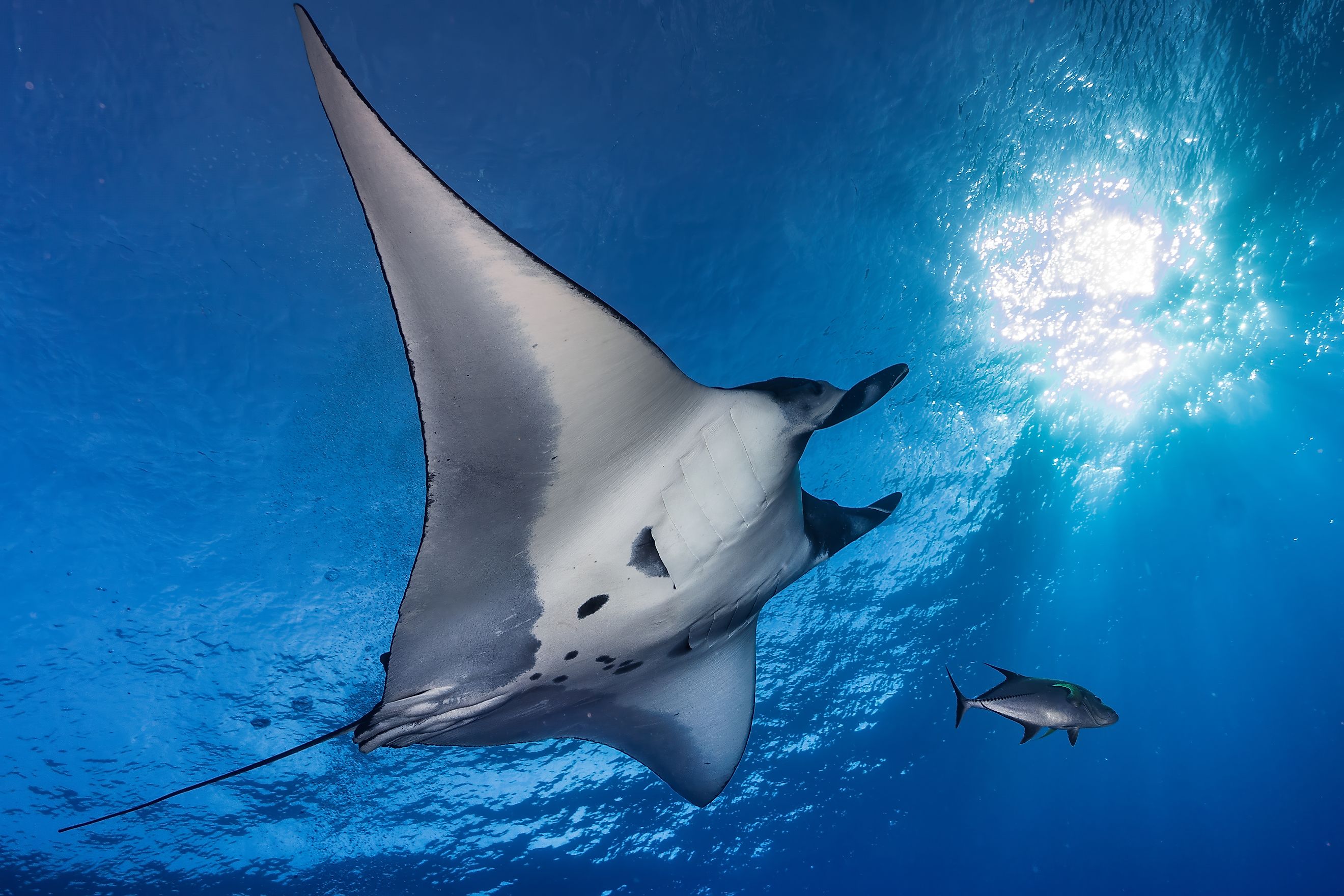
Giant Manta Ray
The giant manta ray is the largest ray on Earth, a plankton eater with a wingspan that can stretch wider than a small car is long. Gliding through the open ocean on broad triangular fins, it looks less like a fish and more like a dark kite sweeping across the blue. Despite its size and its old nickname of devil ray, the animal is harmless to people and carries no stinging barb.
Scientifically known as Mobula birostris, the giant manta ray roams warm and temperate seas around the world, reaching coastal upwellings and remote seamounts far from land. It is a slow breeder, an ocean wanderer, and one of the most intelligent fish in the sea, with a brain large for its body and a documented capacity for curiosity toward divers.
It is also in trouble. In 2019 the International Union for Conservation of Nature uplisted the species to Endangered, driven largely by a growing international trade in its gill plates and by the animal's own painfully slow reproduction. Understanding what makes the giant manta ray remarkable is the first step toward understanding why its survival now hangs in the balance.
Taxonomic Classification

The giant manta ray belongs to the family Mobulidae, the group of devil rays and manta rays, within the order Myliobatiformes. Like sharks, it is a cartilaginous fish, meaning its skeleton is built from cartilage rather than bone. It was first described by Johann Julius Walbaum in 1792, and for much of the twentieth century it was lumped together with other manta populations under a single poorly understood species.
That changed in 2009, when researcher Andrea Marshall and colleagues formally separated the manta rays into two distinct species. The reef manta ray (Mobula alfredi) is the smaller, more coastal of the two, while the giant or oceanic manta ray (Mobula birostris) is the larger, far ranging species described here. A further taxonomic shift arrived around 2017, when DNA evidence led scientists to fold the old genus Manta into the genus Mobula, which is why older sources still refer to the animal as Manta birostris. This kind of revision is common in modern marine biology as genetic tools reveal relationships that body shape alone could hide. In 2025, scientists described a third species: the Atlantic manta ray (Mobula yarae), split from the Atlantic population of Mobula birostris. The group's boundaries are clearly still being redrawn.
Physical Description

Size is the first thing anyone notices. The giant manta ray reaches a wingspan of roughly 23 feet (7 meters), and the largest confirmed individuals approach 26 feet (8 meters) across. Guinness World Records lists a maximum recorded wingspan near 30 feet (9 meters), though most adults measure closer to 17 to 22 feet (5 to 7 meters). A full grown animal can weigh up to two tons, somewhere between 3,000 and 4,400 pounds (1,400 to 2,000 kilograms). No other ray comes close.
The body is shaped like a flattened diamond, dominated by the two enormous pectoral fins that function as wings. At the front of the head sit a pair of cephalic fins, the horn like paddles that give devil rays their name. These unroll during feeding to help funnel water and prey into the wide, forward facing mouth. Unlike stingrays, the giant manta ray has only a short, whip like tail with no venomous spine, so it poses no danger to swimmers.
Coloration is typically dark gray to black across the top of the disc, often marked with pale shoulder patches that can form a rough chevron. The underside is mostly white, scattered with gray blotches. Those belly markings matter to scientists, because the pattern on each manta is unique and stays stable over its life, working much like a human fingerprint for identifying individuals. The skin itself is rough and covered in tiny tooth like denticles, the same structures that armor shark skin. Males and females look broadly similar in color and shape, with females growing somewhat larger on average.
Range and Habitat

The giant manta ray is a circumglobal species, found in tropical, subtropical, and warm temperate waters across the Atlantic, Pacific, and Indian Oceans. It favors productive areas where currents push nutrient rich water toward the surface, including coastlines with regular upwelling, offshore pinnacles, oceanic islands, and seamounts. These zones concentrate the plankton the animal depends on.
Although often seen near the surface, the species is at home across a wide range of depths and has been tracked diving to around 3,300 feet (1,000 meters). Many mantas follow a daily rhythm, feeding in deeper water at night and moving into warmer shallows during the day. The animal is highly migratory and capable of long distance movement, with tagged individuals recorded traveling hundreds of miles. Even so, populations tend to show a degree of site loyalty, returning to the same feeding grounds and cleaning stations year after year. One of the largest known aggregations lives off the coast of Ecuador, where researchers have cataloged more than 22,000 individuals.
Diet

For an animal so large, the giant manta ray feeds on some of the smallest prey in the sea. It is a filter feeder that lives almost entirely on zooplankton, including krill, copepods, small shrimps, crab larvae, and the eggs and larvae of fish. It will occasionally take small fish, but drifting plankton is the heart of its diet.
The feeding method is elegant. As the manta swims forward with its mouth open, its cephalic fins channel a stream of water inside, where specialized filter plates along the gill arches strain out food while letting seawater pass through. This apparatus is efficient enough to sort edible particles from the flow and resist clogging. Giant manta rays often gather in numbers where plankton blooms, and they are frequently seen feeding alongside whale sharks that target the same dense swarms. A single animal can consume a substantial share of its body weight in plankton over the course of a week, which is why rich, reliable feeding grounds are so important to the species.
Behavior

Giant manta rays are generally solitary, but they are far from antisocial. They gather at predictable locations to feed, to mate, and to visit cleaning stations, where small reef fish pick parasites and dead skin from their bodies. These cleaning stations function as social hubs, and some individuals return to the same sites repeatedly.
The species is strong and tireless in the water. Because it relies on forward motion to pass oxygen rich water over its gills, it cannot rest on the seabed the way many bottom dwelling rays do, so it keeps swimming more or less constantly. One of its more dramatic habits is breaching, launching its huge body clear of the surface and landing with a loud slap. Scientists are not certain why mantas do this, with possible explanations that include parasite removal, communication, and simple play. Relative to its size, the giant manta ray has one of the largest brains of any fish, and it shows signs of problem solving and curiosity, sometimes approaching and circling divers rather than fleeing.
Reproduction

The reproductive biology of the giant manta ray is the single greatest reason the species recovers so slowly from any loss. Females reach sexual maturity late, often somewhere between ten and fifteen years of age, and courtship involves elaborate mating trains in which several males pursue a single female.
After mating, the female carries her young internally for roughly twelve to thirteen months. The species is aplacental viviparous, which means the embryo develops inside the mother nourished by a yolk rather than a placenta, and is born live. A female almost always produces just one pup at a time, rarely two. Newborns emerge with a disc width of about 3.5 to 4.5 feet (1.1 to 1.4 meters), already folded in their wings and fully able to swim. Crucially, females do not breed every year. Many reproduce only once every two to five years, so a single female may give birth to only a handful of pups across her entire life. With a lifespan estimated at around 40 years, and perhaps longer, the giant manta ray lives slow and reproduces slower still.
Importance to the World

As a large, plankton feeding animal, the giant manta ray plays a role in the ocean's food web and serves as an indicator of healthy, productive waters. Where mantas gather in numbers, they signal abundant plankton and a functioning coastal ecosystem, which makes them useful to scientists monitoring ocean health.
Their economic value is easier to measure. Living giant manta rays are worth far more over time than dead ones. Manta focused dive and snorkel tourism generates significant revenue in countries such as Mozambique, Indonesia, and Ecuador, supporting local economies and giving communities a direct financial reason to protect the animals. Studies have repeatedly shown that a single manta observed by tourists over its lifetime is worth many times the one time value of its body parts on the market. That contrast has become a central argument for conservation.
Threats

The giant manta ray was assessed as Endangered on the IUCN Red List in 2019, an uplisting from its earlier Vulnerable status. Scientists suspect the global population has fallen by 50 to 79 percent over roughly three generations, a span of about 87 years, with further decline expected as current pressures continue.
The driving force behind that decline is fishing. In recent decades a market has grown in parts of Asia for manta gill plates, the filtering structures sold for use in traditional remedies, and this trade has pushed some fisheries to target the species directly where they once caught it only by accident. Giant manta rays are also taken as bycatch in large scale commercial gear such as purse seines, longlines, and gillnets, and their migratory habits carry them across many national boundaries and through heavily fished waters. Because the species breeds so slowly, even modest levels of fishing can outpace its ability to replace lost animals. On the conservation side, the giant manta ray is now protected under international agreements including CITES and the Convention on Migratory Species, and it is listed as threatened under the United States Endangered Species Act. More than a dozen countries have granted it national protection, and in places where it is no longer fished, sighting trends appear to be holding steady, a hopeful sign that protection can work.
Takeaway
The giant manta ray combines enormous size with an unexpectedly gentle way of life. It is the largest ray in the ocean, yet feeds mainly on tiny plankton. Despite its power and ability to leap from the water, it is generally calm around divers and often visits the same cleaning stations repeatedly. Its wide-ranging movements connect populations across entire ocean regions, but its long lifespan and slow reproductive rate make it difficult for populations to recover from heavy losses. Reducing the trade in gill plates, limiting bycatch, and protecting important feeding and cleaning areas are therefore central to its conservation. Ecotourism can also give local communities an economic reason to protect living manta rays rather than support their capture.
Fun Facts

- Every manta has a fingerprint. The pattern of spots and blotches on each animal's pale underside is unique and stays with it for life, letting researchers identify individuals from photographs alone.
- They have the biggest brain of any fish. Relative to body size, the giant manta ray's brain is among the largest in the fish world, and the animal shows curiosity, memory, and problem solving behavior.
- No sting here. Despite the devil ray nickname and a resemblance to stingrays, the giant manta ray has no venomous barb and is completely harmless to people.
- Giant from birth. A newborn pup already measures about 3.5 to 4.5 feet (1.1 to 1.4 meters) across and is born rolled up in its own wings, swimming away on its own within moments.
- They fly out of the water. Giant manta rays sometimes breach, launching their entire body into the air before crashing back down, a behavior scientists still cannot fully explain.
Quick Facts
- Scientific name: Mobula birostris (formerly Manta birostris)
- Family and order: Mobulidae, Myliobatiformes
- IUCN status: Endangered (assessed 2019)
- Wingspan: up to about 23 to 26 feet (7 to 8 meters)
- Weight: up to roughly two tons, around 3,000 to 4,400 pounds (1,400 to 2,000 kilograms)
- Lifespan: estimated around 40 years or more
- Diet type: planktivore and filter feeder, mainly zooplankton and krill
- Range: tropical, subtropical, and warm temperate waters worldwide