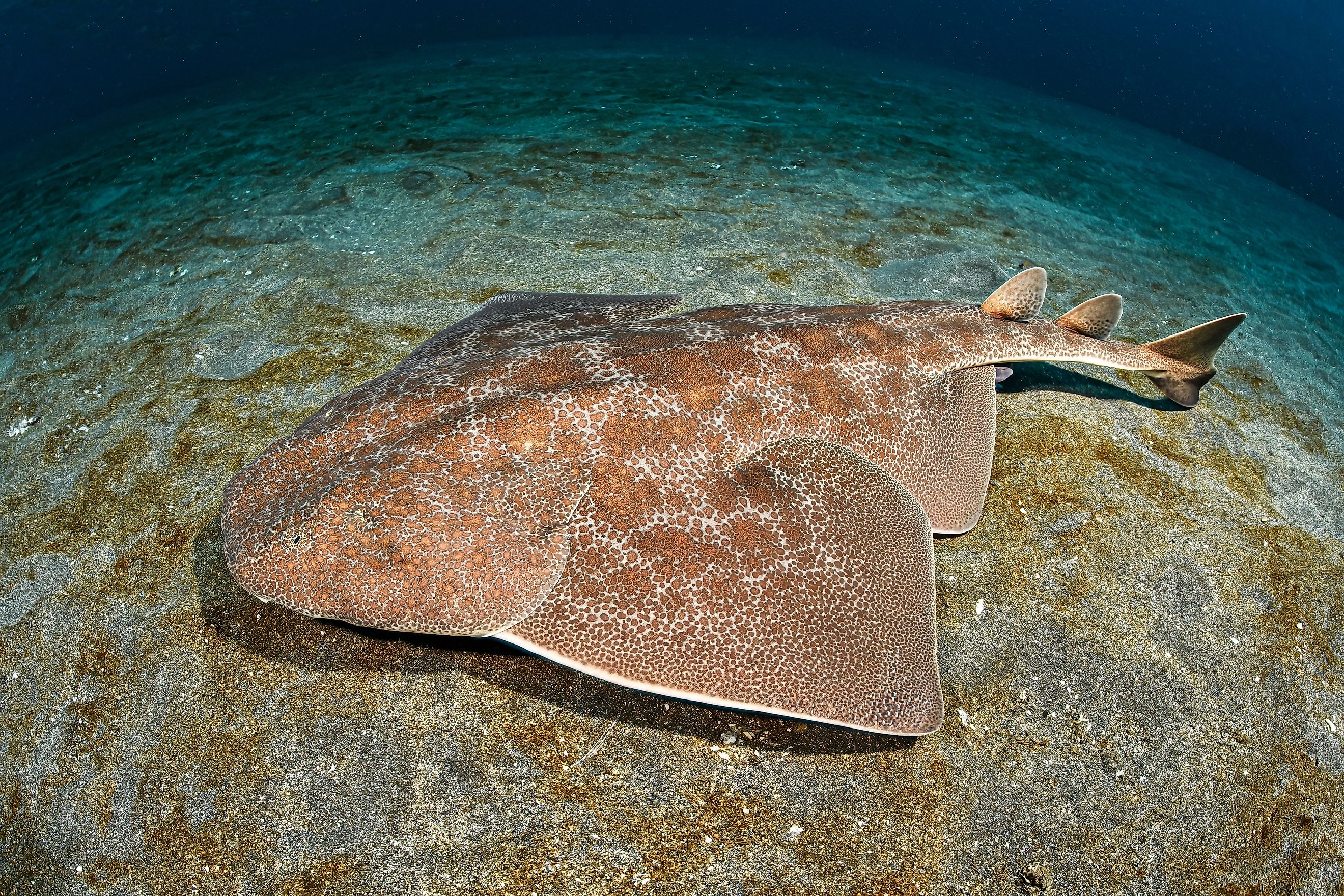
Angel Shark
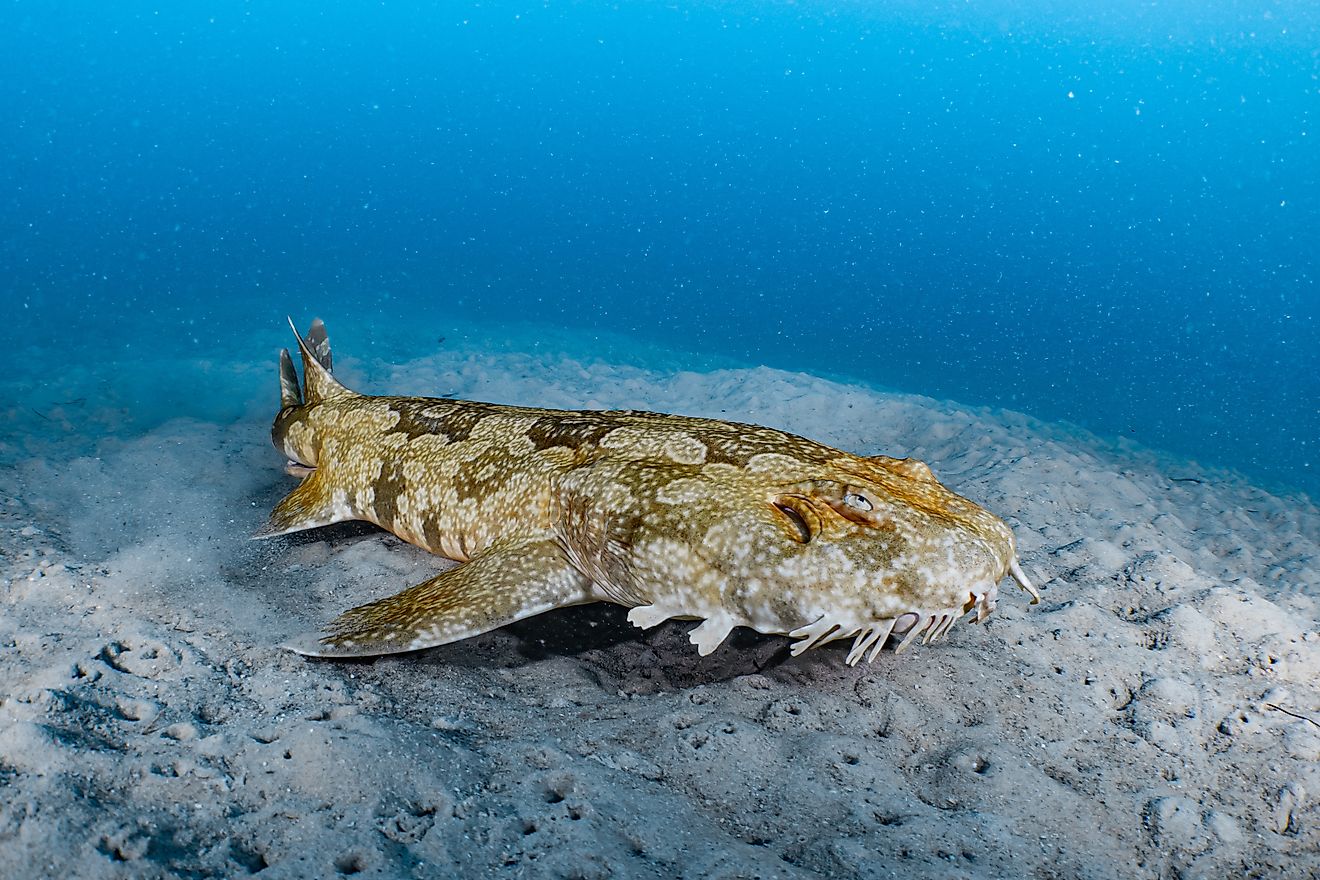
Angel sharks can easily be mistaken for rays at first glance. Their flattened bodies and broad, winglike fins allow them to lie almost flush with the seafloor, giving them a very different appearance from better known sharks such as great whites and hammerheads. This body shape is central to their hunting strategy. They bury themselves in sand or mud and wait for fish to come close before lunging upward and seizing them in a rapid ambush.
Angel sharks make up the genus Squatina, a group of bottom-dwelling cartilaginous fishes found in temperate and tropical seas around the world. They are true sharks despite their flattened, ray-like shape, and they fill a quiet but important role as ambush hunters on continental shelves and coastal flats.
They are also among the most threatened sharks on Earth. Several species, including the common angelshark of the eastern Atlantic and Mediterranean, have been pushed to the edge of extinction by bottom fishing. Understanding what these animals are, how they live, and why they matter is a useful step toward keeping them in the water.
Taxonomic Classification

Angel sharks belong to the kingdom Animalia, phylum Chordata, and class Chondrichthyes, the cartilaginous fishes that also include rays, skates, and chimaeras. Within that class they sit in the subclass Elasmobranchii alongside all other sharks and rays. Their order, Squatiniformes, contains a single living family, Squatinidae, and a single living genus, Squatina, which was named by the French zoologist Andre Marie Constant Dumeril in 1806.
The number of recognized species has grown as researchers apply DNA tools to a group that long hid many look-alikes. Current treatments place the total at more than twenty species, with recent counts reaching around two dozen. The type species is the common angelshark, Squatina squatina, described by Carl Linnaeus in 1758. Other well-studied members include the Pacific angelshark (Squatina californica), the Japanese angelshark (Squatina japonica), the sand devil or Atlantic angelshark (Squatina dumeril), the sawback angelshark (Squatina aculeata), and the smoothback angelshark (Squatina oculata). Several of these were once confused with one another, and genetic work keeps splitting populations that were formerly lumped together, so the family tree remains a moving target.
Physical Description

An angel shark is built for life on the bottom. Its body is strongly flattened top to bottom, and its enlarged pectoral and pelvic fins fan out to the sides in broad, wing-like lobes. This shape gives the animal the rounded, disk-like outline of a ray. One detail settles the confusion. In rays the pectoral fins fuse to the head, while in angel sharks the front edges of those fins stay separate from it. The gill slits also run along the sides of the body rather than fully underneath, another shark trait that rays lack.
The forward half of the body is wide and pancake-flat, but the rear half keeps the muscular, tapering form of a more conventional shark, ending in a tail that powers the animal's upward lunge. Short, cone-shaped barbels project from the snout and help the shark detect prey hidden in sediment. The eyes sit on top of the head, and a pair of openings called spiracles lie just behind them.
Most angel sharks reach a length of about 5 feet (1.5 m). The Japanese angelshark grows larger and can approach 6.6 feet (2 m). The common angelshark has been recorded at up to roughly 6 feet (1.8 m), and the sand devil reaches around 4 to 5 feet (1.2 to 1.5 m) and a weight of at least 35 pounds (16 kg). Coloration is usually gray to reddish or chocolate brown across the back, scattered with small pale spots and darker blotches, while the underside is plain white. That mottled upper surface works as camouflage, letting a buried shark vanish against sand and gravel.
Range and Habitat

Angel sharks live in temperate and tropical seas worldwide, including the eastern Atlantic, the Mediterranean, the coasts of the Americas, West Africa, East Asia, and Australia. They are bottom dwellers that favor soft substrates of sand and mud on continental shelves, where they can bury themselves and wait. Most species keep to relatively shallow coastal water, though at least one ranges into the deep sea, with records down to about 4,300 feet (1,300 m).
The common angelshark offers a clear picture of how far these ranges have shrunk. Its historical distribution stretched along the eastern Atlantic between Norway and North Africa and throughout the Mediterranean and Black Seas. Decades of heavy bottom fishing have since erased the species from much of that area, leaving scattered, fragmented remnants. Today the waters around the Canary Islands stand out as the last reliable stronghold for the common angelshark, which makes that archipelago a focus for conservation and research.
Diet

Angel sharks are carnivores that hunt by ambush rather than pursuit. A buried shark lies motionless with little more than its eyes exposed, then snaps upward and forward to seize prey that strays too close. The strike is extremely fast, powered by the muscular rear body and tail, and the wide mouth and sharp, pointed teeth close on the target before it can escape.
The diet is dominated by bony fishes, with flatfishes and other bottom-living species featuring heavily. Angel sharks also take skates, crustaceans, mollusks, and squid depending on what is available in their habitat. Because they sit partway up the food web as mid-level predators, they help regulate the numbers of the smaller fishes and invertebrates they eat, a role that ripples through the wider seafloor community.
Behavior

The defining behavior of the genus is the lie-and-wait strategy that shapes everything else about these animals. Many angel sharks are most active at night, spending daylight hours buried in sediment with only the eyes and part of the back showing. A shark settles in by shuffling its fins to flick sand over its body until it all but disappears.
While buried, an angel shark breathes without stirring up a telltale cloud at its mouth. It draws clean water in through the spiracles behind its eyes and passes it over the gills, an adaptation shared with other bottom-resting elasmobranchs. This stationary, sit-and-ambush habit keeps individual sharks tied to particular patches of seafloor, and it helps explain why the group is so vulnerable to habitat disturbance. An animal that depends on staying put cannot easily flee a trawl net dragging across its hunting ground.
Reproduction

Angel sharks are ovoviviparous, which means the eggs develop and hatch inside the mother, who then gives birth to live young. There is no placental connection between mother and embryo. The young are nourished by their yolk sacs until they are born as fully formed miniatures of the adults. Litter sizes vary by species and by the size of the mother. Many angel sharks produce up to around a dozen pups per litter, and the common angelshark has been recorded with litters ranging between 7 and 25 pups after a gestation of roughly 8 to 10 months.
Newborn common angelsharks measure about 9.5 to 12 inches (24 to 30 cm) in length, and the species matures at a large size, with reports of maturity between roughly 4.2 and 5.5 feet (128 to 169 cm). Slow growth, late maturity, and modest litter sizes are common across sharks, and they leave angel shark populations slow to rebuild once their numbers fall.
Importance to the World

As mid-level predators on soft-bottom habitats, angel sharks help keep the communities they live in balanced. By preying on abundant bottom fishes and invertebrates, they exert a steady check on those populations, and their presence is one marker of a functioning coastal ecosystem. Where angel sharks have vanished, scientists treat the loss as a warning sign about the health of the wider seafloor.
Angel sharks also carry outsized value as a flagship for marine conservation. Because they act as an umbrella species, the shallow sandy habitats protected to help them recover end up sheltering a much wider community of seabed animals that would otherwise attract little notice. The effort to save them has drawn in the public as well. Recreational divers in the Canary Islands were among the first to report that angel sharks still gathered there in numbers, and that grassroots observation grew into organized sighting counts in which divers log every animal they encounter, turning a popular dive destination into a steady source of the data that conservation planning depends on.
Threats

Angel sharks are among the most imperiled families of sharks and rays in the world. Their flat, bottom-hugging bodies put them squarely in the path of the gear that does the most damage to seafloor life. Bottom trawls and gillnets catch them readily, often as bycatch rather than as a target, and that pressure has driven several species into steep decline.
The common angelshark has been assessed as Critically Endangered on the IUCN Red List, a status first applied in 2010 and reaffirmed in later assessments. The smoothback angelshark and the sawback angelshark, both of the eastern Atlantic and Mediterranean, are also listed as Critically Endangered. Other members of the genus elsewhere in the world fall into lower but still concerning categories, with the Pacific angelshark assessed as a species of conservation concern in the eastern Pacific. Habitat loss and the degradation of coastal nursery areas add to the fishing pressure.
Protection has started to catch up in some places. The United Kingdom gave the common angelshark full legal protection under its Wildlife and Countryside Act in 2008, and the species was added to Appendices I and II of the Convention on the Conservation of Migratory Species of Wild Animals in 2017. The Angel Shark Conservation Network, formed through the IUCN and the Shark Trust, coordinates research and recovery work, with the Canary Islands and parts of the eastern Mediterranean treated as priority areas. Whether these measures prove enough will depend on reducing the bycatch that still removes animals faster than slow-breeding populations can replace them.
Takeaway
The angel shark challenges the usual image of what a shark looks and behaves like. Its raylike body, flattened shape, and reliance on stillness make it a highly specialized predator of the seafloor. Those same adaptations, however, leave it particularly vulnerable to fishing gear that disturbs or sweeps across the bottom. Several species now face serious declines, including populations that were once widespread across European waters. Conservation efforts in places such as the Canary Islands show that populations can recover when effective protection is put in place. Long term survival will depend on reducing destructive bottom fishing and protecting the coastal habitats where these sharks spend much of their lives.
Fun Facts

- They are sharks, not rays. The quickest way to tell them apart is the pectoral fins. In rays those fins fuse to the head, while in angel sharks they stay separate, and the gill slits run along the sides of the body like a true shark.
- They breathe through the top of the head. While buried, an angel shark pulls water in through the spiracles behind its eyes rather than its mouth, so it can take in oxygen without blowing its cover in the sand.
- Their old nickname is monkfish. The hooded shape of the head reminded early observers of a monk's cowl, giving the common angelshark the names monk and monkfish, though it is unrelated to the bony fish sold under that name today.
- The ambush strike is nearly too fast to see. An angel shark can snap upward and engulf a passing fish in a split second, a sudden lunge powered by its muscular tail from a dead stop.
- They are ancient animals. Close relatives of modern angel sharks swam the seas in the age of the dinosaurs, and the lineage can be traced back more than one hundred million years.
Quick Facts
- Scientific name: Genus Squatina (type species Squatina squatina)
- Family: Squatinidae
- Order: Squatiniformes
- IUCN status: Varies by species, with the common angelshark listed as Critically Endangered
- Length: About 5 feet (1.5 m) for most species, up to 6.6 feet (2 m) in the Japanese angelshark
- Weight: At least 35 pounds (16 kg) in larger species
- Lifespan: Up to around 35 years in the wild
- Diet: Carnivore, feeding on bony fishes, skates, crustaceans, mollusks, and squid
- Range: Temperate and tropical coastal seas worldwide
- Habitat: Sandy and muddy seafloors on continental shelves