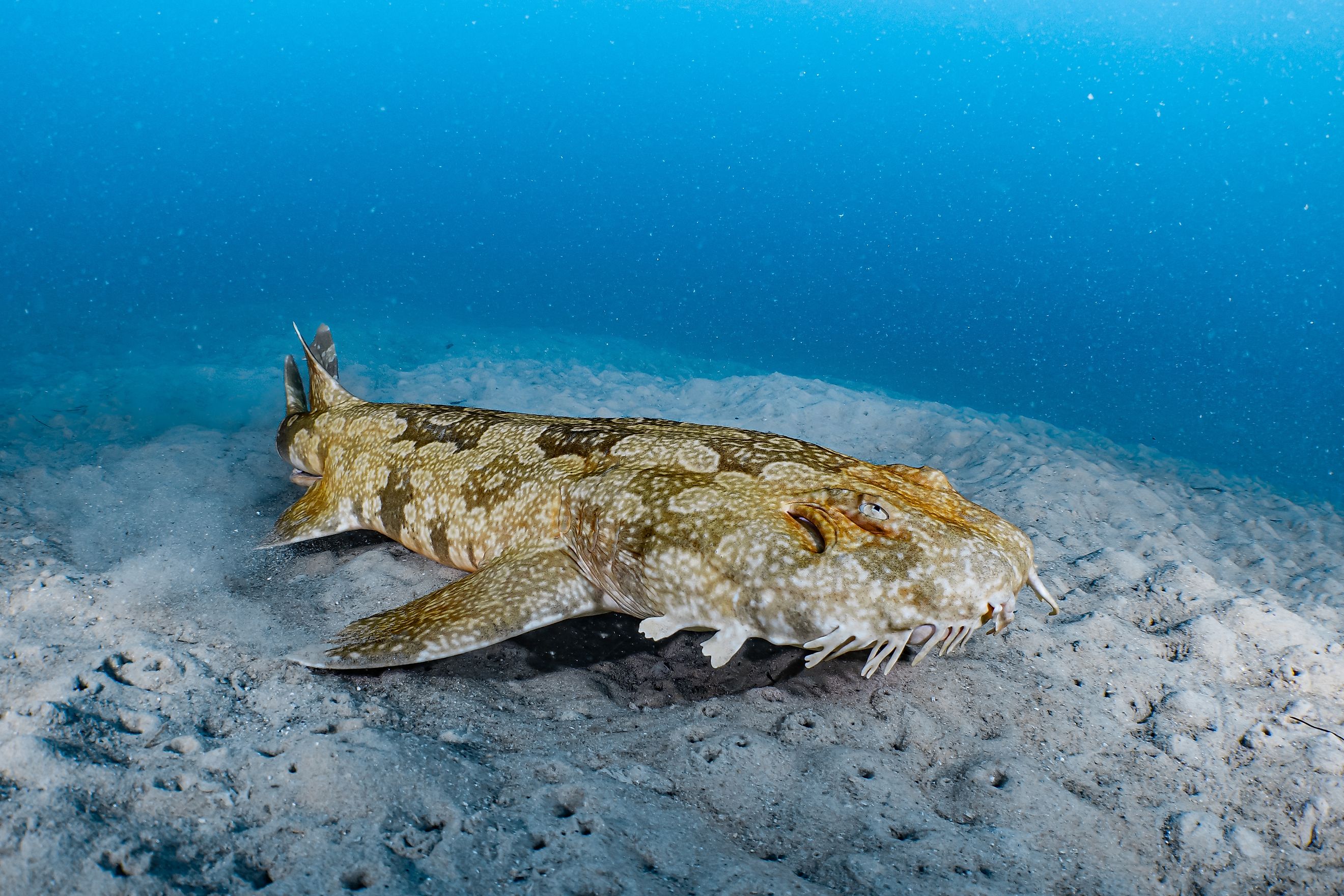
Wobbegong
Wobbegongs are among the most accomplished ambush predators in the ocean, sharks so thoroughly disguised that fish and divers alike can pass within inches of one without noticing it at all. Pressed flat against the seafloor, fringed with fleshy flaps of skin, and patterned like a weathered rug, a wobbegong looks less like a shark than like a living piece of the reef.
The name is believed to come from an Australian Aboriginal language and is often translated as "shaggy beard," a reference to the branching lobes of skin that hang around the animal's mouth. These sharks make up the family Orectolobidae, part of the carpet shark order Orectolobiformes, and they live mostly in the shallow coastal waters around Australia and Indonesia. Despite their sluggish reputation, they are efficient hunters armed with a lightning-fast strike and a set of long, backward-curving teeth.
Twelve living species are recognized today. The smallest are compact reef dwellers barely longer than a forearm, while the largest are heavy-bodied giants that stretch beyond ten feet. What unites them is a shared strategy of patience, camouflage, and sudden violence that has served the group well for millions of years.
Taxonomic Classification

Wobbegongs belong to the class Chondrichthyes, the cartilaginous fishes, and the order Orectolobiformes, commonly called carpet sharks. Within that order they form the family Orectolobidae. Scientists currently recognize twelve living species spread across three genera, Orectolobus, Eucrossorhinus, and Sutorectus. The genus Orectolobus contains the great majority with ten species, while Eucrossorhinus holds only the tasselled wobbegong (Eucrossorhinus dasypogon) and Sutorectus only the cobbler wobbegong (Sutorectus tentaculatus).
The family has undergone heavy revision in recent decades. Several species were described only in the past twenty years, with one named in 2006, three more in 2008, and another in 2010. The gulf wobbegong, also called the banded wobbegong (Orectolobus halei), was raised to full species status after long being lumped in with the ornate wobbegong. This steady reshuffling reflects both the strong family resemblance among wobbegongs and the growing role of DNA analysis in separating closely related sharks that look nearly identical to the eye.
The genus name Orectolobus traces to Greek roots meaning "stretched-out lobe," a direct nod to the long nasal barbels and skin flaps that give the group its unmistakable profile. The spotted wobbegong (Orectolobus maculatus), first described by Bonnaterre in 1788, serves as the type species against which the rest of the genus is measured.
Physical Description

The wobbegong body plan is built entirely around concealment. The head and trunk are strongly flattened, allowing the animal to lie low against sand, rock, or coral rubble. Running along the sides of the head is a fringe of branched dermal lobes, the feature that distinguishes wobbegongs from every other shark except, loosely, the angel sharks. These lobes break up the outline of the head and blur the line between animal and seafloor. A pair of nasal barbels hangs near the snout and helps the shark taste and feel its surroundings.
Coloration completes the disguise. Most wobbegongs wear a mottled wash of browns, grays, and yellows marked with saddles, rings, blotches, and fine broken lines. The exact pattern varies by species, but in every case it mimics the dappled texture of a reef floor. The tasselled wobbegong carries this look to an extreme, with an elaborate, almost lace-like beard of skin tassels ringing its entire head.
Size varies widely across the family. Most species reach a maximum length of only about 4.1 feet (1.25 m). Two species break sharply from that pattern. Both the spotted wobbegong and the gulf wobbegong can grow to roughly 10 feet (3 m), and the spotted wobbegong's largest verified measurement reaches about 10.5 feet (3.2 m), though most individuals of that species fall between 5 and 6 feet (1.5 and 1.8 m). The mouth sits near the front of the head rather than underneath it, an arrangement that lets the shark seize prey passing directly in front of its face.
Range and Habitat

Wobbegongs are creatures of the western Pacific Ocean and the eastern Indian Ocean. The center of their diversity lies around Australia and Indonesia, where most species occur. One outlier, the Japanese wobbegong (Orectolobus japonicus), ranges north through the western Pacific as far as Japan. Australia alone is home to the large majority of described species, making its coastline the heartland of the family.
Within that broad range, wobbegongs favor shallow, structured environments. They haunt coral and rocky reefs, seagrass beds, coastal bays, and the gentle slope of the continental shelf, and they readily shelter under ledges, in caves, and beneath piers and jetties. Most individuals stay in shallow water close to shore, although the family as a whole has been recorded at depths approaching 280 feet (roughly 85 m) and, in some species, considerably deeper. The spotted wobbegong, for instance, is usually found between the surface and about 360 feet (110 m).
Diet and Hunting

The wobbegong is a sit-and-wait predator in the purest sense. Rather than chase down a meal, it settles onto the bottom, blends into the background, and waits for prey to wander close. When a suitable target drifts within range, the shark lunges forward and flares its jaws open at remarkable speed, creating a sudden rush of water that pulls the victim inward. Long, slender, backward-pointing teeth then lock the prey in place and make escape nearly impossible.
The menu is broad. Wobbegongs take bony fish of many kinds along with octopuses, crabs, lobsters, and other bottom-dwelling invertebrates. Larger species are known to eat smaller sharks and rays as well, a reminder that these animals sit comfortably in the middle of the reef food web. Most hunting happens at night, when the wobbegong becomes active and its camouflage grows even more effective in the dark. During the day the shark is content to rest, conserving energy for the next ambush.
Behavior

By daylight, a wobbegong is the picture of inactivity, lying motionless for hours at a time. This calm is a hunting tool rather than laziness, since stillness is central to the ambush. Many individuals show strong site fidelity, returning to the same patch of reef or the same resting ledge again and again. That loyalty to a favored spot makes them reliable sights for divers but also leaves local populations exposed to overfishing.
One of the more surprising wobbegong behaviors is a form of walking. Using muscular pectoral fins, some wobbegongs can drag themselves across exposed rock and even haul their bodies partly out of the water to move between tide pools. They are not aggressive toward people under normal circumstances, but they will bite when stepped on, cornered, or handled, and their powerful jaws can clamp down with a grip that is hard to break. Records of such bites exist, yet none has ever been fatal.
Reproduction

Reproductive strategies differ across the family. Some wobbegongs are egg-layers that deposit oval egg cases on the seafloor, some retain those egg cases inside the body until the young hatch, and others are ovoviviparous, nourishing developing embryos on yolk before giving birth to live young. The spotted wobbegong follows the live-bearing path. Females of that species carry litters that commonly number around twenty pups and can reach nearly forty, each newborn measuring roughly 8 to 9 inches (21 to 23 cm) at birth.
Growth is slow and maturity comes late. Spotted wobbegongs reach breeding size at around 4 feet (1.2 m) and can live for about 22 years. This combination of slow growth, late maturity, and modest reproductive output means wobbegong populations recover slowly from losses, a trait that shapes how they must be managed.
Importance to the World

As mid-level predators, wobbegongs help regulate the numbers of the fish and invertebrates they eat, contributing to the balance of the reef and shelf communities they inhabit. Their long residence on a single patch of reef also makes them part of the fixed furniture of those ecosystems, interacting with the same neighbors over months and years.
Wobbegongs matter to people as well. Their flesh is eaten in Australia, where it is sold as part of the fish sometimes marketed under the general label of flake, and their distinctively patterned skin has historically been worked into leather. Smaller species occasionally enter the aquarium trade, prized for their odd shape and striking camouflage. These uses give the sharks a measurable economic footprint, which in turn makes their conservation a matter of practical as well as ecological concern.
Threats and Conservation

Most wobbegong species are currently listed as Least Concern on the IUCN Red List, a relatively reassuring picture for a group of sharks. There are exceptions. The Indonesian wobbegong (Orectolobus leptolineatus) is assessed as Near Threatened, and several species carry decreasing or uncertain population trends. Some assessments have flagged data gaps, meaning the true status of a few species remains poorly understood.
The main pressures are fishing and habitat change. Wobbegongs are caught both deliberately, for their meat and skin, and incidentally as bycatch in other fisheries. Their strong attachment to particular sites makes them easy to locate and remove, so heavy fishing in a small area can thin out a local population quickly. The spotted wobbegong offers a cautionary and hopeful example at once. It was once assessed as Vulnerable after catches declined sharply in New South Wales, but after catch limits and size restrictions were introduced in 2008, its numbers stabilized and its status improved. That recovery shows that careful management can work when it is applied in time.
Takeaway
Wobbegongs have built their success around remaining unnoticed until the right moment. Their skin fringes, intricate patterns, and habit of lying motionless on the seafloor allow them to blend into reefs and ambush prey at close range. This strategy has served them well across the coastal waters of Australia and Indonesia for millions of years. However, their strong attachment to particular habitats and relatively slow reproduction can make them vulnerable to fishing pressure and habitat disturbance. Their generally stable conservation status is encouraging, while the recovery of the spotted wobbegong shows that effective fishing regulations can help maintain healthy populations.
Fun Facts

- Their name may mean "shaggy beard." The word wobbegong is widely thought to come from an Australian Aboriginal language, describing the fringe of skin lobes around the mouth.
- They can walk on land. Using their stout pectoral fins, some wobbegongs drag themselves across exposed rock and briefly out of the water to cross between tide pools.
- A wobbegong once ate another shark head first. On the Great Barrier Reef, a tasselled wobbegong was photographed swallowing a brown-banded bamboo shark roughly three-quarters its own length, in what researchers believe was the first such event captured on camera.
- They are related to the whale shark. As members of the carpet shark order, wobbegongs share an order with the largest fish in the sea.
- Their bite is hard to shake. When provoked, a wobbegong can lock its jaws onto a limb and hold on with a grip that has surprised more than one careless wader.
Quick Facts
- Family: Orectolobidae
- Order: Orectolobiformes (carpet sharks)
- Number of species: 12, across 3 genera
- Largest species: Spotted and gulf wobbegongs, up to about 10 feet (3 m)
- Typical size: Most species under 4.1 feet (1.25 m)
- IUCN status: Most species Least Concern, with the Indonesian wobbegong listed as Near Threatened
- Diet: Carnivore, including bony fish, octopuses, crustaceans, and smaller sharks and rays
- Range: Western Pacific and eastern Indian Ocean, chiefly around Australia and Indonesia
- Habitat: Coral and rocky reefs, seagrass beds, coastal bays, and the continental shelf
- Lifespan: Up to about 22 years (spotted wobbegong)
- Reproduction: Varies by species, including live birth and egg-laying