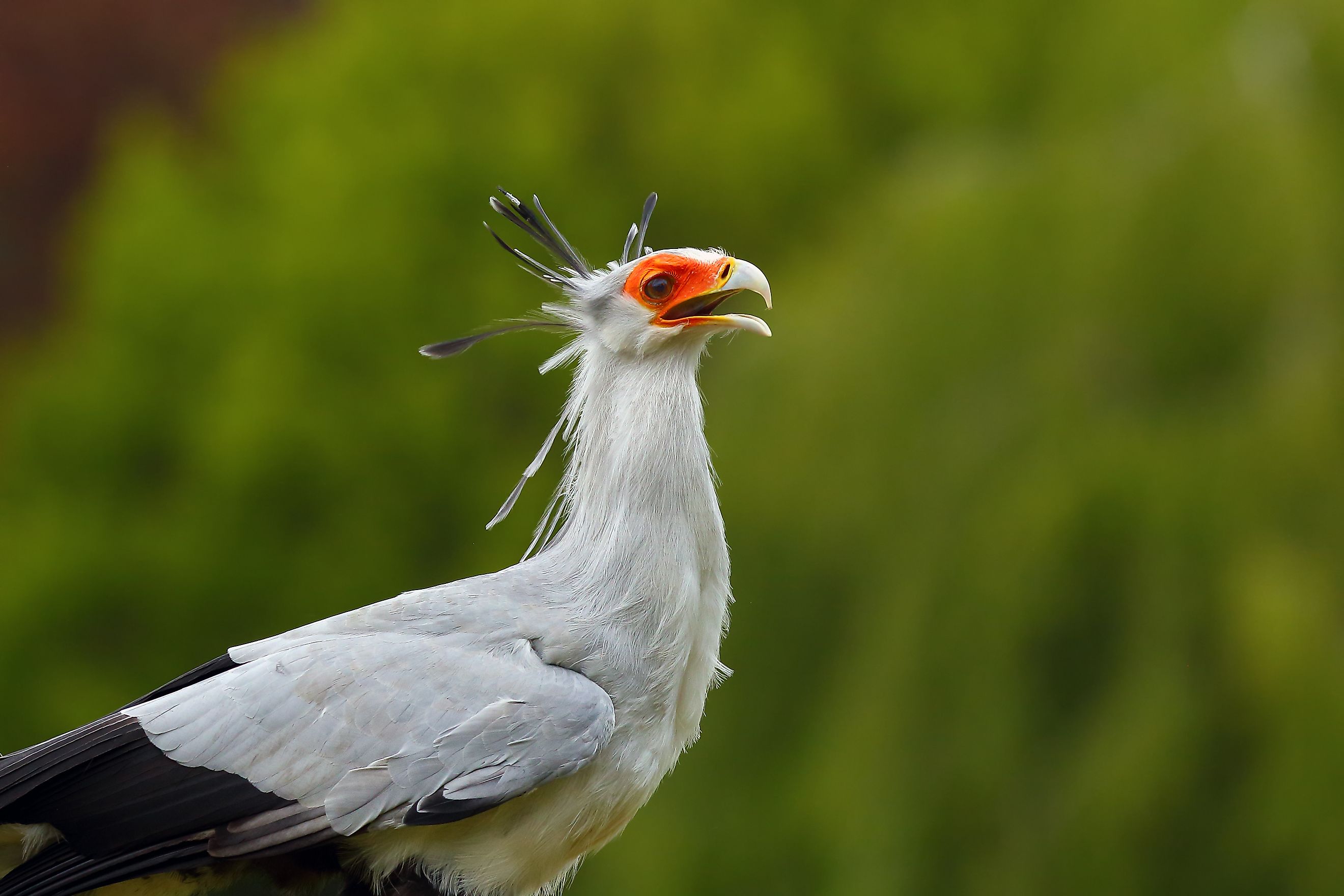
Secretarybird
The secretarybird has one of the most unusual hunting styles among birds of prey. Rather than diving from above like an eagle or falcon, this long legged raptor walks through African grasslands in search of snakes, lizards, and rodents, killing them with rapid, powerful kicks. Standing about 4 feet (1.2 m) tall, it has an unusual appearance that combines features of a crane and an eagle, and its distinctive form has puzzled scientists over its evolutionary relationships for centuries.
The secretarybird (Sagittarius serpentarius) is a large bird of prey found only in sub-Saharan Africa, where it patrols open savannas and grasslands in search of food. It is the only living member of its family, which makes it one of the most evolutionarily distinct raptors on Earth.
That distinctiveness is one reason the species deserves attention. Another is its decline. Once common across much of the continent, the secretarybird is now listed as Endangered, and its future depends on the health of the open landscapes it calls home.
Taxonomic Classification

The secretarybird belongs to the kingdom Animalia, the phylum Chordata, and the class Aves. Within the birds, it sits in the order Accipitriformes, the group that also contains hawks, eagles, kites, and Old World vultures. It is, however, placed in its own family, Sagittariidae, and it is the only living species in both that family and the genus Sagittarius. Its full scientific name is Sagittarius serpentarius.
The species was first described in 1779 by the English illustrator John Frederick Miller, who originally placed it in the falcon genus as Falco serpentarius. The genus name Sagittarius means "archer" in Latin, possibly a reference to the bird's upright stride and the quill-like feathers on its head. The species name serpentarius refers to its reputation as a snake killer.
For a long time, ornithologists were unsure whether the secretarybird was more closely related to raptors, cranes, or the South American seriemas, which share its long legs and ground-hunting habits. Modern DNA studies place it firmly among the Accipitriformes, near the base of the lineage that gave rise to hawks and eagles. Its resemblance to seriemas is now considered a case of convergent evolution, in which unrelated animals develop similar traits because they live similar lives. Fossil relatives from Europe show that the family was once more widespread, but today only one species survives. No subspecies are recognized.
Physical Description

The secretarybird is instantly recognizable. Its most striking feature is a pair of extraordinarily long legs, which make up much of its height. Adults stand about 4 feet (1.2 m) tall and measure roughly 4 to 5 feet (1.25 to 1.5 m) from the tip of the bill to the end of the tail. They weigh between about 5 and 9.5 pounds (2.3 to 4.3 kg). Males are usually slightly larger than females, though the difference is small.
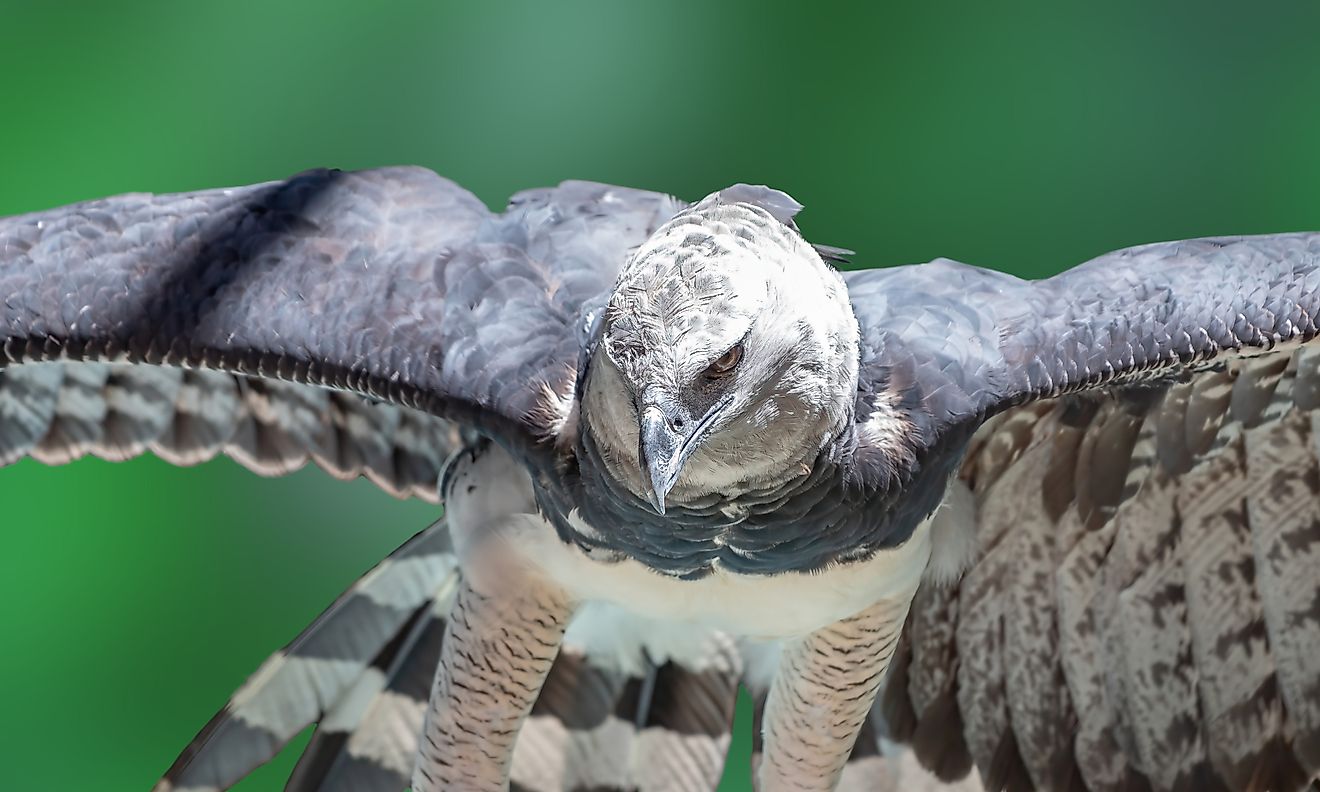
The plumage is mostly pale blue-gray on the head, neck, and body. The flight feathers, thighs, and lower belly are black, giving the bird the appearance of wearing dark shorts. A crest of long black feathers sprouts from the back of the head and can be raised during displays or when the bird is excited. These feathers are the likely source of the common name. Many sources suggest that early European observers thought the crest resembled the quill pens that clerks and secretaries once kept behind their ears. Another theory links the name to an Arabic phrase meaning "hunter bird," though that explanation is less widely accepted.
The face is bare of feathers and ranges in color between yellow and bright orange-red. The bill is hooked like that of an eagle, a clear sign of its raptor ancestry. The eyes are framed by long lashes, which help shield them from dust and struggling prey.
The legs themselves are a marvel of engineering. The lower legs are covered in thick, heavy scales that offer protection against snake bites. The toes are short and stubby compared with those of other raptors, which suits a bird that strikes prey with its feet rather than grasping it in flight. Although it spends most of its time walking, the secretarybird is a strong flier. Its wingspan reaches about 6.9 feet (2.1 m), and two elongated central tail feathers trail behind it in flight, creating a distinctive silhouette.
Young birds resemble adults but have duller, browner plumage, shorter crests, and a yellowish face. They gain full adult coloring over their first couple of years.
Range and Habitat

The secretarybird is endemic to Africa. It occurs in more than 30 countries south of the Sahara. Its range reaches Senegal and Mali in the west, Ethiopia and Somalia in the east, and the tip of South Africa in the south. Across this enormous range, it favors open country where it can walk freely and spot prey in short vegetation.
Typical habitats include grasslands, open savannas, and semi-arid scrublands dotted with small, flat-topped trees such as acacias. These trees are important because the birds use them for nesting and roosting. The species generally avoids dense forests, thick woodland, and true deserts, since tall or heavy vegetation makes ground hunting difficult. It occurs at elevations between sea level and high plateaus, and it has been recorded above 9,800 feet (3,000 m) in parts of East Africa.
The historical range has shrunk in several regions. The bird is now thought to be locally extinct in many parts of West Africa, and in East Africa it is increasingly restricted to protected areas such as national parks and reserves.
Diet

The secretarybird is a carnivore with a broad appetite. Although it is famous as a snake hunter, snakes make up only part of its diet. It also eats insects such as grasshoppers and beetles, along with rodents, hares, lizards, tortoises, frogs, and the eggs and chicks of ground-nesting birds. In some areas, large insects make up the bulk of what it eats by number, while mammals and reptiles supply most of the energy.
Hunting takes place almost entirely on foot. A secretarybird walks steadily through the grass, often covering more than 12 miles (20 km) in a single day. As it moves, it stamps on clumps of vegetation to flush out hidden animals. When it finds prey, it attacks with rapid, forceful kicks aimed at the head.
These kicks are among the most remarkable strikes in the animal world. A study of a captive male in the United Kingdom, published in 2016, found that a single kick could deliver a force of about five times the bird's own body weight. The foot remained in contact with the target for only around 15 milliseconds, faster than the blink of a human eye. This speed and precision allow the bird to kill venomous snakes before they can strike back. Small prey is usually swallowed whole, while larger animals are torn apart with the hooked bill.
Secretarybirds are also known to take advantage of grassland fires. They gather along the edges of burning areas to catch animals fleeing the flames.
Behavior

The secretarybird is diurnal, meaning it is active during the day. Each morning it leaves its night roost, usually at the top of a tree, and spends many hours walking and hunting. At dusk, it returns to a tree to sleep.
Adults usually live in pairs or small family groups and are strongly territorial. A pair may defend a home range of about 19 square miles (50 square km), though the size varies with prey availability. Pairs often stay together for years and may use the same territory for long periods.
Communication includes a deep, croaking call, usually heard during displays or at the nest. Otherwise the bird is fairly quiet. In territorial disputes, rivals may chase each other on foot with wings raised, or they may leap and kick at one another. In the air, pairs perform soaring displays and undulating flights that advertise their territory to neighbors.
Most secretarybirds are sedentary, staying in the same area year-round. Some populations move locally in response to rainfall and food supply, and young birds may travel long distances before settling into a territory of their own.
Reproduction

Secretarybirds are monogamous and can breed at any time of year, though breeding often peaks during and after the rainy season, when prey is most abundant. Courtship includes aerial displays in which the birds swoop and climb in wide arcs, along with ground displays and chases.
The pair builds a large, flat platform of sticks on top of a thorny tree, often an acacia. The nest can reach about 8 feet (2.5 m) across and is reused and added to over several years. It is usually placed low enough on the tree to be reached from the ground, since the adults often approach it by walking and then hopping up.
The female lays one to three pale, chalky eggs. Both parents take part in incubation, which lasts about 45 days. After hatching, the chicks are fed by both adults, who regurgitate partly digested food onto the nest floor. When food is scarce, the youngest chick often starves, and usually only one or two young survive.
Chicks remain in the nest for about 75 to 85 days before they fledge. Young birds sometimes leave the nest before they can fly well and spend a period on the ground, where they are vulnerable. Secretarybirds reach maturity at about two to three years of age. In the wild, they are thought to live around 10 to 15 years, and in captivity they have lived close to 20 years.
Importance to the World

As a top ground predator, the secretarybird helps control populations of rodents, snakes, and insects. By keeping rodent numbers in check, it limits damage to crops and stored food and may reduce the spread of diseases that rodents carry. Its appetite for grasshoppers and other large insects also helps regulate grassland ecosystems.
The secretarybird also serves as a useful barometer for the health of African grasslands. Because it needs wide stretches of open country and a steady supply of prey, its presence signals an ecosystem that is still functioning well, while its disappearance often warns that the landscape is being degraded. For this reason, conservationists treat it as a flagship species, using it to rally support and funding that end up protecting many other grassland animals that share its range. Its scientific value adds to this. As the sole survivor of an entire bird family, it carries a branch of evolutionary history that would be lost for good if the species vanished.
Threats

The secretarybird is listed as Endangered on the IUCN Red List. It was moved to Vulnerable in 2011 and then to Endangered in 2020, after mounting evidence showed severe declines across its range. BirdLife International estimates the global population at between 6,700 and 67,000 mature individuals, a wide range that reflects how little large-scale survey data exists. The population trend is decreasing.
Regional studies paint a worrying picture. Road counts in Botswana showed a 78 percent drop in sightings between the early 1990s and the mid-2010s. In South Africa, citizen science data showed that reporting rates fell across nearly three-quarters of the surveyed area over about 30 years.
The main threat is habitat loss and degradation. Grasslands are being converted to farms, tree plantations, and settlements. Overgrazing by livestock and the spread of woody shrubs make the remaining land less suitable for hunting. Frequent burning can reduce the amount of prey available.
Other dangers come directly from people. Secretarybirds collide with fences and power lines, and the Endangered Wildlife Trust recorded nearly 100 power-line deaths over a 20-year period in South Africa. Birds are also harmed by poisoned baits, pesticide exposure, hunting, nest disturbance, and capture for the wildlife trade. Worsening droughts linked to climate change can make these problems more severe.
Conservation efforts are underway. The species is listed on CITES Appendix II, which regulates international trade. It occurs in many national parks and protected areas. Researchers are using GPS tracking to learn how the birds move through the landscape, and conservation groups work with landowners to manage their property in ways that support the species. Experts have called for a coordinated, continent-wide monitoring program to produce a reliable population estimate.
Takeaway
The secretarybird has a hunting style unlike that of most other raptors. Instead of attacking from the air, it stalks prey on long legs and uses rapid, powerful kicks to subdue it, including venomous snakes. Its distinctive crest and unusual hunting behavior have made it one of Africa's most recognizable birds of prey. It also helps control populations of insects, rodents, and other small animals across the grasslands it inhabits. However, its numbers are declining as open habitats disappear and human pressures increase. Protecting the secretarybird will depend on preserving the savannas and grasslands where it hunts, nests, and raises its young.
Fun Facts

- Kick master. A secretarybird's kick can hit with about five times its own body weight in force and lasts only around 15 milliseconds.
- Long-distance walker. Secretarybirds often walk more than 12 miles (20 km) a day while hunting.
- National symbol. The bird appears on the coat of arms of South Africa and the national emblem of Sudan.
- One of a kind. It is the only living member of the family Sagittariidae.
- Fire follower. Secretarybirds patrol the edges of grass fires to catch fleeing animals.
Quick Facts
- Scientific name: Sagittarius serpentarius
- Family: Sagittariidae
- Order: Accipitriformes
- IUCN status: Endangered (2020 assessment)
- Population: 6,700 to 67,000 mature individuals (decreasing)
- Height: About 4 feet (1.2 m)
- Length: About 4 to 5 feet (1.25 to 1.5 m)
- Wingspan: About 6.9 feet (2.1 m)
- Weight: About 5 to 9.5 pounds (2.3 to 4.3 kg)
- Lifespan: About 10 to 15 years in the wild, close to 20 years in captivity
- Diet: Carnivore (insects, rodents, snakes, lizards, and other small animals)
- Range: Sub-Saharan Africa
- Habitat: Grasslands, open savannas, and semi-arid scrublands