Hellbender
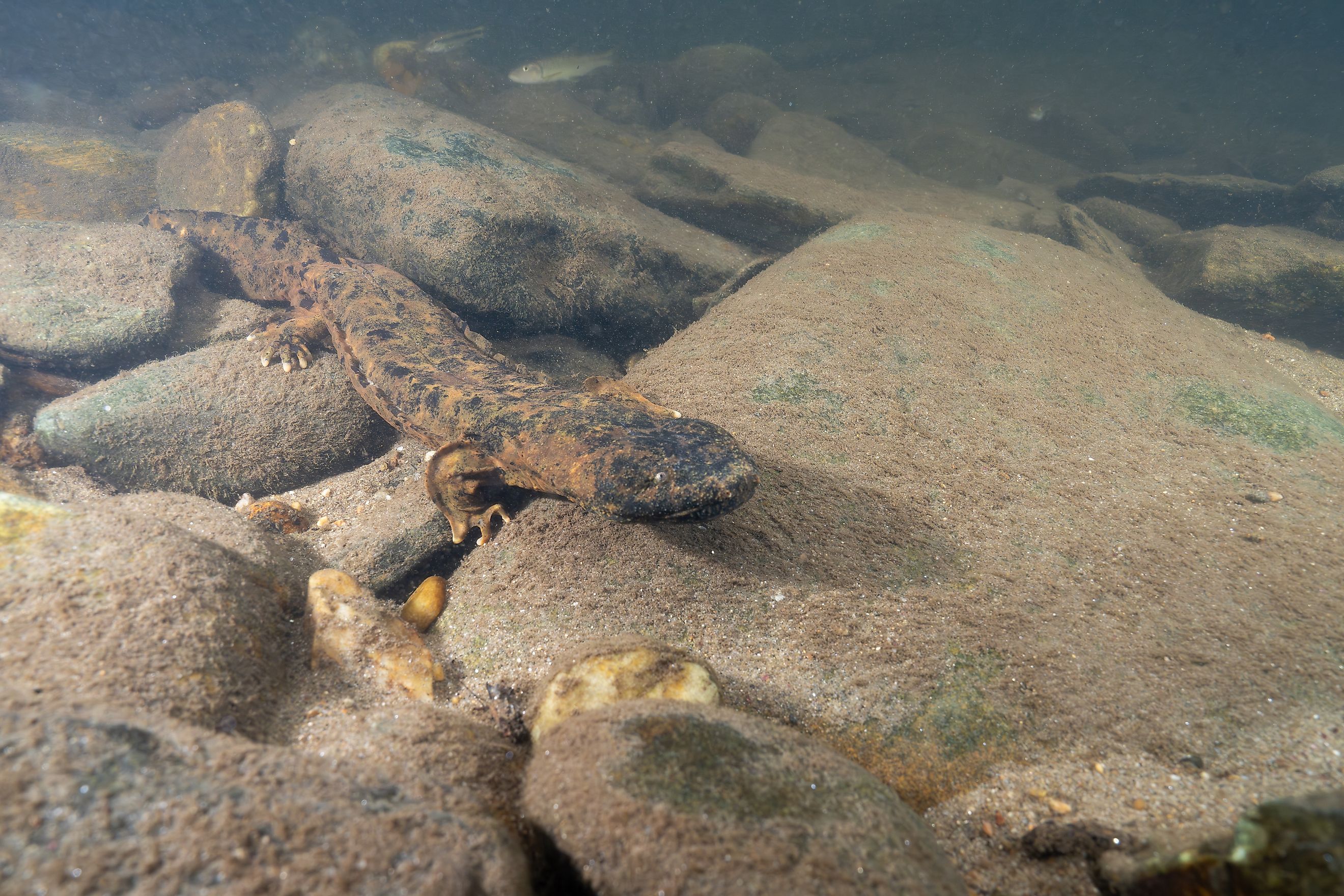
Turn over the right rock in a cold Appalachian stream and you might come face to face with an animal that looks like a leftover from another age. It is flat as a pancake, wrapped in loose folds of wrinkled brown skin, and can stretch nearly 2.5 feet (74 cm) long. It has tiny eyes, no visible gills, and a coat of slime thick enough to earn it the nickname "snot otter." This is the hellbender, the largest salamander in North America.
Those wrinkles do real work. The hellbender pulls most of its oxygen straight from the water through its skin and uses its lungs mainly to control buoyancy. It hunts crayfish in the dark, sucking them in with a sudden gulp of water. In late summer, males dig nests beneath boulders and guard hundreds of eggs for two months or more, a level of fatherly devotion that is rare among amphibians.
The hellbender also comes from a family with deep roots. Fossils show that its giant salamander relatives were living in what is now China more than 160 million years ago, when dinosaurs ruled the land. Today its survival hinges on clean, cold, rocky streams. That need has made the hellbender one of the clearest warning signs of river health in the eastern United States, and its steady decline is also a story about the waters it calls home.
Taxonomic Classification

The hellbender belongs to the kingdom Animalia, the phylum Chordata, and the class Amphibia. Within the amphibians, it is placed in the order Caudata, which contains all salamanders and newts. It is a member of the family Cryptobranchidae, a small group known as the giant salamanders. Its scientific name is Cryptobranchus alleganiensis. The genus name comes from Greek words meaning "hidden gill," a reference to the fact that adults lack visible external gills. The species name refers to the Allegheny Mountains, part of the animal's core range. French zoologist François Marie Daudin described the species in 1803.
Two subspecies are traditionally recognized. The eastern hellbender, Cryptobranchus alleganiensis alleganiensis, occupies most of the range. The Ozark hellbender, Cryptobranchus alleganiensis bishopi, lives only in the Ozark Plateau of southern Missouri and northern Arkansas. Genetic studies have revealed several distinct lineages within the species, and some researchers have suggested that the current classification may eventually be revised. The closest relatives of the hellbender are the Japanese giant salamander and the Chinese giant salamanders of the genus Andrias, which can grow considerably larger.
Physical Description

The hellbender is built for life on a stream bottom. Its body and head are strongly flattened, allowing it to squeeze into narrow gaps under rocks and to hold its position in swift currents. Adults typically measure 12 to 20 inches (30 to 51 cm) in total length, and the largest individuals can reach about 29 inches (74 cm). Most adults weigh between 3 and 5 pounds (1.4 and 2.3 kg). Among all salamanders, only its giant relatives in Asia grow larger.
The most distinctive feature of the hellbender is its loose, wrinkled skin. Thick folds run along both sides of the body between the front and hind legs. These folds greatly increase the surface area of the skin, which is where the animal absorbs most of its oxygen. Although hellbenders have lungs, they rely on them mainly for buoyancy rather than breathing. When oxygen levels in the water drop, a hellbender may sway or rock its body side to side to move fresh water across its skin.
Coloration is generally brown, gray, olive, or reddish, often with darker blotches that help the animal blend in with rocks and sediment. The belly is usually lighter. The head is broad and flat, and the eyes are very small and set on top of the head. Vision is poor, but the skin across the body, and especially the tail, is sensitive to light. Hellbenders sense movement through a lateral line system that detects vibrations in the water. The legs are short and sturdy, with four toes on each front foot and five on each hind foot. The tail is thick at the base and flattened side to side, functioning like a rudder and paddle. The skin produces a slippery mucus that protects the animal and gives it the nickname "snot otter."
Males and females look very similar for most of the year. During the breeding season, the area around the male's vent becomes noticeably swollen, which is one of the few reliable ways to tell the sexes apart.
Range and Habitat

Hellbenders are found only in the eastern and central United States. The eastern hellbender has been recorded in New York, Pennsylvania, Ohio, Maryland, West Virginia, Virginia, Kentucky, Tennessee, North Carolina, Georgia, Alabama, Mississippi, Indiana, Illinois, and Missouri. The heart of its range lies in the Appalachian Mountains and the Ohio and Tennessee River drainages. The Ozark hellbender is restricted to a handful of rivers in the White River and Black River systems of southern Missouri and northern Arkansas.
The historical range has shrunk considerably. The eastern hellbender is now believed to be gone or of unknown status in a large share of the streams where it once lived, and some state populations are extremely small or possibly extirpated.
Within its range, the hellbender has very specific habitat needs. It lives in clear, cool, fast-flowing streams and rivers with high oxygen levels. The most important feature of good hellbender habitat is an abundance of large, flat rocks resting on gravel or cobble, with open space underneath. These rocks serve as shelters, hunting bases, and nest sites. Each adult usually claims a single rock or a small group of rocks as a home site and may use the same shelter for many years. Streams choked with silt, where the spaces under rocks have filled in, cannot support healthy hellbender populations.
Diet

Crayfish make up the bulk of the hellbender's diet. In many streams, crayfish account for the large majority of the prey that adults consume. Hellbenders also eat small fish, aquatic insects and their larvae, snails, worms, and tadpoles. They are opportunistic feeders and will take almost any animal small enough to swallow. Cannibalism is common, and adults sometimes eat smaller hellbenders or their eggs.
Hellbenders are ambush and prowling predators. At night they leave their rocks and move slowly along the stream bottom, using their lateral line and sense of smell to locate prey. When a hellbender gets close enough, it opens its wide mouth quickly, creating a sudden rush of water that pulls prey inside. This technique, known as suction feeding, is highly effective in fast currents. Larvae feed mainly on small aquatic insects and grow gradually over several years.
Hellbenders are also prey for other animals, especially when young. Fish, turtles, water snakes, river otters, and wading birds feed on eggs, larvae, and juveniles. Adults have few natural predators because of their size and protective mucus.
Behavior

Hellbenders are primarily nocturnal and remain hidden beneath rocks during the day. Activity peaks at dusk and after dark, though individuals may emerge in daylight during the breeding season. They are solitary animals and defend their shelter rocks against other hellbenders. Disputes over rocks can involve biting, and many adults carry scars from these encounters.
These salamanders are sedentary. Studies using tracking devices have shown that most adults stay within a relatively small stretch of stream for long periods, often moving only a short distance between a few favored rocks. Because they are entirely aquatic, they almost never leave the water. They have no voice and communicate mainly through chemical cues and physical contact.
Reproduction

Hellbenders reach sexual maturity at about five to eight years of age. Breeding takes place in late summer and early fall, usually from late August through September. Unlike most salamanders, hellbenders use external fertilization, a trait they share with their Asian relatives.
The male prepares a nest by excavating a saucer-shaped chamber beneath a large rock, with an entrance facing downstream. He then guards the site and allows one or more females to enter. A female lays several hundred eggs in long strings that resemble beads on a rosary, and the male releases sperm over them. Several females may lay eggs in the same nest. The male drives the females away and remains with the eggs for the rest of the incubation period.
Paternal care is one of the most interesting aspects of hellbender biology. The male guards the nest for roughly two to three months, rocking and undulating his body to keep the eggs supplied with oxygen and defending them from predators. He may also eat some of the eggs, a behavior that scientists believe may help remove unhealthy eggs or sustain the male during his long vigil.
Larvae hatch at about 1 inch (2.5 cm) long and have external gills. They lose these gills at around 18 months to two years of age, when they reach about 4 to 5 inches (10 to 13 cm) in length. Growth is slow, which is one reason hellbender populations recover so poorly from losses. In the wild, hellbenders are believed to live 30 years or more, and captive individuals have lived even longer.
Importance to the World

As a top predator of crayfish, the hellbender helps shape the ecology of the streams it inhabits. By controlling crayfish numbers, it influences the populations of the insects, plants, and small animals that crayfish consume. Hellbender eggs and larvae also provide food for fish and other stream wildlife.
The hellbender's greatest value to people may be as an indicator species. Because it breathes through its skin and requires clean, cold, well-oxygenated water, the presence of a healthy, reproducing hellbender population signals a healthy stream. Declines often point to sedimentation, pollution, or other problems that also affect fisheries and drinking water. In recognition of its role, Pennsylvania named the eastern hellbender its official state amphibian in 2019. The animal has also become a symbol of clean-water conservation throughout Appalachia.
Threats

The IUCN Red List classifies Cryptobranchus alleganiensis as Vulnerable, based on a 2022 assessment that estimated a decline of about 30 to 50 percent over the past three generations. Populations across most of the range are decreasing, and many remaining groups consist largely of older adults with little evidence of successful breeding.
The leading threat is sedimentation. Soil washing into streams from farming, logging, construction, and road building fills the spaces beneath rocks that hellbenders need for shelter and nesting. Dams and impoundments slow and warm the water, reducing oxygen levels and fragmenting populations. Water pollution from agricultural runoff, mining, and wastewater also harms these animals, whose permeable skin readily absorbs contaminants. Diseases such as the chytrid fungus and ranavirus have been detected in wild hellbenders. Other threats include illegal collection for the pet trade and killing by anglers who mistakenly believe the salamanders are venomous or harmful to fish.
The Ozark hellbender has suffered especially severe declines and was listed as endangered under the United States Endangered Species Act in 2011. The eastern hellbender population in Missouri was listed as endangered in 2021. In December 2024, the United States Fish and Wildlife Service proposed listing the eastern hellbender as endangered throughout its range. Both subspecies are also listed under Appendix III of CITES, which helps regulate international trade.
Conservation efforts are growing. The Saint Louis Zoo achieved the first captive breeding of hellbenders in 2011, and zoos now raise young hellbenders for release into the wild. Biologists install artificial nest boxes in streams where natural nest rocks are scarce. Landowners, watershed groups, and state agencies are working to plant streamside vegetation, reduce erosion, and restore water quality. Public outreach programs also teach anglers and paddlers to leave hellbenders and their rocks undisturbed.
Takeaway
The hellbender is a living link to an ancient group of giant amphibians and one of the most specialized animals in North American fresh water. Its flattened body, wrinkled breathing skin, and devoted fathers make it a fascinating subject for scientists and nature lovers alike. Its survival depends on clean, cold, rocky streams, and that same dependence makes it a powerful measure of the health of the rivers people rely on. Although populations have fallen sharply, captive breeding, habitat restoration, and expanded legal protection offer real hope. Protecting the hellbender ultimately means protecting the waterways of the eastern United States.
Fun Facts

- A skin-breather. Hellbenders absorb most of their oxygen through their skin, and their lungs serve mainly to control buoyancy.
- Stay-at-home dads. Male hellbenders guard their nests for months, fanning the eggs with their bodies to keep them supplied with oxygen.
- A mystery name. No one knows for certain where the name "hellbender" came from, though one popular story claims early settlers thought the animal looked like it had crawled up from the underworld.
- Harmless to people. Despite their fearsome nicknames, hellbenders are not venomous and pose no danger to humans.
- Light-sensitive tails. Hellbenders can detect light through their skin, particularly on the tail, which may help them stay hidden beneath their rocks.
Quick Facts
- Common Name: Hellbender
- Scientific Name: Cryptobranchus alleganiensis
- Family: Cryptobranchidae (giant salamanders)
- Order: Caudata
- Subspecies: Eastern hellbender and Ozark hellbender
- IUCN Status: Vulnerable (2022)
- Length: 12 to 20 inches (30 to 51 cm) typically, up to about 29 inches (74 cm)
- Weight: 3 to 5 pounds (1.4 to 2.3 kg)
- Lifespan: 30 years or more in the wild
- Diet: Carnivore, feeding mainly on crayfish
- Activity: Nocturnal
- Range: Eastern and central United States, including the Appalachian and Ozark regions
- Habitat: Clear, cool, fast-flowing streams with large flat rocks