How Far North Brown Recluse Spiders Live
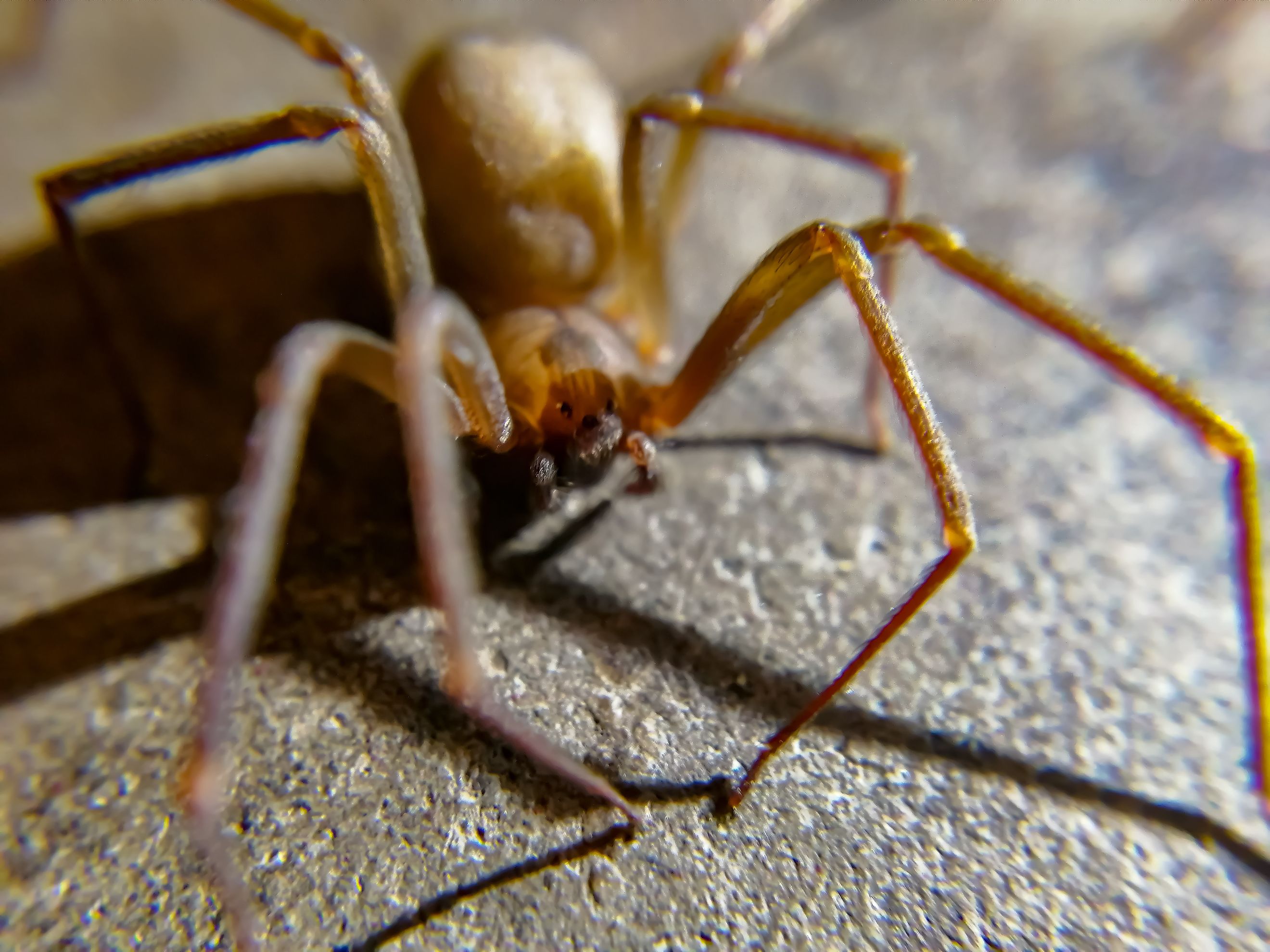
The brown recluse's established northern range extends less far than its reputation might suggest. Across the central United States, its range reaches roughly the 40th parallel, passing through southeastern Nebraska, southern Iowa, central Illinois, and the southern counties of Indiana and Ohio. Farther north, established populations become scarce and eventually disappear from the landscape. The species is native to the south central interior of North America, with the Great Plains at its western edge, the Appalachian foothills to the east, and the Gulf Coast to the south. Its northern limit is shaped largely by winter temperatures, which restrict its ability to survive in areas beyond its established range.
The Documented Edge

The brown recluse's core range spans Kansas east into Kentucky and reaches south through Iowa into Louisiana. Its wider footprint stretches between southeastern Nebraska and southwestern Ohio, taking in Missouri, Oklahoma, Tennessee, and parts of northern Georgia, Alabama, and Texas. Arachnologist Richard Vetter spent years separating the spider's true range from the much larger area people fear it inhabits. In a nationwide study published in 2005, he offered to identify any spider people believed was a brown recluse and received 1,773 arachnids from 49 states. Most were not brown recluses at all, and the genuine ones came almost entirely from states where the spider is already established, rarely from anywhere outside its known range. This helps explain why people are still confused about how far north the spider actually lives.
Why Cold Draws the Boundary

Temperature limits how far north the brown recluse can live, and two biologists have measured this. Kenneth Cramer, a biologist at Monmouth College in Illinois, and Alex Maywright published a 2008 study in which they exposed brown recluses to temperatures between 3 and minus 14 degrees Celsius. They tested both short four-hour periods and longer 30-day stretches to mimic a tough winter. By measuring the temperature under the leaf litter where the spiders hide, they found that the litter protects the spiders from the coldest air. Using this information and January temperature maps, they predicted a northern boundary that closely matches where the spider is actually found in Illinois. The result is simple. If winter cold reaches the spiders in their hiding places, they die and the population cannot survive. This explains why the edge of their range stays where it is, even though people report seeing them farther north. Cramer, who has studied a wild population in a colleague's garage for over ten years, has asked for specimens from northern Illinois, where records are rare and many come from spiders carried in rather than born there.
The spider that entered the record in 1940

Willis Gertsch and Stanley Mulaik gave the brown recluse its scientific name in 1940, describing it from Texas specimens in a paper for the Bulletin of the American Museum of Natural History. For many years, scientists paid little attention to the spider's basic biology and focused mostly on its venom. By then, the public's idea of where the spider lived had already grown far beyond what was actually documented. Doctors in states without brown recluse populations, especially in California, have often diagnosed brown recluse bites. This mistake happened so often that it became common belief. There have even been unconfirmed bite reports from as far north as Alaska, where the spider has never been found. The brown recluse is one of only a short list of spiders worth watching in the United States, and even then, its true range is limited.
Heated Buildings Change the Picture

Cold weather keeps brown recluses outside, but indoors the picture changes. The spiders travel easily in boxes, furniture, or firewood, and a single pair carried into a heated house can persist for years, even well north of the species' usual range. That is how indoor colonies turn up in places like Minnesota or Michigan, where the spider is never found outdoors. One of the most detailed cases happened in 2001, when a family in a 19th-century limestone house in Lenexa, Kansas, collected 2,055 brown recluses from their home over six months. Vetter, along with homeowner Diane Barger, reported in 2002 that at least 400 of those spiders were large enough to cause a serious bite. Still, no one in the family was bitten. They moved their beds away from the walls and spent half a year collecting spiders, ending up with a long list but no injuries. The episode is a standard illustration that living alongside brown recluses, even in large numbers, rarely translates into bites.
A boundary that may move

The northern edge is not set forever. In 2011, Erin Saupe, then at the University of Kansas, worked with Monica Papes, Paul Selden, and Vetter to study the spider's possible future range. They used ecological niche models and found that suitable habitat could move north into Nebraska, South Dakota, Minnesota, Wisconsin, Michigan, Ohio, and Pennsylvania. Saupe and her team warned that this shift could be a medical issue as well as a biogeographic one, since doctors in these areas may not recognize the spider's bite, which is often confused with other conditions. It is still unclear whether the spiders will actually move as predicted, and there is little evidence so far.
What the northern limit means for people

Near the edge of the brown recluse's range, the practical picture is calmer than its reputation suggests. The spider is shy and nocturnal, hiding in dark, undisturbed spots, and it bites mainly when pressed against skin, often inside clothing, bedding, or shoes left on the floor. Most encounters can be avoided by shaking out stored clothes and shoes, moving beds a few inches from the wall, wearing gloves when handling woodpiles or basement boxes, and keeping storage areas tidy. A bite may cause a slow-forming sore and, in rare cases, local tissue damage. If a wound keeps getting worse after it appears, seeking medical care matters, especially for young children. Even so, serious outcomes are uncommon. Most bites heal on their own, only a small share produce the necrotic lesion the spider is known for, and fewer still cause a systemic reaction. Deaths are exceptionally rare, and the few on record are usually only suspected rather than confirmed. The danger the spider poses is far smaller than the fear it inspires. North of its known range, a necrotic sore is far more likely to come from a bacterial infection or another cause than from a spider that does not live there, and a wrong diagnosis can lead to the wrong treatment. Cold weather keeps the brown recluse within its range, just as it limits other venomous animals whose activity drops as temperatures fall.
The Bottom Line
The brown recluse's northern range has remained close to the 40th parallel in most carefully documented records, limited by winter temperatures that prevent it from surviving outdoors in colder regions. Its reputation, however, has spread far beyond that boundary. Since Gertsch and Mulaik described the species in 1940, people have attributed bites to brown recluses hundreds of miles beyond their established range. As a result, residents of states with no confirmed populations may still be convinced that one has bitten them. Research paints a different picture, pointing to a relatively restricted range, venom that rarely causes lasting harm, and a spider that generally avoids human contact. Models published by Saupe and colleagues in 2011 suggest that milder winters could eventually allow the species to establish populations farther north, although evidence of such an expansion remains limited. For people living near its current range, sensible precautions are more useful than fear. Farther north, a worsening skin lesion should prompt medical assessment rather than an automatic assumption that a brown recluse is responsible.