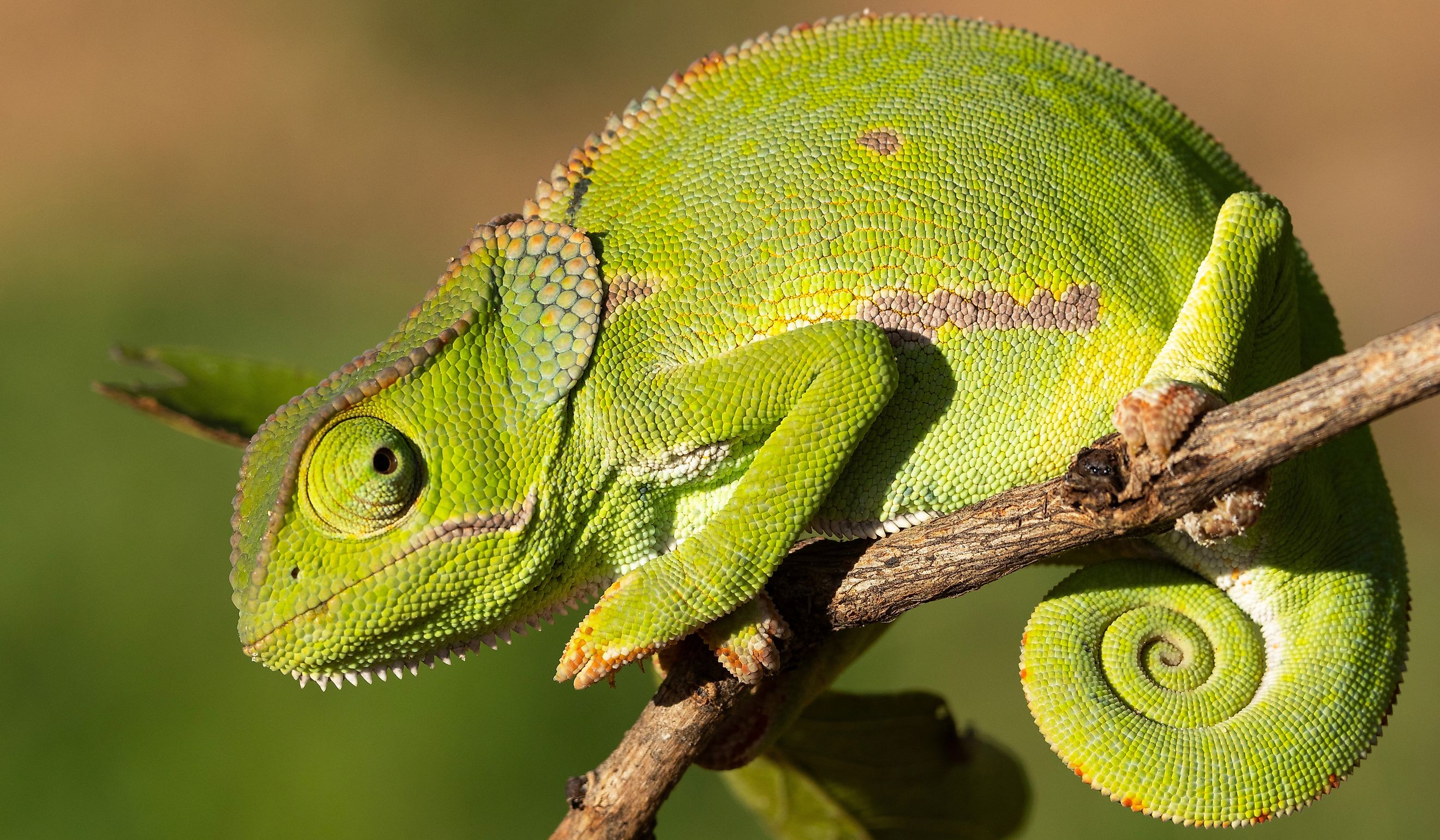
Chameleon
Chameleons, from the family Chamaeleonidae, are unique reptiles found primarily in Madagascar and other parts of Africa. They are known for their remarkable color-changing abilities, their independently rotating eyes, and their long, sticky tongues that can stretch to two times their body length, enabling them to catch insects swiftly and easily. While there are more than 200 recognized species of chameleons worldwide, roughly one-third are currently at risk of extinction due to factors such as habitat loss, climate change, and illegal pet trade.
Scientific Classification
Chameleons are animals in the Phylum Chordata, Class Reptilia, and Order Squamata. They belong to the Family Chamaeleonidae.
Physical Characteristics And Behavior

Chameleons are probably best known for their ability to change color, shifting through an array of bright and dull colors, including green, blue, red, yellow, orange, brown, gray, and white. Contrary to popular belief, chameleons do not alter their appearance solely for camouflage; these color changes can occur for a variety of reasons, including shifts in mood, humidity, light levels, and temperature. Chameleons often use color to regulate their body temperature, using darker shades (e.g., brown, gray, black) to absorb heat and brighter colors to stay cool during the hot summer months.

Color changes also play an important role in chameleons’ communication, particularly among themselves. Males often display bright colors to attract mates or warn rivals, with dominant males typically exhibiting more vibrant coloration and more submissive males generally displaying darker browns or grays. Female chameleons likewise alter their coloration to signal their interest in potential mates, indicating whether they will accept or reject them based on their chosen coloration.

Another distinctive feature of chameleons is their eyes, which can rotate independently of one another. This allows them to scan up to 180 degrees in each direction, helping them detect both prey and predators while remaining alert to their surroundings. Finally, another hallmark of the chameleon is its tongue, which can extend to twice the length of the chameleon’s own body, often striking in milliseconds. A chameleon’s tongue is one of the fastest muscles in the animal kingdom, capable of going from 0 to 60 mph in a hundredth of a second. It accelerates with around 50 g’s of force (almost five times the force of a fighter jet!), reaching speeds of over 20 feet per second.
Range And Habitat

Chameleons are found primarily in Madagascar, Africa, and parts of Asia and Europe. Madagascar alone is home to nearly two-thirds of all known chameleon species, representing the center of chameleon diversity. Although chameleons remain widespread across these regions, many populations face increasing threats of extinction, primarily from human activities. Habitat loss, ecosystem degradation, agricultural pesticides, and illegal pet trading are all major factors affecting chameleons to this day. Chameleons occupy a variety of habitats, including tropical rainforests, savannas, woodlands, shrublands, and mountainous regions. Most species are highly adapted to life in trees and bushes, where they use their camouflage and climbing abilities to avoid predators and hunt prey.
Diet

Chameleons are carnivorous reptiles that feed mainly on insects and other small creatures. Their diet commonly includes crickets, grasshoppers, flies, beetles, and caterpillars. Larger chameleon species may also eat small lizards, birds, or other tiny vertebrates. They use their long, sticky tongues to capture prey with remarkable speed and accuracy, often striking in only a fraction of a second. This feeding strategy allows them to consume a wide variety of animals while remaining relatively stationary and conserving energy. Chameleons rely heavily on their excellent eyesight to locate prey and judge distances before launching their tongues. These specialized hunting abilities make them highly effective predators in their natural habitats, helping to control insect populations and acting as natural pest control.
Reproduction And Life Cycle

Chameleons are generally solitary animals and typically come together only for mating. Many of the color changes observed in chameleons are associated with breeding behavior, pregnancy, or, in the case of females, signaling disinterest in a potential mate. Chameleons are often capable of mating throughout the year. Female chameleons possess the unusual ability to store sperm for extended periods and can delay fertilization, allowing them to lay fertilized eggs years after mating. Female chameleons typically lay clutches ranging from 10 to 60 eggs. Chameleon eggs may take several months to over a year to hatch, depending on the species and environmental conditions. After laying their eggs, female chameleons provide no parental care, and the offspring are left to survive independently from the moment they hatch.
Threats And Predators

Chameleons face numerous threats in the wild, particularly from human intervention. Human-driven pressures include habitat degradation, climate change, agricultural pesticide use, and collection for the illegal pet trade. Together, these factors have contributed to population declines in many chameleon species. Natural predators of chameleons include birds, snakes, and small mammals. While chameleons' ability to change color and remain motionless can help reduce the risk of predation, they still remain vulnerable to a variety of predators across their range. In some regions, deforestation has reduced the availability of suitable habitats, making it more difficult for chameleons to find food, shelter, and breeding sites. As a result, conservation efforts are becoming increasingly important to protect vulnerable species from further decline.
Importance To The Ecosystem

Chameleons play an important role in maintaining healthy ecosystems. By consuming large numbers of insects, they help regulate insect populations and serve as a form of natural pest control. This benefits both agricultural areas and forests by reducing the likelihood of damaging insect outbreaks. Chameleons also occupy an important position in food webs. As prey for birds, snakes, and small mammals, they provide a valuable food source for numerous predators and help support ecosystem balance. Their presence can also serve as an indicator of environmental health, as many chameleon species are sensitive to habitat changes and ecosystem disturbances. In short, healthy chameleon populations often reflect healthy and functioning ecosystems.
Why Chameleons Are One of Nature’s Most Remarkable Species
Chameleons are among the most fascinating reptiles on Earth, known for their extraordinary color-changing abilities, independently rotating eyes, and lightning-fast tongues. Beyond their unique adaptations, these remarkable animals play an essential role in maintaining healthy ecosystems by controlling insect populations and supporting food webs. However, increasing threats such as habitat destruction, climate change, and illegal wildlife trade continue to put many chameleon species at risk. Protecting chameleons and their habitats is critical to preserving the incredible biodiversity they represent and ensuring these distinctive reptiles remain a part of our natural world for generations to come.