How Far South Mountain Goats Live In The United States
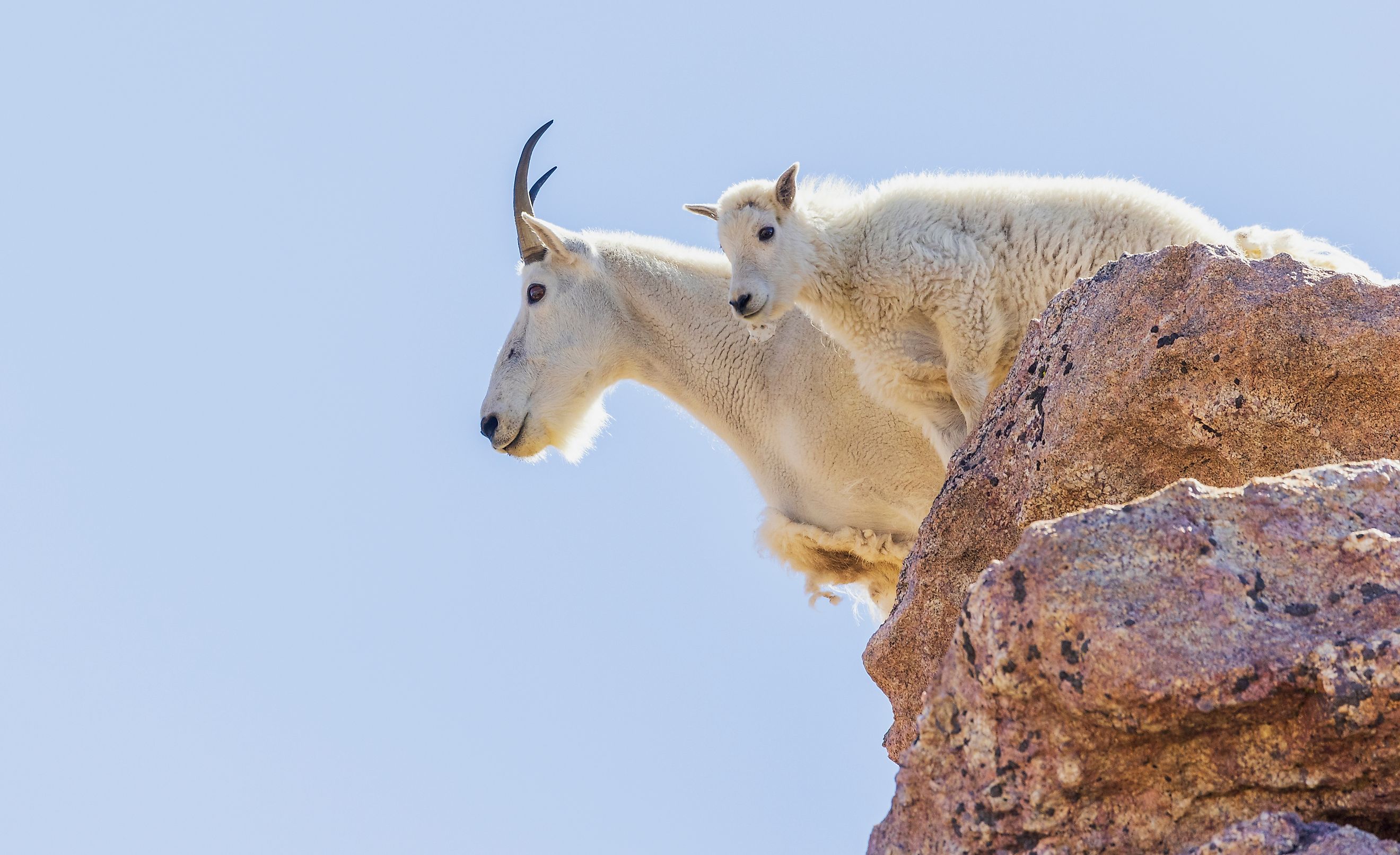
There are two answers and they sit about six degrees of latitude apart. The accepted southern edge of the mountain goat's native range is the Sawtooth Range in Idaho, north of 43 degrees. Today goats live in Colorado's San Juan Mountains and Utah's La Sal Mountains, both below 38.5 degrees, several hundred miles further south. Everything in that gap was put there deliberately, starting with fourteen animals trucked down from Montana in 1947. Whether that counts as the species' range depends on which agency you ask.
The Native Range Stops In Idaho

The original distribution is described consistently across state and federal documents.
The mountain goat is native to northwestern North America from roughly 44 degrees north to 63 degrees north, running from southeastern Alaska south to the Columbia River in Washington, east across the Idaho panhandle into western Montana, and north to southern Yukon.
The southernmost non-introduced population recognized today is in Idaho's Sawtooth Range, north of 43 degrees latitude near 114 degrees west. Everything south of that line is the result of a truck.
Colorado Started In 1947

The state that now holds the largest southern population began with a very small shipment.
Fourteen goats were brought from Montana in 1947 and released in the Collegiate Range. Further releases followed through to 1972, totaling roughly 60 animals across Mount Evans, the Needle Mountains, the Ragged Mountains, the Gore Range and the Sawatch.
From those sites the animals spread on their own into the San Juans, the Elk and West Elk Mountains, the Mosquito Range, the Front Range and Grand Mesa. The population now exceeds 1,600.
Utah Went Further South Still

Utah's program was larger in number of events and reached an unexpected destination.
The first transplant arrived in 1967, and the state has since run 30 separate transplant events releasing 276 animals. Goats now inhabit the Wasatch Front, the Uinta Mountains, the Tushar Mountains and the La Sal Mountains.
The La Sals sit above Moab, visible from Arches National Park, at roughly 38.4 degrees north. That puts mountain goats on skyline above red rock desert, which is not where anybody would look for an alpine species.
The Source Herds Came From Olympic National Park

There is a neat circularity in where Utah's animals originally came from.
Initial Utah transplants used mountain goats taken from Olympic National Park in Washington, itself a population established by introduction rather than native occupation. The Tushar Mountains herd later became Utah's most common source because it grew quickly and was easy to access.
So some southern goats descend from an introduced population that another agency has spent years trying to remove.
Nevada And South Dakota Are Outliers

Two more states hold goats well outside anything the species reached on its own.
Nevada has populations in the Ruby Mountains and the East Humboldt Range. South Dakota has goats in the Black Hills, descended from animals that escaped a Custer State Park enclosure in the 1920s after Peter Norbeck arranged their introduction.
The Black Hills herd has been volatile, falling to roughly 80 animals by 1983, recovering to 150 or 170 by the 1990s, then declining again in the early 2000s.
Ten States Now Have Them

The combined native and introduced distribution covers far more ground than the original.
NatureServe lists mountain goats in Alaska, Colorado, Idaho, Montana, Nevada, Oregon, South Dakota, Utah, Washington and Wyoming. Of those, the species is genuinely native to four.
Throughout the 1900s goats were introduced outside their historical range in Alaska, Washington, Oregon, Idaho, Montana, Wyoming, South Dakota, Colorado, Utah and Nevada, and reintroduced within their native range where they had been wiped out.
Colorado Disputes The Whole Premise

Here the subject stops being a map question and becomes an argument.
A literature review of historical accounts found credible nineteenth-century testimony placing mountain goats south of 40 degrees north in the Colorado Rockies. Mountain men arriving in the 1820s and 1830s to trap beaver reported seeing the white goat in ranges where introduced herds live today.
The review concluded the species likely lived in the Colorado Rockies until it was locally eradicated during the Gold Rush that began in 1858. If correct, the 1947 release was a reintroduction rather than an introduction.
Three Agencies, Two Answers

The disagreement is not academic, because it determines how the animals get managed.
Rocky Mountain National Park, the US Forest Service and the Bureau of Land Management all treat the mountain goat as an exotic or introduced species in Colorado. The Colorado Division of Wildlife classifies it as native, under a twenty-year resident rule for introduced animals.
The same goat on the same ridge is a native species or an invasive one depending on whose land it is standing on.
Elevation Matters More Than Latitude

The reason southern introductions worked at all comes down to height rather than how far north they are.
In the northern Rockies mountain goats range between about 4,900 and 8,900 feet. The introduced Colorado population in the Sawatch Range occupies ground from 9,120 feet to 13,230.
Colorado goats live several thousand feet higher than Montana goats because they have to. Going south costs you latitude, and the only way to replace it is altitude.
The Short Answer

Mountain goats reach about 37.5 degrees north in Colorado's San Juan Mountains and 38.4 in Utah's La Sal Mountains above Moab, which is roughly six degrees of latitude below the accepted native limit in Idaho's Sawtooth Range.
Every one of those southern animals descends from a deliberate release, the earliest being fourteen goats from Montana in 1947. Whether that makes them a southern extension of the species or a permanent transplant is a question Colorado's wildlife agency and three federal agencies answer differently, about the same animals, on the same mountains.