Why Mountain Lions Disappeared From The Eastern US
Mountain lions once ranged across much of the eastern United States, but heavy hunting, declining deer populations, and widespread habitat loss pushed them out during the 1800s and early 1900s. Settlers killed cougars to protect livestock and game, governments paid bounties for their removal, and expanding towns and roads broke apart the forests they depended on.
By the early 20th century, mountain lions had disappeared from most of the East. After reviewing historical records and decades of reported sightings, the US Fish and Wildlife Service concluded that the eastern cougar population was extinct and removed it from the Endangered Species Act list in 2018.
The Killing of Mountain Lions by Settlers

For the early European settlers, a mountain lion was dangerous not just because of its claws or teeth but also because it competed with people for deer and occasionally killed their livestock. Governments eventually encouraged people to kill the mountain lions. Some of the bounty programs began early in history.
Research cited by the Biodiversity Heritage Library found records of a Connecticut bounty of 20 shillings for catamounts in 1694. Massachusetts offered a 40-shilling reward beginning in 1742 and later increased it. These policies turned the killing of predators into an organized, collective effort.
Mountain lions were shot, trapped, and pursued across territory that was becoming increasingly populated by settlers. The US Fish and Wildlife Service describes the eastern cougar as having been relentlessly hunted and trapped after European settlers came to see the animal as a threat to livestock, people, and wild game. By the late 1800s, cougars had disappeared from much of the eastern United States.
This did not happen only to mountain lions. Wolves, bears, and other predators were also killed in large organized predator-control campaigns as settlement expanded. Mountain lions, however, reproduce slowly compared to other predators and require large territories, making sustained human-caused mortality especially difficult for a population to withstand.
Their Food Was Disappearing Too

Like in basic war tactics, destroying provisions is half the battle, but in this situation it was not intentional. There were unregulated and regulated commercial markets in the transatlantic for venison, skins, and antlers. These markets created such a high demand that overhunting was bound to come to keep up the supply.
Mountain lions are adaptable predators, but deer make up an important part of their prey across much of North America. The Michigan Department of Natural Resources describes deer as their primary wild prey over most of the species' range.
During the same period in which people persecuted mountain lions, unregulated hunting dramatically reduced populations of deer and other large game animals. A mountain lion that escaped hunters still needed enough prey to support itself. As deer became scarce, the remaining pumas had fewer places where they could find both food and safety from people.
Deer eventually made a strong recovery in much of the eastern United States. By then, however, the mountain lion populations that once depended upon them were already gone.
The Eastern Forest Was Being Cut Apart

Eastern North America originally contained vast areas of interconnected forest. But as logging, expanding settlements, roads, and towns came in, it broke apart much of that habitat during the period when mountain lions were already being heavily hunted. Cougars can survive in a variety of landscapes, so deforestation alone does not explain their disappearance. The cause was a combination of pressures. Habitat disappeared while prey declined and people actively killed the surviving predators.
Modern research shows just how important large connected landscapes can be to the mountain lions. A 2023 study in Landscape Ecology examined possible cougar habitat and dispersal corridors across eastern North America. Researchers found potentially suitable habitat in parts of the Upper Midwest, Ozarks, Appalachians, New England, and Canada. The best areas generally contained extensive forest or shrubland, relatively little human development, and access to water.
The Last Eastern Cougars Held On In Remote Areas

As settlement pushed mountain lions out of increasingly developed areas, some survived longer in remote forests and mountains. The exact date of the eastern population's disappearance is difficult to establish because an elusive predator rarely leaves a neat historical record. The US Fish and Wildlife Service considers a 1938 record from Maine among the last known records of the historical eastern cougar, while a 1932 record survived from New Brunswick in Canada. For decades afterward, people continued to report mountain lions throughout the East. Some saw bobcats, dogs, or other animals. Others may really have seen cougars.
Researchers have documented cougars traveling vast distances. One of the clearest examples ended beside a Connecticut highway. In June 2011, a vehicle struck and killed a 140-pound male mountain lion in Milford, Connecticut. Genetic testing later linked the animal to the Black Hills population of South Dakota. Records from the Upper Midwest helped researchers trace part of its journey, which covered around 1,500 miles.
Mountain Lions Are Moving East Again

Some mountain lions survived across much of western North America, and some individuals have wandered far beyond established breeding populations. Researchers documented 178 confirmed cougar records across a Midwestern study area between 1990 and 2008 in a 2012 study published in The Journal of Wildlife Management. Of the confirmations for which sex could be determined, 76 percent were males. That pattern fits the tendency of young male cougars to travel great distances while searching for territory.
Later research recorded more than 950 confirmed cougars east of established populations while examining possible routes into eastern North America. However, wandering males alone cannot establish a new population. Females must also reach suitable habitat, survive, reproduce, and establish territories.
A 2024 study published in Biological Conservation modeled cougar expansion through 2100 and predicted relatively limited recolonization of currently unoccupied territory. The researchers identified vehicle collisions and other forms of human-caused mortality as major obstacles for females moving east. Their models also showed cougar range expanding slowly, generally by only a few kilometers per year along the edge of established populations.

In 2025, Michigan wildlife officials verified two cougar cubs in Ontonagon County in the Upper Peninsula. A trail-camera photograph taken that December later showed an adult female traveling with the two young animals. The Michigan Department of Natural Resources called it the first verified cougar reproduction in the state in more than a century and the first verified reproduction east of the Mississippi River in more than 100 years.
Wisconsin has also continued to record wandering cougars. The Wisconsin Department of Natural Resources verified multiple observations during 2025 and 2026. In February 2026, a train killed a GPS-collared male cougar in Wisconsin that researchers had originally collared in western Nebraska. The animal traveled through North Dakota and Minnesota before reaching Wisconsin. Despite these sightings, Wisconsin still reports no established breeding population.
Florida Was The Great Exception
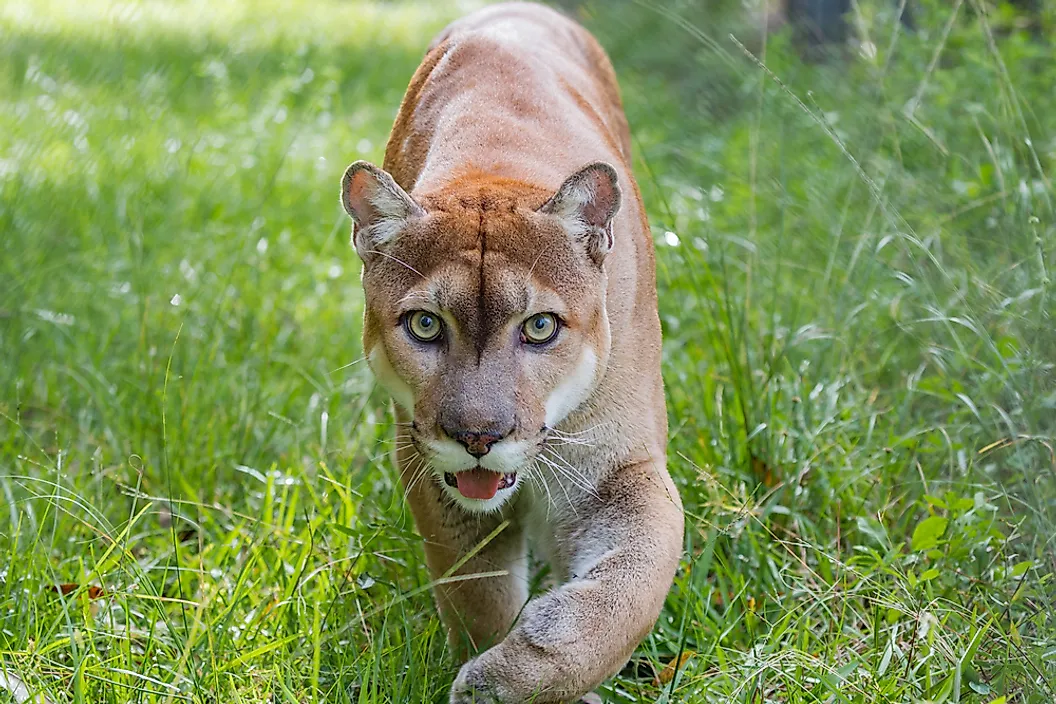
One cougar population survived the broader collapse in the East. The Florida panther persisted in South Florida after mountain lions disappeared from most of the eastern United States.
The Florida Fish and Wildlife Conservation Commission currently estimates that about 120 to 230 adult panthers remain, primarily in southwest Florida. Males occasionally wander much farther north through the peninsula.
For that reason, statements that mountain lions are extinct in the eastern United States can be misleading. The historical eastern cougar population disappeared, but mountain lions never vanished from every part of the eastern half of the country.
What A Return To The East Would Take

From a habitat standpoint, much of the East could support mountain lions again. Researchers have identified large areas of potentially suitable cougar habitat. One study examining the northeastern United States found that regions such as the Adirondacks contained enough forest and prey to support cougars, although conflict with humans remained an important obstacle.
The greater challenge is getting the animals there and establishing breeding populations.
Road networks, developed areas, long distances between existing populations, legal harvest in some source states, and the slower dispersal of females all work against rapid recolonization. The 2024 modeling study suggests that mountain lions are unlikely to naturally reclaim the entire East anytime soon.
Still, the verified female and cubs in Michigan show that the boundary can move.